
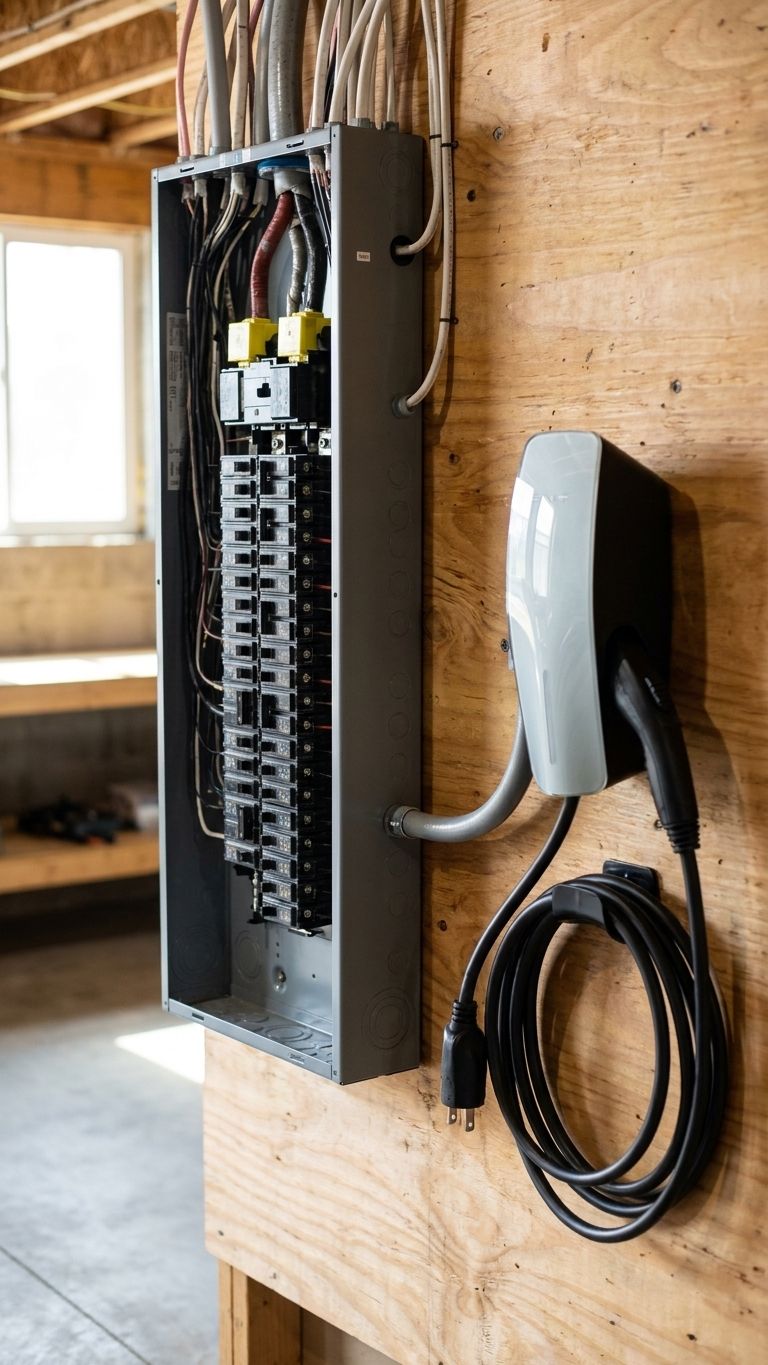
An EV charger draws more continuous current than almost anything else in a house, and most panels installed before 2010 weren't built for it. This guide breaks down when an electrical panel upgrade for EV charger installation is actually required in Central New Jersey, what it costs, and which upgrade path fits your home.
- A 100-amp panel with an electric range or HVAC often can't support a Level 2 EV charger without an upgrade or load management device.
- A full electrical panel upgrade for EV charger installation in NJ typically runs $2,000 to $7,000 depending on amperage and utility work.
- 200-amp upgrades cover one EV plus normal household load; 400-amp or subpanel setups fit multi-EV homes and small commercial sites.
- Load management devices like a Span or Lumin can add a charger without a panel swap on some 100-amp services — consider before you commit to a full upgrade.
- Skip any contractor who won't pull a permit for the panel work — NJ townships require it and inspectors check it.
Why this matters
Central New Jersey homes built in the 1970s through the 1990s were commonly wired with 100-amp panels sized for a stove, a dryer, and central air — not a car that pulls 30 to 48 amps for hours every night. Add a heat pump or an induction range to that same panel and you're often past capacity before the charger even goes in.
Getting the panel sizing wrong causes two failure modes: the inspector flags the install and you pay for rework, or the panel runs hot under sustained EV load and trips or degrades over time. Neither is cheap to fix after the fact, which is why sizing the panel correctly the first time matters more than the charger brand you pick.
Who this is for
This guide is for homeowners in Monmouth, Middlesex, Somerset, and Union counties who own or plan to buy a Tesla, a ChargePoint-compatible EV, or any plug-in vehicle and want a Level 2 charger installed at home rather than relying on public stations. It's also for anyone whose home still runs a 100-amp or 60-amp panel and has already added central air, an electric range, or a hot tub — the exact combination that pushes older services past their limit. If you're weighing a full panel upgrade against a load-management workaround, the criteria below will tell you which side of that decision you're on.
What to look for in an electrical panel upgrade for EV charger installation
Panel amperage headroom
A licensed electrician calculates your existing load — HVAC, water heater, range, dryer — against total panel capacity before adding a 40 or 50-amp EV circuit. If the math leaves less than 20% headroom, the panel needs to go from 100-amp to 150 or 200-amp before the charger circuit is safe to add. This is the single number that decides whether you need a full upgrade or just a new circuit.
Panel age and brand
Panels older than 25 to 30 years, or those made by Federal Pacific or Zinsco, carry known breaker reliability problems independent of EV load. Adding a high-draw circuit to a panel that's already unreliable is the wrong sequence — replace the panel first, then add the charger circuit. In 2026, most NJ electricians won't add a dedicated EV breaker to a Federal Pacific panel at all.
Utility service capacity
The panel is only half the equation — the wire and meter coming from the utility pole has its own amperage rating. A 200-amp panel fed by 100-amp utility service still can't deliver 200 amps, and upgrading the service (not just the panel) requires coordination with PSE&G or JCP&L, plus a separate inspection. Skip this check and you'll pass panel inspection but still trip on total draw.
Permit and inspection requirements
Every Central NJ township requires a permit for panel work, and most require a separate inspection for the EV charger circuit itself. A contractor who skips the permit isn't saving you money — they're transferring risk to you if a fire marshal or home sale inspection later finds unpermitted electrical work. Ask for the permit number before work starts, not after.
Charger circuit type
Level 2 chargers need a dedicated 240-volt circuit sized to the charger's continuous draw, almost always 40 or 50 amps on a NEMA 14-50 or hardwired connection. A shared circuit, an extension cord, or a 15-amp outlet adapter is not a substitute and will trip breakers under sustained load. This is a code violation in New Jersey, not just a bad idea.
Future electrification load
If a heat pump, induction range, or second EV is likely within the next five years, size the panel for that load now rather than upgrading twice. A 200-amp panel installed in 2026 with one EV circuit today has room for a heat pump later; a 150-amp panel sized tight to current needs usually doesn't.
Top upgrade paths
The minimum viable fix — load management device. For a 100-amp panel with 15-20% headroom, a Span or similar load-management panel monitors total household draw and throttles the EV charger during peak use instead of replacing the panel outright. It costs less than a full panel swap and installs in a day. Consider this route only if your existing panel is modern (not Federal Pacific or Zinsco) and your household load is genuinely borderline, not already maxed out.
The standard fix — 100-amp to 200-amp panel upgrade. This is the most common electrical panel upgrade for EV charger installation in NJ homes, and it covers one Level 2 charger plus normal household appliances with margin to spare. Installed cost in Central NJ typically runs $2,000 to $7,000 depending on whether the utility service also needs upgrading. Buy this if you're planning to keep the home long-term and want headroom for future appliances, not just the charger.
The high-headroom fix — 400-amp panel or subpanel add. For homes running two EVs, a pool, and central HVAC, or for small commercial properties, a 400-amp main panel or a dedicated EV subpanel keeps the charger circuit isolated from the rest of the house load. This costs more upfront but avoids a second upgrade in five years. Buy if you already know a second EV or major electrification project (heat pump, backup generator) is coming.
The tempting shortcut — a bigger breaker without a load calculation. Some installers will just add a larger breaker to an existing panel without running the actual load math, betting that nothing trips. Skip this every time — it's the setup most likely to fail inspection or overheat a panel that was never rated for the added draw.
The wildcard — 60-amp panel replacement. Homes wired before the 1970s sometimes still run 60-amp fuse panels. These need a full panel and often full service replacement before any EV circuit is possible, no shortcuts available. Buy the full replacement; there's no partial fix here.
What to avoid
- A charger installed on a shared circuit with the dryer or range outlet to save on panel work — this looks like a working install until both appliances run at once and something trips.
- A panel upgrade quote with no permit line item. If the estimate doesn't mention a township permit, the contractor is planning to skip it.
- A used or reconditioned panel sold as a cost-saving alternative to new. NJ code requires new equipment for a panel upgrade tied to an EV installation in most townships.
Verdict comparison
| Upgrade path | Best for | Typical install cost (2026) | Verdict |
|---|---|---|---|
| Load management device | Modern 100A panel, borderline headroom | Lower than a full panel swap | Consider |
| 100A to 200A panel upgrade | Single EV, long-term homeowner | $2,000-$7,000 | Buy |
| 400A panel or subpanel | Multi-EV, pool, future heat pump | Higher, varies by utility work | Buy |
| Bigger breaker, no load calc | No one — this is a shortcut | Cheap upfront, costly later | Skip |
| 60A to full panel replacement | Pre-1970s homes | Higher, service replacement included | Buy |
Get your panel checked before you buy a charger
Licensed NJ electricians calculate load and permit the upgrade correctly the first time.
FAQ
Do I need a panel upgrade for an EV charger in NJ?
You need a panel upgrade if your existing panel and household load don't leave enough headroom for a 40-50 amp EV circuit, which is common on 100-amp panels with central air and an electric range. A licensed electrician confirms this with a load calculation before any work starts.
How much does an electrical panel upgrade for EV charger installation cost in NJ?
A 100-amp to 200-amp panel upgrade typically costs $2,000 to $7,000 installed in Central NJ as of 2026, depending on whether the utility service also needs upgrading. Load management devices as an alternative usually cost less than a full panel swap.
Can I add an EV charger without upgrading my panel?
Yes, if your panel has enough spare capacity or you install a load-management device that throttles the charger during peak household use. This only works on modern panels with borderline headroom, not on older or already-maxed panels.
What size panel do I need for a Tesla or ChargePoint Level 2 charger?
Most Level 2 chargers need a dedicated 40 or 50-amp circuit, which usually means a 200-amp main panel with adequate spare capacity. Homes planning a second EV or a heat pump should size up to 400 amps or add a subpanel instead.
Is a 100-amp panel enough for an EV charger?
It depends on what else is on the panel — a 100-amp service with electric heat, a range, and central air rarely has room left for a 40-amp EV circuit. A load calculation from a licensed electrician tells you the actual headroom before you commit to a charger purchase.
Do I need a permit to upgrade my electrical panel in New Jersey?
Yes, every Central NJ township requires a permit for panel upgrades and a separate inspection for the new EV charger circuit. Skipping the permit creates a problem later during a home sale or insurance claim, even if the work itself is done correctly.
How long does an EV charger panel upgrade take?
A standard 100-amp to 200-amp panel upgrade with an EV circuit typically takes one to two days including inspection scheduling, though utility coordination can add time if the service line also needs upgrading. Load management device installs usually finish in a single day.
One last thing
The detail most homeowners miss isn't the panel — it's the utility service feeding it. A brand-new 200-amp panel bolted onto a 100-amp utility drop still caps out at 100 amps until the utility company upgrades the service line, and that coordination step with PSE&G or JCP&L is the part that actually stretches a project timeline in 2026, not the panel work itself.


