
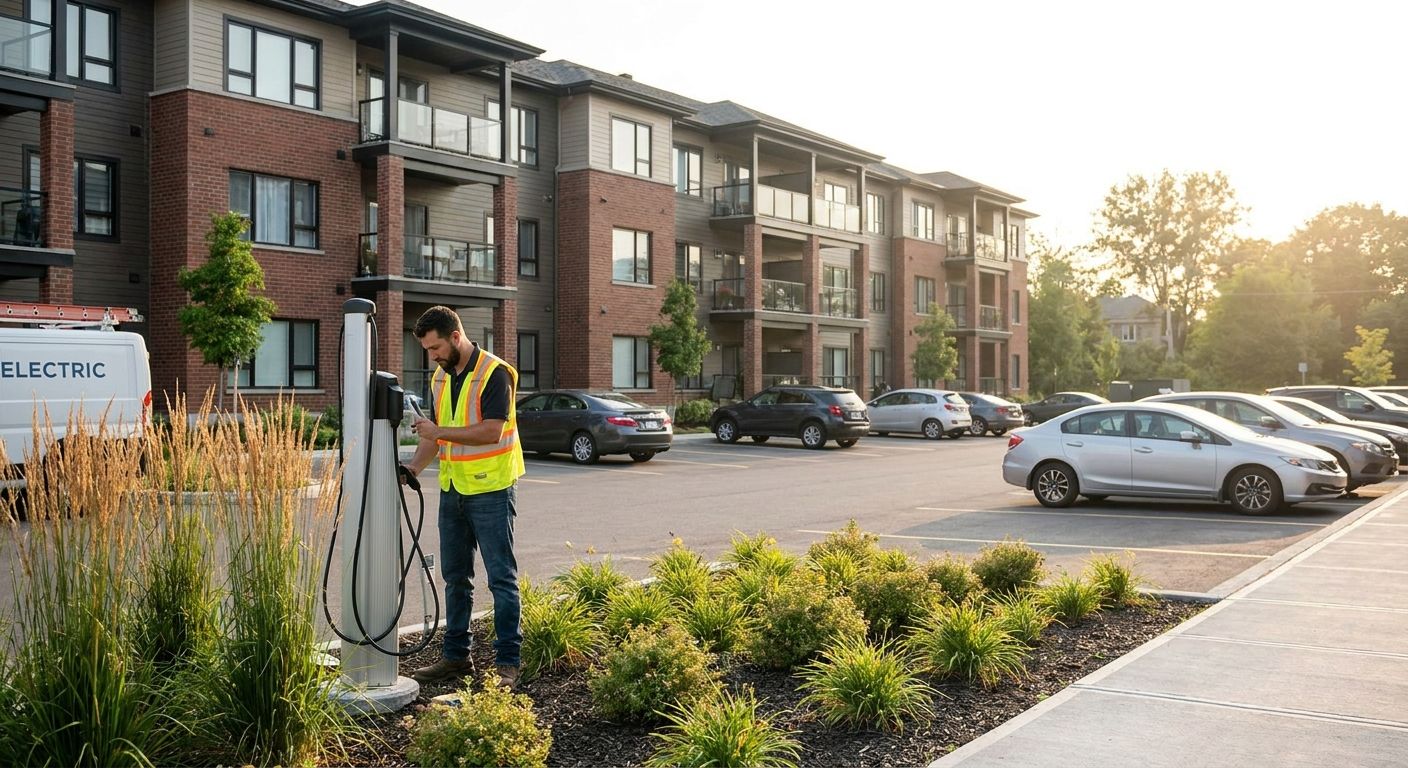
Condo boards and HOA property managers across Monmouth, Middlesex, Somerset, and Union counties field EV charger requests every month now, and most of them are unsure what they can legally require, what the electrical side actually costs the association, and which installation approach won't turn into a liability headache two years later.
- A dedicated circuit run from the unit owner's own panel is the safe pick for single-owner installs in NJ condos.
- New Jersey's 2021 EV charging law bars HOA boards from issuing a blanket ban on charger requests — Buy into a written policy now, not after a resident sues.
- Shared common-area chargers need a submeter or per-kWh billing plan before installation, not after residents start plugging in.
- Level 1 120V cords are a Skip for any multi-unit building — they're slow and they don't solve the shared-infrastructure problem HOAs actually face.
- Licensed NJ electricians pulling permits under NEC 625 protect the association from insurance and code-violation exposure.
Why this matters
HOA boards that stall on EV charger installation requests are exposed two ways: legally, because New Jersey passed a law in 2021 requiring condo and homeowner associations to permit reasonable EV charger installations rather than issue outright denials, and financially, because ad-hoc installs done without a load calculation or a metering plan create shared-cost disputes that boards end up mediating for years.
The fix isn't a blanket policy that says yes or no to every request. It's a written framework — who pays for the circuit, who owns the equipment, how the electricity gets metered, and which licensed contractor does the work — decided once, before the second or third resident asks.
Who this is for
This guide is for HOA board members, condo association property managers, and self-managed co-op boards in Central New Jersey deciding how to handle EV charger installation requests from unit owners in 2026. It's also for individual condo owners trying to understand what they can request under NJ law and what the electrical work actually requires before bringing a proposal to the board. If you're managing a 20-unit garden apartment complex in Edison or a 200-unit high-rise in New Brunswick, the electrical fundamentals are the same — only the scale of the metering and panel-capacity decisions changes.
What to look for in EV charger installation for HOA communities
Panel capacity and load calculation
Before anyone touches wiring, a licensed electrician needs to run a load calculation on the building's existing electrical service to confirm it can carry an additional 40-amp to 50-amp circuit without tripping the main. Older Central Jersey buildings from the 1970s and 1980s were never sized for EV loads, and skipping this step is how associations end up with nuisance outages during peak charging hours.
NEC 625 compliance and permits
EV charging equipment installation falls under NEC Article 625, and NJ municipalities require an electrical permit and inspection for any dedicated EV circuit — no exceptions for condo garages. A permit pulled under the wrong name, or no permit at all, becomes the association's problem the day a fire marshal or insurance adjuster asks for paperwork.
Metering approach
Shared garages need a decision on how electricity gets billed before the first charger goes in: a submeter tied to the unit owner's account, a flat monthly HOA fee, or a networked charger with built-in per-session billing. Boards that skip this step end up splitting the electric bill across all owners, including the ones who don't drive an EV — a fast way to create resentment at annual meetings.
NJ's right-to-charge framework
New Jersey law restricts HOA and condo boards from denying EV charger installation outright, but boards can still set reasonable rules on placement, contractor licensing, and cost allocation. Understanding where that line sits keeps the board out of a legal fight and keeps the policy defensible if challenged.
Licensed installer with liability coverage
Any contractor working in shared electrical infrastructure needs a New Jersey electrical contractor license and liability coverage that names the association, not just the unit owner. Spartan Home Pros does not subcontract EV charger installation work, which matters in a multi-unit setting where the board needs one accountable licensed electrician, not a chain of subs.
Charger hardware compatibility
The most common EV charger installation requests in Central Jersey are for Tesla Wall Connectors, ChargePoint Home Flex units, and generic J1772 Level 2 chargers — all of which run on the same 240V circuit but have different networking and access-control features that matter more in a shared garage than a single-family driveway.
Top picks: installation approaches for condos and HOAs
The safe pick: dedicated circuit from the unit owner's panel
When a unit owner has a deeded or assigned parking spot with direct electrical access, running a dedicated 40-amp circuit from that owner's own panel is the cleanest approach. Buy. It isolates cost and liability to one owner, needs no shared metering agreement, and closes the door on billing disputes entirely.
The budget play: shared circuit with an energy management system
For garages with limited panel capacity, a load-management device lets multiple chargers share one circuit by throttling output when several cars draw power at once — a real solution for buildings that can't add a full new service. Consider. It costs less than upgrading the main panel but caps how many owners can charge simultaneously at full 40-amp output.
The HOA-friendly build: common-area charging with submetering
Installing two to four networked chargers in common-area spots, each with its own submeter or per-kWh billing through the charger's app, gives the association a scalable answer to future requests instead of one-off installs. Buy. It centralizes cost tracking and avoids the precedent problem of approving individual circuits case by case.
What to skip: Level 1 120V cords in shared garages
A standard 120V outlet technically charges an EV, but at roughly 3-5 miles of range per hour it doesn't meet daily commuting needs and it doesn't solve the metering and liability questions a board actually faces. Skip. If a resident proposes this as the association's official solution, it's a sign the request needs a licensed electrician's input before it goes further.
The forward-looking pick: networked visitor charging
For buildings with guest parking or amenity spaces, a networked Level 2 charger with pay-per-session access serves visitors and residents without assigned spots without creating an ongoing billing headache for the board. Consider. It's a bigger upfront install than a single dedicated circuit, but it future-proofs the garage for the next five years of EV adoption in Central Jersey.
What to avoid
- Approving a request without a load calculation. A verbal yes from the board with no electrician assessment is how a garage panel gets overloaded during winter charging peaks.
- Letting an unlicensed handyman run the circuit. NEC 625 and NJ permit requirements exist for EV charging equipment specifically — a general handyman running a car charger circuit is a code violation waiting for an inspection.
- Writing a one-off policy for the first requester. Every request after the first one will reference the terms given to the first owner, so the board's initial decision becomes the de facto policy whether it meant to or not.
Get an HOA EV charger assessment
Licensed NJ electricians, no subcontracting, permits handled.
Verdict comparison
| Approach | Best for | Panel impact | Verdict |
|---|---|---|---|
| Dedicated circuit, owner's panel | Single unit with own parking | Low, isolated to one unit | Buy |
| Shared circuit + load management | Limited-capacity buildings | Moderate, shared draw | Consider |
| Common-area + submetering | Multi-request buildings | High, needs upgrade | Buy |
| Level 1 120V cord | Nothing multi-unit | Minimal, but too slow | Skip |
| Networked visitor charging | Guest parking, amenities | High, needs upgrade | Consider |
FAQ
Can an HOA in NJ deny an EV charger installation request?
No, not outright. New Jersey law passed in 2021 restricts condo and homeowner associations from issuing a blanket denial, though boards can set reasonable rules on placement, licensing, and cost allocation.
Who pays for EV charger installation in a condo building?
Typically the requesting unit owner pays for their own dedicated circuit and charger, while common-area chargers are usually funded and billed back through the association's metering or fee structure.
Does EV charger installation require a permit in New Jersey?
Yes, every dedicated EV charging circuit falls under NEC Article 625 and requires a municipal electrical permit and inspection, regardless of whether it's a single-family home or a condo garage.
What size circuit does a Level 2 EV charger need?
Most residential Level 2 chargers run on a 40-amp circuit protected by a 50-amp breaker at 240 volts, though some lower-output units use a 30-amp circuit instead.
Can multiple EV chargers share one circuit in an HOA garage?
Yes, with a load management system that throttles output when several vehicles draw power simultaneously, which is common in buildings without capacity for a full panel upgrade.
Is a Tesla Wall Connector different from a ChargePoint installation?
Both run on the same 240V Level 2 circuit, but they differ in networking, app-based billing, and access control — features that matter more in a shared HOA garage than a private driveway.
How long does EV charger installation take in a condo building?
A single dedicated circuit install typically takes one work day once permits are approved, while common-area multi-charger installs with submetering take longer depending on panel capacity.
Do HOA boards need a written EV charging policy?
Yes — a written policy covering cost allocation, contractor licensing, and metering keeps the board consistent across requests and defensible if a decision is ever challenged.
One last thing
The boards that avoid disputes aren't the ones with the strictest EV charger policy — they're the ones that got a licensed electrician to run the load calculation and write the metering plan before the first resident asked, instead of reacting request by request in 2026 and beyond.
Spartan Home Pros does not subcontract electrical work and pulls permits directly for every EV charger installation, which is the detail that matters most when an HOA board needs one accountable name on the paperwork, not a chain of subs.


