
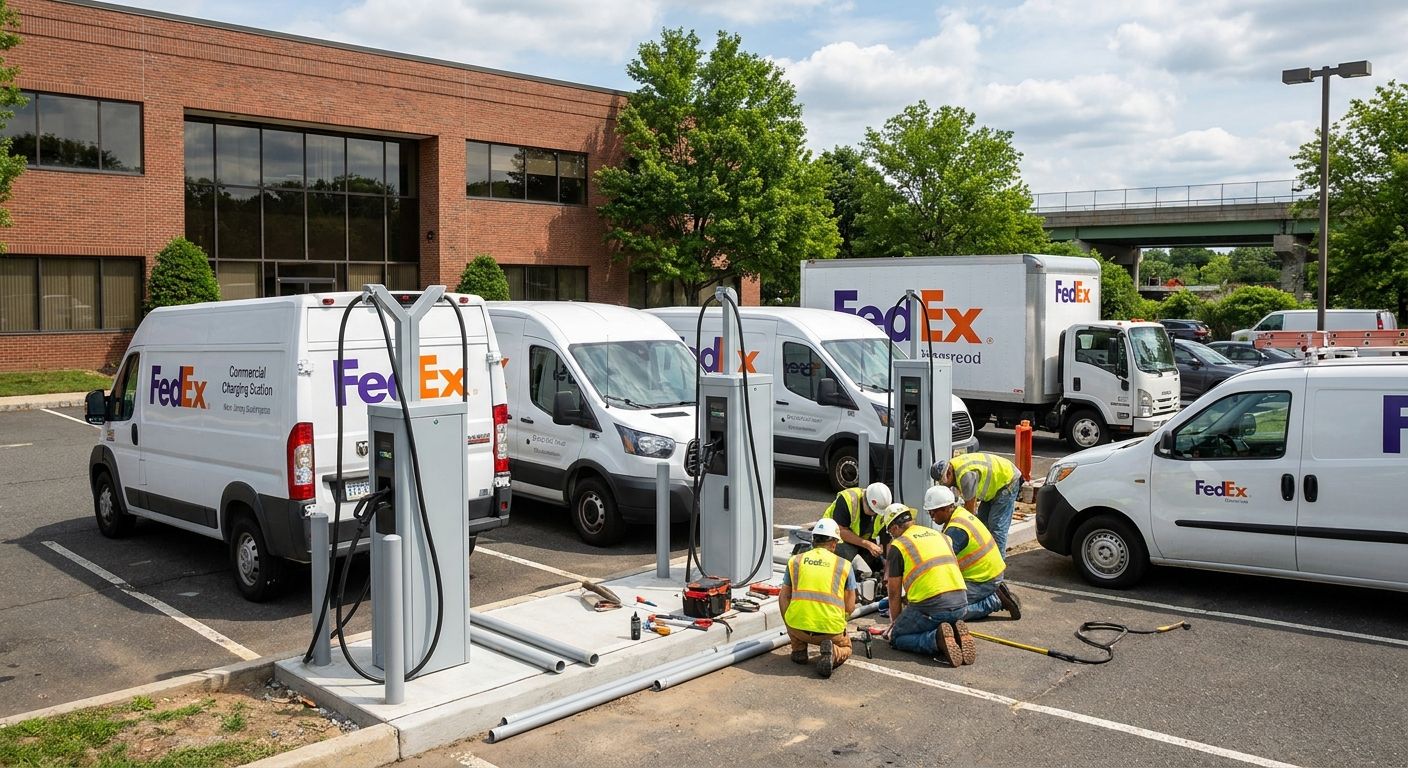
Fleet electrification in Central New Jersey means one thing at the panel: your building's electrical service has to carry a load it was never designed for, and getting that wrong stalls trucks in the lot instead of on the road.
- Commercial EV charger installation NJ projects live or die on panel capacity — check amperage before picking a charger.
- Level 2 chargers cover most fleet depot charging in 2026; DC fast charging is for high-turnover routes only.
- The federal 30C credit covers up to 30% of installation costs, capped at $100,000 per charger, for business installs.
- Spartan Home Pros handles licensed panel upgrades and charger installs together — split projects cost more and take longer.
Why this matters
A fleet of five delivery vans or a dozen service trucks doesn't charge like a single homeowner's sedan. The load calculation, the permit package, and the utility coordination all scale up, and a contractor who's only wired residential Level 2 units at 240V/40A will underbuild for a depot running six chargers overnight.
Central New Jersey businesses in Monmouth, Middlesex, Somerset, and Union counties are hitting this wall right now. Local delivery operators, HVAC and plumbing contractors, and property managers adding tenant charging are all asking the same question: what does commercial EV charger installation NJ actually require, and who can pull the permits without six months of back-and-forth with the township.
Who this is for
This guide is for facilities managers, small fleet owners, and commercial property managers in Central New Jersey planning to install two or more EV chargers for company vehicles or tenant use in 2026. If you're wiring a single charger for a personal car in your driveway, the residential Level 2 install path is simpler and cheaper — this is about depot-scale planning, panel capacity, and the permitting that comes with a commercial electrical service.
What to look for in commercial EV charger installation for NJ fleets
Panel and service capacity
Before anyone talks charger brands, someone needs to run a load calculation on your existing electrical service. Most commercial buildings built before the 2000s carry 200-amp or 400-amp services that are already near capacity with HVAC, lighting, and equipment loads — adding six 40-amp Level 2 circuits without a panel upgrade trips breakers or violates code. A 200-amp panel upgrade for a commercial building runs in the $2,000 to $7,000 range depending on service size and existing wiring, and skipping this step is the single most common reason fleet charger projects stall mid-install.
Licensed electrician, not a charger installer
EV charger hardware companies subcontract installation to whoever's available, and that's where projects go sideways — no permit pull, no inspection sign-off, and no accountability when a breaker trips at 2am. Spartan Home Pros does not subcontract electrical work; the technician who runs your load calculation is the same one who pulls the permit and terminates the wiring. For commercial work, confirm the electrician is licensed in New Jersey and has pulled commercial electrical permits in your specific township — Middlesex County inspectors and Monmouth County inspectors don't always apply the same interpretation of NEC Article 625.
Charger type matched to duty cycle
Level 2 chargers (240V, typically 32-80 amps) deliver 15-40 miles of range per hour and cover overnight depot charging for most delivery and service fleets. DC fast chargers deliver far more power but require a much larger electrical service, dedicated transformer capacity in many cases, and cost significantly more to install — they only make financial sense for high-turnover routes where a vehicle needs a full charge in under an hour between shifts.
Utility coordination and demand charges
PSE&G and Jersey Central Power & Light both require notification for commercial charging installations above certain load thresholds, and adding six to twelve chargers can push your building into a higher demand-charge tier on your utility bill. A contractor who's done commercial EV work in your utility territory knows which load management strategies — like network-managed charging that staggers start times — keep demand charges from eating into the fuel savings you're installing chargers to capture.
Incentive and rebate eligibility
The federal Alternative Fuel Vehicle Refueling Property Credit (Section 30C) covers up to 30% of equipment and installation costs for business EV charging projects, capped at $100,000 per charger, for installs placed in service through 2032. New Jersey's Department of Environmental Protection also runs "It Pay$ to Plug In," a grant program that reimburses businesses a portion of Level 2 and DC fast charger installation costs. Both programs require documentation submitted before or during installation — retroactive claims after the electrician has already closed out the permit rarely qualify.
Permitting timeline
Commercial electrical permits in Central NJ townships typically require a plan review before work starts, and inspectors want to see the load calculation, single-line diagram, and charger spec sheets up front. Projects that skip this and try to install first, permit later, end up with exposed conduit sitting unused for weeks while the township sorts out the paperwork.
Top picks: charger setups for NJ fleets
The straightforward pick: networked Level 2 for depot charging. A bank of networked Level 2 chargers at 48 amps each covers overnight charging for a fleet of 5-15 vehicles without requiring a service upgrade beyond a standard 400-amp commercial panel in most Central NJ buildings. Networked units let you stagger charge start times to avoid demand-charge spikes and track per-vehicle usage for fuel-cost reporting. Buy if your vehicles return to base overnight and you have 8+ hours of dwell time.
The scale-up pick: mixed Level 2 and one DC fast unit. For fleets running two shifts or vehicles that need a midday top-up, pairing a bank of Level 2 chargers with a single DC fast charger covers both use cases without over-building fast-charge capacity you rarely need. This setup requires a heavier electrical service — often 600 amps or a dedicated transformer — and the permitting timeline runs longer. Consider this only after a licensed electrician confirms your utility service can support it.
The wildcard: solar-plus-storage paired with chargers. Pairing a commercial charger bank with on-site solar and battery storage reduces demand-charge exposure and can offset installation costs further through additional state incentive stacking. It's a longer project with more moving parts — permitting, utility interconnection, and a bigger up-front investment. Consider if you're already planning a solar install or roof replacement in 2026; skip it if your only goal is getting trucks charged by morning.
What to avoid
- Unmanaged chargers on an already-tight panel. They look identical to networked units on the showroom floor, but without load management software, six chargers starting simultaneously at 6pm can trip the main breaker or push you into a demand-charge penalty tier.
- A residential-grade electrician doing commercial work. Someone who's wired forty home Level 2 chargers may have never pulled a commercial permit or run a three-phase load calculation — ask directly about commercial electrical license history before signing anything.
- Chasing incentives before the load calculation is done. Applying for 30C or NJDEP grant funding before confirming your panel can support the install wastes paperwork time if the project scope changes once the electrician runs numbers.
Verdict comparison
| Criteria | Networked Level 2 bank | Level 2 + DC fast mix | Solar-plus-storage bundle |
|---|---|---|---|
| Panel upgrade needed | Sometimes | Almost always | Almost always |
| Best fleet dwell time | 8+ hours overnight | Split shifts, midday gaps | Any, with storage buffer |
| Permitting timeline | Shorter | Longer | Longest |
| Demand charge risk | Low with load management | Moderate | Lowest |
| Verdict | Buy for most depots | Consider for two-shift ops | Consider if solar is already planned |
Get a fleet charging load assessment
Licensed NJ electricians, no subcontractors, upfront pricing.
FAQ
How much does commercial EV charger installation cost in NJ?
Commercial EV charger installation in NJ depends heavily on whether a panel upgrade is needed — a 200-amp panel upgrade alone runs $2,000 to $7,000, before charger hardware and labor. Fleets needing DC fast charging or a service upgrade beyond 400 amps should expect a significantly larger project scope.
Do I need a permit to install EV chargers for a business fleet in NJ?
Yes, commercial EV charger installations in New Jersey require an electrical permit and inspection under NEC Article 625. Township inspectors typically require a load calculation and single-line diagram before approving the plan.
Is Level 2 or DC fast charging better for a delivery fleet?
Level 2 charging covers most delivery and service fleets that return to base overnight with 8 or more hours of dwell time. DC fast charging only makes sense for vehicles that need a full charge in under an hour between shifts, and it requires a much larger electrical service.
What federal incentives apply to commercial EV charger installation in 2026?
The federal Section 30C credit covers up to 30% of equipment and installation costs, capped at $100,000 per charger, for business installations placed in service through 2032. Documentation typically needs to be submitted during the installation process, not after.
Does New Jersey offer grants for commercial EV charging stations?
New Jersey's Department of Environmental Protection runs the 'It Pay$ to Plug In' program, which reimburses businesses a portion of Level 2 and DC fast charger installation costs. Eligibility and documentation requirements should be confirmed before installation begins.
Can my existing electrical panel handle a fleet charging bank?
It depends on your current service size and existing load — most buildings with a 200-amp or 400-amp service need a load calculation before adding multiple Level 2 circuits. A licensed electrician can determine this with a single site visit before any charger hardware is ordered.
Should I hire an electrician or an EV charger installation company?
Hire a licensed electrician who pulls commercial permits directly rather than a charger hardware company that subcontracts installation. Subcontracted installs often skip permit and inspection steps that matter for warranty claims and incentive eligibility.
One last thing
The part fleet operators miss most in 2026: demand charges, not electricity rates, are what determine whether fleet charging actually saves money. A poorly staggered charger bank can add more to a monthly utility bill through demand-charge penalties than it saves in avoided fuel costs, which is why load management software matters more than charger brand.
Spartan Home Pros runs the load calculation and permit package as one project rather than splitting panel work from charger installation, which is the step most commercial EV charger installation NJ quotes leave out until the second invoice arrives.


