
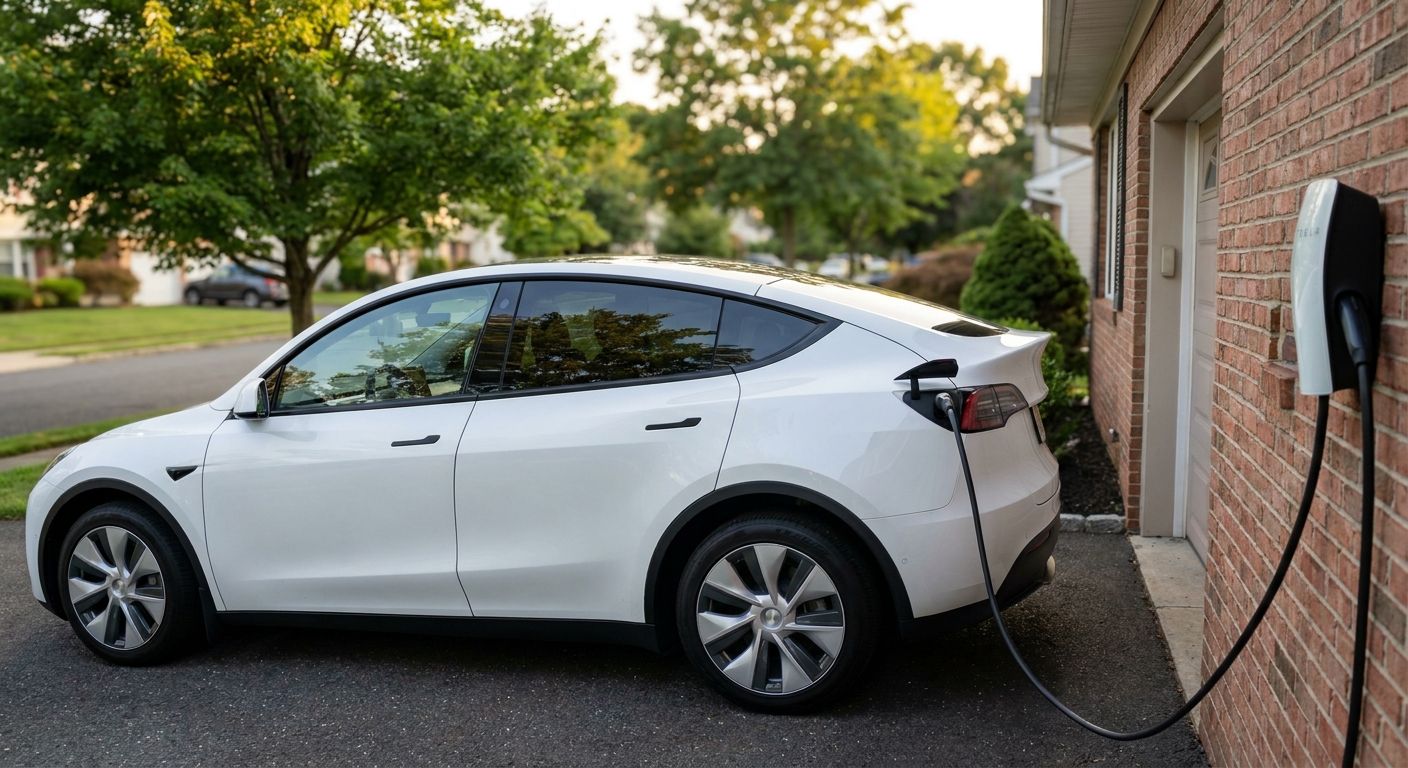
If you drive a Tesla in Monmouth, Middlesex, Somerset, or Union County, the charger you install at home determines how fast you charge and whether your electrical panel can handle it without nuisance trips or a full upgrade. This guide breaks down what a licensed NJ electrician actually checks before recommending a Tesla home charger installation, and where homeowners waste money.
- Tesla Wall Connector hardwired at 240V/48A is the fastest home charging setup for NJ homeowners in 2026 — Buy for daily drivers.
- A NEMA 14-50 outlet install costs less and works with any EV, not just Tesla — Consider if you might switch brands.
- Panels under 100 amps usually need an upgrade before charger installation; that job runs $2,000 to $7,000 in New Jersey.
- Skip unpermitted big-box outlet installs — NJ inspectors and home-sale buyers can flag them later.
- Spartan Home Pros runs a flat minimum service call of $229.99, no hourly meter running while the crew works.
Why this matters
A Tesla home charger installation is not a plug-and-go job. It's a 240-volt circuit sized to the vehicle's onboard charger, run through a panel that has to have amperage to spare, and in New Jersey it needs a permit and an inspection to be done legally.
Skip any of those steps and you either trip breakers, create a liability problem in an insurance claim, or fail a home sale inspection down the road. Getting it right in 2026 means matching the charger hardware, the circuit, and the panel to how you actually drive — not just to whatever the installer had in the truck.
Who this is for
This guide is for Tesla owners in Central New Jersey who charge at home overnight and want a setup that matches their daily mileage without over-building. It applies whether you're in a 1970s Colonial on a 100-amp panel in Edison or a newer build in Marlboro already wired for 200 amps — the criteria below apply either way, and so does the decision between a hardwired Wall Connector and a NEMA 14-50 outlet.
What to look for in a Tesla home charger installation
Panel capacity and amperage headroom
A Tesla Wall Connector is commonly configured to draw up to 48 amps continuous on a 240V circuit, which needs a 60-amp dedicated breaker. A panel already loaded with HVAC, an electric range, and a hot tub won't have room without a load calculation and possibly an upgrade. This is the biggest cost variable in the whole job — not the charger itself.
A licensed electrical contractor, not a handyman
New Jersey requires electrical work to be performed by a licensed electrical contractor, and a Tesla charger circuit is not general handyman work. A licensed electrician pulls the permit, sizes wire gauge to the length of the run, and signs off on code compliance that protects you if there's ever an inspection or insurance question. Spartan Home Pros does not subcontract this work — the same crew that files the permit runs the wire.
Permit and inspection compliance
Every Central NJ township requires a permit for a new 240V circuit, and skipping it is the most common mistake on DIY and unlicensed installs. An uninspected circuit can hold up a home sale and shifts liability onto the homeowner.
Hardwired Wall Connector vs. NEMA 14-50 outlet
A hardwired Tesla Wall Connector delivers the fastest home charging speed the vehicle supports and removes a plug connection as a wear point. A NEMA 14-50 outlet paired with the Mobile Connector charges more slowly but works with any EV, which matters when a second car in the household isn't a Tesla.
Distance from panel to charging location
A garage wall directly opposite the panel is a short, simple run. A detached garage or a driveway spot 60 feet away means longer conduit, possibly trenching, and higher labor before any hardware gets mounted.
Utility incentive programs
PSE&G and JCP&L both run EV charging incentive programs in New Jersey, and terms change year to year. Confirm current 2026 program rules directly with your utility before you build them into the budget.
Top picks for Tesla home charger installation
The safe pick: hardwired Tesla Wall Connector
A hardwired Wall Connector on a dedicated 240V/60A circuit is the standard recommendation for a household with one Tesla and a panel that has capacity to spare. It supports up to 48 amps continuous and eliminates the plug as a failure point over years of nightly cycling. Verdict: Buy for Tesla-only households with adequate panel capacity.
The flexible pick: NEMA 14-50 outlet
A NEMA 14-50 outlet costs less to install than a hardwired connector and works with Tesla's Mobile Connector or any other EV's portable cable, typically at up to 32 amps. It's the right call if you aren't committed to Tesla long-term or a second vehicle in the driveway is a different brand. Verdict: Consider when charging speed is not the priority.
The unglamorous pick: panel upgrade first, charger second
Homes still running a 100-amp panel from the 1970s or 1980s usually need a load calculation before any 240V circuit gets added, and in many cases that means a full panel upgrade at $2,000 to $7,000 in New Jersey in 2026. Doing the upgrade first avoids a half-finished project where the charger install stalls mid-job. Verdict: Buy for older homes before stacking EV load on top of existing HVAC and appliance draw.
The wildcard: dual-vehicle load sharing
Two EVs in one driveway do not automatically require two full-size circuits. Load-sharing between connectors, or a single circuit scheduled around off-peak hours, can keep the panel work smaller. Verdict: Consider if a second EV is arriving within a year — plan the circuit once instead of paying for two visits.
Get a Tesla charger quote
Licensed NJ electrical contractor. Flat minimum service call, no hourly meter.
What to avoid
- Unpermitted outlet installs. Cheaper up front, a problem at township inspection or at closing when a buyer's inspector asks for the permit record.
- Extension cords or non-EV-rated adapters as a permanent setup. They are not rated for sustained overnight current draw. This is a fire risk, not a shortcut.
- Adding a 60-amp circuit to a panel already near capacity. Without a load calculation, the failure shows up on the first cold night when HVAC and charging run at the same time.
Verdict comparison
| Setup | Charging draw | Permit needed | Main cost driver | Verdict |
|---|---|---|---|---|
| Hardwired Wall Connector | Up to 48A continuous | Yes | Panel capacity, run length | Buy |
| NEMA 14-50 outlet | Up to 32A with Mobile Connector | Yes | Outlet and wiring only | Consider |
| Panel upgrade first | Enables 60A circuit | Yes | Panel swap: $2,000-$7,000 | Buy for older homes |
| Dual-EV load sharing | Split across connectors | Yes | Single larger circuit | Consider |
| Unpermitted big-box install | Unverified | Skipped (the problem) | Cheap now, costly later | Skip |
FAQ
How much does Tesla home charger installation cost in NJ?
Cost depends on panel capacity and the length of the circuit run, so a licensed NJ electrician needs to see the panel to quote it accurately. If the panel needs an upgrade first, that work alone runs $2,000 to $7,000 in New Jersey in 2026.
Do I need a permit for EV charger installation in New Jersey?
Yes. Every Central NJ township requires a permit for a new 240V circuit, and the inspection record matters at resale. Skipping it shifts liability onto the homeowner.
Can my current panel handle a Tesla Wall Connector?
That depends on the panel's rated amperage and what else draws power, such as HVAC and an electric range. A load calculation from a licensed electrician answers it definitively rather than by guesswork.
Is a Tesla Wall Connector better than a NEMA 14-50 outlet?
A hardwired Wall Connector charges faster, at up to 48 amps continuous, while a NEMA 14-50 outlet charges more slowly but works with any EV brand. Pick the Wall Connector for a Tesla-only household and the outlet if you may switch vehicles.
How long does Tesla home charger installation take?
A straightforward install on a wall near a panel with spare capacity is typically a single service visit. A detached garage run or a panel upgrade adds time for conduit or the panel swap itself.
Does the same installation work for non-Tesla EVs?
Yes. The 240V circuit and NEMA 14-50 outlet serve any EV, and only the hardwired Wall Connector is Tesla-specific hardware. The underlying electrical work is brand-agnostic.
Are there rebates for installing an EV charger in NJ?
PSE&G and JCP&L both run EV charging incentive programs, and terms change year to year. Confirm current 2026 program details directly with your utility before budgeting.
What size breaker does a Tesla home charger need?
A hardwired Tesla Wall Connector set to 48 amps continuous runs on a 60-amp dedicated breaker. A NEMA 14-50 outlet setup usually sits on a 50-amp breaker instead.
One last thing
The panel is almost always the bottleneck, not the charger. Homeowners shop hardware first and treat panel capacity as an afterthought — flip that order and the project moves faster, because one visit from a licensed NJ electrician tells you whether you're looking at a simple outlet job or a $2,000 to $7,000 panel upgrade before the charger conversation even starts.


