
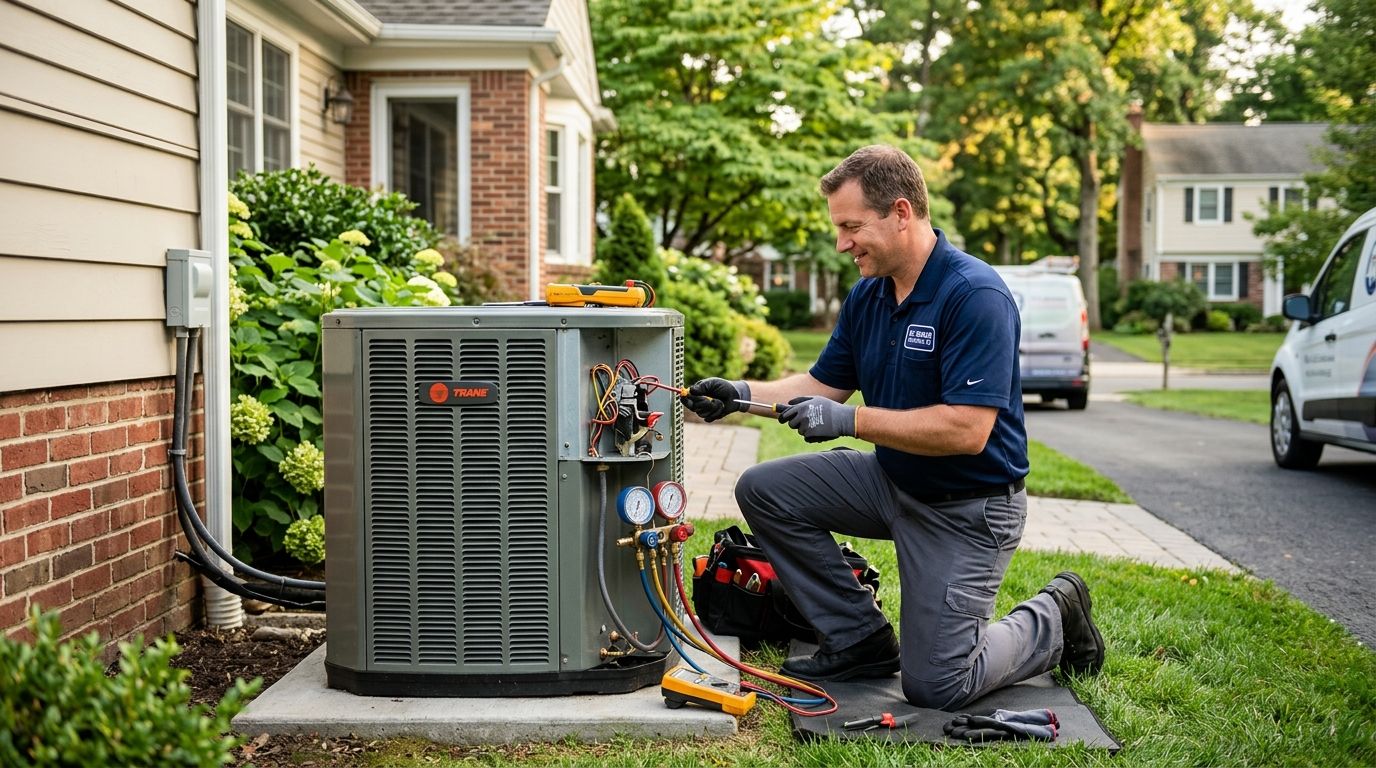
AC repair for Westfield NJ homeowners is the process of diagnosing why a central air system stopped cooling and fixing the specific part that failed, with the goal of restoring cold air before the next heat spike instead of paying for a full replacement you don't need. Westfield's housing stock skews toward older colonials and additions built decades apart, which means mismatched ductwork, aging condensers, and electrical panels that predate the AC load they now carry are common culprits behind a service call here.
- Most AC repair for Westfield NJ homeowners traces back to a failed capacitor, a refrigerant leak, or a breaker that can't handle the load — not the whole system.
- A licensed technician diagnoses the actual failure point before recommending replacement, which is the fastest way to avoid overpaying in 2026.
- Homes with an older 100-amp panel often need an electrical check alongside AC repair, especially after a higher-efficiency unit was installed.
- Waiting until the hottest week of summer to call means longer hold times and higher risk of a full breakdown mid-heat wave.
Why AC repair matters for Westfield homeowners
A cooling system that fails on a 95-degree day in Westfield isn't just uncomfortable — it's a call that competes with every other homeowner on the same block who waited for the same heat wave to test their system. The towns Spartan Home Pros services across Union, Middlesex, Somerset, and Monmouth counties share the same pattern: service calls spike the first week temperatures cross into the 90s, and homeowners who scheduled a spring check-up skip that line entirely.
Westfield's older homes add a second layer most homeowners don't think about until a technician points it out. A system installed in the 2000s often draws more amperage than the panel was built for, especially if the panel itself is original to a house built before 1970. That combination — an aging AC unit and an undersized panel — shows up again and again as the real reason a system keeps tripping breakers instead of cooling the house. A repair call that only replaces a part without checking the panel's capacity is a repair that comes back.
A licensed HVAC technician at Spartan Home Pros diagnoses both sides of that equation on the same visit, which is the difference between a one-time fix and a repeat service call three weeks later.
Check the thermostat and breaker before you call anyone
Half of "my AC isn't working" calls in 2026 turn out to be something a homeowner can rule out in five minutes.
- Confirm the thermostat is set to Cool and the target temperature is below the current room temperature
- Replace the thermostat batteries if the display is dim or blank
- Check the breaker panel for a tripped switch labeled AC or condenser
- Look for a disconnect switch near the outdoor unit and confirm it hasn't been bumped or pulled
- Reset the breaker once, and if it trips again immediately, stop — that's an electrical fault, not a fluke
Inspect the outdoor condenser unit for debris and damage
The condenser sits outside year-round, and Westfield's tree cover means leaves, grass clippings, and pollen build up fast.
- Clear leaves, grass, and debris from within two feet of the unit on all sides
- Check the fins for bending or crushing from a mower, hose, or storm debris
- Look for oil residue around refrigerant line fittings, which signals a slow leak
- Confirm the fan spins freely and isn't obstructed by a stick or nest
- Check for visible ice buildup on the copper lines running into the house
Look for ice on the refrigerant lines
Ice on the lines almost always means one of two things: low refrigerant from a leak, or restricted airflow from a dirty filter or blocked return. Neither fixes itself, and running the system while it's icing over can damage the compressor — the most expensive part in the unit.
- Turn the system off and let the ice melt fully before restarting anything
- Replace the air filter if it hasn't been changed in the last 60-90 days
- Check that furniture, curtains, or boxes aren't blocking a return vent
- If ice comes back within a day of a clean restart, the problem is refrigerant, not airflow
Listen for grinding, clicking, or buzzing before the compressor starts
Electrical components fail before mechanical ones in most cooling systems. A capacitor that's degrading makes a distinct clicking or humming sound as it tries — and fails — to start the compressor motor.
- Listen for a rapid clicking sound followed by silence, a classic capacitor symptom
- Note any burning smell near the outdoor unit or the indoor air handler
- Check if the fan starts but the compressor never kicks in
- Watch for the system short-cycling — running for under five minutes, then stopping
“If the capacitor test fails, the compressor won't start — no amount of refrigerant fixes that.”
Call a licensed technician once electrical or refrigerant work is involved
Once troubleshooting points to a capacitor, a refrigerant leak, or a breaker that trips on every reset, this stops being a homeowner-fixable problem. Refrigerant work requires EPA certification, and any repair that touches the electrical side of a system should go through a licensed electrician, not a handyman.
- Confirm the technician is licensed and doesn't subcontract the diagnostic or the repair
- Ask for the specific part that failed before agreeing to any work
- Get a written estimate before parts are ordered, not after
- Ask whether the panel was checked as part of the visit, especially in homes built before 1980
Compare repair cost against the age of your system
A repair on a five-year-old unit is a different decision than a repair on a fifteen-year-old one. The rule most NJ contractors use: if the repair costs more than a third of what a new system costs installed, and the unit is past the ten-year mark, replacement usually wins on total cost over the next five years.
Set a maintenance schedule to avoid the next breakdown
A spring check-up catches capacitor wear, low refrigerant, and dirty coils before they turn into a July emergency call.
- Change the air filter every 60-90 days during cooling season
- Schedule a professional tune-up in April or May, before the first heat wave
- Keep two feet of clearance around the outdoor unit year-round
- Ask for a capacitor and contactor check at every visit — these are the parts that fail first
Comparison of AC repair paths for Westfield homeowners
| Option | Best For | Key Limitation |
|---|---|---|
| DIY troubleshooting (filter, breaker, thermostat) | Homeowners ruling out simple causes before calling | Doesn't touch refrigerant or electrical faults |
| Licensed diagnostic and repair | Homes with a specific part failure and a system under 12 years old | Requires scheduling and a service call fee |
| Seasonal maintenance plan | Homeowners who want to avoid mid-summer breakdowns | Doesn't cover a failure that's already happened |
| Full system replacement | Systems over 12-15 years old with repeat repairs | Larger upfront cost than a single repair |
Schedule AC repair in Westfield
Licensed technicians, no subcontracting, straight diagnostic before any repair.
Common mistakes Westfield homeowners make
- Waiting for the hottest week to call instead of scheduling a check-up in spring, then competing with every other homeowner for a same-week slot
- Assuming an older 100-amp panel can handle a newer, higher-SEER condenser without ever having the panel's capacity checked
- Repeatedly recharging refrigerant on a system with a known leak instead of fixing the leak itself, which just delays the same call
- Hiring whoever answers the phone fastest without confirming the crew is licensed and isn't subcontracted out
- Ignoring early capacitor warning signs — clicking, slow starts, short-cycling — until the compressor itself fails
See also how heat wave conditions drive up repair costs across NJ if your system tends to struggle during the worst stretch of summer.
FAQ
How much does AC repair cost in Westfield NJ?
AC repair cost in Westfield NJ depends on the specific part that failed — a capacitor replacement costs far less than a refrigerant leak repair or a compressor replacement. A licensed technician should diagnose the exact failure before quoting a fixed number.
Is it worth repairing an AC unit over 10 years old?
It depends on the repair cost relative to a new system. If the repair runs close to a third of full replacement cost and the unit is past 10-12 years old, replacement usually saves money over the next five cooling seasons.
How fast can I get emergency AC repair in Westfield NJ?
Response time depends on the contractor's schedule and the time of year — demand spikes hard the first week temperatures cross into the 90s. Scheduling a spring tune-up avoids competing for a same-week emergency slot.
Do I need a permit for AC repair in NJ?
Straightforward part repairs like a capacitor or contactor swap typically don't require a permit, but full system replacement or any work touching the electrical panel usually does under NJ code. A licensed contractor pulls the permit when one is required.
Why does my AC blow warm air instead of cold?
Warm air usually means low refrigerant from a leak, a failed compressor, or a dirty condenser coil blocking heat transfer. Check the outdoor unit for ice or debris first, then call a technician if the problem doesn't clear.
How often should I service my central AC system?
Once a year, ideally in spring before the first heat wave of the season. Annual service catches capacitor wear and refrigerant loss before either causes a full breakdown.
Can a bad electrical panel cause AC problems?
Yes — an undersized or aging panel can trip breakers under the AC's startup load, especially in homes with a 100-amp panel and a newer, higher-efficiency condenser. A technician should check panel capacity alongside any repeated breaker trip.
What size AC unit do I need for a Westfield home?
Sizing depends on square footage, insulation, and window exposure, not a flat number per home. A load calculation done during a service visit gives an accurate figure instead of a rough estimate.
One last thing
The detail most homeowners miss going into 2026: a brand-new, higher-efficiency condenser draws more amperage on startup than the unit it replaced, even though it uses less energy overall while running. On a house with an original 100-amp panel from the 1960s or 1970s, that startup draw is what trips the breaker — not a failure in the AC unit itself. A repair call that only looks at the AC side misses the actual fix.


