
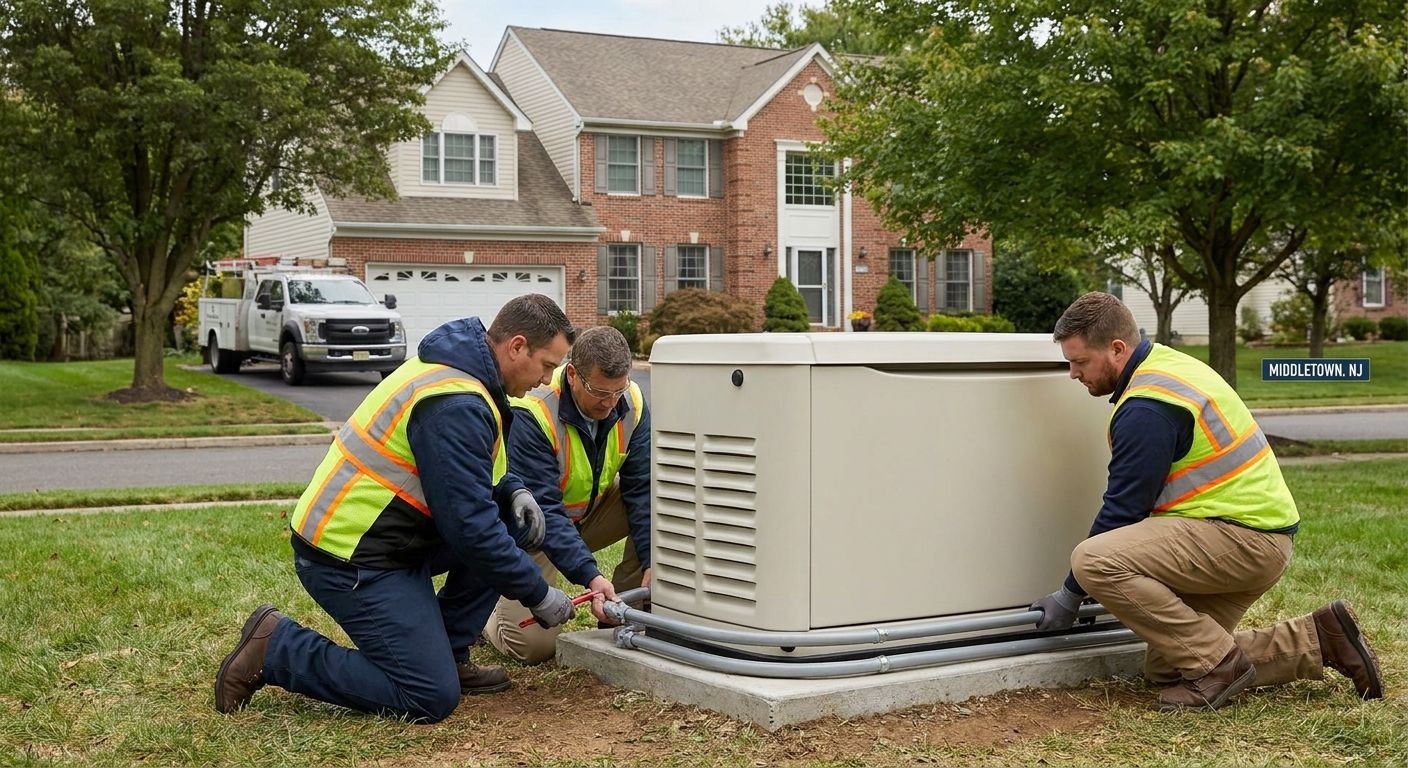
Middletown NJ sits along the Bayshore in Monmouth County, and every homeowner here knows what a nor'easter does to the power grid. Whole house generator installation in Middletown NJ means matching the right kW size, transfer switch, and fuel line to your actual panel — not just bolting a unit to the side of the house.
- 22kW to 26kW standby generators cover most Middletown colonials and capes with central air — buy sized to your panel.
- A 100-amp panel can't support a whole-home transfer switch; upgrade to 200-amp service first.
- NJ requires an electrical permit and inspection for standby generator installation — skip that and you can't get insurance to pay out later.
- Portable generators under 10kW are a storm-season stopgap, not whole-home coverage — skip them as a permanent fix.
Why this matters
Monmouth County loses power every storm season, and Middletown's low-lying streets near the Navesink and Raritan Bay make outages last longer than they do further inland. A generator sized wrong — or installed without a permit — either fails to run your central air and well pump, or gets flagged during a home sale inspection.
The difference between a generator that works in January 2026 and one that trips a breaker every time the furnace and fridge kick on at once comes down to three things: panel amperage, transfer switch rating, and fuel supply. Get those wrong and the generator itself doesn't matter.
Who this is for
This guide is for Middletown homeowners with a 100-amp or 200-amp panel who lose power for more than a few hours during a typical storm and want the whole house covered — not just a fridge and a few lamps. If you're already comparing panel capacity for a generator, it's worth checking whether the same service upgrade would also support a Level 2 EV charger, since both draw off the same main breaker. Spartan Home Pros handles panel upgrades, generator installation, and EV charger wiring as one licensed crew — no subcontractors, no separate trip charges for each trade.
What to look for in generator installation for Middletown homeowners
Panel Amperage and Service Capacity
A whole-home standby generator needs a 200-amp panel to run central air, a well pump, and kitchen circuits at the same time. Homes built before the 1990s in Middletown often still run 100-amp service, and that has to be upgraded before a generator installer will even quote a transfer switch.
Automatic Transfer Switch Rating
The transfer switch has to match your panel amperage, not your generator's output. A 200-amp panel needs a 200-amp transfer switch — undersizing this component is the single most common mistake homeowners run into when they shop by generator price alone.
Fuel Source: Natural Gas vs. Propane
Most of Middletown has natural gas service, which means a standby generator runs indefinitely without refueling during an extended outage. Homes on well and septic without gas lines run on propane, which requires a tank sized to the generator's burn rate and periodic refills.
Local Permits and Inspection
New Jersey requires an electrical permit and a fuel gas permit for standby generator installation, plus a township inspection before the unit goes live. Skip this step and you've got an uninspected fuel-burning appliance next to your house — insurers ask for the permit paperwork after any claim involving fire or carbon monoxide.
Placement, Clearance, and Noise
Manufacturer installation guidelines call for roughly 18 inches of clearance from doors, windows, and vents to keep exhaust away from living space. Middletown's smaller lots also mean setback rules from property lines matter — a generator placed too close to a neighbor's fence can trigger a variance issue during resale.
Right-size options for Middletown homes
The essentials pick — 14kW to 18kW air-cooled standby. Covers the fridge, well pump, sump pump, furnace, and a handful of lighting circuits. This size fits capes and smaller ranches common in Middletown's older sections where the panel is already 200-amp but the house doesn't run central air off the same system. Verdict: Buy for homes under roughly 2,200 square feet without whole-home AC.
The whole-home pick — 22kW to 26kW standby. Runs central air, the well pump, kitchen appliances, and every circuit in the panel at once. This is the size that matches most Middletown colonials and homes built in the 2000s with 200-amp service and central HVAC. Verdict: Buy for anyone who wants zero compromise during a multi-day outage.
The wildcard — battery-and-solar backup. Battery systems paired with solar can carry a fridge and some lighting for hours, but they're not sized to start a well pump or run central air for a multi-day nor'easter outage the way a fuel-fired standby unit is. Verdict: Consider as a supplement to a standby generator, Skip as your only backup.
The stopgap — portable generator under 10kW. Fine for keeping a sump pump and a space heater running while you wait for a standby install to get scheduled. It's not connected to your panel through an automatic transfer switch, so someone has to manually run extension cords every time the power drops. Verdict: Skip for permanent whole-home coverage.
What to avoid
- An undersized transfer switch on a 200-amp panel. A 100-amp switch on a 200-amp service caps what the generator can actually power, even if the generator itself is rated big enough.
- Skipping the permit to save a week. Middletown building inspectors check for generator permits during unrelated work — a solar install, a roof permit, a home sale appraisal — and an unpermitted unit becomes a problem later, not now.
- Buying the generator before checking panel capacity. If your home is still on 100-amp service, EV charger installation for NJ homeowners draws on the same math — a panel upgrade often has to happen before either a generator or a Level 2 charger goes in.
Verdict comparison
| Option | Size | Fuel | Transfer Switch | Best For | Verdict |
|---|---|---|---|---|---|
| Essentials standby | 14-18 kW | Natural gas or propane | 100-200A | Capes, ranches, no central AC | Buy |
| Whole-home standby | 22-26 kW | Natural gas or propane | 200A | Colonials, homes with central AC | Buy |
| Battery + solar | Varies | None | N/A | Supplement to standby | Consider |
| Portable generator | Under 10 kW | Gasoline | None (manual) | Short-term stopgap | Skip |
Get a generator sizing quote
Licensed NJ electricians handle the panel check, permit, and install.
FAQ
What size whole-home generator do I need for a house in Middletown NJ?
Most Middletown colonials with central air and 200-amp service need a 22kW to 26kW standby generator. Smaller capes and ranches without central AC often run fine on a 14kW to 18kW unit.
How much does generator installation cost in Middletown NJ?
Cost depends on generator size, fuel line work, and whether the panel needs an upgrade first. Homeowners get an itemized quote after a licensed electrician evaluates the panel and site.
Is a permit required for generator installation in New Jersey?
Yes. New Jersey requires an electrical permit and a fuel gas permit for standby generator installation, plus a township inspection before the unit is turned on.
Can I install a generator myself in NJ?
No — standby generator installation involves gas line work, an automatic transfer switch tied into your main panel, and a permitted inspection, all of which require a licensed electrician and, in most townships, a licensed plumber for the fuel line.
Natural gas or propane, which is better for a whole-home generator in Middletown?
Natural gas runs indefinitely during an outage since it draws from the utility line, which is why most Middletown homes with gas service use it. Homes on well and septic without gas access run on propane, which needs a sized tank and refills during extended outages.
Do I need a new electrical panel to add a generator?
If your home still runs 100-amp service, yes — a whole-home transfer switch needs a 200-amp panel to carry central air, a well pump, and kitchen circuits at once. Homes already on 200-amp service usually skip this step.
What's the difference between a portable and standby generator?
A standby generator is wired permanently to your panel through an automatic transfer switch and starts on its own within seconds of an outage. A portable generator has to be manually connected with extension cords and only covers a few circuits at a time.
How long will a whole-home generator run during an outage?
A natural gas standby generator runs as long as the utility gas line keeps flowing, which is typically for the full duration of an outage. A propane unit runs until the tank empties, so tank size has to match expected outage length.
One last thing
Middletown's Bayshore neighborhoods took some of the longest outages in Monmouth County after Hurricane Sandy in 2012, and installers across Central NJ still see the same pattern every fall: bookings spike in September and October, right when nor'easter season starts and lead times stretch out. Get the panel evaluated and the permit filed in summer 2026, not the week before the first storm — that's the one move that actually beats the waitlist.


