
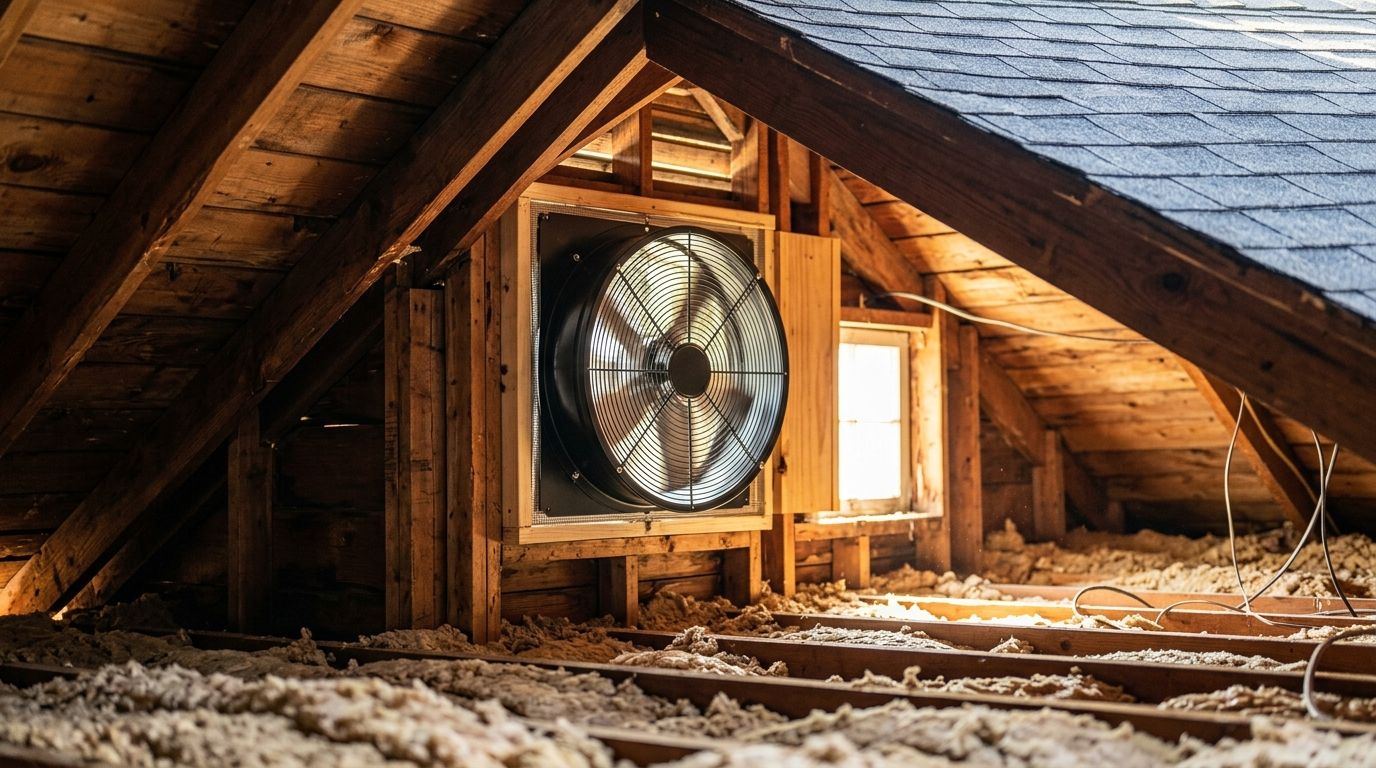
Central New Jersey attics regularly hit 140-150°F on a July afternoon, and the wrong attic fan either does nothing about it or actively pulls conditioned air out of your living space. This guide ranks the five attic fan types homeowners in Monmouth, Middlesex, Somerset, and Union counties actually install in 2026, tells you which one fits your roof and budget situation, and flags the failure modes each type carries.
- The best attic fan overall in 2026 is an electric gable-mounted fan with a humidistat and thermostat combo switch.
- Solar-powered attic fans win for homes without easy attic wiring access — no new circuit needed.
- Whole-house fans cool the entire living space, not just the attic, and work best on cool NJ evenings.
- Every powered attic fan needs matching soffit intake venting or it backdrafts and pulls AC air from the house.
- Size any attic fan to roughly 1 CFM per square foot of attic floor — undersized units run constantly and still lose the fight.
Why this matters
An oversized HVAC system fighting a 150°F attic in August runs longer, cycles harder, and shortens compressor life — that's a service call Spartan Home Pros sees every summer across Central NJ. A correctly sized attic fan drops attic temperature and takes load off the AC before it ever turns on.
The catch: not every attic fan type suits every roof. A licensed electrician handling attic fan installation checks your existing wiring, soffit vent count, and roof pitch before recommending a type — because the wrong pick either underperforms or creates a moisture problem in January.
What makes the best attic fan
- CFM rating matched to attic square footage — roughly 1 CFM per square foot of attic floor space is the standard sizing rule.
- Thermostat and humidistat control — the fan should switch on by temperature in summer and humidity year-round, not run on a dumb timer.
- Power source fit — solar works without new wiring; electric needs an accessible circuit or a new one run.
- Adequate intake venting — soffit vents have to move as much air in as the fan pushes out, or it pulls air from the house instead.
- Noise level at the ceiling below — a fan mounted over a bedroom needs a lower sone rating than one over a garage attic.
- Roof compatibility — gable fans need a gable end; ridge fans need continuous ridge venting already in place.
At a glance
| Attic fan type | Best for | Standout feature | Key limitation |
|---|---|---|---|
| Electric gable-mounted fan | Consistent airflow in any weather | Runs on demand, day or night | Needs a dedicated circuit run to the attic |
| Solar-powered attic fan | No new wiring access | Zero added electric draw during daylight | Output drops on cloudy days and stops at night |
| Ridge-mounted powered fan | Shingle roofs with existing ridge venting | Low profile, no gable wall needed | Requires continuous ridge vent already installed |
| Whole-house fan | Cooling the entire living space, not just the attic | Pulls house air out through the attic on cool nights | Needs sealed attic access when not running |
| Smart/WiFi humidistat fan | Humidity-prone attics and remote monitoring | App alerts on temperature and moisture spikes | Higher upfront wiring complexity than a basic switch |
Get your attic fan sized right
A licensed NJ electrician checks wiring, venting, and CFM before you buy.
1. Electric gable-mounted fan: best attic fan for consistent summer airflow
An electric gable-mounted fan mounts into an existing gable vent opening and runs off a dedicated circuit, triggered by a thermostat that flips it on once the attic crosses roughly 100-110°F. It moves air regardless of sun exposure or time of day, which matters in Central NJ where humid overnight air still needs to move.
Electric gable fan pros:
- Works at night and on overcast days, unlike solar
- Higher sustained CFM output than most solar units
- Pairs with a humidistat for year-round moisture control, not just summer heat
Electric gable fan cons:
- Requires a new or existing 120V circuit run to the attic
- Adds a small amount to the electric bill during peak run hours
- Needs matched soffit intake or it draws conditioned air from the house through ceiling gaps
Best for: homes with an accessible attic circuit and a gable end vent already framed in.
Verdict: Buy — this is the default pick for most Central NJ homes in 2026 unless wiring access is the blocker.
2. Solar-powered attic fan: best attic fan for homes without easy wiring access
A solar-powered attic fan mounts directly on the roof deck with an integrated panel, drawing zero grid electricity. It runs whenever the sun is out, which happens to align with peak attic heat — the fan works hardest exactly when the attic needs it most.
Solar attic fan pros:
- No new electrical circuit or panel work required
- No added utility cost during operation
- Roof-mounted placement works on homes without a gable end
Solar attic fan cons:
- Output drops sharply on cloudy days and stops entirely at night
- Roof penetration adds a flashing point that needs proper sealing
- Typically lower sustained CFM than a hardwired electric unit of the same size
Best for: homeowners who want attic ventilation without opening a panel or running new circuits — a real advantage if a panel upgrade isn't already on the schedule.
Verdict: Buy — solid pick when wiring access or panel capacity is the constraint, with the tradeoff that nighttime and winter humidity control is weaker.
3. Ridge-mounted powered fan: best attic fan for shingle roofs with existing ridge venting
A ridge-mounted powered fan installs along the roof ridge line where continuous ridge venting already exists, pulling air out along the highest point of the attic. It sits lower profile than a roof-mounted box fan and blends into the roofline better than most alternatives.
Ridge fan pros:
- Low visual profile compared to gable or roof-box units
- Draws from the hottest point in the attic — heat rises, so the ridge is where it collects
- Works well on homes with no gable end at all
Ridge fan cons:
- Only works if continuous ridge venting is already in place — retrofitting ridge vent is a bigger job
- Fewer CFM options at the high end compared to gable-mounted units
- Harder to service without roof access
Best for: newer construction or re-roofed homes in Union and Middlesex counties that already have ridge vent installed.
Verdict: Hold — good option, but only if the ridge vent infrastructure is already there. Skip it as a retrofit-from-scratch project.
4. Whole-house fan: best attic fan for cooling the entire living space
A whole-house fan installs in the ceiling between the living space and the attic, pulling cooler outside air through open windows and exhausting hot house air up through the attic and out the roof vents. It's a different job than the other four types — it cools the house, not just the attic — and it's most effective on the shoulder-season NJ evenings when outdoor temps drop into the 60s.
Whole-house fan pros:
- Cools the whole house, not just attic space, on cool nights
- Cuts AC runtime dramatically during spring and fall evenings
- Uses far less electricity than running central air
Whole-house fan cons:
- Only useful when outdoor air is cooler than indoor air — dead weight during a July heat wave
- Needs an insulated, sealed cover when not in use or it drains heat in winter
- Doesn't replace summer attic ventilation on its own
Best for: homeowners who want to cut AC use during NJ's cooler months and are willing to run a supplemental cooling system in peak summer — pairing it with a ductless mini-split system covers both ends of the season.
Verdict: Buy — as a supplement, not a summer-only replacement for a real attic fan.
5. Smart/WiFi humidistat fan: best attic fan for humidity-prone attics
A smart attic fan pairs an electric gable or roof-mounted unit with a WiFi-connected humidistat and app, sending alerts when attic humidity or temperature crosses a set threshold. It's the same hardware as an electric gable fan with a smarter control layer on top.
Smart attic fan pros:
- Remote alerts catch moisture problems before they turn into mold
- App-based scheduling adjusts trigger points seasonally
- Useful diagnostic data if attic humidity has been an ongoing issue
Smart attic fan cons:
- More complex wiring and setup than a basic thermostat switch
- App reliability depends on home WiFi reaching the attic
- Overkill for attics with no history of humidity or moisture problems
Best for: homes with a documented moisture history, or anyone who wants remote visibility into attic conditions instead of checking manually.
Verdict: Hold — worth the added complexity only if humidity has actually been a problem; otherwise a standard thermostat switch does the job.
How we ranked
Each type was scored against the six criteria above: CFM-to-attic-size fit, control sophistication, power source flexibility, intake venting compatibility, noise at ceiling level, and roof compatibility. Electric gable fans scored highest on control and sustained output; solar and ridge fans scored well on installation simplicity but lost points on nighttime or retrofit limitations.
Which attic fan should you choose?
If you're not sure where to start, the electric gable-mounted fan with a thermostat and humidistat combo is the right default for most Central NJ homes in 2026 — it runs regardless of sun or time of day and handles both summer heat and year-round moisture. Choose solar only if wiring access is the real obstacle, and treat a whole-house fan as a spring-and-fall supplement, not a July solution.
The single biggest mistake homeowners make with any powered attic fan is installing it without enough soffit intake venting — the fan ends up pulling conditioned air from the house instead of hot air from the attic.
FAQ
What is the best attic fan for a New Jersey summer?
An electric gable-mounted attic fan with a thermostat and humidistat combo is the best attic fan for most NJ homes in 2026 because it runs day or night regardless of sun exposure. Solar units are a strong second choice when new wiring isn't practical.
Is a solar attic fan as good as an electric one?
A solar attic fan avoids new wiring and adds no electric cost, but its output drops on cloudy days and stops at night. Electric gable fans deliver more consistent CFM across a full 24-hour cycle.
How many CFM does an attic fan need?
Size an attic fan to roughly 1 CFM per square foot of attic floor space. A 1,200 square foot attic needs a fan rated around 1,200 CFM to move air effectively.
Do attic fans really lower the house temperature?
An attic fan lowers attic temperature, which reduces heat transfer into the ceiling below and cuts AC load, but it doesn't directly cool living space the way a whole-house fan does. The two work best together during shoulder seasons.
Can an attic fan pull air-conditioned air out of the house?
Yes, if soffit intake venting is insufficient, a powered attic fan creates negative pressure and pulls conditioned air from the living space through ceiling gaps and can-light housings. Matching intake vent area to fan CFM prevents this.
Do I need an electrician to install an attic fan?
Any electric or smart attic fan needs a dedicated circuit run to the attic, which requires a licensed electrician in New Jersey for the wiring and often a permit. Solar units skip the wiring step but still need proper roof flashing.
What's the difference between an attic fan and a whole-house fan?
An attic fan only ventilates the attic space to reduce heat buildup, while a whole-house fan pulls air through the entire living space and exhausts it through the attic. They solve different problems and work well installed together.
Do ridge vent fans work without existing ridge venting?
No, a ridge-mounted powered fan requires continuous ridge venting already installed along the roofline. Retrofitting ridge vent from scratch is a bigger roofing project than adding the fan itself.
One last thing
Most homeowners size the fan and skip the intake math entirely — a 1,200 CFM fan with undersized soffit vents doesn't move 1,200 CFM of attic air, it moves whatever the intake allows and pulls the rest from the house below. Check soffit vent area before buying the fan, not after.


