
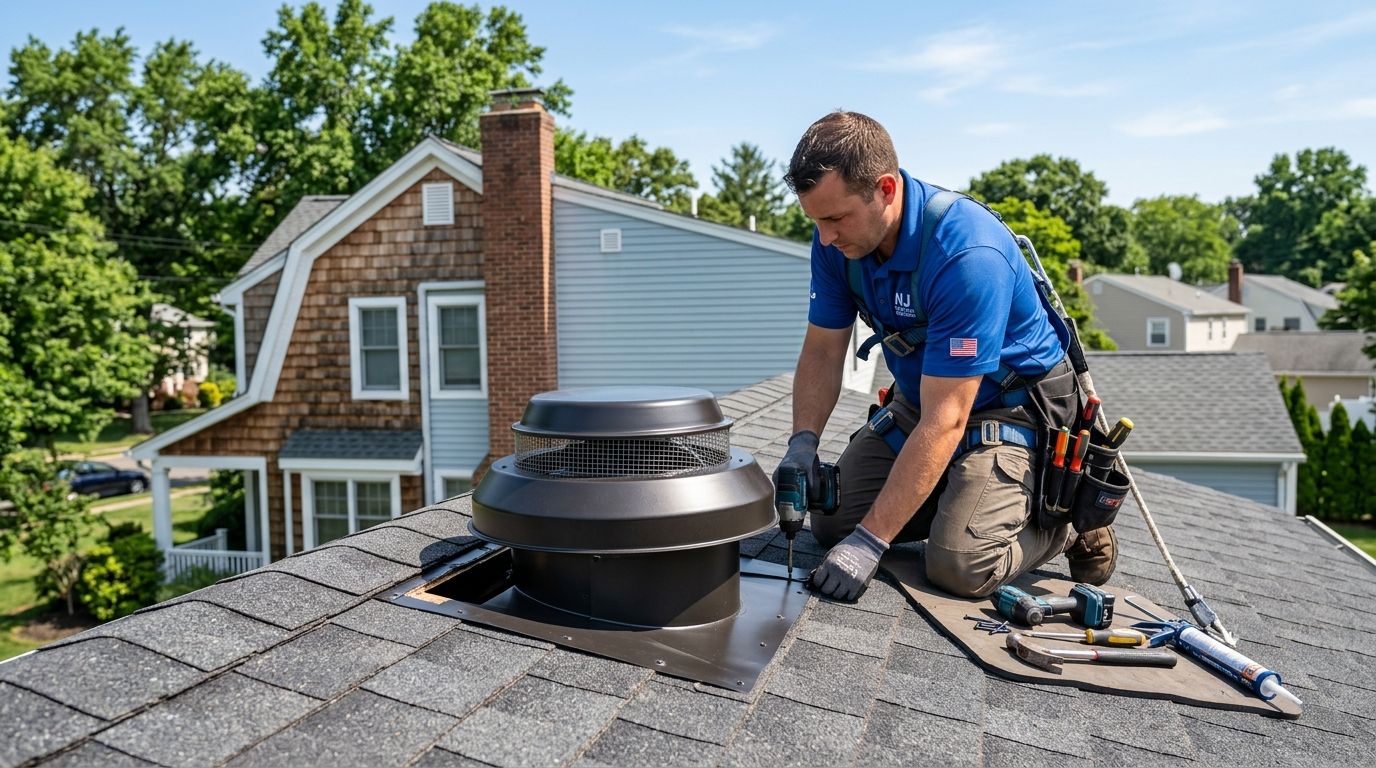
Central New Jersey attic fan installation is the process of wiring and mounting a powered or solar exhaust fan into your attic space, aimed at pulling summer heat out before it soaks through the ceiling and forces your AC to run longer than it should. Homes in Monmouth, Middlesex, Somerset, and Union counties deal with humid, 90-degree stretches every summer, and a lot of Central Jersey attics were built with intake venting sized for a house half their age.
- Attic fan installation nj works best paired with matched soffit intake venting — fans alone can backdraft conditioned air from living spaces.
- Hardwired electric attic fans need a dedicated circuit and often a panel capacity check before installation in 2026.
- Solar attic fans skip the wiring but lose power on cloudy days and cannot run overnight.
- Central Jersey attics regularly exceed 140°F on summer afternoons in unventilated roof spaces.
- A humidistat-controlled fan cuts summer moisture buildup that leads to mold and warped roof sheathing.
Why attic fan installation matters for Central Jersey homeowners
An attic that sits at 140-150°F all afternoon in July does not stay in the attic. That heat radiates through the ceiling drywall into bedrooms and living rooms, and your central AC compensates by cycling longer and more often. Homeowners who have already worked through how to reduce HVAC repair costs during an NJ heat wave know that heat load on the system is the first thing to fix before repair bills stack up.
Older Central Jersey homes — especially colonials and capes built before the 1990s — were framed with less attic ventilation than current practice recommends. A properly sized, correctly vented attic fan can cut attic temperatures meaningfully, but only when the intake side is sized to the standard ventilation ratio of 1 square foot of net free vent area per 150-300 square feet of attic floor. That ratio is the number every install in 2026 should be checked against.
The difference between a fan that helps and a fan that hurts comes down to installation, not the fan itself. Get it wrong and you pull conditioned air up out of your living space through can lights and attic hatches, which raises your cooling bill instead of lowering it.
Check your attic's ventilation math first
Before anyone touches a fan, the intake-to-exhaust ratio has to check out. An exhaust fan without enough soffit or gable intake short-circuits and pulls air from the house below instead of from outside.
- Measure your attic's square footage
- Count existing soffit vents and estimate their net free area
- Check for painted-over or insulation-blocked vents, common in homes over 20 years old
- Confirm gable vents are not serving as the only intake source
- Rule out bathroom or dryer exhaust ducts terminating in the attic instead of outside
Decide between solar, hardwired electric, and whole-house fan types
Each fan type solves a different problem, and picking the wrong one is the single most common attic fan mistake homeowners make in 2026.
- Solar-powered attic fans need no wiring and no panel work, but stop the moment the sun goes down or clouds roll in
- Hardwired electric attic fans run on demand via thermostat, day or night, but need a dedicated circuit
- Whole-house fans pull air through the entire house and exhaust it through the attic — different job, higher airflow, louder operation
- Gable-mounted fans work in homes with strong gable ventilation but do less for the hip-roof designs common in newer Central Jersey developments
Verify your panel has capacity for a hardwired circuit
This is where most DIY attic fan projects stall. A hardwired attic fan draws a small load, but it still needs an open breaker slot and a code-compliant run from the panel.
- Confirm your panel has an open slot at the correct voltage for the fan
- Check panel age and condition — panels showing signs they need an upgrade should be addressed before adding new circuits
- Verify the run length from panel to attic does not require a larger wire gauge than planned
- Confirm an accessible disconnect or switch is part of the plan, per NJ electrical code
Homeowners who run this wire themselves without a permit often find out during a home sale inspection that the work has to be redone. A licensed electrician pulling the permit and running the circuit correctly the first time costs less than opening drywall twice.
Size the fan to your attic's square footage
An undersized fan runs constantly and barely moves attic temperature. An oversized fan pulls too hard on limited intake venting.
- Match the CFM rating to attic square footage using the 1 CFM per 2-3 square feet rule most manufacturers publish
- Add capacity for dark roofing, since asphalt shingles absorb more heat than light-colored roofing
- Account for cathedral ceilings or finished attic space, which changes the airflow path
- Round up rather than down when your attic falls between two standard fan sizes
Position intake and exhaust correctly
Fan placement decides whether airflow actually clears the hot zone or just recirculates near the ridge.
- Mount the exhaust fan as close to the ridge as the roofline allows
- Keep soffit vents clear of insulation using baffles
- Avoid placing the fan directly above bathroom or kitchen exhaust terminations
- Seal attic floor penetrations — can lights, plumbing stacks, the attic hatch — so the fan is not pulling conditioned air
Add a thermostat or humidistat control
A fan running 24/7 on a manual switch wastes electricity and wears out faster. Automatic controls fix both problems.
- Set the thermostat to trigger the fan around 100-110°F attic temperature
- Add a humidistat alongside or instead of a thermostat when moisture, not just heat, is the concern
- Confirm the control unit is rated for attic temperature extremes
- Reset seasonal settings — winter humidity control needs different thresholds than summer heat control
Schedule the licensed installation
Once the ventilation math, fan type, and panel capacity are settled, the electrical work is a short job for a licensed electrician. Spartan Home Pros handles the electrical side of attic fan installation — dedicated circuit, permit, and code-compliant disconnect — in one visit, so the fan is never left running on an unpermitted tap.
Get your attic fan wired the right way
Licensed NJ electricians handle the circuit, permit, and install in one visit.
Attic fan options compared for NJ homes in 2026
| Option | Best for | Key limitation | Verdict |
|---|---|---|---|
| Solar-powered attic fan | Homes with limited panel access and strong south-facing sun | Stops at night and on overcast days | Buy when wiring access is the blocker |
| Hardwired electric attic fan | Homes needing consistent day-and-night control | Requires a dedicated circuit and panel capacity | Buy for most Central Jersey homes |
| Whole-house fan | Cooling living space directly, not just the attic | Louder, needs large attic vent area | Buy when whole-house cooling is the goal |
| Gable-mounted fan | Homes with strong existing gable venting | Weak on hip-roof designs in newer builds | Hold until roof style is confirmed |
Common mistakes Central Jersey homeowners make
- Skipping the intake check. Installing exhaust without matching soffit intake pulls conditioned air from the house instead of outside air into the attic.
- DIY wiring without a permit. Unpermitted circuits surface at resale inspection and usually get redone by a licensed electrician anyway.
- Blocking soffit vents with insulation. Common in homes that added blown-in insulation without installing baffles first.
- Undersizing for dark asphalt roofs. A fan sized for a light-colored roof underperforms under dark shingles.
- Ignoring winter humidity. A setup built only for summer heat misses the moisture buildup behind mold and warped sheathing.
FAQ
Do I need a permit for attic fan installation in NJ?
Yes, a hardwired electric attic fan needs an electrical permit in New Jersey because it adds a new circuit tied to your panel. Solar attic fans that never touch the panel generally avoid that electrical permit, but requirements vary by township.
Can I install an attic fan myself?
Mounting the fan is straightforward, but running a dedicated circuit from the panel to the attic calls for a licensed electrician in New Jersey. Unpermitted DIY wiring is one of the most common reasons attic fan work gets flagged at inspection.
How much does attic fan installation cost in NJ?
Cost depends on fan type, panel capacity, and the length of the wire run, so get a quote tied to your actual panel rather than a national average. Panel condition varies widely between older and newer Central Jersey homes.
Is a solar attic fan better than a hardwired one?
A solar attic fan wins when you want to avoid new wiring, but it only runs while the sun is out. A hardwired electric fan runs on a thermostat day or night, which matters more through humid Central Jersey summers.
Will an attic fan lower my AC bill?
An attic fan reduces the heat load pushing into your living space, which can shorten AC run time, but only when intake venting is sized correctly. Without matching soffit intake it can pull conditioned air upward instead.
What size attic fan do I need?
Size is based on attic square footage at roughly 1 CFM per 2-3 square feet, adjusted up for dark roofing that absorbs more heat. An electrician or HVAC contractor should confirm the number against your specific attic first.
Do attic fans help with winter moisture?
A humidistat-controlled attic fan moves damp air out in winter, which reduces the moisture that warps roof sheathing and feeds mold. A summer-only thermostat setup does nothing in the cold months.
Can an attic fan replace a whole-house fan?
No. An attic fan exhausts heat from the attic space only, while a whole-house fan pulls air through the living space and out through the attic. They solve different problems and some homes use both.
One last thing
The detail most homeowners miss: an attic fan installed without matching intake venting does not just underperform — it can raise your cooling bill by depressurizing the attic enough to draw conditioned air up through ceiling penetrations. The fan runs, the attic reads cooler, and the AC still works harder than it did in 2026 before the install. Check the intake-to-exhaust ratio before you buy any fan, not after it is mounted.


