
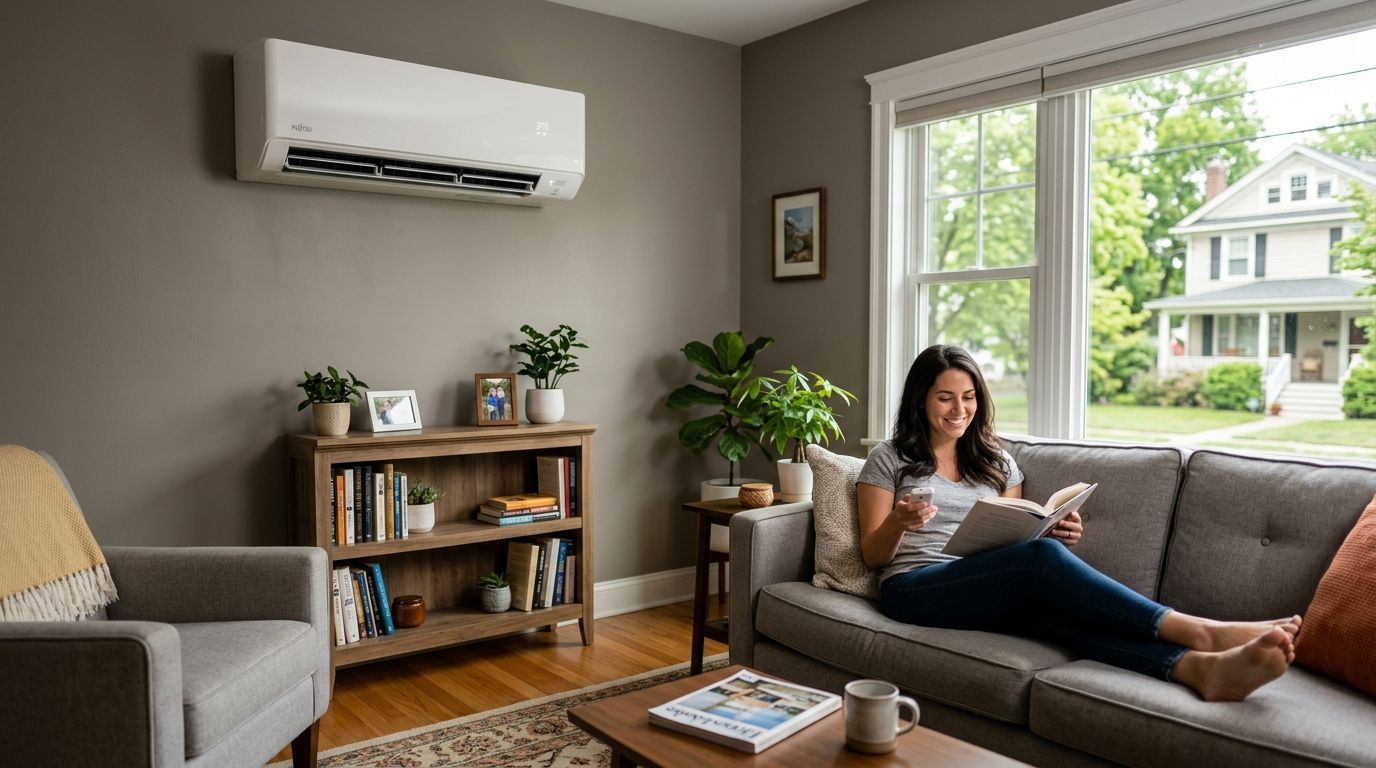
Mitsubishi Electric's Hyper-Heat lineup wins for whole-home heating in New Jersey winters, Daikin Aurora wins for quiet operation in room additions, Fujitsu Halcyon wins for multi-zone whole-house coverage, LG Multi F wins for budget-conscious buyers adding one or two rooms, and Gree Sapphire wins for garages and workshops that need basic heating and cooling without a premium price tag.
- Mitsubishi Electric Hyper-Heat is the best ductless mini split system for NJ homes that need reliable heat below 20°F.
- Fujitsu Halcyon supports up to eight indoor zones off one outdoor unit — the pick for whole-house retrofits.
- Daikin Aurora runs quietest of the five, a fit for additions next to bedrooms or home offices.
- None of these systems replace a failing electrical panel — mini splits on older 100-amp service often trip breakers under load.
Why this matters
Central New Jersey homes built before forced-air ductwork became standard — plenty of Cape Cods and older colonials in Union, Middlesex, and Monmouth counties — rely on ductless mini splits to cool a converted attic or heat a garage without ripping open walls for ductwork. The wrong system either can't hold temperature through a January cold snap or costs more to run than it should.
Mini split reliability in 2026 comes down to two things: how the compressor handles cold-climate demand, and whether your home's electrical panel can support the new circuit. A mini split installation for a home addition almost always needs a dedicated 208/240V circuit, and homes still running a 100-amp panel from the 1970s often need a load calculation before the installer pulls a permit. Homeowners looking to cut HVAC repair costs during a heat wave should factor mini split efficiency into that math too — a properly sized system runs less and stresses the panel less.
What makes the best ductless mini split system
- Cold-climate rating — systems rated to operate efficiently below 5°F matter for NJ winters, not just marketing copy about "heat pump technology."
- Zone flexibility — how many indoor heads one outdoor compressor supports, and whether zones can run independent temperatures.
- Sound level at the indoor head — matters most in bedrooms, nurseries, and home offices.
- Compressor and refrigerant type — inverter-driven compressors modulate output instead of cycling on/off, which cuts wear and power draw.
- Warranty coverage on parts and compressor — varies by manufacturer and whether the installer is a certified dealer.
- Electrical compatibility — voltage and breaker requirements the existing panel has to support without an upgrade.
Ductless mini splits at a glance
| System | Best For | Standout Feature | Key Limitation |
|---|---|---|---|
| Mitsubishi Electric Hyper-Heat | Whole-home heating in cold climates | Rated for continuous heating output at low outdoor temperatures | Higher upfront equipment cost than standard heat-pump mini splits |
| Daikin Aurora | Quiet operation in additions | Low decibel rating at the indoor head | Fewer multi-zone outdoor unit options than Fujitsu |
| Fujitsu Halcyon | Multi-zone whole-house retrofits | Supports up to 8 indoor zones off one outdoor condenser | Installation complexity rises fast past 4 zones |
| LG Multi F | Budget-conscious single or two-room additions | Lower equipment cost for single-zone setups | Cold-climate heating performance trails Mitsubishi and Daikin |
| Gree Sapphire | Garages and workshops | Straightforward single-zone install, lower parts cost | Not built for whole-home load or extreme cold reliability |
1. Mitsubishi Electric Hyper-Heat: best ductless mini split for whole-home winter heating
Mitsubishi Electric's Hyper-Heat compressor line is built to keep producing usable heat when the outdoor temperature drops into single digits, which is the exact scenario that kills cheaper heat-pump mini splits every January in Central Jersey. The inverter-driven compressor modulates speed instead of cycling fully on and off, which keeps indoor temperature swings small.
Mitsubishi Electric pros:
- Maintains heating capacity at low outdoor temperatures better than most standard heat-pump mini splits
- Inverter compressor reduces on/off cycling and power spikes
- Wide range of indoor head styles — wall-mounted, ceiling cassette, ducted
Mitsubishi Electric cons:
- Equipment cost runs higher than Daikin or LG for comparable capacity
- Requires a certified Diamond Contractor for full warranty coverage
Mitsubishi Electric pricing: Ask an installer for a quote based on zone count and existing panel capacity — no flat rate applies across single-zone versus multi-zone jobs.
Best for: homeowners who want the ductless system to carry real heating load through a NJ winter, not just supplement a furnace.
Verdict: Buy — for whole-home heating reliability, this is the system to install in 2026.
2. Daikin Aurora: best ductless mini split for quiet room additions
Daikin's Aurora line is engineered for cold-climate performance too, but its edge is indoor head noise level — a real factor when the unit sits on a bedroom or nursery wall six feet from a headboard. Daikin also builds its own compressors in-house, which keeps parts consistent across the line.
Daikin Aurora pros:
- Quietest indoor head operation among the five systems here
- Cold-climate rated compressor, comparable to Mitsubishi's Hyper-Heat approach
- In-house compressor manufacturing simplifies warranty claims
Daikin Aurora cons:
- Fewer multi-zone outdoor unit configurations than Fujitsu
- Certified installer network is smaller in parts of Central Jersey
Best for: a single-zone addition over a bedroom, home office, or nursery where noise matters as much as temperature.
Verdict: Buy — the right pick when quiet matters more than zone count.
3. Fujitsu Halcyon: best ductless mini split for multi-zone whole-house retrofits
Fujitsu Halcyon outdoor condensers support up to eight indoor zones on some models, which makes it the practical choice for a whole-house retrofit where a homeowner wants independent temperature control in four or five rooms without running new ductwork through finished walls.
Fujitsu Halcyon pros:
- Supports more indoor zones per outdoor unit than Mitsubishi or Daikin in comparable price tiers
- Independent zone control lets each room run its own setpoint
- Broad range of indoor head types for retrofits
Fujitsu Halcyon cons:
- Line-set and refrigerant routing gets complicated past four zones, which raises labor cost
- Cold-climate heating output trails Mitsubishi Hyper-Heat at extreme low temperatures
Best for: whole-house conversions where four or more rooms each need independent zone control.
Verdict: Buy — the multi-zone specialist, with the caveat that installation labor scales up with zone count.
4. LG Multi F: best ductless mini split for budget-conscious single additions
LG's Multi F line covers single-zone and small multi-zone setups at a lower equipment cost than Mitsubishi or Daikin. It's a reasonable fit for a converted attic, finished basement, or single bonus room where the homeowner isn't trying to heat the whole house through it.
LG Multi F pros:
- Lower equipment cost for single or two-zone installs
- Wi-Fi enabled controls on most current models
- Adequate cooling performance for NJ summer humidity
LG Multi F cons:
- Cold-climate heating performance falls behind Mitsubishi and Daikin in sustained sub-20°F conditions
- Fewer high-zone-count outdoor unit options
Best for: one or two additional rooms where cooling matters more than deep winter heating.
Verdict: Hold — solid for cooling-focused additions, not the pick if the room needs to hold heat through February.
5. Gree Sapphire: best ductless mini split for garages and workshops
Gree Sapphire is the straightforward, lower-cost option for a garage, detached workshop, or single unconditioned space that needs basic heating and cooling without whole-home ambitions. It's a single-zone system in most configurations, which keeps installation simple.
Gree Sapphire pros:
- Lower parts and equipment cost than the other four systems
- Simple single-zone installation, shorter labor time
- Adequate for supplemental heating and cooling in a detached space
Gree Sapphire cons:
- Not built for whole-home load or extended sub-freezing operation
- Smaller certified dealer and parts network than Mitsubishi, Daikin, or Fujitsu
Best for: a garage, workshop, or converted shed where the goal is comfort, not full climate control.
Verdict: Hold — fine for a secondary space, skip it for a primary living area.
How this list was ranked
Each system was scored against the six criteria above — cold-climate rating, zone flexibility, indoor noise, compressor type, warranty structure, and electrical compatibility — then matched to the use case where it performs best rather than forced into a single "winner takes all" ranking. That's why Mitsubishi and Fujitsu both rank near the top: they solve different problems.
“A mini split rated for cold-climate heating still needs a panel that can carry the load — the compressor doesn't fix an undersized breaker.”
Which ductless mini split should you choose?
If you're heating a whole floor through a NJ winter, go with Mitsubishi Electric Hyper-Heat. If noise is the deciding factor for a bedroom addition, Daikin Aurora is the better call. Whole-house retrofits with four-plus zones point to Fujitsu Halcyon, and single-room budget projects lean LG Multi F or Gree Sapphire depending on whether the space is a living area or a garage.
Before any of these systems get installed, confirm the existing electrical panel can carry a new 208/240V circuit — a common gap in homes still running original 100-amp service from the 1960s and 1970s. Pairing a mini split with a best heat pump systems for NJ winters comparison and a smart thermostat built for the New Jersey climate gets the most out of zone-by-zone control.
Get a mini split installation quote
Licensed NJ electrical and HVAC install, no subcontractors.
FAQ
What is the best ductless mini split system for NJ winters?
Mitsubishi Electric Hyper-Heat is the best choice for New Jersey winters in 2026 because its compressor maintains heating capacity at low outdoor temperatures better than standard heat-pump mini splits. Daikin Aurora is a close second on cold-climate performance with quieter indoor operation.
Is Fujitsu better than Mitsubishi for mini splits?
Fujitsu Halcyon supports more indoor zones per outdoor unit, making it better for whole-house retrofits with four or more rooms. Mitsubishi Electric wins on sustained cold-climate heating output for whole-home winter use.
Do ductless mini splits need a new electrical circuit?
Yes, most residential mini split systems require a dedicated 208/240V circuit sized to the outdoor unit's amperage draw. Homes on older 100-amp panels frequently need a load calculation before the circuit can be added.
Can a mini split heat a whole house in New Jersey?
A multi-zone system like Fujitsu Halcyon or Mitsubishi Electric can heat a whole house when zones are placed correctly, but it requires more indoor heads and a larger outdoor condenser than a single-room installation.
How many zones can one outdoor mini split unit support?
Fujitsu Halcyon outdoor units support up to eight indoor zones on some models, more than most Mitsubishi or Daikin multi-zone configurations. Zone count affects line-set routing complexity and installation labor.
Are ductless mini splits good for garages in NJ?
Yes, a single-zone system like Gree Sapphire handles basic heating and cooling for a garage or workshop at lower equipment cost than whole-home systems. It's not built for sustained sub-freezing operation the way Mitsubishi or Daikin cold-climate lines are.
Do mini splits work better than window AC units?
Ductless mini splits run quieter, provide both heating and cooling, and don't block a window, which is why they replace window units in NJ additions and converted attic spaces. They cost more upfront than a window unit but run on a dedicated circuit instead of a standard outlet.
What size mini split do I need for a 400 square foot addition?
Sizing depends on insulation, window count, and ceiling height, not square footage alone — an installer needs to run a load calculation for an accurate BTU recommendation. Oversizing a mini split causes short-cycling, which wears the compressor faster than proper sizing.
One last thing
The compressor rating on the spec sheet only tells half the story — the other half is whether the existing panel and circuit can deliver clean power to it. Homeowners who skip that check in 2026 end up with a mini split that trips breakers under heavy winter load, which looks like a bad compressor but is actually an undersized panel.


