
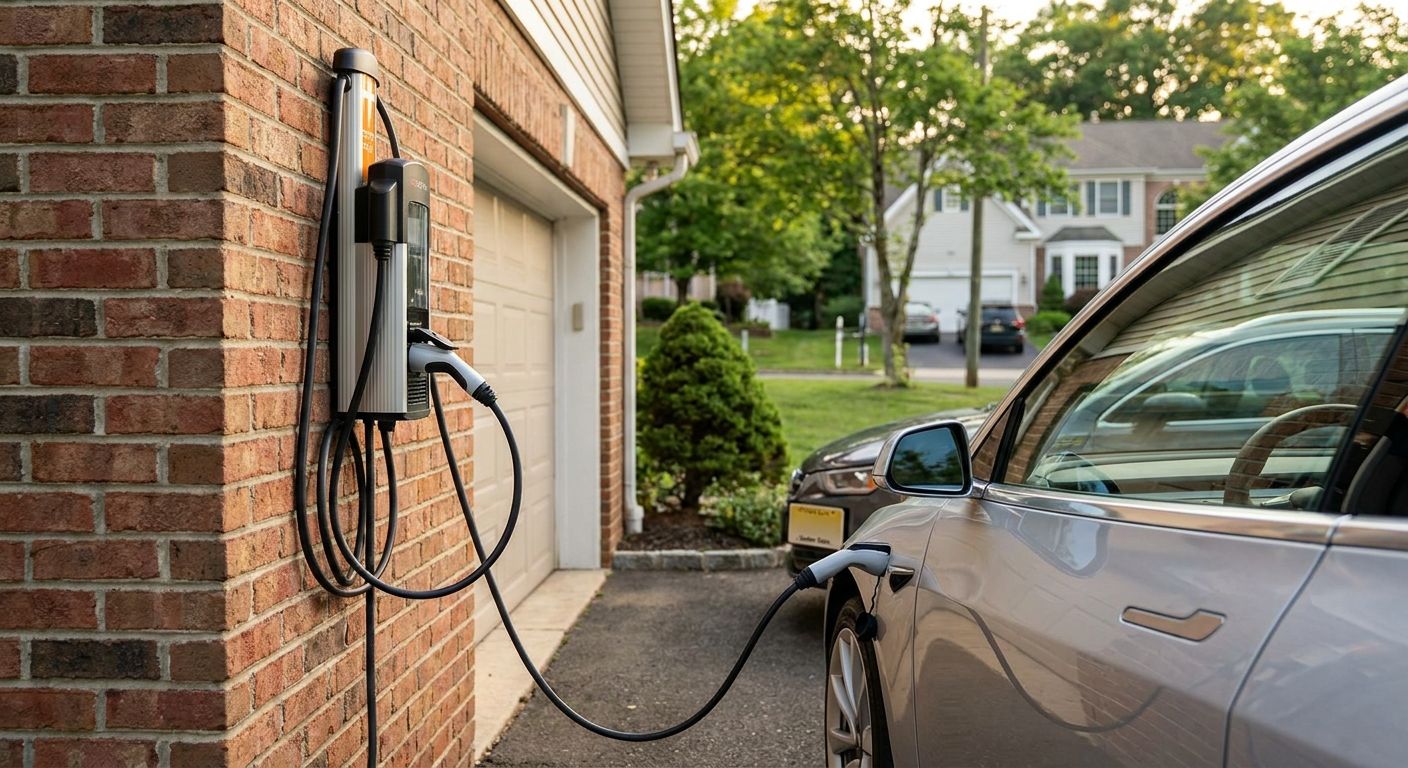
New Jersey homeowners shopping for a Level 2 home EV charger in 2026 have five solid products to choose from, and the right one depends on what car sits in the driveway, what your panel can handle, and whether the charger lives indoors or out. Best overall: ChargePoint Home Flex. Best for Tesla owners: Tesla Wall Connector. Best budget smart charger: Emporia EV Charger. Best for outdoor installs: Grizzl-E Classic. Best no-frills option: ClipperCreek HCS-40. This guide ranks all five and tells you which one fits a Central Jersey home.
- ChargePoint Home Flex is the best home EV charger NJ homeowners can buy for most panels — adjustable 16-50A output works with any EV.
- Tesla Wall Connector delivers up to 48A and is the pick for single-Tesla households.
- Emporia EV Charger gives app control and 48A output without a monthly subscription fee.
- Grizzl-E Classic is rated for unheated garages and outdoor mounting better than the others here.
- ClipperCreek HCS-40 skips WiFi entirely for owners who just want a charger that turns on and stays on.
Why this matters
New Jersey's Uniform Construction Code requires a permit and a licensed electrician for any Level 2 charger install — no shortcut, no matter which charger you buy. Plenty of Central Jersey homes built before 2000 still run 100-amp panels, and a charger pulling 40 to 48 amps can push that panel past what it can safely carry alongside a range, dryer, and central air. EV charger installation for NJ homeowners starts with a load calculation on the existing panel before anyone touches the charger itself.
The charger you pick in 2026 still matters beyond the panel question. Amperage, mounting hardware, cable length, and app features vary enough between these five products that the wrong pick means a slower charge, a charger that can't reach the car, or a unit that fails outdoors in a Jersey winter.
What makes the best home EV charger
- Output amperage — determines how many miles of range you add per hour of charging.
- Hardwired vs. plug-in (NEMA 14-50) — hardwired units skip a failure-prone outlet connection; plug-in units are easier to relocate.
- Smart features — WiFi scheduling, energy tracking, and load management matter if you're on time-of-use utility rates.
- Cable length — a charger mounted on the wrong wall can leave 6 feet of cable stretched across a garage floor.
- Weather rating — outdoor and unheated-garage installs need a NEMA 4 or better enclosure.
- Panel compatibility — some chargers adjust their draw to fit a 100-amp panel; others assume 200 amps is available.
Home EV chargers at a glance
| Charger | Best for | Standout feature | Key limitation |
|---|---|---|---|
| ChargePoint Home Flex | Most NJ homes, any panel size | Adjustable 16-50A output | App requires account setup |
| Tesla Wall Connector | Tesla owners | 48A output, compact wall mount | Non-Tesla EVs need an adapter |
| Emporia EV Charger | Budget-conscious smart-charger buyers | No monthly subscription fee | Shorter cable than competitors |
| Grizzl-E Classic | Outdoor or unheated garage installs | NEMA 4 weatherproof enclosure | No app or WiFi scheduling |
| ClipperCreek HCS-40 | Buyers who want zero smart features | No WiFi to set up or fail | No remote monitoring at all |
1. ChargePoint Home Flex: best home EV charger for most NJ panels
ChargePoint Home Flex ships with adjustable output between 16 and 50 amps, set during install to match whatever your panel can spare. It works with any EV sold in the US, not just one brand, and pairs with an app for scheduling and energy tracking.
ChargePoint Home Flex pros:
- Adjustable amperage fits both 100-amp and 200-amp panels
- Works with every EV on the road, not one manufacturer
- Hardwired or plug-in NEMA 14-50 install options
ChargePoint Home Flex cons:
- App account required for full scheduling features
- Cable length is average, not the longest on this list
Best for: homeowners who aren't sure their panel can support full 48-amp output, or households with more than one EV brand. Verdict: Buy.
2. Tesla Wall Connector: best home EV charger NJ Tesla owners can buy
Tesla Wall Connector delivers up to 48 amps and mounts flush to a wall with a compact footprint. It's built for Tesla vehicles first, though newer generations charge non-Tesla EVs with an adapter.
Tesla Wall Connector pros:
- 48A output charges a depleted Tesla battery overnight
- Compact mount, minimal garage wall space needed
- Reliable hardware with a long track record in the field
Tesla Wall Connector cons:
- Non-Tesla EVs need a separate adapter to charge
- No amperage adjustment — it runs at what the panel supports
Best for: single-Tesla households where flexibility for other EV brands isn't a factor. EV charger installation for Tesla owners in NJ covers the panel and wiring needs specific to this charger. Verdict: Buy.
3. Emporia EV Charger: best budget smart charger
Emporia EV Charger runs at up to 48 amps and connects to an app for scheduling and usage tracking, without a recurring subscription fee. The unit is smaller than most competitors, which helps in a tight garage corner.
Emporia EV Charger pros:
- No monthly fee for app features
- Compact housing fits tight installation spots
- 48A output matches pricier competitors
Emporia EV Charger cons:
- Cable length runs shorter than ChargePoint or Tesla units
- Smaller company means fewer years of field history than ClipperCreek or Tesla
Best for: homeowners who want app scheduling without paying a subscription. Verdict: Buy.
4. Grizzl-E Classic: best home EV charger for outdoor and unheated garage installs
Grizzl-E Classic is built with a NEMA 4 enclosure rated for outdoor mounting and unheated garages — a real consideration for a New Jersey winter. It skips WiFi and app features entirely in favor of a rugged, simple housing.
Grizzl-E Classic pros:
- Weatherproof enclosure handles outdoor mounting
- No app to set up, no account required
- Rugged housing tolerates temperature swings
Grizzl-E Classic cons:
- No remote scheduling or energy tracking
- Not the choice if you want smart-home integration
Best for: carports, driveways, and detached garages without climate control. Verdict: Buy if the charger lives outside; Skip if you want app control.
5. ClipperCreek HCS-40: best no-frills home EV charger
ClipperCreek HCS-40 is rated for 40 amps and built without WiFi, an app, or any smart feature to configure. It's the simplest unit on this list — plug it in electrically and it charges, nothing to update or troubleshoot.
ClipperCreek HCS-40 pros:
- No app or WiFi to set up or fail
- Long track record for reliability
- Simple install with fewer components to go wrong
ClipperCreek HCS-40 cons:
- No remote monitoring or scheduling
- 40A output is lower than the Tesla Wall Connector or Emporia
Best for: owners who don't want a phone app involved in charging their car. Verdict: Buy for simplicity; Wait if scheduling around time-of-use rates matters to you.
How this list was ranked
Each charger was measured against the six criteria above — output amperage, hardwired vs. plug-in flexibility, smart features, cable length, weather rating, and panel compatibility. No single charger wins on every criterion, which is why the list splits by use case instead of stacking all five as if they compete head-to-head. A charger that's right for an unheated detached garage in Somerset County isn't the right pick for a Tesla owner with an attached two-car garage in Middletown.
Get your panel checked before you buy
A load calculation tells you which charger your panel can actually support.
Condo and HOA-community installs add another layer — shared electrical infrastructure and HOA approval can rule out certain mounting options before amperage even enters the conversation. EV charger installation for condos and HOA communities walks through what's different about a shared-panel install versus a single-family home.
Which home EV charger should you choose?
For most Central New Jersey homeowners in 2026, ChargePoint Home Flex is still the default pick — it adjusts to whatever a 100-amp or 200-amp panel can spare, and it works no matter what EV brand you drive next. Tesla-only households get more value from the Tesla Wall Connector's compact mount and 48A output. Anyone mounting a charger outdoors should skip the smart-charger conversation entirely and go with the Grizzl-E Classic's weatherproof housing.
FAQ
What's the best home EV charger for NJ homeowners in 2026?
ChargePoint Home Flex is the best overall pick because its 16-50A adjustable output fits both 100-amp and 200-amp panels and works with any EV brand. Tesla-only households often prefer the Tesla Wall Connector instead.
Is the Tesla Wall Connector better than the ChargePoint Home Flex?
For a single-Tesla household, the Wall Connector's 48A output and compact mount are hard to beat. The ChargePoint Home Flex wins for mixed-EV households or panels that can't spare a full 48 amps.
How much amperage do I need for a home EV charger?
Most Level 2 chargers run between 16 and 50 amps, and the right number depends on your panel's spare capacity, not just the charger's maximum rating. A load calculation on the existing panel determines the safe number before installation.
Do I need a permit to install an EV charger in New Jersey?
Yes. New Jersey's Uniform Construction Code requires an electrical permit and a licensed electrician for Level 2 charger installations, regardless of which charger you buy.
Can a 100-amp panel handle a Level 2 EV charger?
Sometimes, depending on what else draws power from that panel. A load calculation is the only way to know for certain, and an adjustable charger like the ChargePoint Home Flex gives more room to work with than a fixed 48A unit.
Does a home EV charger need to be hardwired?
No — several chargers on this list, including the ChargePoint Home Flex, install as either hardwired or plug-in via a NEMA 14-50 outlet. Hardwired installs remove one potential failure point at the outlet connection.
What's the difference between a Level 1 and Level 2 home EV charger?
Level 1 uses a standard 120-volt outlet and charges slowly overnight; Level 2 chargers use 240 volts and the higher amperage covered in this guide, adding far more range per hour.
Can I install a home EV charger outdoors in New Jersey?
Yes, with a charger rated for outdoor exposure like the Grizzl-E Classic and its NEMA 4 enclosure. Chargers without a weatherproof rating shouldn't be mounted outside or in an unheated garage through a New Jersey winter.
One last thing
The cheapest fix for a slow charge isn't a faster charger — it's checking whether your panel is even delivering the amperage the charger is rated for. A ChargePoint Home Flex set to 48 amps on a panel that can only spare 32 amps charges no faster than a lower-rated unit, and a licensed electrician catches that mismatch before the charger goes on the wall, not after.


