
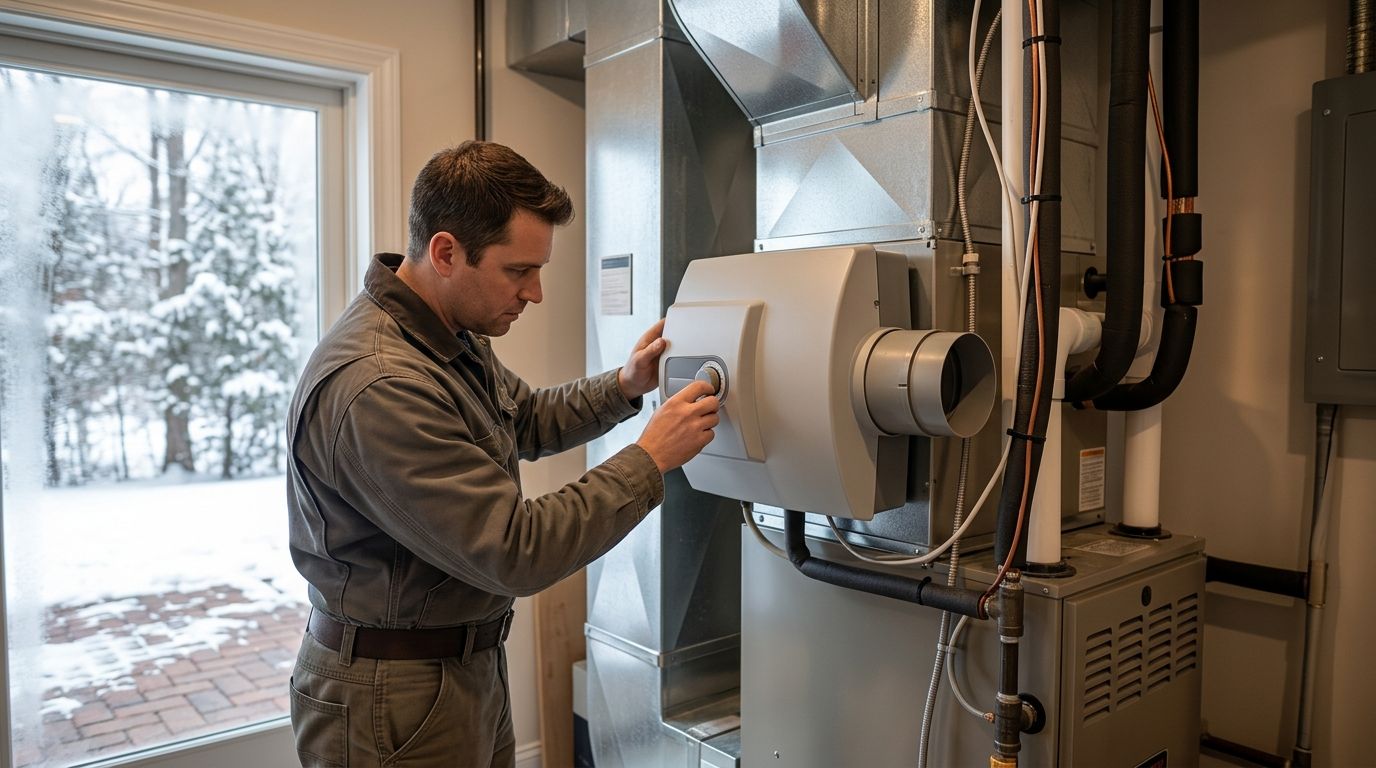
Best overall: a fan-powered evaporative humidifier for a compatible forced-air system. Best for higher moisture demand: a steam humidifier. Best budget option: a bypass evaporative humidifier. For a New Jersey home without compatible ductwork, choose a whole-house-capacity console humidifier instead. These are the best whole house humidifiers for winter in 2026 by system type—not an unverified ranking of specific models.
- Best whole house humidifiers for winter: fan-powered evaporative is the default for compatible forced-air homes in 2026.
- Choose bypass evaporative for a simpler ducted setup, steam for higher moisture demand, or console without compatible ducts.
- Keep indoor humidity within the EPA's ideal 30%–50% range and lower the setting if windows collect moisture.
- Spartan Home Pros handles HVAC repair in Central New Jersey; confirm humidifier installation scope before booking.
Why this matters in a New Jersey winter
Heating cold outdoor air can leave indoor air uncomfortably dry. A whole-house humidifier adds moisture, but the right type depends on your heating equipment and ductwork. Buying a duct-mounted unit before checking compatibility puts the equipment decision ahead of the house.
Too much moisture creates a different problem. The U.S. Environmental Protection Agency's mold guidance says to keep indoor relative humidity below 60%, ideally between 30% and 50%. Use a hygrometer to check the room rather than treating a humidistat setting as proof of the humidity throughout your home.
In 2026, start with the HVAC system, then pick the humidifier. If your heat is not delivered through compatible ducts, a duct-mounted recommendation is not your default. If you need an assessment of a heating or cooling problem in Central New Jersey, Spartan Home Pros is a licensed electrical and HVAC contractor serving Monmouth, Middlesex, Somerset, and Union counties. Confirm humidifier installation scope directly; HVAC repair is the service established here.
What makes the best whole house humidifier for winter?
- System compatibility: A duct-mounted unit needs a suitable forced-air setup. A console unit operates in the living space instead.
- Moisture demand: Match the humidifier to the home's measured dryness and how much moisture the equipment must add. A bigger unit is not automatically a better fit.
- Humidity control: You need a way to measure room humidity and reduce output when condensation appears.
- Water and upkeep: Ask how the unit gets water, where excess water goes, and what parts need routine cleaning or replacement.
- Installation fit: Duct access, available space, electrical connections, and manufacturer requirements affect which designs are practical.
- Seasonal use: The best choice is one you can maintain and control through winter, not just one that can produce the most moisture.
These criteria separate a useful 2026 shortlist from a list of models that may not work with your heating system. A humidifier should solve measured dryness without leaving wet windows or damp surfaces.
Whole-house humidifiers at a glance
| Rank and type | Best for | Standout feature | Key limitation |
|---|---|---|---|
| 1. Fan-powered evaporative | Compatible forced-air homes seeking a ducted default | Built-in fan moves air through a wet panel | Needs a compatible installation location and maintenance |
| 2. Bypass evaporative | Forced-air homes prioritizing a simpler ducted design | Uses airflow through a bypass connection | Requires a suitable duct arrangement |
| 3. Steam | Homes with higher moisture demand | Generates moisture independently of an evaporative panel | More installation requirements and upkeep to review |
| 4. Whole-house-capacity console | Homes without compatible forced-air ducts | Operates without a duct-mounted connection | Placement and water refilling remain household tasks |
The table ranks types, not individual products. No model specifications, tested output figures, or installed quotes were supplied for a product-level verdict. Check the actual equipment and home before choosing a unit in 2026.
1. Fan-powered evaporative: best whole-house humidifier for a compatible forced-air home
A fan-powered evaporative humidifier moves air through a wetted panel and introduces moisture through a compatible forced-air system. It is the 2026 default when you have suitable ductwork and want a ducted option without choosing steam generation first. The word compatible does the work here: the location and controls must suit the existing equipment.
Fan-powered evaporative pros:
- Built-in fan provides airflow through the humidifier rather than relying on a bypass connection.
- Ducted placement keeps the humidification equipment out of occupied rooms.
- A humidity control can be paired with room measurements to adjust winter operation.
Fan-powered evaporative cons:
- It still needs an appropriate duct location, water connection, and planned maintenance.
- Evaporative panels need attention; ignoring them weakens the case for this choice.
- It is not the default for a home without compatible forced-air ducts.
Best for: A homeowner whose forced-air equipment can accept a fan-powered unit and who will maintain the wet panel. Ask an HVAC professional to check the proposed location and controls before selecting a model. Verdict: Buy when system compatibility and upkeep are confirmed; otherwise, hold.
2. Bypass evaporative: best whole-house humidifier for a simpler ducted setup
A bypass evaporative humidifier directs air across a wetted panel through a bypass connection between duct sections. It is the budget-oriented pick in this comparison because it avoids the humidifier's dedicated fan and steam-generating components—not because a particular installed quote is established. Your duct layout determines whether that simpler design is a sensible option.
Bypass evaporative pros:
- Uses a straightforward evaporative approach.
- Keeps the humidifier connected to compatible forced-air ductwork rather than occupying floor space.
- Gives you a distinct alternative when a bypass connection fits the system.
Bypass evaporative cons:
- Requires a suitable duct arrangement; it is not a universal replacement for a fan-powered unit.
- The wet panel and water path still need upkeep.
- You should not select it solely from a product photo or a claim of whole-house coverage.
Best for: A forced-air home where an installer confirms the bypass path is appropriate and the owner wants the simpler ducted design. Verdict: Buy if that layout checks out; skip it if the required duct connection does not fit.
3. Steam: best whole-house humidifier for higher moisture demand
A steam humidifier heats water to generate moisture for distribution through a compatible system. Consider it when measured indoor dryness persists and an HVAC professional finds that an evaporative design does not fit the home's moisture demand. The ability to generate steam is a functional distinction, not permission to run the home at a higher humidity target.
Steam humidifier pros:
- Generates moisture without relying on air passing across an evaporative panel.
- Gives an installer another design to assess when evaporative options do not fit the requirement.
- Can be evaluated against a defined humidity-control plan rather than chosen by name alone.
Steam humidifier cons:
- Heating water adds electrical and installation considerations.
- Water quality, cleaning, and component maintenance need explicit review.
- Without measured humidity and condensation checks, added output can worsen a moisture problem.
Best for: A homeowner with a documented need for more moisture than a suitable evaporative setup can provide. Get the equipment requirements and control approach checked against the existing HVAC system. Verdict: Hold until the moisture demand and installation fit are established; buy only when both are clear.
4. Whole-house-capacity console: best option without compatible ducts
A console humidifier stands in a living space and releases moisture without a duct-mounted connection. That makes it the practical category to examine when a home lacks compatible forced-air ductwork. A whole-house-capacity label does not guarantee even humidity in every closed-off room; verify conditions where people actually spend time.
Whole-house-capacity console pros:
- Does not require a duct-mounted humidifier connection.
- Lets you place the equipment in an occupied area rather than modify ductwork.
- Room humidity can be checked directly with a hygrometer.
Whole-house-capacity console cons:
- You must account for placement, refilling, and cleaning.
- Moisture distribution depends on the home's layout and airflow.
- It does not solve a separate heating-system fault that is causing discomfort.
Best for: A home without suitable ductwork whose occupants can manage the unit and measure humidity in more than one room. Verdict: Buy for that use case; skip it if you expect a portable unit to regulate every room without checking results.
How to choose before you order
First, identify how your home is heated. A forced-air furnace, a ducted heat pump, and a home without compatible ducts do not present the same installation choices. If the system is not working correctly, address the heating problem separately; humidification does not repair it. Spartan Home Pros provides heating and cooling repair in Central New Jersey, but the available information does not establish that it installs humidifiers.
Second, measure humidity in the rooms that feel dry. Compare those readings with the EPA's ideal 30%–50% range, then check windows and other cold surfaces for condensation. A room that feels dry and a window that collects water can exist in the same home; the answer is not simply more output.
Third, ask how each candidate will be controlled and maintained. For a ducted unit, have the installer explain where it connects, how it gets water, and how the humidity control responds when conditions change. For a console, identify who will refill and clean it and where it can sit without wetting nearby surfaces.
Finally, review the proposed equipment against the manufacturer's installation instructions and your actual HVAC configuration. Do not choose from a coverage claim alone. Spartan Home Pros is an HVAC repair contractor, not a verified humidifier installer in the supplied service description; confirm the requested work before treating any contractor as an installation option.
How we ranked the 2026 choices
This ranking starts with compatibility, then considers humidity control, maintenance, and the work needed to keep the equipment operating. Fan-powered evaporative comes first as a default for a suitable forced-air home. Bypass takes the simpler ducted slot, steam takes the higher-demand slot, and console takes the no-compatible-ducts slot.
These are use-case rankings, not claims that a particular manufacturer outperforms another. Without named models, specifications, or comparable installation proposals, a brand-by-brand leaderboard would give you false precision. The useful decision is which type belongs in your home before you compare individual units.
Which whole-house humidifier should you choose?
Choose a fan-powered evaporative humidifier if you have a compatible forced-air system and want a ducted default in 2026. Choose bypass when the duct arrangement favors its simpler design. Choose steam only after confirming a higher moisture requirement and the installation details; choose a whole-house-capacity console when compatible ducts are absent.
Do not let the best-for label override a wet window or a humidity reading. In a Central New Jersey winter, the winning setup is the one that addresses dry indoor air while keeping moisture under control. If your discomfort coincides with a heating fault, Spartan Home Pros can assess the heating or cooling repair need within its stated service scope; confirm any separate humidifier work directly.
FAQ
What are the best whole house humidifiers for winter in 2026?
A fan-powered evaporative humidifier is the default for a compatible forced-air home. Bypass suits a compatible simpler ducted setup, steam deserves review for higher moisture demand, and a console suits a home without compatible ducts.
Is a steam humidifier better than an evaporative humidifier?
A steam humidifier is not automatically better. Choose it when measured moisture demand and installation requirements justify it; an evaporative type is the starting point for many compatible forced-air setups.
Can I use a whole-house humidifier without ducts?
A whole-house-capacity console humidifier is an option without compatible ducts. Check humidity in separate rooms because placement and airflow affect where the added moisture reaches.
What humidity should I aim for in winter?
The EPA's ideal indoor relative-humidity range is 30%–50%, and its mold guidance says to keep humidity below 60%. Use a hygrometer and reduce humidifier output if windows or other surfaces collect moisture.
What is the difference between bypass and fan-powered humidifiers?
A bypass humidifier uses a duct connection to move air across a wet panel, while a fan-powered unit has its own fan to move air through the panel. The suitable design depends on the existing ductwork and installation location.
Does a whole-house humidifier fix a heating problem?
No. A humidifier adds moisture; it does not repair a heating system that fails to heat the home properly. Address heating faults separately before selecting humidification equipment.
Does Spartan Home Pros install whole-house humidifiers?
Humidifier installation is not established in Spartan Home Pros' supplied service description. Spartan Home Pros is a licensed electrical and HVAC contractor offering heating and cooling repair in Central New Jersey; confirm humidifier installation scope directly.
One last thing
Check the coldest windows before turning the humidifier up. A hygrometer tells you the room reading; condensation shows where moisture is already becoming a problem. In 2026, that quick comparison is more useful than buying the highest-output type by default.


