
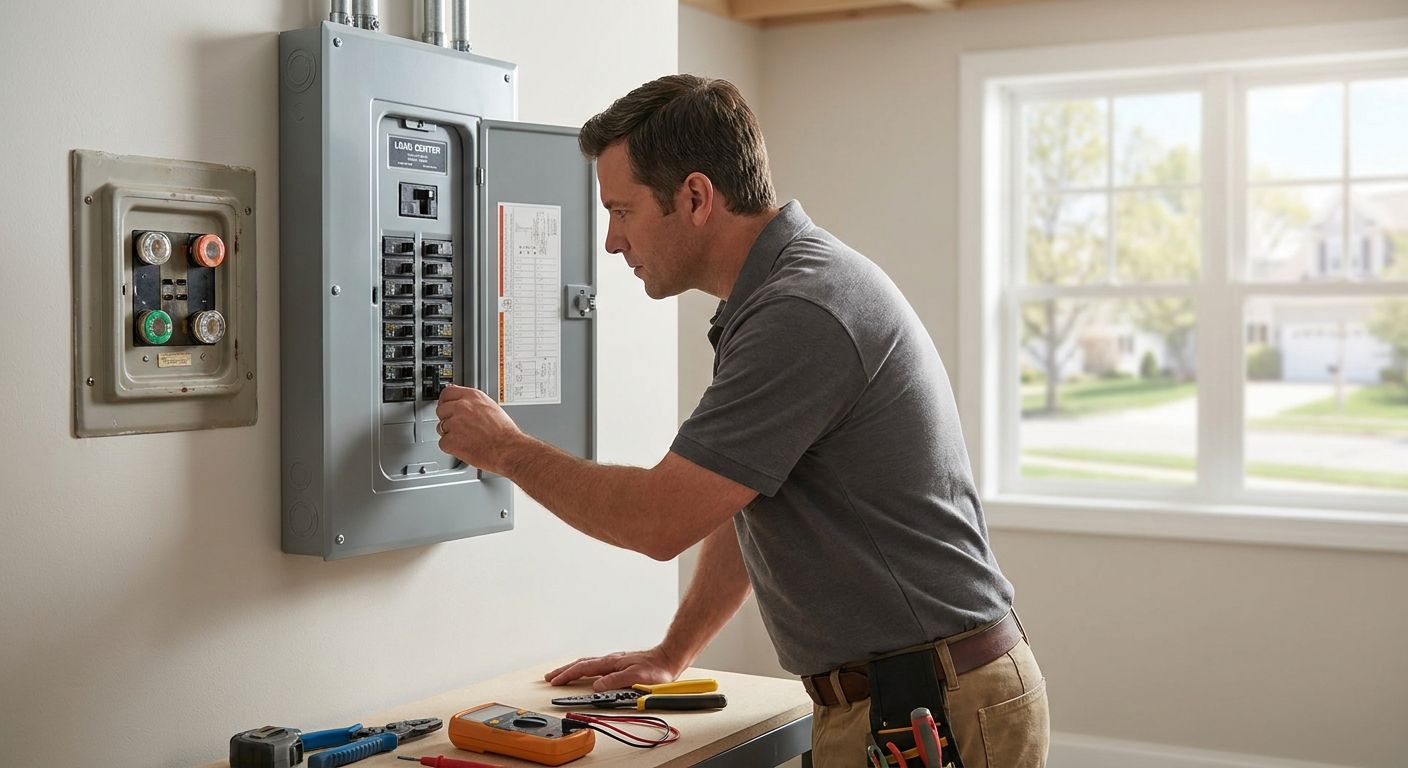
Freehold NJ homeowners upgrading an electrical panel are almost always solving one of two problems: an outdated 100-amp panel that can't run a new EV charger or generator, or a panel brand with a documented fire-risk history that needs to come out before an insurer flags it. A panel upgrade for Freehold NJ homeowners typically means swapping that old panel for a new 150-amp or 200-amp service, sized so the house can carry central air, an EV charger, and a standby generator at the same time without nuisance tripping.
Freehold's housing stock skews older than a lot of Central Jersey towns — split-levels and colonials built in the 1960s through the 1980s still carry original 100-amp panels, and a fair number of those are Federal Pacific Electric (FPE) or Zinsco brands with a well-documented breaker-failure history. Add Monmouth County's utility territory (JCP&L) and Freehold Township or Freehold Borough's separate permit desks, and the process has a few extra steps most homeowners in newer developments never deal with.
- A 100-amp panel from the 1970s can't safely run a Level 2 EV charger plus a whole-house generator in most Freehold homes.
- Federal Pacific Electric (FPE) and Zinsco panels have a documented fire-risk history and should be replaced, not repaired.
- An electrical panel upgrade in Freehold NJ runs roughly $2,000 to $7,000 depending on amperage and scope.
- Spartan Home Pros does not subcontract panel work and charges no hourly meter — a $229.99 minimum service call covers diagnosis.
- JCP&L coordination and a township permit add 1-2 extra steps in Freehold versus towns on other utilities.
Why panel upgrades matter for Freehold homeowners
A panel isn't just a box of breakers — it's the ceiling on what your house can run at once. Freehold homeowners adding a Level 2 EV charger or a Generac standby generator are the two groups most likely to discover their 100-amp panel is already maxed out before the new circuit gets added.
Insurance is the other driver. FPE and Zinsco panels are known for breakers that fail to trip during an overload, and some carriers in New Jersey now ask directly about panel brand during underwriting or renewal. Replacing the panel before that conversation happens is cheaper than a denied claim.
Freehold Township and Freehold Borough both require an electrical permit and inspection for a full panel swap — this isn't optional paperwork, it's what makes the upgrade insurable and resellable. Skipping it to save a week is the single most common mistake homeowners make on this project, and it's covered below.
Identify your current panel's amperage and brand
Start at the panel itself, not with a contractor's guess.
- Open the panel door and read the amperage rating printed on the main breaker at the top (usually 60, 100, 150, or 200 amps).
- Check the manufacturer label for Federal Pacific Electric, FPE, Zinsco, or Challenger — all three have known breaker-failure histories.
- Note whether the panel is full (no open breaker slots) — a full panel with no room for a new circuit is its own upgrade trigger.
- Look for scorch marks, a burning smell, or a breaker that's warm to the touch — any of these means stop and call a licensed electrician, don't wait for a scheduled upgrade.
- Photograph the label and interior so a contractor can quote without a second visit.
Confirm whether your panel is a fire-risk brand
This step is free and takes five minutes, and it changes everything downstream.
- Search the panel brand plus "recall" or "fire risk" — FPE Stab-Lok and Zinsco panels both have public documentation going back decades.
- Ask your homeowner's insurance carrier directly whether they flag or surcharge for FPE/Zinsco panels at renewal.
- If you're selling or refinancing in Freehold, ask your realtor or lender whether the panel brand will come up during inspection — it frequently does.
- Treat a confirmed FPE or Zinsco panel as a replace-now item, not a wait-and-see item, regardless of whether anything looks visibly wrong.
Size the new panel for what you actually plan to add
Don't upgrade to match the old amperage — upgrade to match your next five years.
- List every large load you plan to add: EV charger, standby generator, central air, hot tub, workshop tools.
- A single Level 2 EV charger alone often justifies moving from 100 amps to 150 amps in an older Freehold home.
- Add a whole-house generator to that same house and 200 amps is usually the right call, not 150.
- If you're only adding one EV charger and nothing else, a panel upgrade sized specifically for EV charger installation may cost less than a full 200-amp rebuild — ask for both quotes before you commit.
- Homeowners planning a whole-house generator should size the panel and the generator together in the same visit, not sequentially — sequential quoting almost always costs more in the end.
Pull the Freehold Township or Borough permit
A panel swap without a permit isn't a shortcut — it's a liability that surfaces at resale or claim time.
- Confirm whether your address falls under Freehold Township or Freehold Borough — the two have separate construction offices.
- A licensed electrician pulls the permit under their own license number, not yours — never accept a quote that skips this.
- Ask what inspection triggers the permit closes on (rough-in inspection, then final) so you know what to expect on-site.
- Keep the closed permit and inspection sign-off with your home records — it's what an insurer or buyer's attorney will ask for later.
Coordinate the utility shutoff with JCP&L
Freehold is served by JCP&L, and the utility — not your electrician — pulls the meter before the panel swap.
- Your contractor schedules the JCP&L meter pull directly; you shouldn't be the one calling the utility.
- Expect a service interruption window, typically measured in hours, not days, for a straightforward swap.
- Ask upfront whether the crew is coordinating the JCP&L appointment on the same day as the panel work — separate trips add delay.
- Confirm before the work starts that there's no subcontracting between the electrical crew and whoever handles the utility coordination — one crew, one point of accountability.
Schedule the swap and final inspection
The physical work is usually a single day; the inspection is what makes it official.
- Ask for a written scope: panel brand, amperage, breaker count, and whether the meter socket is being replaced too.
- Confirm pricing upfront — a flat project price, not an hourly meter that runs while the crew works.
- Spartan Home Pros quotes electrical panel upgrades in Freehold in the $2,000 to $7,000 range depending on amperage and scope, with a $229.99 minimum service call for diagnosis if you're not sure yet what you need.
- Schedule the final township inspection before you consider the project done — a swap without a closed inspection isn't a finished panel upgrade.
Get the panel labeled and documented
The paperwork after the swap is what protects you later.
- Request an updated breaker directory/label inside the panel door — required by code and useful the next time you're troubleshooting a tripped circuit.
- Keep copies of the permit, inspection sign-off, and final invoice together in one folder.
- Notify your homeowner's insurance carrier of the new panel brand and amperage — this can affect premiums, especially if the old panel was FPE or Zinsco.
Comparison of panel upgrade options for Freehold homes
| Option | Best for | Where it falls in the range | Key limitation |
|---|---|---|---|
| 100-amp to 150-amp upgrade | One EV charger, no generator | Lower end of the $2,000-$7,000 range | Won't leave headroom for a future generator |
| 100-amp to 200-amp upgrade | EV charger plus whole-house generator | Mid-to-upper end of the range | Higher upfront cost, longer permit-to-inspection timeline |
| Sub-panel addition (no main upgrade) | Adding one circuit to an already-adequate panel | Lower end of the range | Doesn't fix an FPE/Zinsco fire-risk panel |
| Meter and service upgrade combined with panel swap | Homes where the meter socket is also outdated | Upper end of the range | Requires JCP&L coordination on top of the panel permit |
Verdict: if you're adding an EV charger and a generator in the same project window, go straight to 200 amps — a 150-amp upgrade you'll outgrow in two years costs more in the long run than doing it once.
Get a panel upgrade quote for your Freehold home
Licensed NJ electricians, flat pricing, no subcontracting.
Common mistakes Freehold homeowners make
- Assuming 100 amps is "probably fine" for an EV charger plus central air — it's usually not, and finding out mid-installation delays the project.
- Skipping the township permit because the swap "just looks like a breaker box replacement" — inspectors and insurers both check for this at resale.
- Not checking for FPE or Zinsco branding before assuming a repair (not a replacement) will fix a tripping breaker.
- Calling the utility themselves instead of letting the electrical contractor coordinate the JCP&L meter pull, which creates scheduling gaps.
- Choosing the cheapest quote without asking about subcontracting — a panel swap involves permit liability, and you want the licensed electrician who pulled the permit to be the one doing the work.
FAQ
How much does an electrical panel upgrade cost in Freehold NJ?
An electrical panel upgrade in Freehold NJ typically costs $2,000 to $7,000 depending on whether you're moving to 150 amps or 200 amps and whether the meter socket needs replacement too. A diagnostic visit runs a $229.99 minimum service call if you're not sure yet what size you need.
Do I need a permit for a panel upgrade in Freehold Township?
Yes. Freehold Township and Freehold Borough both require an electrical permit and inspection for a panel swap, pulled under the electrician's license, not the homeowner's.
Is a Federal Pacific Electric panel dangerous?
FPE Stab-Lok panels have a documented history of breakers failing to trip during an overload, which is why many electricians and insurers recommend replacement rather than repair.
What size panel do I need for an EV charger and a generator?
Most Freehold homes adding both a Level 2 EV charger and a whole-house generator need to move to 200 amps; a single EV charger alone can sometimes be handled with a 150-amp upgrade.
Who is my electric utility in Freehold NJ?
Freehold is served by JCP&L, which coordinates the meter shutoff during a panel swap — your electrical contractor schedules this directly.
How long does a panel upgrade take?
The physical panel swap is usually done in a single day, with the utility service interruption measured in hours; the permit and final inspection add time on either end.
Will upgrading my panel affect my homeowner's insurance?
Replacing an FPE or Zinsco panel with a new one can lower your premium or resolve an underwriting flag, since some carriers surcharge or decline coverage for known fire-risk brands.
Does Spartan Home Pros subcontract panel upgrades in Freehold?
No. Spartan Home Pros performs panel upgrades with its own payroll technicians rather than subcontracting the work out.
One last thing
A panel brand check costs nothing and takes five minutes, but it's the step most Freehold homeowners skip before calling for quotes — if your panel says Federal Pacific Electric or Zinsco on the label, that's the real project, not the breaker that's been tripping. Everything else — the EV charger, the generator, the recessed lighting circuit — is downstream of getting that panel right in 2026, not the other way around.


