
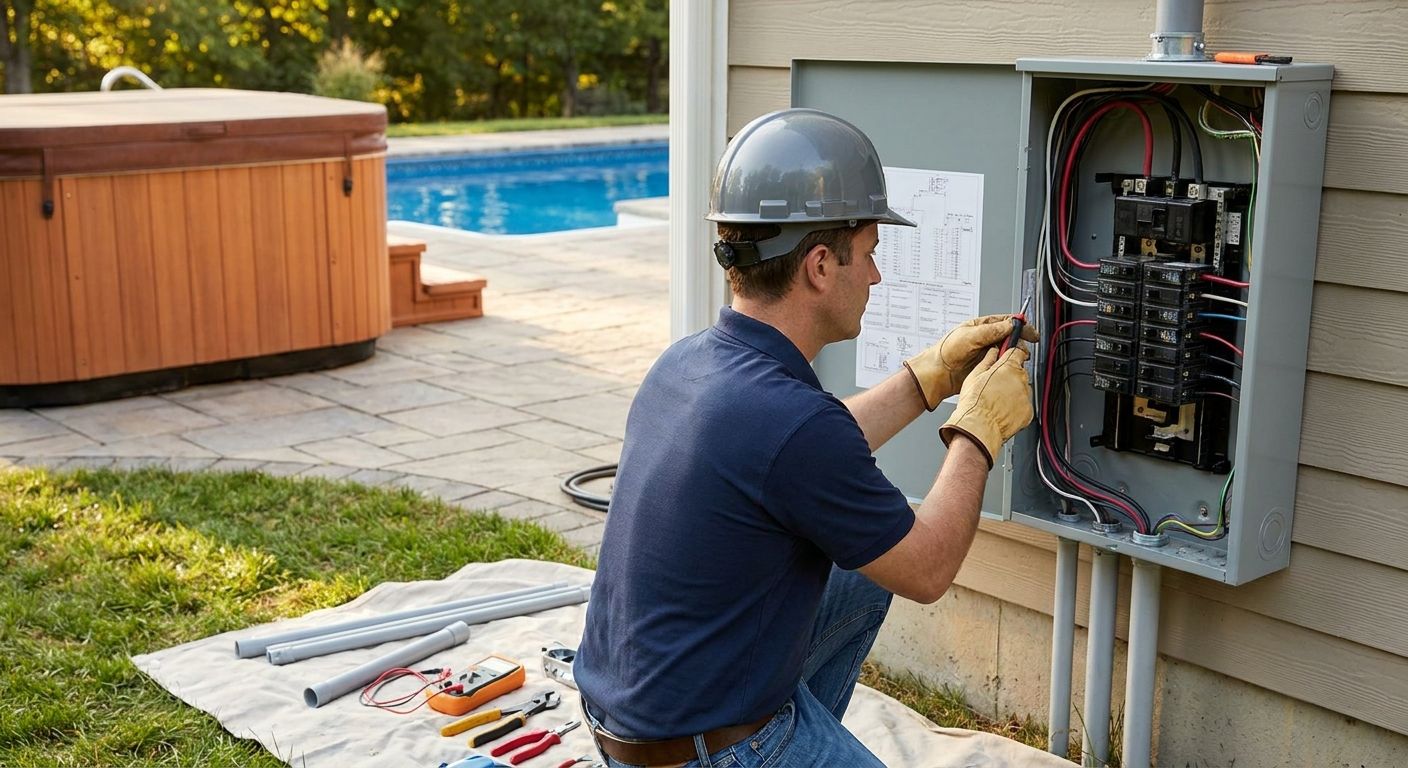
Homeowners adding a hot tub or in-ground pool in Central New Jersey almost always need a dedicated 50 or 60 amp GFCI-protected circuit, and roughly a third of Monmouth and Middlesex County homes on a 100-amp panel don't have room for it without an electrical panel upgrade for hot tub or pool equipment. This segment's needs differ from a typical panel job because the load isn't just added lighting or an outlet — it's a continuous, high-draw circuit with strict code requirements around bonding, disconnects, and water proximity.
- A hot tub needs a dedicated 50-60A GFCI circuit — most 100A panels can't add one without an electrical panel upgrade for hot tub installs.
- NEC 680 requires an emergency disconnect within sight of the tub, 5 to 50 feet from the water's edge.
- A 200A panel gives room for the tub, a pool pump, and future EV charger load without a second upgrade.
- Spartan Home Pros pulls permits and schedules inspection as part of the panel upgrade, not as an add-on.
Why panel capacity matters for hot tub and pool owners
A hot tub pulls more continuous amperage than almost anything else in a house — more than a range, more than a dryer, close to what a small EV charger draws. Pool pumps, heaters, and salt chlorination systems stack on top of that if you're adding a pool the same season.
Homeowners searching for electrical panel upgrade hot tub pricing are usually mid-quote from a pool or spa installer who just told them their existing panel is full. That's the real trigger: the spa dealer's electrician looks at the panel, counts open breaker slots, and sends the homeowner looking for a licensed electrician before the delivery date locks in.
How to size and upgrade your panel for a hot tub or pool
Check your current panel's amperage and open slots
Before anything gets quoted, look at what you're starting with. Panel labels list amperage on the main breaker; slot count is a quick visual count.
- Read the amperage stamped on the main breaker (60A, 100A, 150A, or 200A)
- Count open breaker slots — a hot tub circuit needs two adjacent slots for a double-pole 50-60A breaker
- Note the panel's manufacturer and age; panels older than 25-30 years often lack tandem breaker compatibility
- Check for existing high-draw circuits (range, dryer, central AC) that already crowd the panel
- Photograph the panel interior and the main label for your electrician's initial review
Calculate the hot tub or pool's electrical load
Spa and pool manufacturers publish the amperage and breaker size each unit requires — this isn't guesswork once you have the spec sheet.
- Pull the amp draw and required breaker size from the hot tub's nameplate or owner's manual
- Add the pool pump, heater, and any salt system amperage if installing a pool the same year
- Factor in future loads — EV charger, generator transfer switch — even if not installed yet
- A licensed electrician can run a full load calculation against your panel's existing draw in one visit, which is the fastest way to know if you need a subpanel or a full upgrade rather than guessing from breaker labels alone
Confirm code requirements before you buy the tub
NEC Article 680 governs pools, spas, and hot tubs, and NJ municipalities enforce it at inspection — skipping this step is the single most common reason installs get red-tagged.
- Confirm GFCI protection is required on the dedicated circuit (it always is for hot tubs and pool equipment)
- Locate the emergency disconnect between 5 and 50 feet from the water's edge, within sight of the equipment
- Verify equipotential bonding requirements for metal pool components and any surrounding concrete or pavers
- Check your township's permit requirements — Monmouth, Middlesex, Somerset, and Union counties each schedule inspections differently
- Ask whether your HOA or township has setback rules affecting where the disconnect and subpanel can sit
Decide between a subpanel and a full panel upgrade
A subpanel dedicated to the tub can work if your main panel has amperage headroom even without open slots. A full panel upgrade for EV charger installation in NJ-style job — bumping from 100A to 200A — makes more sense if you're stacking multiple new loads.
- Get a load calculation that separates "amperage available" from "physical slots open" — these are different problems with different fixes
- Ask for a subpanel quote and a full 200A panel quote side by side before deciding
- Weigh future plans: a pool heater, an EV charger, or a generator transfer switch all justify going straight to 200A
- Confirm your electrician pulls the permit and schedules the township inspection as part of the quoted price, not as a separate line item
Get permits pulled and inspection scheduled
NJ townships require a permit for any panel work and a separate electrical inspection before the tub or pool can be filled and energized.
- Confirm the contractor is licensed in NJ and carries the permit under their own license number, not a subcontractor's
- Ask for the estimated timeline from permit submission to inspection date in your specific township
- Schedule the panel work and the spa/pool delivery with enough buffer for inspection — a failed rough-in inspection can delay a hot tub delivery by weeks
Install the dedicated circuit and disconnect
This is the physical work: running conduit, setting the disconnect, landing the breaker, and bonding.
- Run the circuit in conduit rated for outdoor, wet-location use
- Mount the disconnect at code-compliant height and distance from the water
- Bond all metal components per the load calculation and inspector's checklist
- Label the breaker clearly at the panel for future service calls
Test and commission before the first fill
Don't fill the tub until the circuit's been tested — GFCI trips after water contact are common and usually mean a wiring issue, not a bad tub.
- Test GFCI trip function with the tub empty and equipment powered
- Verify the disconnect physically cuts all power to the tub circuit
- Confirm inspection sign-off before scheduling the water fill and startup with your spa dealer
Comparison: panel options for hot tub and pool installs
| Option | Best for | Key limitation |
|---|---|---|
| Subpanel addition | Homes with amperage headroom but no open slots | Doesn't solve future load stacking (EV charger, generator) |
| 100A to 200A panel upgrade | Homes adding a tub plus a pool, EV charger, or generator | Higher upfront cost than a subpanel alone |
| Portable generator backup | Homeowners who only need occasional backup for the tub circuit | Manual start, doesn't cover the full house during an outage |
| Whole-house generator with transfer switch | Homeowners who want the tub circuit and the rest of the house covered during outages | Requires its own load calculation and, often, its own panel work |
If backup power during a storm outage matters as much as the tub itself, a whole-house generator installation quoted alongside the panel work avoids a second electrician visit later.
Common mistakes hot tub and pool owners make
- Buying the tub before checking the panel. Spa dealers sell the unit first and mention the electrical requirement last, leaving homeowners scrambling for a licensed electrician on a tight delivery deadline.
- Assuming a subpanel is always cheaper. A subpanel that doesn't leave room for a pool pump or EV charger later means paying for two jobs instead of one 200A upgrade.
- Skipping the permit to save time. Unpermitted panel work shows up at resale inspections and can void manufacturer warranties on the tub itself.
- Filling the tub before GFCI testing. Water contact on an untested circuit is the single most common cause of a tripped breaker on install day.
- Ignoring disconnect placement rules. A disconnect mounted too close to the water or out of sight of the equipment fails inspection and delays the whole project.
Get your panel evaluated before you buy
Licensed NJ electricians, no subcontractors, permits pulled as part of the job.
FAQ
Do I need a panel upgrade for a hot tub?
You need a panel upgrade if your current panel doesn't have two open adjacent slots for a 50-60A double-pole breaker or lacks the amperage headroom for the tub's continuous draw. A load calculation from a licensed electrician confirms which applies to your panel.
What size breaker does a hot tub need?
Most hot tubs need a dedicated 50 or 60 amp GFCI-protected breaker, based on the amperage listed on the unit's nameplate. Always confirm against the specific model's manufacturer spec sheet, not a generic estimate.
Can I add a hot tub circuit to a 100-amp panel?
Sometimes, if a load calculation shows enough amperage headroom and two open breaker slots exist. If not, a subpanel or a full 200A panel upgrade is required before the circuit can be installed.
How far does a hot tub disconnect need to be from the water?
NEC 680 requires the emergency disconnect to sit between 5 and 50 feet from the water's edge, within sight of the equipment. NJ townships enforce this at inspection, so placement has to be planned before installation, not adjusted after.
Is a subpanel or full panel upgrade better for a pool and hot tub together?
A subpanel works if there's enough main amperage for both loads, but a full panel upgrade to 200A is better if you're also planning an EV charger or generator. Get quotes for both before deciding since the subpanel can end up being the more expensive path long-term.
Do I need a permit for a hot tub electrical circuit in NJ?
Yes, NJ townships require a permit for the dedicated circuit and panel work, plus an inspection before the tub can be filled and energized. Skipping the permit risks a failed resale inspection and can affect the tub's warranty.
Why did my hot tub trip the breaker the first time I filled it?
A GFCI trip on first fill usually means a wiring or bonding issue that wasn't caught before water contact, not a defective tub. The circuit should be tested with the tub empty before scheduling the water fill.
One last thing
The spa dealer's install timeline and the electrician's permit timeline rarely match up on the first try in 2026 — townships across Monmouth and Middlesex counties are scheduling electrical inspections further out than dealers quote for delivery, so get the panel evaluated the same week you sign the tub contract, not after it ships.


