
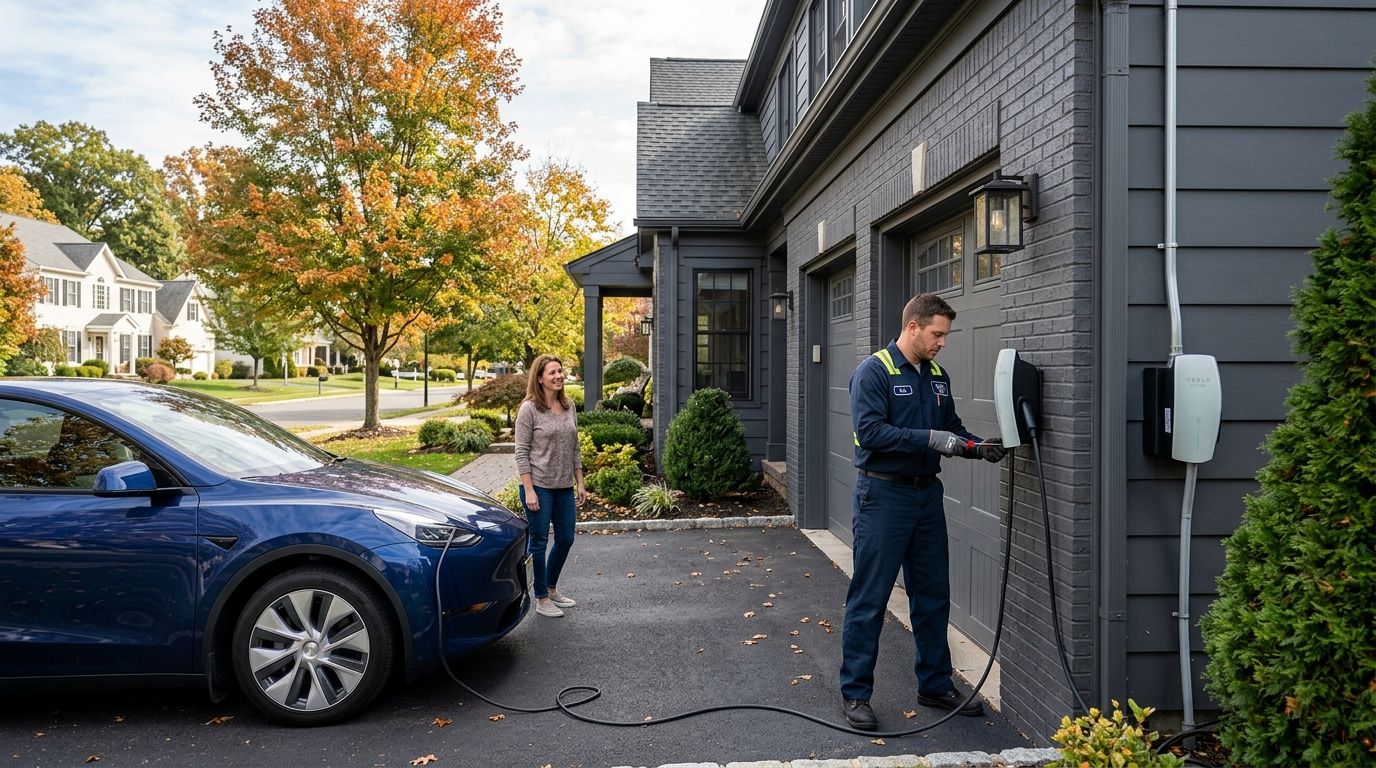
EV charger installation for Bridgewater NJ homeowners means adding a dedicated 240-volt circuit and a Level 2 charging station to your electrical system so you can charge overnight instead of hunting for a public plug. Bridgewater's housing stock skews older, and Somerset County's permit process moves through the township building department, which changes the sequence compared to new-construction towns nearby.
- A 100-amp panel common in older Bridgewater homes usually can't support a Level 2 charger without an upgrade.
- Bridgewater Township requires an electrical permit and inspection for any new 240-volt circuit tied to charger installation.
- Spartan Home Pros handles panel load calculations, permit filing, and EV charger installation bridgewater nj homeowners need without subcontracting the electrical work.
- NEMA 14-50 outlets cost less to install than hardwired chargers but limit you to portable Level 2 units.
Why EV charger installation matters for Bridgewater homeowners
Bridgewater sits in Somerset County, a service area where a large share of homes were built between the 1960s and 1980s with 100-amp panels that were never sized for a car charger plus central air, a range, and a dryer running at the same time. That combination is exactly why a straightforward Level 2 install can turn into a panel upgrade project once an electrician runs the numbers.
Township code enforcement in Somerset County also inspects new circuits before you can legally energize a charger, which is a step homeowners in unincorporated areas sometimes skip. Getting EV charger installation for Bridgewater NJ homeowners done right means starting with the panel, not the charger.
Confirm your panel has capacity for a charger
Before you buy anything, open the panel door and read the main breaker rating. A 100-amp panel with a handful of open slots is a different project than a 200-amp panel with room to spare.
- Check the main breaker amperage stamped on the panel door
- Count open breaker slots — a Level 2 charger typically needs a 40 to 60 amp double-pole breaker
- Note any existing high-draw circuits (central AC, electric range, dryer)
- Ask an electrician to run a load calculation rather than guessing
- Photograph the panel label and breaker layout before you call anyone
Homeowners can do the first two steps themselves in five minutes. The load calculation is the part that determines whether you need EV charger installation for NJ homeowners with a straight-in circuit or a panel upgrade first.
Choose the right charger level for your driving habits
Most homeowners jump straight to Level 2, but the right choice depends on daily mileage and how long the car sits in the driveway overnight.
- Level 1 (120V): no new circuit needed, adds roughly 3-5 miles of range per hour
- Level 2 (240V): needs a dedicated circuit, adds 20-40 miles of range per hour depending on amperage
- Plug-in Level 2 units let you unplug and take the charger if you move
- Hardwired Level 2 units draw higher amperage and skip the outlet failure point entirely
- Smart chargers with app scheduling can shift charging to off-peak utility hours
Check Bridgewater Township permit rules before wiring anything
Somerset County municipalities require a permit for any new 240-volt residential circuit, and Bridgewater is no exception.
- Call the Bridgewater Township building department to confirm current permit requirements
- Ask whether an inspection is required before or after the charger is energized
- Confirm setback and clearance rules if the charger mounts near a garage door
- Save the permit card — resale appraisals and home inspectors ask for it
A licensed electrical contractor pulls the permit as part of the job instead of leaving it to the homeowner. Spartan Home Pros files the Bridgewater permit, schedules the inspection, and does not subcontract the electrical work to a third party — the same crew that runs the load calculation installs the charger.
Pick a mounting location that meets code clearance
Where the charger goes affects wire run length, conduit cost, and whether it survives a New Jersey winter.
- Mount near the parking spot you actually use, not the shortest wire run
- Keep the unit within the charging cable's reach of the car's charge port
- Confirm minimum clearance from the ground and from doors per code
- Choose a NEMA 4 or better rated enclosure for outdoor mounting in NJ weather
- Avoid mounting directly above where road salt spray hits in winter
Decide between a NEMA outlet and a hardwired charger
This decision drives both the install method and the long-term reliability of the circuit.
| Option | Best for | Key limitation | Verdict |
|---|---|---|---|
| NEMA 14-50 outlet | Homeowners who may upgrade chargers later or plan to move | Outlet connections can loosen over years of high-amp cycling | Buy if flexibility matters |
| Hardwired Level 2 charger | Homeowners staying long-term who want max reliability | No outlet, harder to swap chargers later | Buy for a permanent install |
| Level 1 trickle charge, no new circuit | Low daily mileage, overnight parking only | Too slow for daily 40+ mile commutes | Hold unless mileage is low |
| Panel upgrade + Level 2 combo | Homes with a 100-amp panel and no spare capacity | Adds a second project and a second inspection | Buy if the panel is already maxed |
Schedule licensed installation and inspection
Once the panel, charger, and permit path are settled, the actual install day is short — usually a few hours for a straightforward run.
- Confirm the electrician is licensed in New Jersey, not just insured
- Ask whether the same company handles both the wiring and the permit inspection
- Get the final inspection scheduled before the crew leaves
- Test the charger with the actual vehicle before signing off on the job
Register the charger and check utility programs
After inspection, a few housekeeping steps close out the project.
- Register the charger model with the manufacturer for firmware updates
- Ask your utility whether time-of-use rates apply to EV charging in Somerset County
- Keep the permit and inspection paperwork with your home records
- Note the breaker location in case the panel needs future work
Get your Bridgewater panel checked
Load calculation and permit filing included with EV charger installation.
Common mistakes Bridgewater homeowners make
- Skipping the permit because a neighbor did the same install without one — Bridgewater inspectors do check during resale.
- Assuming the panel has room without a load calculation, then discovering the breaker trips every time the AC and charger run together.
- Mounting the charger too far from the parking spot, which adds unnecessary conduit runs and cost.
- Buying a charger before confirming amperage, then finding out the panel can only support a lower-amp circuit than the unit needs.
- Hiring an unlicensed installer for a 240-volt circuit tied directly into the main panel — this is not a DIY-friendly circuit in most Somerset County homes.
FAQ
How much does EV charger installation cost in Bridgewater NJ?
Cost depends on panel capacity, wire run length, and whether a panel upgrade is needed first — get a load calculation before pricing the job. Homes with a 100-amp panel typically need more work than homes already on 200 amps.
Do I need a permit for a home EV charger in Bridgewater NJ?
Yes, Bridgewater Township requires a permit and inspection for any new 240-volt circuit. Skipping the permit can cause problems at resale when an inspector asks for the paperwork.
Can my 100-amp panel handle a Level 2 EV charger?
Not always — a licensed electrician needs to run a load calculation accounting for your AC, range, and dryer before adding a 40-60 amp charger circuit. Many older Bridgewater homes need a panel upgrade first.
Is a NEMA 14-50 outlet better than a hardwired charger?
A NEMA outlet gives you flexibility to swap chargers or move the unit later, while a hardwired charger is more reliable for a permanent install. Choose based on how long you plan to stay in the home.
How long does EV charger installation take in Bridgewater NJ?
A straightforward install with an existing panel that has capacity usually takes a few hours plus the scheduled inspection. A panel upgrade adds a separate project and a second inspection.
Does Bridgewater NJ offer rebates for home EV chargers?
Check current utility and state programs directly, since rebate availability changes year to year. Ask your electrician whether time-of-use rates apply to charging in Somerset County.
Should I hire an electrician who subcontracts the work?
No — ask directly whether the company that quotes the job is the same crew doing the wiring and pulling the permit. A single accountable crew reduces scheduling gaps between wiring and inspection.
One last thing
The detail that trips up most Bridgewater homeowners isn't the charger — it's the panel underneath a 1970s kitchen remodel that already ate up the spare breaker slots. Check the panel label before you shop for a charger, not after.


