
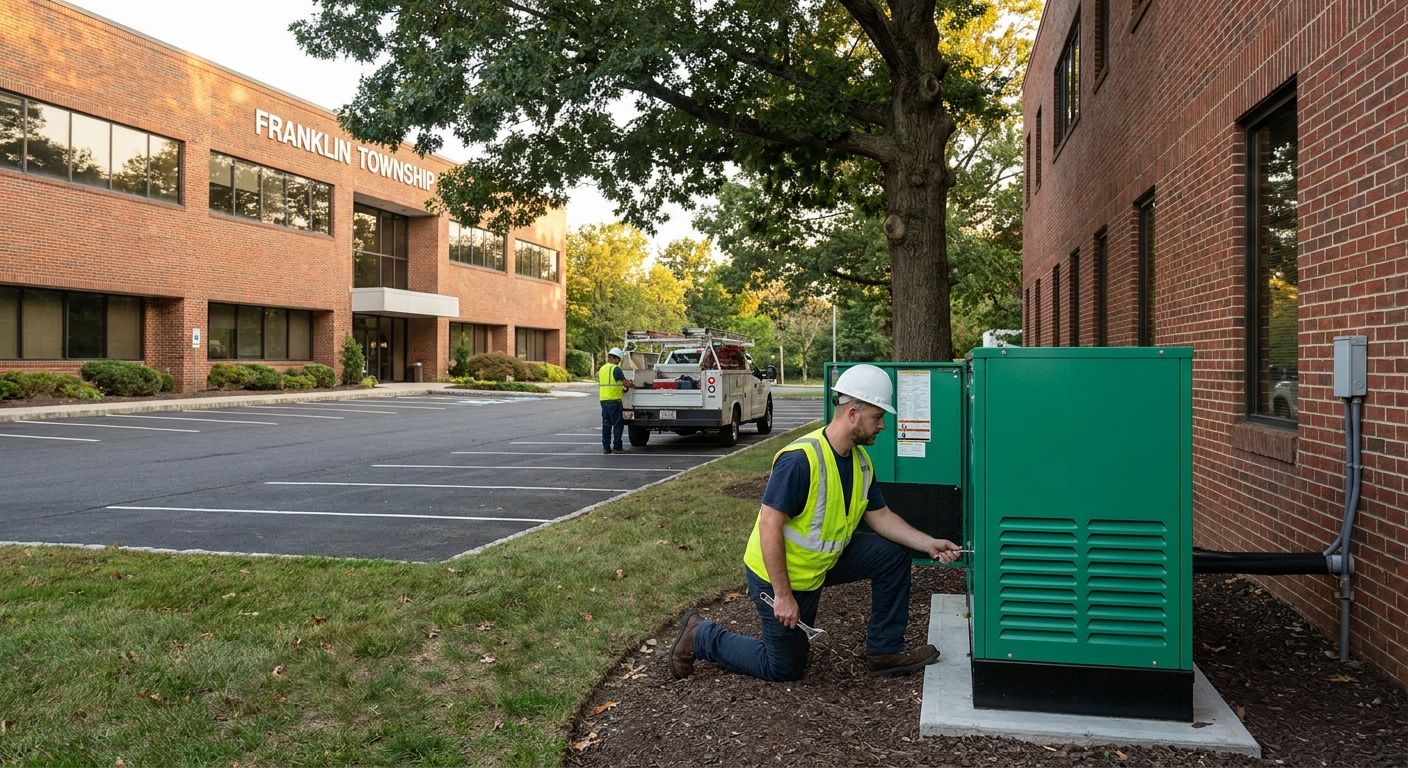
Generator installation for Franklin Township NJ businesses means sizing, permitting, and wiring a standby unit that keeps a storefront, medical suite, or warehouse running when PSE&G power drops during a storm or grid event. Commercial jobs differ from a homeowner install because you're dealing with three-phase or heavier single-phase loads, code review tied to your occupancy type, and an automatic transfer switch that has to isolate your circuits correctly under Franklin Township's electrical inspection process.
Spartan Home Pros handles licensed generator installation for businesses across Somerset County, and the process below is the same one used on commercial jobs in Franklin Township, Somerville, and neighboring Central New Jersey towns.
- Generator installation for Franklin Township NJ businesses starts with a load audit, not a generator brand pick.
- Standby units on a permitted automatic transfer switch beat portables for any business that can't afford downtime.
- Spartan Home Pros does not subcontract generator installs — the electrician who wires the transfer switch is a payroll technician.
- Franklin Township permitting adds 1-2 inspection steps most homeowner guides skip entirely.
Why generator installation matters for Franklin Township businesses
Franklin Township runs a mix of retail strips along Route 27, medical and dental offices, and light industrial and warehouse space near Route 287. A power outage that's a minor inconvenience for a household becomes a lost sale, a spoiled refrigerated inventory, or a shut clinic for a business.
Commercial occupancies also carry stricter code requirements than a single-family home. Franklin Township's electrical inspector will check your transfer switch wiring, panel labeling, and grounding against commercial code — not the simplified residential checklist. Skipping that review is the fastest way to fail final inspection and delay your certificate of occupancy or reopening.
Get a sense of the residential side of this process on the whole-house generator installation guide for Somerville NJ homeowners — the sizing logic is similar, but business loads run heavier and add HVAC and refrigeration circuits residential guides don't cover. Visit Spartan Home Pros directly if you want a load audit scheduled before you read further.
Audit your electrical load first
Don't pick a generator size before you know what you're actually running. This is the step most Franklin Township businesses skip, and it's the reason undersized units fail during the first real outage.
- Walk your panel and list every circuit: HVAC compressors, refrigeration, POS systems, security and fire alarm panels, server racks.
- Pull the nameplate amperage or wattage off HVAC and refrigeration units — these are your biggest draws and the ones that stall an undersized generator.
- Decide what "must run" during an outage versus what can go dark: a retail store may only need lighting, registers, and one HVAC zone.
- Check your utility bill for peak demand if you're on a commercial rate — it tells you your real maximum load.
- Note any single-phase versus three-phase equipment, since that changes generator selection entirely.
Decide between portable, standby, and subpanel setups
A portable generator with a manual transfer switch is the cheapest entry point, but it needs a person on-site to start it and refuel it every few hours. That's a real limitation for a business that closes overnight or runs unattended equipment like refrigeration or servers.
- Portable + manual transfer switch: lowest upfront cost, requires manual startup, fuel runs out without staff on-site.
- Standby generator + automatic transfer switch: starts within seconds of an outage with no staff present, sized to your full or partial building load.
- Subpanel-only setup: powers just the must-run circuits (refrigeration, security, one HVAC zone) off a smaller standby unit at lower installed cost than whole-building coverage.
For any business open on a schedule staff can't guarantee — medical offices, restaurants with walk-in coolers, 24-hour operations — a standby unit with an automatic transfer switch is the only option that doesn't depend on someone being there when the power drops.
Confirm your panel can handle the transfer switch
An automatic transfer switch ties directly into your main panel, and older commercial panels — especially ones still on fuses or under 200 amps — often can't accept it without an upgrade first.
- Check your panel's amperage rating against your total connected load plus the transfer switch requirement.
- Look for available breaker slots; a full panel needs a subpanel or a swap before a transfer switch goes in.
- Confirm your panel is grounded and bonded to current code — Franklin Township inspectors flag this on commercial jobs regularly.
- If your business is also planning EV charger installs for a fleet, size the panel upgrade for both loads at once rather than doing it twice — see the panel upgrade guide for EV charger installation in NJ for how that sizing works.
Spartan Home Pros evaluates panel capacity as part of every commercial generator installation quote, before recommending a generator model.
Get the Franklin Township permit and code review
Commercial generator installs in Franklin Township require an electrical permit and, depending on fuel type and generator location, a fire subcode review. Skipping this step is the single most common reason installs get red-tagged.
- File the electrical permit before installation begins — Franklin Township requires this for any new transfer switch install.
- Confirm setback distances if you're installing a fuel-fired unit near a building, property line, or window — these vary by generator size and fuel type.
- Schedule the rough-in inspection before the unit is buried in siding or landscaping.
- Keep documentation of the transfer switch wiring diagram on hand for the final inspection.
- Confirm your fire alarm and life-safety systems are on the correct emergency circuit if your business occupancy requires it.
Pick a generator size and fuel type
Once you know your must-run load and your panel capacity, sizing the generator itself is straightforward math, not guesswork.
- Add up the running wattage of every must-run circuit, then add the starting wattage spike of your largest motor (usually HVAC or refrigeration compressor).
- Round up to the next standard generator size rather than sizing to the exact number — real-world loads run above nameplate.
- Choose natural gas if your building already has a gas line; it removes refueling entirely and is the standard choice for standby commercial units.
- Choose propane if gas service isn't available on-site; it requires a tank but avoids fuel delivery gaps during regional emergencies.
- Confirm your fuel supplier can deliver the flow rate your generator size demands — undersized gas lines choke larger units.
Schedule installation and transfer switch wiring
Installation day is where load calculations and permits turn into a working system. This is the step where hiring matters most, because a poorly wired transfer switch is a life-safety and code-compliance risk, not just an inconvenience.
- Confirm the crew installing the transfer switch is the same licensed electrical crew, not a subcontractor unfamiliar with your panel.
- Verify the generator pad or mounting meets local setback and drainage requirements before the unit is set.
- Test the automatic transfer switch's transfer time — most commercial units should switch over within 10-20 seconds of an outage.
- Confirm the final inspection is scheduled with Franklin Township before the unit goes into regular service.
Get a commercial generator quote
Licensed electricians, no subcontracting, load audit included.
Set up a maintenance plan
A standby generator that's never run since installation day is a liability, not a backup system. Most failures during real outages trace back to skipped maintenance, not equipment defects.
- Schedule an annual oil and filter service, matching the manufacturer's interval.
- Run the generator's self-test cycle weekly (most standby units do this automatically) and confirm it's actually completing.
- Inspect the battery that starts the unit at least twice a year — dead start batteries are the top cause of failed transfers.
- Keep a service log for insurance and code compliance purposes on commercial properties.
Comparison of generator options for Franklin Township businesses
| Option | Best for | Key limitation |
|---|---|---|
| Portable + manual transfer switch | Small retail with staff always on-site during outages | Requires manual startup and refueling; no coverage when unattended |
| Standby generator, full building | Medical offices, restaurants, any 24-hour or unattended operation | Higher installed cost than a subpanel-only setup |
| Standby generator, subpanel/essentials only | Businesses that only need refrigeration, security, and one HVAC zone covered | Doesn't cover full building operations during extended outages |
Common mistakes Franklin Township businesses make
- Sizing off nameplate wattage alone — starting wattage spikes from HVAC and refrigeration compressors get skipped, and the generator stalls the first time both kick on together.
- Skipping the permit because "it's just a generator swap" — Franklin Township requires a permit and inspection for the transfer switch regardless of whether the generator itself is new or replaced.
- Choosing a portable unit for an unattended business — a restaurant or clinic that closes overnight needs automatic transfer, not a generator someone has to start.
- Ignoring panel capacity until the transfer switch won't fit — this turns a generator install into an unplanned panel upgrade mid-project.
- No maintenance plan after install — a generator that fails its first real test during a storm usually failed because nobody ran the self-test cycle in months.
If your business also runs a delivery or service fleet, coordinating generator and EV charging installs together avoids a second panel upgrade later — see the EV charger installation guide for NJ business fleets for how that combined sizing works.
FAQ
How much does commercial generator installation cost in Franklin Township NJ?
Cost depends on generator size, fuel type, and whether your panel needs an upgrade before the transfer switch goes in — get a load audit and site quote rather than pricing off a single number, since commercial loads vary widely by occupancy type.
Do I need a permit for a business generator install in Franklin Township?
Yes. Franklin Township requires an electrical permit for any new transfer switch installation, plus a fire subcode review depending on the fuel type and where the unit sits relative to the building.
What size generator does a small business need?
Size is based on the total running wattage of your must-run circuits plus the largest motor's starting wattage spike, not the square footage of your building. A load audit before purchase prevents undersizing.
Is a standby generator better than a portable one for a business?
For any business that isn't staffed 24/7, yes — a standby unit with an automatic transfer switch starts within seconds of an outage without anyone present, while a portable unit needs manual startup and refueling.
Can my existing electrical panel handle a generator transfer switch?
Older panels under 200 amps or without available breaker slots often need an upgrade before a transfer switch can be added — a panel evaluation should happen before generator selection, not after.
How long does commercial generator installation take?
Timeline depends on permit approval, panel readiness, and inspection scheduling with Franklin Township, in addition to the physical installation itself.
Does Spartan Home Pros subcontract generator installation work?
No. Spartan Home Pros uses payroll electricians for generator and transfer switch installation, not subcontracted crews.
What fuel type is best for a commercial standby generator?
Natural gas is standard when a gas line is already on-site since it removes refueling entirely; propane is the fallback when gas service isn't available.
One last thing
The detail that trips up most Franklin Township businesses isn't the generator itself — it's the transfer switch inspection. A generator that runs fine on a test start can still fail final inspection if the transfer switch wiring doesn't isolate your circuits from the utility feed correctly, and that's a code violation, not a cosmetic issue. Get the electrical contractor doing the wiring involved before you buy the unit, not after.


