
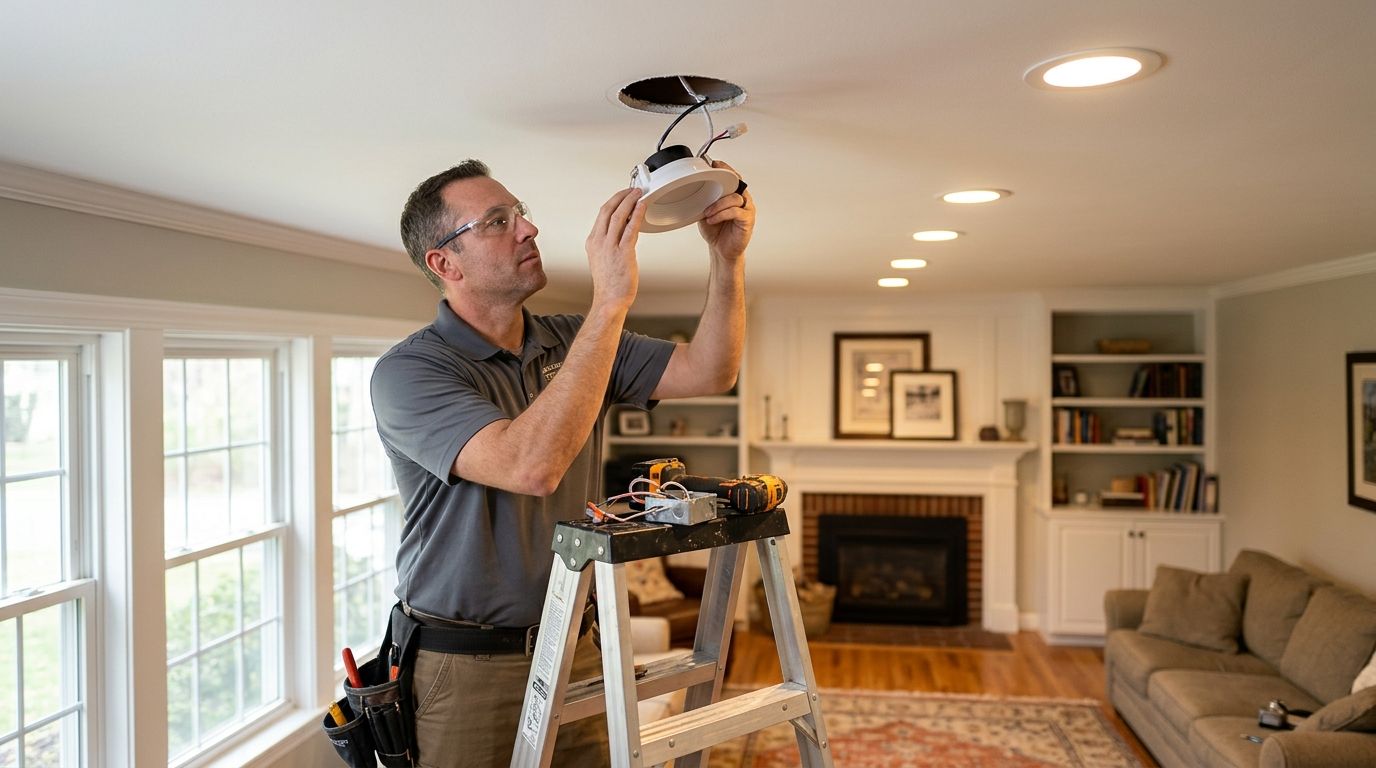
Recessed lighting installation for Bound Brook NJ homeowners means swapping dated ceiling fixtures for flush LED cans wired into your home's existing circuits — and doing it in a way that respects the borough's older housing stock and its flood history along the Raritan River. Bound Brook homes built in the 1940s and 1950s often carry 60-amp or 100-amp panels that were never sized for a dozen new light fixtures, and basements below flood elevation need extra circuit protection before any wiring goes in.
- Recessed lighting installation in Bound Brook NJ works on standard 15-amp or 20-amp circuits for most single-room jobs.
- Homes built before 1960 in Bound Brook often carry 60-100 amp panels that limit how many cans you can add safely.
- Basements near the Raritan River flood zone need GFCI-protected circuits before recessed cans go in.
- LED retrofit cans cut lighting energy use roughly 65% versus the incandescent fixtures common in older Bound Brook colonials.
- Spartan Home Pros does not subcontract recessed lighting work — one licensed crew handles wiring, cans, and trim.
Why recessed lighting installation matters for Bound Brook homeowners
Bound Brook sits along the Raritan River in Somerset County, and much of its housing stock predates 1960. That combination creates two problems recessed lighting installation has to solve at once: aging electrical infrastructure and, in low-lying sections of the borough, wiring that has to survive flood exposure in basements and first-floor spaces.
A lot of Bound Brook homes still run on 60-amp or 100-amp service panels installed decades before central air, electric ranges, and a dozen recessed cans became standard. Adding six to eight new fixtures to a circuit that's already carrying a refrigerator and window units can trip breakers or, worse, overheat old wiring behind plaster walls. That's why a proper recessed lighting installation in Bound Brook NJ starts with the panel, not the ceiling.
Step 1: Check your panel's amperage before adding cans
Before anyone drills a hole in your ceiling, the circuit needs to be verified.
- Confirm your panel is 100 amps or higher for a whole-room recessed lighting project
- Count existing loads already on the circuit you plan to tap
- Test for double-tapped breakers, common in Bound Brook homes rewired piecemeal over the decades
- Flag aluminum branch wiring if your home dates to the late 1960s or early 1970s
- Get a licensed load calculation instead of guessing at breaker capacity
Homes running on undersized service often need work covered separately — see electrical panel upgrade options for nearby Hillsborough NJ homeowners for what a panel swap involves before you commit to a lighting layout.
Step 2: Map your ceiling joists and framing
Older Bound Brook homes rarely have the joist spacing modern layout templates assume.
- Locate joists with a stud finder rated for ceiling work, not just walls
- Note any balloon framing common in pre-1950s construction
- Mark obstructions — ductwork, plumbing stacks, knob-and-tube remnants
- Photograph the attic side before insulation goes back over anything
Step 3: Choose IC-rated cans for insulated attics
Any can light touching insulation must be IC-rated (insulation contact rated) or it becomes a fire hazard.
- IC-rated cans allow blown or batt insulation to sit directly against the housing
- Non-IC cans require a 3-inch clearance, which most retrofit attics don't have
- Airtight IC-rated cans also cut attic air leakage, a real issue in drafty older Bound Brook attics
- Confirm rating on the box — it's often the difference between a passed and failed inspection
Step 4: Plan can spacing and room layout
Spacing is where most DIY recessed lighting jobs go wrong.
- General rule: divide ceiling height by two for spacing in feet (an 8-foot ceiling spaces cans about 4 feet apart)
- Pull cans back 18-24 inches from walls to avoid harsh shadowing
- Add extra fixtures over kitchen counters, reading chairs, or vanities as task lighting
- Use a full layout plan before drilling — a detailed recessed lighting layout guide walks through spacing math room by room
Step 5: Add dimmers and smart controls
Once the cans are in, control options separate a good install from a great one.
- Dimmer switches rated for LED loads (not old incandescent dimmers, which flicker on LED)
- Smart switches for scheduling and remote control
- Separate zones for kitchen task lighting versus living room ambient lighting
- Three-way switching for rooms with two entry points
Step 6: Protect basement and flood-zone circuits with GFCI
Bound Brook's flood history along the Raritan makes this step non-negotiable for basement or ground-floor work.
- GFCI protection on any circuit within 6 feet of a floor drain or sump area
- Weatherproof, in-use covers on any exposed junction boxes in basements
- Circuit routing above known flood elevation lines where the layout allows it
- A licensed inspection of prior flood-damaged wiring before energizing new circuits
Step 7: Schedule the electrical inspection and permit
Bound Brook requires a permit and inspection for new lighting circuits tied into a panel.
- Pull the permit before work starts, not after
- Schedule rough-in inspection before drywall or ceiling patching closes up the wiring
- Keep the final inspection certificate — it matters at resale
- A licensed electrician handles this paperwork as part of the job, not as an add-on
Comparison: recessed lighting options for Bound Brook homes
| Option | Best for | Key limitation |
|---|---|---|
| Standard baffle trim LED can | Living rooms, bedrooms needing even ambient light | Fixed beam angle, no adjustability |
| Retrofit LED can (existing housing) | Older homes replacing incandescent cans without ceiling demo | Only works if existing housing is sound and correctly rated |
| Gimbal/adjustable trim | Kitchens, art walls, task lighting | Costs more per fixture than fixed trim |
| Smart WiFi recessed light | Tech-forward households wanting app or voice control | Requires stable home WiFi and a compatible hub for full features |
For a broader look at fixture types and trim styles that hold up in New Jersey's humidity swings, the best recessed lighting fixtures for NJ homes guide breaks down what lasts and what doesn't.
Get your Bound Brook lighting quote
Licensed electricians, no subcontractors, upfront pricing.
Common mistakes Bound Brook homeowners make
- Skipping the panel check. Adding eight new cans to a 60-amp panel already running a window AC unit is how breakers start tripping nightly.
- Using non-IC cans in an insulated attic. It's a fire code violation and an easy one to miss without an inspection.
- Ignoring flood-zone wiring rules in basements. Ground-floor and basement circuits near the Raritan need GFCI protection that homeowners three towns over don't have to think about.
- Pulling no permit. Bound Brook inspects new lighting circuits, and unpermitted work becomes a real problem at resale disclosure.
- Spacing cans by eye instead of by ceiling height. Uneven spacing in older homes with irregular joist bays creates dark corners that no amount of extra fixtures fixes later.
FAQ
How much does recessed lighting installation cost in Bound Brook NJ?
Cost depends on the number of fixtures, ceiling access, and whether panel work is needed alongside the lighting. Get a fixed quote before work starts rather than an hourly estimate.
Do I need a permit for recessed lighting in Bound Brook?
Yes. New lighting circuits tied into your panel require a permit and inspection in Bound Brook. A licensed electrician pulls this as part of the job.
Can my old panel handle new recessed lighting?
Many Bound Brook homes built before 1960 run 60-amp or 100-amp panels that may need a load calculation before adding six or more new fixtures. A panel upgrade is sometimes required first.
Is recessed lighting installation different for basements near the Raritan River?
Yes. Basements in flood-prone sections of Bound Brook need GFCI-protected circuits and weatherproof junction boxes, which standard upper-floor installs don't require.
How many recessed lights do I need for a living room?
A common rule spaces cans at roughly half the ceiling height in feet — an 8-foot ceiling spaces fixtures about 4 feet apart, which usually lands at 6 to 8 cans for an average living room.
Are LED recessed lights worth it over old incandescent cans?
LED retrofit cans use roughly 65% less energy than the incandescent fixtures still common in older Bound Brook homes, and they run cooler against attic insulation.
Can I install recessed lighting myself?
Cutting the ceiling and mounting the can is straightforward; running new circuit wiring safely to code, especially on an older panel, is where DIY jobs in Bound Brook fail inspection.
Does Spartan Home Pros handle both the panel and the lighting?
Yes, one licensed crew handles panel evaluation, wiring, and fixture installation on the same job rather than splitting the work between subcontractors.
One last thing
The detail Bound Brook homeowners miss most often: a recessed lighting job that looks identical to one in a newer Bridgewater or Hillsborough subdivision can require an entirely different circuit plan once you factor in a 1948 panel and a basement six inches below the borough's flood elevation line. The wiring plan matters more than the fixture choice in older housing stock like Bound Brook's — get the panel and circuit routing checked before picking trim styles.


