
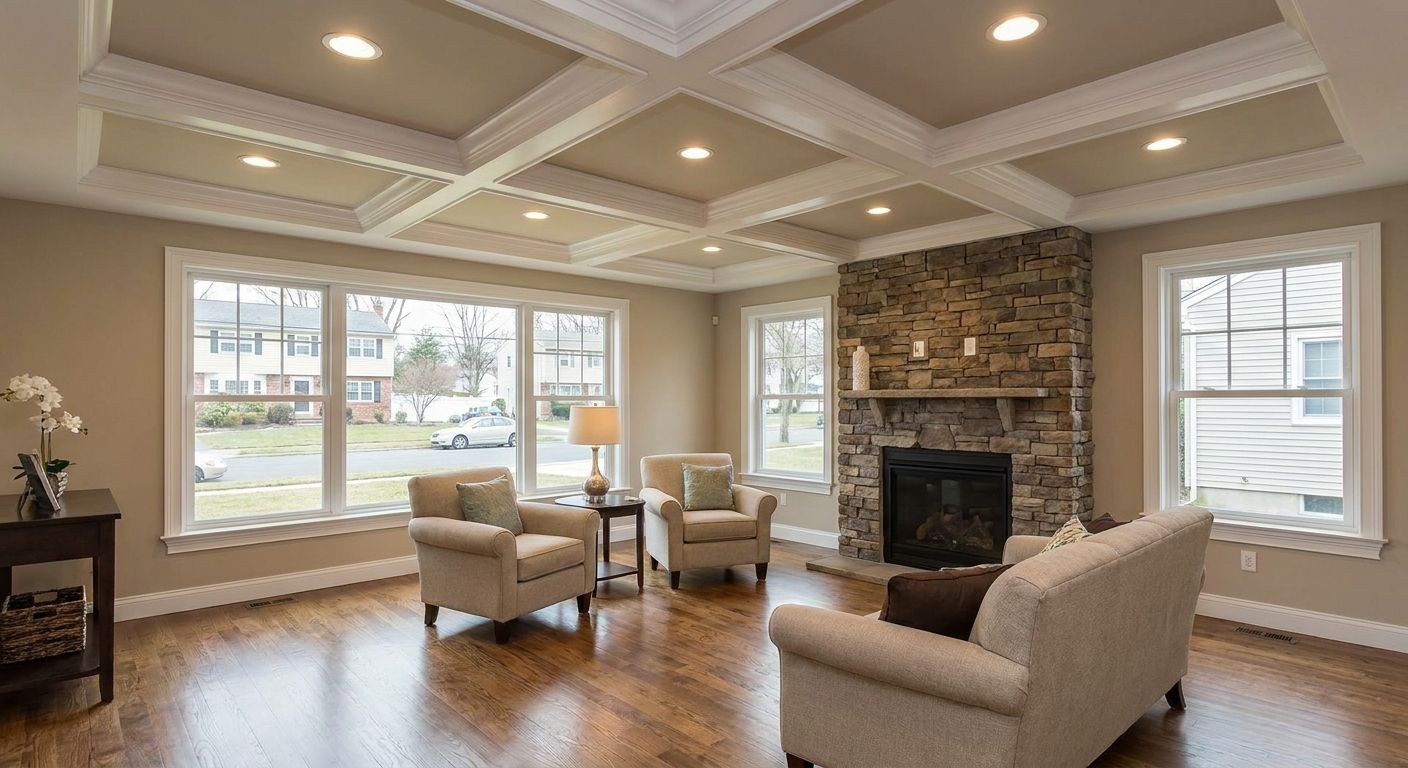
Recessed lighting fixtures sold in New Jersey in 2026 fall into a handful of real categories, and picking the wrong one means a return trip to patch drywall or swap housings. This guide ranks the six types that come up most often on electrical service calls across Monmouth, Middlesex, Somerset, and Union counties, and tells you which one fits your ceiling, your room, and your code requirements.
- IC-rated LED retrofit recessed lights are the best recessed lighting fixtures for most NJ homes in 2026.
- Wafer/slim disc LED fixtures win for finished basements with under 4 inches of joist clearance.
- Damp-rated recessed lights are required in bathrooms, covered porches, and garages under NJ code.
- Smart tunable-white fixtures make sense for whole-home dimming schedules, not single-room fixes.
- Non-IC-rated fixtures touching attic insulation are a fire code problem, not a style choice.
Why this matters
Most recessed lighting in NJ homes built before 2010 runs on incandescent or halogen cans rated for 65 to 75 watts each. A kitchen with eight of those fixtures is pulling 500-plus watts just for downlights. Swapping to LED trims typically drops that same fixture to 9 to 15 watts while matching the output of the old bulb, which is why recessed lighting upgrades are one of the more common calls Spartan Home Pros gets alongside recessed lighting installation requests tied to kitchen and basement remodels.
The catch is that not every recessed fixture fits every ceiling. Insulated attics need IC-rated (insulation contact) housings. Bathrooms and covered porches need damp or wet ratings. Basements with 2x8 joists often can't fit a standard 6-inch can at all. Getting the type wrong means either a code violation or a fixture that physically doesn't fit — both are avoidable once you know what to look for.
What makes the best recessed lighting fixture
- IC rating — required when the fixture housing will contact or be covered by attic insulation
- Airtight (AT) certification — cuts conditioned air leakage into the attic, which matters for NJ's heating and cooling bills
- Dimmer compatibility — most NJ homes already have dimmers on living and dining circuits; the fixture needs to match
- CRI of 90 or higher — matters most in kitchens and anywhere color accuracy counts (countertops, artwork, makeup mirrors)
- Damp or wet rating — non-negotiable in bathrooms, over tubs, and on covered porches
- Retrofit vs. new-construction housing — retrofit kits work through the existing ceiling hole; new-construction housings need open joist bays
At a glance
| Fixture type | Best for | Standout feature | Key limitation |
|---|---|---|---|
| IC-rated LED retrofit | Whole-home upgrades | Fits existing 4-6 inch can openings | Housing swap needed if old can isn't IC-rated |
| Wafer/slim disc LED | Finished basements | Fits in as little as 1-2 inches of joist depth | Lower total lumen output per fixture than deep cans |
| Damp-rated recessed | Bathrooms, covered porches | Sealed trim resists moisture intrusion | Limited trim style options compared to standard cans |
| Gimbal/adjustable trim | Kitchens, accent walls | Trim tilts up to roughly 30 degrees for aiming | Slightly deeper housing than fixed trims |
| Smart tunable-white | Whole-home lighting control | Adjusts color temperature and dims by schedule | Needs a hub or app-based control, not a simple switch |
| Basic non-dimmable LED | Closets, utility rooms, budget upgrades | Simplest install, no compatibility issues | No dimming, no color adjustment |
IC-rated LED retrofit recessed lights are the best recessed lighting fixtures for most New Jersey homes in 2026 because they solve the two most common problems at once: energy code compliance in insulated ceilings and a direct fit into existing can openings without new framing.
1. IC-rated LED retrofit lights: best recessed lighting for whole-home upgrades
These fixtures replace the trim and bulb of an existing recessed can with a self-contained LED module rated for direct contact with insulation. They're the default recommendation for any NJ home converting incandescent or halogen cans to LED, especially where the attic above is insulated and the fixture will be buried.
IC-rated LED retrofit pros:
- Fits most existing 4-inch and 6-inch can openings without new housing
- Meets NJ's high-efficacy lighting requirements for insulated ceilings
- Cuts wattage per fixture from roughly 65W to 9-15W for equivalent light output
IC-rated LED retrofit cons:
- Older non-IC-rated housings still need to be swapped, not just re-trimmed
- Dimmer compatibility has to be checked against the fixture, not assumed
Best for: Whole-home downlight conversions in homes with insulated ceilings. Verdict: Buy.
2. Wafer/slim disc LED: best recessed lighting for finished basements
Wafer lights ditch the deep metal can entirely, mounting a thin LED disc directly against the ceiling drywall with a shallow junction box behind it. That's the difference-maker in finished basements, where joist depth after a drop ceiling or furring strips often leaves less than 4 inches to work with.
Wafer/slim disc LED pros:
- Installs in as little as 1 to 2 inches of ceiling cavity
- No can housing to source or match trim styles to
- Lower profile reads as flush, almost architectural, against a finished ceiling
Wafer/slim disc LED cons:
- Individual fixtures put out less total light than a deep 6-inch can, so basements often need more fixtures per room
- Not field-serviceable — the whole unit gets replaced if it fails, not just a bulb
For basement finishing projects specifically, recessed lighting for finished basements is the more common project type where this fixture shows up, since basement ceilings are almost always the tightest clearance in the house.
Best for: Finished basements with shallow joist bays or dropped ceilings. Verdict: Buy.
3. Damp-rated recessed lights: best recessed lighting for bathrooms and covered porches
Damp-rated (and wet-rated, for direct exposure) recessed fixtures use sealed gaskets and moisture-resistant trims. This isn't a style preference — standard dry-location cans installed over a tub, shower, or on a covered porch are a code and safety problem in humid or wet conditions.
Damp-rated recessed pros:
- Sealed housing resists condensation and moisture intrusion
- Available in both retrofit and new-construction versions
- Required, not optional, for bathroom ceilings and covered exterior soffits
Damp-rated recessed cons:
- Fewer trim style and finish options than standard interior fixtures
- Wet-rated versions (for direct rain or spray exposure) cost more design complexity than damp-rated
Best for: Bathroom ceilings, covered porches, and garages. Verdict: Buy where moisture exposure applies; Skip for dry interior rooms — you're paying for a rating you don't need.
“A recessed fixture that isn't IC-rated and is touching attic insulation isn't a style problem, it's a fire code problem.”
4. Gimbal/adjustable trim: best recessed lighting for kitchens and accent lighting
Gimbal trims let the light source tilt within the housing, typically up to around 30 degrees, so the beam can be aimed at a backsplash, an island, or a piece of art instead of pointing straight down. That aiming ability is what separates a kitchen with usable task lighting from one that's evenly, blandly lit.
Gimbal/adjustable trim pros:
- Aims light at countertops, islands, or artwork instead of just the floor below
- Works well mixed with fixed-trim fixtures in the same room for layered lighting
- Available in the same LED, IC-rated, dimmable combinations as fixed trims
Gimbal/adjustable trim cons:
- Slightly deeper housing than a comparable fixed trim
- Easy to over-aim and create glare if fixtures aren't spaced correctly
Kitchen remodels are where this fixture earns its keep — it's the type most often specified on kitchen remodel lighting plans that call out task lighting over counters separately from general ceiling light.
Best for: Kitchens, galleries, and any room needing directional accent light. Verdict: Buy.
5. Smart tunable-white recessed lights: best recessed lighting for whole-home control
These fixtures adjust both dimming and color temperature — shifting from a cooler daylight tone in the morning to a warmer tone in the evening — through an app or hub rather than a wall switch alone. They make the most sense as a whole-home decision, not a one-room upgrade, since the value is in scheduling and zone control across multiple rooms.
Smart tunable-white pros:
- Adjusts color temperature on a schedule, not just brightness
- Can be grouped into zones and scenes across a whole floor
- Pairs with existing smart home systems in most cases
Smart tunable-white cons:
- Requires a hub or app-based control layer, which is one more thing to maintain
- Higher complexity to troubleshoot than a fixture on a standard switch or dimmer
Best for: Homeowners already running a smart lighting system who want recessed fixtures to match. Verdict: Hold — worth it only if you're already committed to a smart lighting ecosystem, otherwise it's added complexity for marginal benefit.
6. Basic non-dimmable LED retrofit: budget-friendly recessed lighting
The simplest option: a fixed-output LED retrofit trim with no dimming and no color adjustment, built for spaces where lighting quality matters less than getting the fixture in and working. Closets, laundry rooms, utility spaces, and garages are the typical fit.
Basic non-dimmable LED pros:
- Simplest install with no dimmer or hub compatibility to verify
- Fewest points of failure of any fixture type on this list
- Works in any standard 4- or 6-inch can opening
Basic non-dimmable LED cons:
- No dimming means no flexibility for mood or task lighting
- Feels flat in living spaces where lighting layering matters
Best for: Closets, utility rooms, garages, and other low-priority spaces. Verdict: Buy for utility spaces; Skip for living rooms, kitchens, and bedrooms.
Get your recessed lighting layout right the first time
Spartan Home Pros installs and retrofits recessed lighting across Central NJ.
How we ranked these
Each fixture type is scored against the criteria above: IC/AT rating where insulation contact applies, damp or wet rating where moisture applies, dimmer and CRI performance for living spaces, and physical fit against typical NJ joist depths. No fixture wins across every category — that's the point. A basement wafer light and a kitchen gimbal trim solve different problems, and ranking them against each other on a single scale would hide that.
Which recessed lighting fixture should you choose?
For most New Jersey homeowners upgrading from old incandescent cans in 2026, IC-rated LED retrofit fixtures are the right default — they fit existing openings and meet code in insulated ceilings without a housing swap. Basements need wafer or slim disc lights because of joist clearance, bathrooms and porches need damp-rated fixtures because of moisture exposure, and kitchens benefit from gimbal trims wherever task lighting matters. Skip smart tunable-white fixtures unless a whole-home smart system is already in place, and reserve basic non-dimmable trims for utility spaces only.
FAQ
What are the best recessed lighting fixtures for a New Jersey home in 2026?
IC-rated LED retrofit fixtures are the best recessed lighting fixtures for most NJ homes in 2026 because they fit existing can openings and meet insulation contact code requirements. Basements, bathrooms, and kitchens each do better with a more specialized type.
Do I need IC-rated recessed lights in New Jersey?
Yes, if the fixture housing will touch or be covered by attic insulation, it needs an IC (insulation contact) rating. This applies to most NJ homes with insulated ceilings below an attic.
Can I put a standard recessed light in a bathroom?
No, bathroom ceilings need a damp-rated or wet-rated fixture depending on proximity to the tub or shower. A standard dry-location fixture in that spot is a moisture and code problem, not a style choice.
What recessed lights work in a basement with a low ceiling?
Wafer or slim disc LED fixtures work best in basements with under 4 inches of joist clearance since they mount flush against the drywall instead of requiring a deep can housing.
Are smart recessed lights worth it?
Smart tunable-white recessed lights are worth it mainly if you already run a smart lighting system across your home. Installed as a single-room fix, the added hub and app complexity outweighs the benefit for most homeowners.
How many watts do LED recessed lights use compared to old incandescent cans?
LED recessed retrofit fixtures typically use 9 to 15 watts to match the output of a 65-watt incandescent can, which is roughly an 80 percent reduction per fixture.
What's the difference between retrofit and new-construction recessed housings?
Retrofit housings install through an existing ceiling opening without accessing the joist bay, while new-construction housings mount directly to open joists before drywall goes up. Retrofit is the typical choice for any remodel where the ceiling is already finished.
One last thing
The fixture homeowners get wrong most often isn't the trim style, it's the IC rating on an old can that's already buried in attic insulation. Swapping just the bulb or trim on a non-IC-rated can that's touching insulation doesn't fix the underlying problem — the housing itself needs to change. If a recessed lighting project in NJ in 2026 skips that check, it's setting up a fire code issue that won't show up until an inspection or an insurance claim.


