
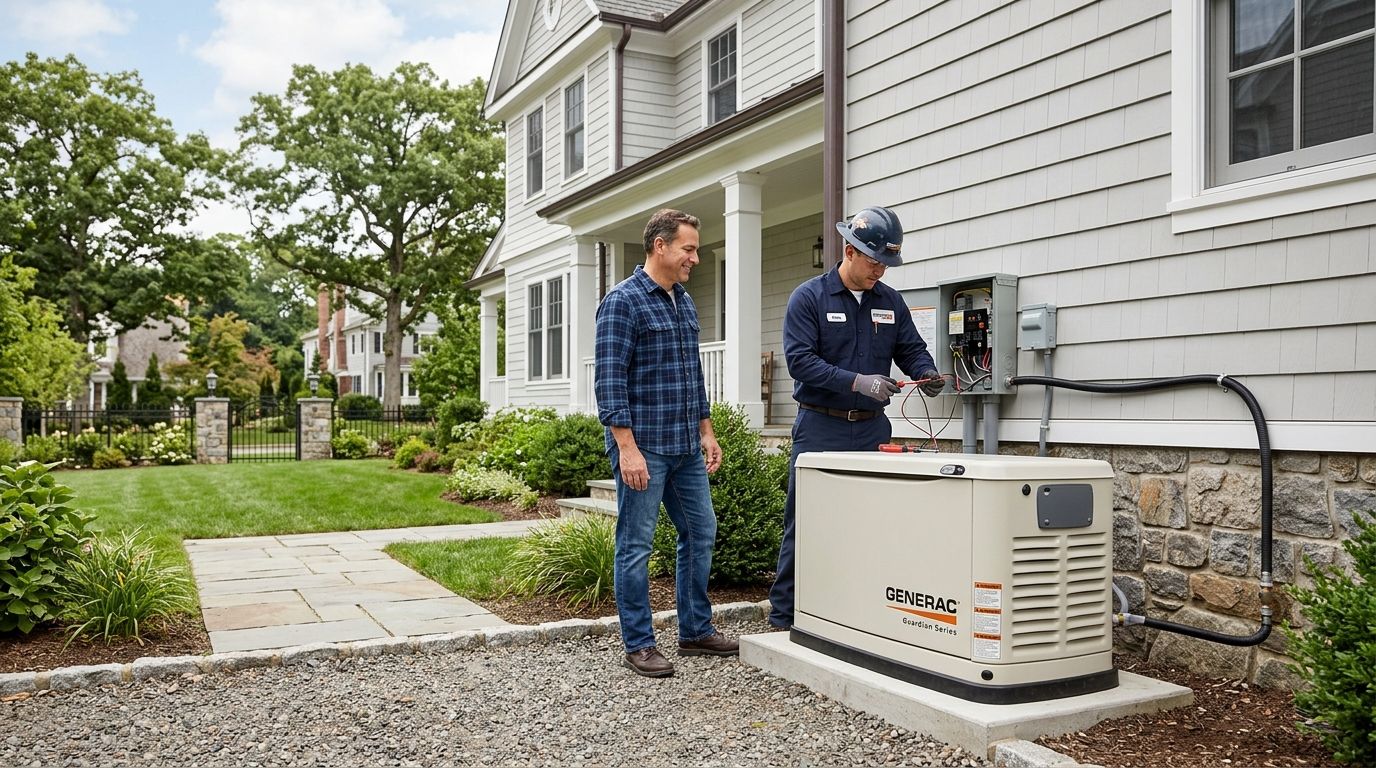
Whole house generator installation for Rumson NJ homeowners means putting in a permanently wired standby generator that switches on automatically within seconds of a utility outage, sized and permitted to the borough's coastal building rules. Waterfront homes along the Shrewsbury and Navesink Rivers lose power more often and stay dark longer after a nor'easter than inland Monmouth County towns, and that changes both the generator size and where it can legally sit on the lot.
- Whole house generator installation in Rumson NJ needs a load calculation, flood-zone-compliant placement, and a permitted electrical tie-in.
- Most Rumson homes run 20kW to 26kW standby units to cover wells, sump pumps, and central HVAC during outages.
- Spartan Home Pros installs and services standby generators across Monmouth, Middlesex, Somerset, and Union counties.
- Undersized generators are the most common failure point — they trip mid-storm, not during the sales pitch.
- Older Rumson homes with Federal Pacific or Zinsco panels usually need a panel upgrade before a transfer switch goes in.
Why whole-house generator installation matters for Rumson
Rumson sits low along tidal water, and that geography means longer outages than towns a few miles inland. A generator sized for a standard NJ colonial doesn't necessarily cover a 4,000-square-foot waterfront home with a well pump, a sump pump running on flood-season overdrive, and central air pulling load on a humid August afternoon.
The borough's building department also treats generator placement differently than most Central Jersey towns because of FEMA flood-zone overlays near the river. A pad that would pass inspection in Freehold or Marlboro can get flagged in Rumson if it sits inside a regulated setback from a bulkhead or below base flood elevation. That's the difference a generic online generator calculator won't catch.
Confirm your home actually needs whole-house coverage
Some Rumson homeowners only need to protect a handful of circuits — sump pump, refrigerator, a few lights. Others, especially larger waterfront properties, need the whole panel covered because losing HVAC, well water, or a home elevator during a multi-day outage isn't an option.
- List every circuit that has to stay live during a 3-day outage, not just the obvious ones
- Flag well pumps and sump pumps separately — these fail first when a partial-coverage generator runs out of capacity
- Check whether the home relies on a private well (common in parts of Rumson) rather than municipal water
- Note any home medical equipment on the panel, which usually pushes a household toward full coverage rather than an essentials-only unit
Size the generator to your home's actual electrical load
Generic sizing charts assume a typical suburban NJ home. Rumson's larger lots and waterfront square footage often push the real number higher than what an online calculator spits out.
- Get a licensed electrician to run a load calculation on the actual panel, not a square-footage estimate
- Add the tonnage of every HVAC zone, since multi-zone systems are common in larger Rumson homes
- Include well pump horsepower if the home isn't on municipal water
- Build in headroom for a future EV charger or hot tub circuit if either is planned
A full walkthrough of the sizing math is in the whole house generator sizing guide — worth reading before you get a quote, not after.
Check your electrical panel's capacity first
A generator is only as good as the panel it ties into. Older Rumson homes, especially colonials built before the 1980s, sometimes still run Federal Pacific or Zinsco panels that can't safely support an automatic transfer switch.
- Confirm panel amperage — 100A panels are common in older homes and often can't handle a full-home transfer switch
- Check the panel brand and age; flagged brands need replacement before generator work proceeds
- Verify there's physical room next to the panel for the transfer switch enclosure
- Ask whether the meter pan and service entrance can handle the added load
Choose a generator brand and fuel type
Most Rumson installs run on natural gas where a line already reaches the house, and propane where it doesn't — common on some of the more remote waterfront lots. Fuel choice affects tank placement, refill logistics, and how loud the unit runs next to a close-set neighbor.
- Compare natural gas vs. propane based on what's already run to the property
- Check noise ratings if the unit will sit within earshot of a neighbor's patio or waterline
- Confirm the automatic transfer switch is rated for the full panel, not just a sub-panel
- Ask what's covered under the manufacturer's warranty versus what's covered under the installer's labor warranty
A side-by-side breakdown of brands sold and installed in NJ is in the best whole-house generator brands guide.
Handle Rumson's permit and placement rules
This is where Rumson diverges from most Central Jersey installs. Waterfront and near-waterfront lots fall under FEMA flood-zone overlays that dictate how close a generator pad can sit to a bulkhead or how high it needs to sit relative to base flood elevation.
- Pull a borough permit and schedule the required NJ Uniform Construction Code inspection
- Check whether the lot needs an elevation certificate review before pad placement is approved
- Confirm the sound ordinance distance from the property line, which can be stricter near tightly spaced waterfront homes
- Ask about historic district review if the property falls inside one of Rumson's designated historic areas
Schedule installation and inspection
Install day covers the pad, the gas or propane line, the electrical tie-in, and the borough inspection sign-off — in that order, since skipping ahead usually means redoing a step.
- Pad gets poured or set first, positioned per the approved permit
- Gas or propane line gets run and pressure-tested before the unit is set
- Electrical tie-in and transfer switch wiring happen next, tied into the main panel
- Borough inspector signs off before the unit goes live
- Installer walks the homeowner through a manual test cycle before leaving
Set a maintenance schedule after installation
A standby generator that never gets serviced is a generator that fails to start the one week it matters. Battery checks, oil changes, and a self-test cycle every two weeks keep the unit ready without owner intervention.
Comparison: backup power options for a Rumson home
| Option | Best for | Key limitation | Verdict |
|---|---|---|---|
| Whole-house standby generator | Homeowners who want every circuit covered automatically | Requires a permitted pad and dedicated fuel line | Buy for waterfront and full-coverage needs |
| Portable gas generator | Tight budgets needing partial, manual backup | Manual startup, extension cords, no automatic transfer | Hold — fine as a stopgap, not a real solution |
| Solar plus battery backup | Homes already invested in solar wanting quiet backup | Runtime limited by battery capacity in multi-day outages | Consider only alongside existing solar |
| No backup power | Homes rarely hit by outages | Full exposure to spoiled food, no heat, no sump pump | Skip for any waterfront or well-water property |
Get a generator sizing quote
Licensed NJ electricians handle sizing, permits, and installation start to finish.
Common mistakes Rumson homeowners make
- Placing the unit inside a FEMA-regulated bulkhead setback without an elevation review — the inspection fails and the unit gets relocated at the owner's cost.
- Sizing for an average NJ home instead of Rumson's larger waterfront square footage — the generator sheds HVAC load during the first heat-wave outage.
- Assuming a propane tank swap solves a no-gas-line waterfront lot without checking the borough's tank placement rules first.
- Skipping the panel inspection — older colonials with Federal Pacific or Zinsco panels can't safely carry a full-home transfer switch.
- Waiting until hurricane season to order — permitted installs booked in August through October back up fast, and the 2026 storm season is already narrowing installer lead time.
FAQ
What size whole-house generator do I need for a home in Rumson NJ?
Most Rumson homes need 20kW to 26kW to cover HVAC, well pump, and sump pump load simultaneously. A licensed electrician's load calculation on your actual panel gives the exact number, not a square-footage estimate.
Is a whole-house generator worth it for a waterfront home?
Yes, for most waterfront Rumson properties, because outages near the river tend to run longer than inland towns. A well pump or sump pump failure during a multi-day outage causes more damage than the generator costs to run.
How long does whole-house generator installation take?
Installation itself typically runs one to two days once permits clear, covering the pad, fuel line, electrical tie-in, and inspection. Permit approval timing varies by borough workload, especially in the months before hurricane season.
Does Rumson require a permit for a standby generator?
Yes, a borough permit and a NJ Uniform Construction Code inspection are required for any permanently wired standby generator. Waterfront lots may also need an elevation certificate review before pad placement is approved.
What generator brands does Spartan Home Pros install?
Spartan Home Pros installs standby generators from established residential brands and matches the unit to your panel's load calculation and fuel access. The brand comparison guide breaks down the tradeoffs by fuel type and noise rating.
Can a whole-house generator run my entire home during a nor'easter?
A properly sized whole-house unit runs HVAC, well pump, sump pump, and every circuit on the panel simultaneously. An undersized unit will shed load or trip, which is why the sizing step matters more than the brand choice.
How much maintenance does a standby generator need after installation?
A standby generator needs a self-test cycle roughly every two weeks, an annual oil change, and periodic battery checks. Skipping maintenance is the leading reason a generator fails to start during an actual outage.
Is a portable generator enough for a Rumson home?
A portable generator covers a handful of circuits manually but can't run a full panel automatically. For waterfront homes with well pumps or medical equipment on the circuit, a whole-house standby unit is the safer call.
One last thing
The detail that trips up more Rumson installs than any other isn't the generator brand — it's the FEMA flood-zone setback. Homeowners who get a permit reviewed for elevation and bulkhead distance before the pad gets poured skip a redo that costs both time and money during the exact season they need the unit working.


