
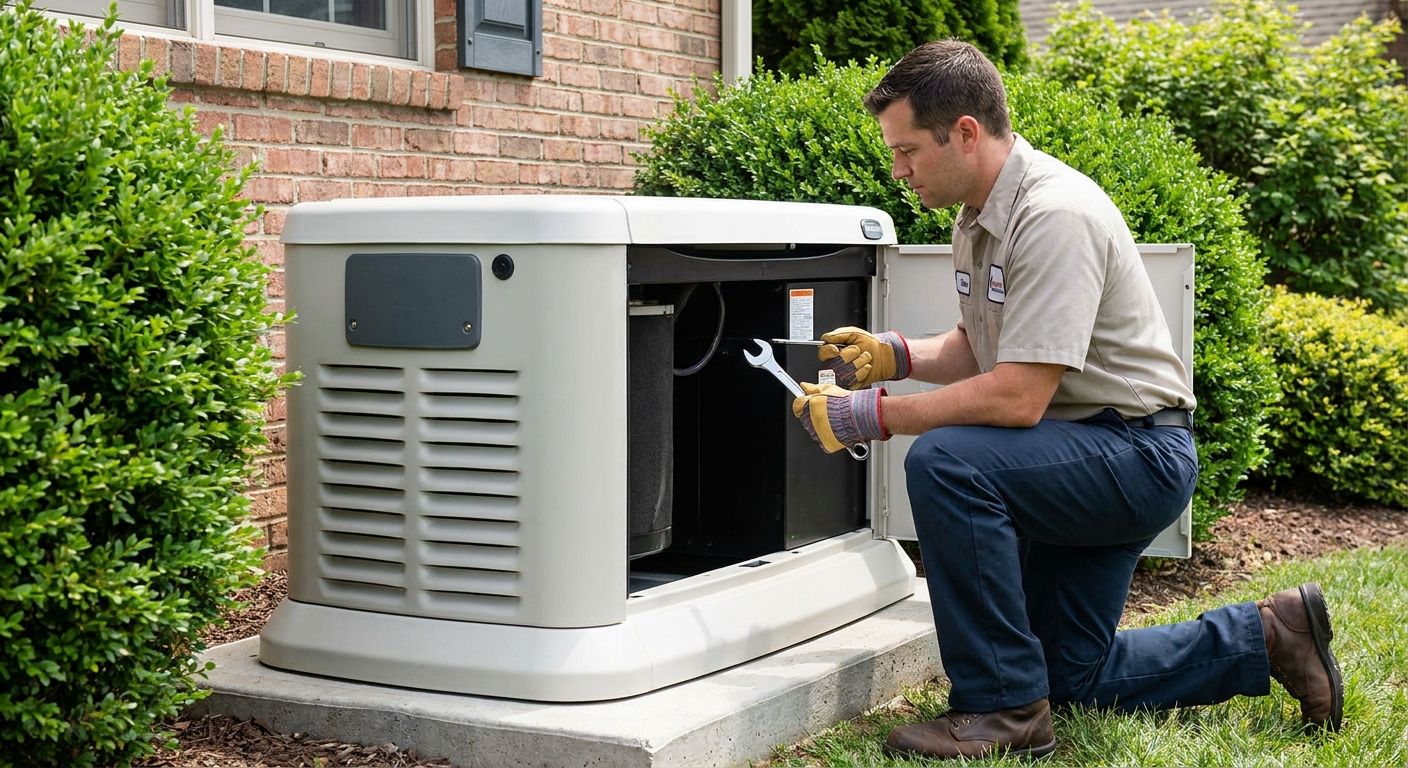
A whole-house generator that just got installed in 2026 isn't a "set it and forget it" appliance — it needs a weekly self-test, an oil change on a set interval, and one professional service visit a year to keep running when the power actually drops. Skip that schedule and the unit that looks fine sitting in your yard can fail to start during the exact storm you bought it for.
- Generator maintenance after installation means a weekly self-test, an oil change every 100 hours or annually, and one professional service visit a year.
- Generac and most standby brands require documented annual maintenance to keep the warranty valid — skipped service voids coverage.
- Batteries typically need replacement every 2-3 years regardless of how often the generator actually runs.
- Homeowners can handle the visual checks and self-test log; licensed technicians should handle the annual full-service inspection.
Why this matters
A standby generator sits idle 99% of the time, which is exactly the problem. Engines that don't run regularly develop stale fuel, dead batteries, and gummed-up carburetors — and none of that shows up until the transfer switch tries to start the unit during an outage. In Central New Jersey, where nor'easters and summer thunderstorms knock out power for hours or days, a generator that fails on demand is worse than not having one, because you stopped budgeting for a portable backup.
How do you maintain a whole-house generator after installation?
Maintenance breaks into three intervals: weekly, semi-annual, and annual. Here's the sequence a licensed technician follows and what a homeowner can check between visits.
- Confirm the automatic self-test runs on schedule. Most standby units, including Generac systems, run a built-in exercise cycle automatically — check the controller display to confirm it fired.
- Inspect the enclosure for debris, pests, and water intrusion. Mulch, leaves, and nesting rodents around the base are the most common cause of airflow blockage.
- Check the oil level and color monthly. Dark, gritty oil signals it's due even if the hour meter hasn't hit the interval yet.
- Test the battery under load twice a year. A generator with a dead starting battery is the single most common no-start call technicians in Monmouth and Middlesex counties see.
- Change the oil and filter every 100 hours of run time or once a year, whichever comes first. This is the standard Generac interval and applies to most air-cooled standby units.
- Book a full professional service visit annually. A licensed tech checks spark plugs, air filter, coolant (on liquid-cooled units), transfer switch operation, and load-bank tests the unit under real demand.
Homeowners who bought a whole-house generator installation in the past year should have received a maintenance log at handoff — that log is what a warranty claim will ask for if the unit fails.
Weekly maintenance: a 12-to-20-minute self-test
Most standby generators run an automatic self-test weekly, cycling the engine for roughly 12 to 20 minutes without transferring load to the house. This burns off condensation, keeps the battery charged, and lubricates internal components. If that test doesn't fire — silence on the scheduled day, or an error code on the controller — that's the first sign of a starting or fuel problem, not something to wait out until the annual visit.
Annual maintenance: one full-service visit
Once a year, a licensed technician should perform a complete inspection: oil and filter change, air filter replacement, spark plug check, battery load test, coolant check on liquid-cooled models, and a load-bank test that runs the generator under simulated house demand rather than just idling. This is also when a technician verifies the transfer switch engages cleanly and the unit still meets the electrical code requirements it was installed under.
For homes running home medical equipment on generator backup, this annual visit isn't optional — a unit that starts but can't hold load under a CPAP, oxygen concentrator, or refrigeration draw is a failure the household can't afford to discover mid-outage.
Why generator maintenance needs vary
- Fuel type — propane units tend to run cleaner and need fewer carburetor services than gasoline-fed units.
- Run hours during outages — a generator that ran 40 hours straight during a multi-day 2026 storm needs an oil check sooner than one that's only run weekly self-tests.
- Environment — coastal salt air in Monmouth County corrodes enclosures and electrical connections faster than inland installs.
- Battery age — starting batteries degrade on a calendar, not just a usage schedule, and typically need replacement every 2 to 3 years.
- Manufacturer warranty terms — Generac and other brands require documented annual maintenance from a licensed technician to keep coverage active; DIY-only maintenance history can void a claim.
- Commercial vs. residential load — a generator backing a restaurant's walk-in coolers and cooking equipment sees harder duty cycles than one backing a single-family home's essential circuits.
Commercial operators, including backup generator installation for NJ restaurants, should budget for more frequent load-bank testing since the equipment they're protecting can't tolerate even a brief drop in power.
Related questions
How often should a whole-house generator be serviced after installation?
A whole-house generator should be serviced once a year at minimum, with an oil change every 100 hours of run time or annually — whichever comes first. Units that see heavy use during storm season may need that oil change sooner regardless of the calendar.
Can I do my own generator maintenance in NJ?
Yes, homeowners can handle the weekly self-test check, visual inspection, and oil-level monitoring themselves. The annual full-service visit — spark plugs, battery load test, coolant, and transfer switch inspection — should go to a licensed technician, both for warranty documentation and because the transfer switch work involves live electrical panels.
Does skipping maintenance void a generator's warranty?
Yes, most standby generator manufacturers, including Generac, require documented annual maintenance performed by a licensed technician to keep the warranty valid. A homeowner who skips the annual visit and later files a claim for engine failure will often find the claim denied for lack of maintenance records.
How long do generator batteries typically last?
Generator starting batteries typically last 2 to 3 years regardless of how often the unit actually runs, since the degradation is calendar-based, not usage-based. A dead battery is the leading cause of "the generator didn't start" service calls.
Do generators still need maintenance if the power never goes out?
Yes — the weekly self-test exists specifically because a generator that never runs during an actual outage still needs regular exercise to prevent stale fuel, battery drain, and gummed-up internal components. A unit that's never seen a real outage but skipped its self-tests is just as likely to fail as one that ran hard all year.
What's the difference between standby and portable generator maintenance?
Standby generators run automatic weekly self-tests and need annual professional service; portable generators need fuel stabilizer treatment before storage and manual start-ups to keep the engine from seizing between uses. Standby units installed with a transfer switch also need that switch inspected annually, which portable units don't have.
Homeowners who financed a generator alongside other electrical work — say, an electrical panel upgrade for a home addition — should keep both maintenance schedules on the same annual visit where possible, since panel capacity and generator load are directly connected.
Book your annual generator service
Licensed NJ technicians, documented for warranty compliance.
Spartan Home Pros handles generator installation and follow-up service across Monmouth, Middlesex, Somerset, and Union counties, and does not subcontract the work out — the technician who installs the unit is licensed to service it afterward.
FAQ
How often should a whole-house generator be serviced after installation?
A whole-house generator should get one full professional service visit a year, plus an oil change every 100 hours of run time or annually, whichever comes first. Heavy storm use in 2026 can push that oil change sooner than the calendar interval.
Can homeowners do generator maintenance themselves?
Homeowners can handle the weekly self-test check, visual inspection, and oil-level monitoring. The annual full-service visit involving the transfer switch and battery load test should go to a licensed technician.
Does skipping maintenance void a Generac warranty?
Yes, Generac and most standby manufacturers require documented annual maintenance from a licensed technician to keep the warranty active. A denied claim for lack of maintenance records is common when owners skip that visit.
How long does a generator self-test take?
Most standby generators run an automatic self-test for roughly 12 to 20 minutes each week. If that cycle doesn't fire on schedule, it's an early warning sign of a starting or fuel problem.
How long do generator batteries last?
Generator starting batteries typically last 2 to 3 years on a calendar basis, regardless of how often the unit runs. A dead battery is the most common reason a generator fails to start during an outage.
Do generators need maintenance if the power never goes out?
Yes, the weekly self-test exists to keep the engine, fuel, and battery in working order even when the generator never sees a real outage. Skipping it leads to stale fuel and a dead starting battery.
What is the difference between standby and portable generator maintenance?
Standby generators run automatic weekly self-tests and need annual transfer switch inspections; portable generators need fuel stabilizer and manual start-ups between uses instead. Standby maintenance is largely automated, portable maintenance is manual.
One last thing
The most overlooked maintenance item isn't the oil or the battery — it's the maintenance log itself. A generator that ran every self-test perfectly for three years but has no written service record is a generator with an unenforceable warranty claim waiting to happen in 2026. Keep the paperwork, not just the parts.


