
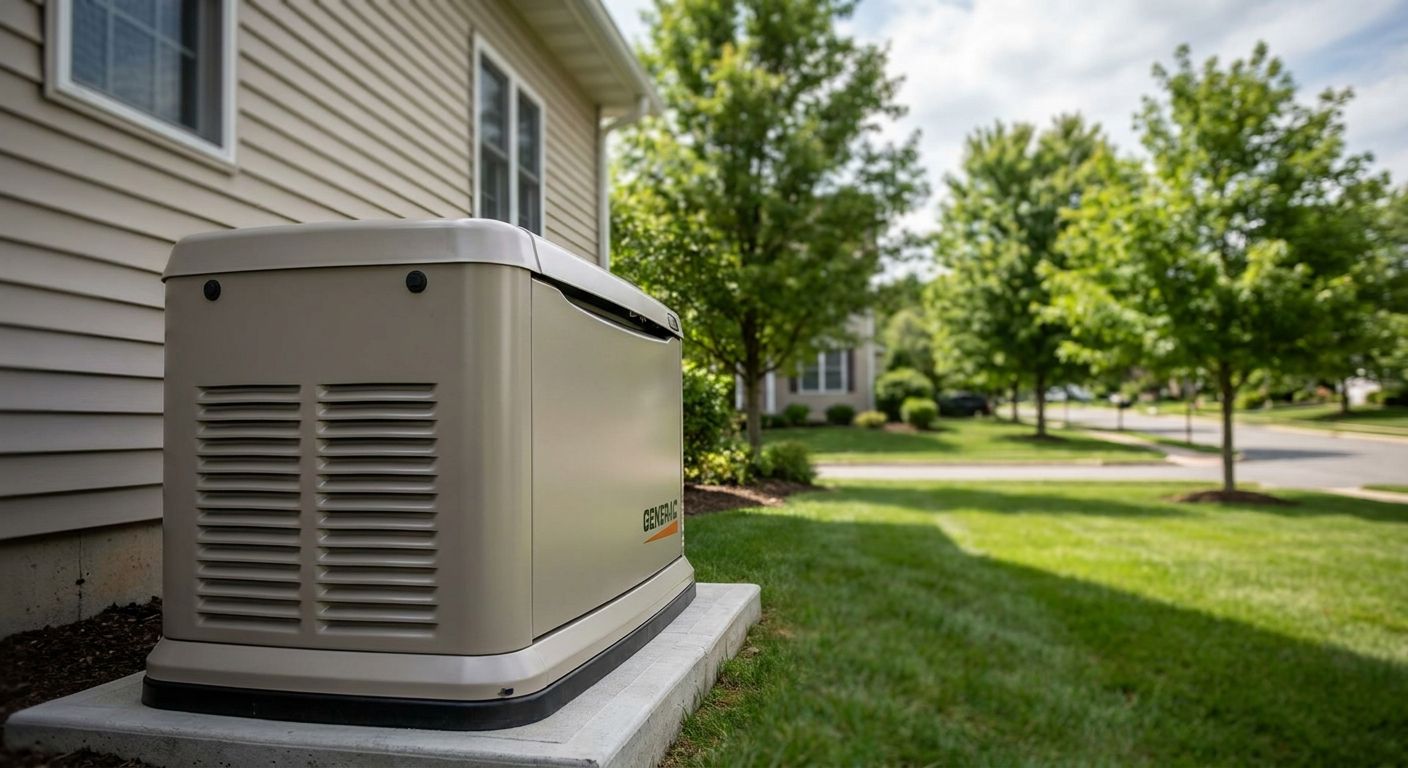
Best overall whole house generator brand for NJ homes in 2026: Generac. Best for tight suburban lots: Kohler. Best budget option for essential-circuit backup: Briggs & Stratton. Best for restaurants and small businesses: Cummins (Onan). This ranking covers the four standby generator brands installed most often across Monmouth, Middlesex, Somerset, and Union counties.
- Generac ranks best overall among whole house generator brands nj homeowners install most often in Central New Jersey.
- Kohler suits quiet suburban lots in towns like Middletown that need a compact, low-noise standby unit.
- Cummins Onan backup generators fit restaurants and small businesses that can't afford a power gap.
- Briggs & Stratton is the budget pick for essential-circuit backup, including homes running medical equipment.
Why this matters
Central New Jersey loses grid power multiple times a year from Nor'easters, summer thunderstorms, and the kind of multi-day outages PSE&G and JCP&L customers saw after Hurricane Sandy. A generator brand name doesn't decide whether your sump pump, furnace, and refrigerator stay on during one of those outages — the size of the unit, the condition of your panel, and the transfer switch wiring decide that.
Spartan Home Pros installs and services all four brands ranked below with licensed technicians on payroll, not subcontracted crews. The brand comparison here is about which manufacturer fits your specific property, not which one has the biggest ad budget.
What makes the best whole house generator brand
- Local parts and technician availability — so a warranty repair doesn't wait behind a depot three states away
- Fuel flexibility — natural gas or propane, depending on whether your street has a gas main
- Enclosure noise and footprint — how close the unit can legally and practically sit to windows and property lines
- Transfer switch compatibility — matching the generator to a 100-amp, 150-amp, or 200-amp panel and the circuits you actually want backed up
- Continuous run-time capacity — built for a multi-day outage, not just a few hours on essential circuits
At a glance
| Brand | Best for | Standout feature | Key limitation |
|---|---|---|---|
| Generac | NJ homes overall | Widest installer and parts network in Central NJ | Storm-season demand can stretch scheduling |
| Kohler | Tight suburban lots | Compact, sound-dampened enclosure design | Fewer authorized NJ dealers than Generac |
| Cummins (Onan) | Restaurants and small businesses | Industrial-grade engine built for continuous run-time | Higher install complexity on commercial panels |
| Briggs & Stratton | Budget-conscious essential-circuit backup | Lower cost entry point into standby power | Fewer large-capacity models for bigger homes |
“A bigger badge name on the generator won't get you whole-home backup if the panel underneath it is already maxed out.”
1. Generac: best whole house generator brand for NJ homes overall
Generac runs on natural gas or propane and switches on automatically within seconds of an outage through an automatic transfer switch wired into your panel. It's the brand most Central NJ electricians and HVAC techs already stock parts for, and the one most NJ homeowners recognize on their neighbors' properties after 2026's storm season.
Generac pros:
- Widest network of installers, technicians, and replacement parts across Monmouth, Middlesex, Somerset, and Union counties
- Model range spans smaller essential-circuit units up to larger whole-home and light-commercial sizes
- Familiar to most licensed NJ electricians, which shortens diagnostic time on service calls
Generac cons:
- Popularity means installation and service scheduling can stretch out during widespread storm outages
- Larger whole-home units need a bigger concrete pad and more clearance from windows and doors than compact alternatives
Generac pricing: installed cost depends on home size, fuel type, and panel condition — see the whole house generator installation in NJ page for a current quote process.
Best for: NJ homeowners who want the broadest service network and don't want to wait on a specialty part. Verdict: Buy.
2. Kohler: best whole house generator brand for tight suburban lots
Kohler builds standby generators around the same natural gas or propane, automatic-transfer-switch model as its competitors, but its enclosure design leans on reducing operating noise and footprint — the manufacturer's engineering background spans small engines and marine equipment, both fields where noise and vibration control matter.
Kohler pros:
- Compact footprint fits closer-set homes common in towns like Middletown, where side-yard clearance is tight
- Enclosure design built around noise reduction, which matters most on lots with neighbors 15-20 feet away
- Solid mid-range size options for typical single-family loads
Kohler cons:
- Fewer authorized NJ dealers than Generac, which can slow parts sourcing on an out-of-cycle repair
- Fewer options at the very top end for large homes with heavy simultaneous loads
Best for: Middletown NJ homeowners and other close-lot suburban properties where noise complaints from neighbors are a real concern. Verdict: Buy for tight lots.
3. Cummins (Onan): best whole house generator brand for restaurants and small businesses
Cummins carries an industrial and diesel engine heritage into its Onan standby line, and that shows up as an engine platform built for continuous run-time rather than occasional home backup. It's the brand that shows up most often behind commercial refrigeration, point-of-sale systems, and three-phase panels.
Cummins pros:
- Engine platform designed for continuous, heavy-duty run-time common in commercial settings
- Handles three-phase power setups that residential-focused brands don't size for
- Reputation built on industrial equipment, not just home backup
Cummins cons:
- Install complexity is higher on panels not already wired for commercial or three-phase loads
- Oversized and unnecessarily expensive for a typical single-family home's essential circuits
Best for: backup generator installation for NJ restaurants and small businesses that lose real revenue the moment refrigeration or POS systems go dark. Verdict: Buy for commercial use; Skip for a typical single-family home.
4. Briggs & Stratton: best budget whole house generator brand for essential circuits
Briggs & Stratton, long known for small engines, offers a home standby line priced below the premium brands and aimed at essential-circuit and partial-home backup rather than full-load whole-home coverage. It's the option that shows up most for homeowners who just need the sump pump, refrigerator, and a medical device running through an outage.
Briggs & Stratton pros:
- Lower cost entry point into automatic standby power compared to premium-tier brands
- Solid fit for homes that only need essential circuits covered, not the whole electrical load
- Simpler transfer switch configurations available for smaller panels
Briggs & Stratton cons:
- Fewer large-capacity models for bigger homes with high simultaneous draw
- Narrower dealer and service network in Central NJ than Generac
Best for: budget-conscious homeowners, including households running home medical equipment that can't tolerate a gap in power. Verdict: Hold for essential circuits; Skip if you need true whole-home coverage.
How we ranked
Each brand was weighed against the five criteria above: local parts and technician access across Central NJ, fuel flexibility, noise and footprint fit for suburban lots, transfer switch and panel compatibility, and continuous run-time capacity for multi-day outages. No brand won on every criterion — that's the point of a decision tree instead of a single leaderboard.
Which whole house generator brand should you choose?
Default to Generac if you want the broadest installer and parts network in Central NJ and no strong reason to pick otherwise. Choose Kohler if your lot is tight and neighbor noise is a real concern. Choose Cummins (Onan) if you're backing up a restaurant, retail space, or any commercial panel. Choose Briggs & Stratton if your budget only covers essential circuits — sump pump, refrigerator, medical equipment — not the whole house.
Get a generator quote for your NJ home
Licensed technicians size the unit and panel together, not separately.
FAQ
What is the best whole house generator brand for NJ homes?
Generac is the best overall pick for most NJ homes in 2026 because of its installer and parts network across Central NJ. Kohler and Cummins beat it on specific use cases like tight lots or commercial loads.
Is Kohler quieter than Generac?
Kohler's enclosure design is built around noise reduction, which matters on tight suburban lots. Exact noise levels vary by model and load, so ask your installer for spec sheets on the specific unit you're comparing.
How much does a whole house generator cost installed in NJ?
Installed cost depends on home size, fuel type, and whether your panel needs upgrading first. Get a site-specific quote rather than relying on a generic number, since panel condition changes the price more than brand does.
Can a Cummins generator power a whole house or just a business?
Cummins Onan units can back up a whole house, but they're engineered for continuous commercial run-time and three-phase panels. For a typical single-family home, Generac or Kohler are usually a better size and price match.
Do these brands all run on natural gas or propane in NJ?
Yes, Generac, Kohler, Cummins, and Briggs & Stratton all offer natural gas and propane configurations. Which fuel works depends on whether your street has a gas main or you're on a propane tank.
Does my electrical panel need an upgrade before installing a generator?
Older 60-amp or 100-amp panels often need an upgrade before a standby generator's transfer switch can be wired in correctly. A 150-amp or 200-amp panel usually has more room to work with.
How do I know what size generator my NJ home needs?
Sizing depends on your square footage, HVAC load, and which circuits you want backed up during an outage. An electrician should size the panel and generator together, not the generator alone.
One last thing
The transfer switch, not the generator badge, decides which circuits actually get power when the grid goes down. A Generac unit wired into an outdated 100-amp panel trips the same way a Kohler or Cummins unit would — the panel and the switch are doing the real work, the generator brand is just the engine behind them.


