
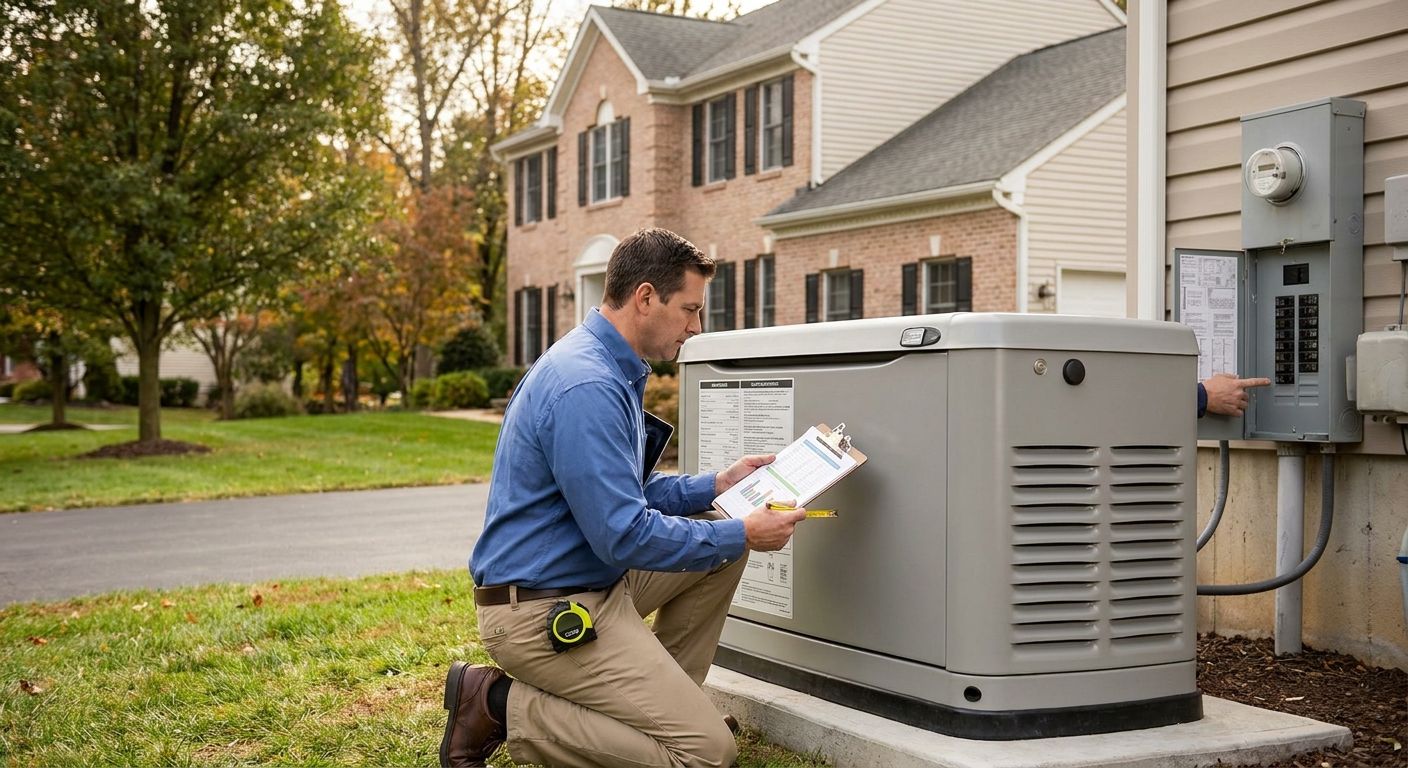
Sizing a whole-house generator comes down to running wattage, not square footage — most Central New Jersey homes need a 22kW to 26kW standby unit to cover the whole house, while homes that only want essential circuits covered (fridge, sump pump, furnace blower, a few outlets) can run on 10kW to 14kW. The number that matters is total connected load in watts, pulled from your panel and your appliance nameplates, not a size chart based on square footage. A generator sized right for wattage can still fail on installation day if your panel's amperage can't support the transfer switch, which is why a licensed electrician checks panel condition before quoting a kW size.
- Most NJ homes need 22kW to 26kW for whole-house coverage in 2026; essential-circuit setups run 10kW to 14kW.
- Sizing is based on running watts of your circuits and panel amperage, not square footage.
- A 100-amp panel often needs an upgrade before a whole-house generator install can proceed.
- Central air, well pumps, and electric heat are the three loads most likely to push you into a bigger unit.
- Spartan Home Pros checks panel load before quoting generator size on every whole-house generator installation in NJ.
Why this matters
Central New Jersey loses power on a normal schedule — nor'easters, summer thunderstorms, and grid strain during heat waves all put homes in Monmouth, Middlesex, Somerset, and Union counties on the outage list more than once a year. A generator sized too small trips its own breaker the first time the AC compressor and the well pump kick on at the same time. A generator sized too big costs more to install and run than the home needs. Getting the math right the first time avoids both problems.
How to size a whole-house generator for your home
Sizing is a sequence, not a guess. Here's the order a licensed electrician works through:
- List your essential circuits. Sump pump, well pump, furnace or boiler blower, refrigerator, and any medical equipment come first — these run on the smallest generators.
- Add the loads you want covered beyond essentials. Central air, electric range, dryer, and a home office setup all add running watts.
- Calculate running watts, not floor area. A 3,000 square foot house with gas heat and window AC units needs far less generator than a 1,800 square foot house running a heat pump and a well pump.
- Check panel amperage. Homes on 100-amp service often need an upgrade before a generator goes in; 150-amp and 200-amp panels usually have more headroom.
- Match total load to a standard generator size. Manufacturers like Generac build in fixed steps — 10kW, 14kW, 18kW, 22kW, 24kW, 26kW, 30kW, 38kW — so your total load gets rounded up to the nearest standard size, not custom-built.
- Confirm the number with a licensed installer before ordering equipment. A whole-house generator installation starts with a load calculation on-site, not a phone estimate.
Essential-circuits generators: 10kW to 14kW
A 10kW to 14kW generator covers sump pump, well pump, furnace blower, refrigerator, and a handful of lighting and outlet circuits. It does not run central air or an electric range. Best for: homeowners who mainly need to keep the basement dry and the heat running during a multi-day outage. Skip this size if the home runs on a well and central AC together — the combined startup load usually exceeds it.
Mid-size whole-home generators: 20kW to 22kW
This range covers most of a typical NJ home's circuits, including a single central AC unit up to about 3 tons, electric range, and dryer, as long as the home isn't also running electric heat. Best for: the average 2,000 to 3,000 square foot home with gas heat and one central AC system. Hold off on this size if the home has a heat pump or electric baseboard heat — that load pushes past 22kW fast.
Large whole-home generators: 24kW to 26kW
A 24kW to 26kW generator covers larger homes with a bigger AC system, electric heat backup, or a well pump running alongside everything else. Best for: homes over 3,000 square feet or any home with electric heat as a primary or backup source. This is the size Spartan Home Pros quotes most often for full-coverage jobs in 2026.
Homes with AC, pools, or medical equipment: 30kW and up
Pool pumps, hot tubs, and continuous medical equipment stack load on top of everything else in the house. A whole-house generator for homes running medical equipment has to account for equipment that can't lose power even for the few seconds a transfer switch takes to engage. Best for: homes with dialysis machines, oxygen concentrators, or similar equipment, and larger homes with pools or multiple AC zones. Buy the extra kW here — undersizing a medical-equipment generator isn't a comfort issue, it's a safety one.
Why generator sizing varies
The kW number changes based on a short list of real factors, not guesswork:
- Central air tonnage — a 3-ton unit draws more startup and running watts than a 2-ton unit
- Well pump horsepower — well pumps have a high startup surge that's easy to underestimate
- Heat source — electric heat and heat pumps add far more load than gas or oil heat
- Panel amperage — a 100-amp panel caps how much generator capacity the existing service can support without an upgrade
- Home square footage — a rough factor, but far less important than the circuits actually being run
- Medical or continuous-power equipment — adds a non-negotiable minimum load that has to be covered even during partial outages
Get your home's generator size confirmed
A licensed electrician runs the load calculation on-site before you buy anything.
How many watts do I need for a whole-house generator?
Most whole-house setups need somewhere between 15,000 and 26,000 watts once central air, electric heat, and appliance startup surges are added together. Essential-circuits-only setups need as little as 8,000 to 10,000 watts. The exact number comes from adding up nameplate wattage on the circuits you want covered, not a flat per-square-foot estimate.
Can I use a portable generator instead of a whole-house unit?
A portable generator can cover a refrigerator, a few lights, and a sump pump, but it can't run central air, an electric water heater, or a well pump without overloading. Portable units also require manual startup and fuel refills every several hours, which becomes a real problem during a multi-day outage. Verdict: portable works for short outages on a small load; a standby unit in the 20kW to 26kW range is the fix for anything longer or bigger.
Does a bigger house always need a bigger generator?
No — square footage matters less than what's actually running on the panel. A 3,500 square foot home with gas heat and window units can size down to 20kW, while a 1,800 square foot home with a heat pump and a well pump can need 24kW or more. Load calculation, not floor plan, sets the number every time.
FAQ
How much power does a whole-house generator need to run central air?
A single 2 to 3-ton central AC system typically needs 3,500 to 6,000 watts of running power plus a startup surge, which is why most whole-house units built for AC start at 20kW. Homes with two AC zones or a larger system often need 24kW or more to avoid tripping the unit on startup.
What size generator do I need for a 2,500 square foot house?
A 2,500 square foot home with gas heat and one central AC system usually fits a 20kW to 22kW generator in 2026. Homes that size with electric heat or a well pump typically need to move up to 24kW.
Is a 22kW generator enough for a house with a pool?
A 22kW generator can run short on power once a pool pump and central air run at the same time as household essentials. Homes with a pool usually size up to 24kW to 30kW to keep both systems running without cycling.
Do I need a panel upgrade before installing a generator?
Homes on 100-amp service often need a panel upgrade before a whole-house generator transfer switch can be installed safely. A 150-amp or 200-amp panel usually has enough existing capacity to skip that step.
What's the difference between essential-circuit and whole-house generators?
An essential-circuit generator, sized 10kW to 14kW, covers a short list of critical loads like the sump pump and refrigerator. A whole-house generator, sized 20kW to 26kW or higher, covers every circuit in the home including central air and electric appliances.
Can I install a whole-house generator on a 100-amp panel?
A 100-amp panel can sometimes support a smaller essential-circuits generator, but most whole-house units above 20kW need a panel upgrade to 150 or 200 amps first. An electrician confirms this during the load calculation before quoting equipment.
What size generator do I need for home medical equipment?
Home medical equipment like oxygen concentrators or dialysis machines needs a generator sized with zero tolerance for gaps, which usually means 22kW or higher paired with a fast-transfer switch. The exact size depends on what other circuits in the home need to stay powered alongside the equipment.
One last thing
The most common sizing mistake in Central New Jersey isn't picking too small a generator — it's picking the size based on the house next door instead of the actual panel. Two homes on the same street with the same square footage can need different generators entirely if one has a well pump and electric heat and the other runs on gas and municipal water. The load calculation, not the neighbor's recommendation, is what determines the right kW number in 2026.


