
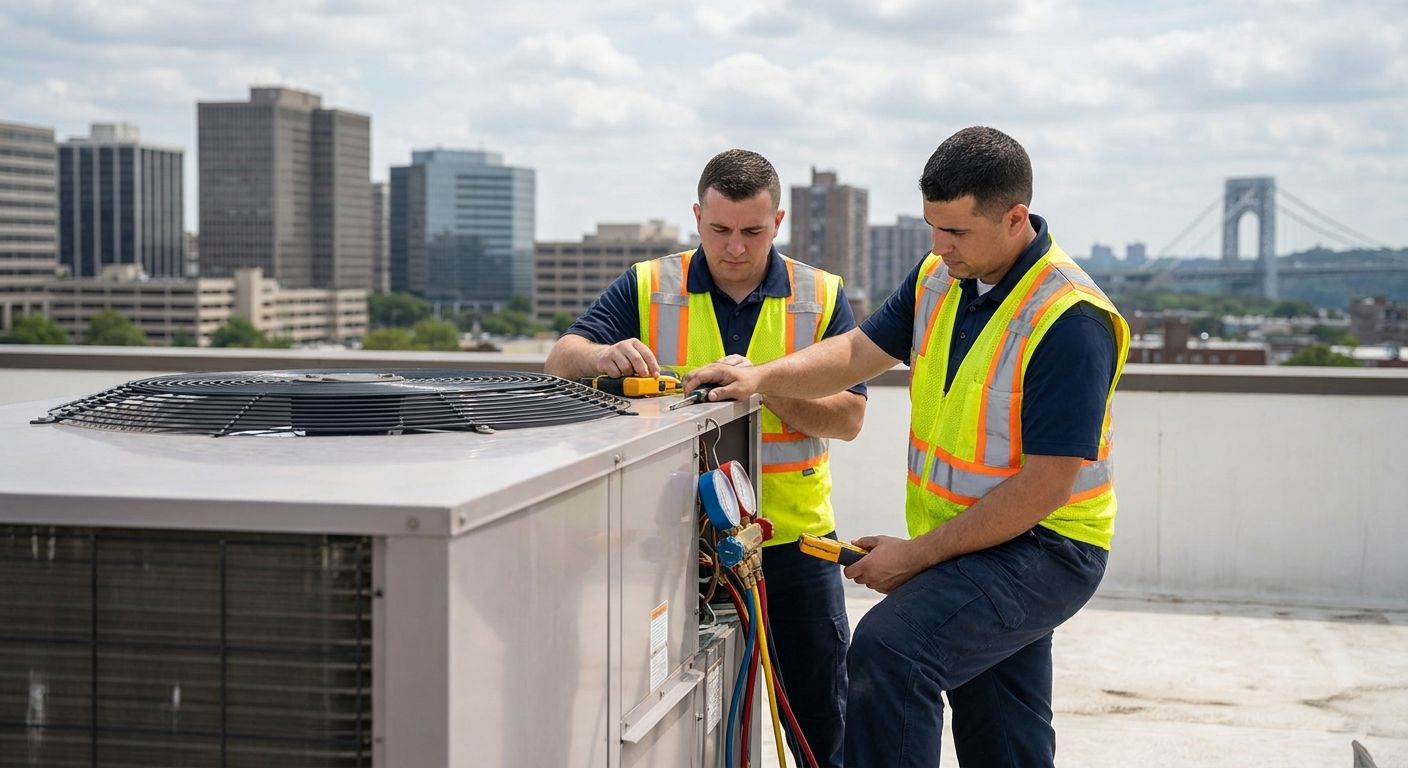
AC repair for NJ businesses is the process of diagnosing and fixing commercial cooling failures — compressor lockouts, refrigerant leaks, blown capacitors, failed contactors, tripped breakers — with the goal of getting the unit running again before it costs the business a day of revenue. A retail sales floor, a restaurant kitchen, or a server room doesn't get the same grace period as a home living room, and the repair plan has to account for that difference from the first phone call.
- AC repair nj business calls in 2026 involve the same core failures as residential units — capacitors, contactors, refrigerant leaks — but downtime costs more per hour.
- Commercial units on undersized electrical panels trip the same breaker repeatedly until the panel gets addressed, not just the AC unit.
- A flat-rate diagnostic call beats an hourly meter for businesses that need a fixed number before approving the repair.
- Restaurants, medical offices, and server rooms need a backup power plan layered on top of the AC fix, not instead of it.
Why AC repair matters for NJ businesses
A home AC failure is uncomfortable. A commercial AC failure is a closed dining room, a sweating retail floor that customers walk out of, or a server room running hot enough to shut down equipment. The tolerance for downtime is measured in hours, not days.
Most commercial cooling failures in Central New Jersey trace back to one of three things: a component that failed on schedule (capacitors and contactors have a service life), a refrigerant leak that's been slowly starving the system for months, or an electrical panel that can't reliably feed the unit's startup draw. That third cause gets missed constantly because it looks like an AC problem when it's actually a panel upgrade for small NJ businesses waiting to happen.
Businesses with older buildings — commercial strips built in the 1980s and 1990s across Monmouth, Middlesex, Somerset, and Union counties — carry panels sized for the tenant mix at construction, not for rooftop units, POS systems, walk-in coolers, and EV charging that got added over the decades since.
Diagnose the failure before you call anyone
Start with what the unit is actually doing. A technician diagnosing blind burns time, and time on a commercial service call adds up.
- Note whether the unit runs but doesn't cool, or doesn't start at all
- Check the breaker — if it's tripped, don't just reset it and walk away
- Listen for a hum with no fan movement — that's often a capacitor, not a compressor
- Check for ice on the coil or lines — that points to a refrigerant issue, not electrical
- Write down when it started and whether it's intermittent or constant
Check your panel capacity before repairing or replacing the unit
If the AC unit trips the same breaker more than once in a week, the fix usually isn't the AC — it's what's feeding it. Rooftop and split commercial units draw a heavy startup surge, and a panel running near capacity can't absorb that surge reliably.
“If the AC trips the same breaker three times in a week, the fix isn't the compressor — it's the panel.”
- Count how many major loads share the panel: AC, refrigeration, lighting, POS, EV charging
- Check the panel's amperage rating against total connected load, not just nameplate capacity
- Look for signs of heat stress on the panel — discoloration, a burning smell, a warm cover
- Get a licensed electrician to pull load calculations rather than guessing
- If the panel is undersized, budget the upgrade alongside the AC repair, not after it
Compare repair cost against replacement age
A compressor failure on a 4-year-old rooftop unit is a repair. The same failure on a 14-year-old unit is a decision point. Most commercial AC units run 12 to 20 years depending on maintenance and load, and repairing a unit past that window often means paying for a fix that buys another failure six months later.
- Pull the unit's install date from the nameplate or building records
- Ask whether the failed part is available or discontinued — older units run into parts scarcity
- Weigh a single repair cost against a pattern of repeat calls on the same unit
- If the unit has failed twice in one cooling season, treat that as a signal, not bad luck
Add a backup plan for refrigeration and cooling-dependent operations
AC repair fixes the cooling problem for this cycle. It doesn't fix what happens the next time a heat wave hits the grid and the unit — or the power feeding it — goes down mid-shift. Restaurants with walk-in coolers, medical offices, and any business running temperature-sensitive inventory need a second layer.
- Identify which loads absolutely cannot lose power: refrigeration, medical equipment, POS and payment systems
- Size a backup generator to those loads specifically, not the whole building
- Restaurants in particular should look at backup generator installation for NJ restaurants before, not after, a spoilage event
- Test transfer switches on a schedule — a generator that hasn't been exercised in a year is a guess, not a plan
Set your thermostat strategy for occupied vs. after-hours
A business running AC at the same setpoint 24 hours a day is paying for cooling nobody's using overnight, and running the compressor harder than it needs to.
- Set a wider setpoint swing for closed hours — most commercial spaces can tolerate 8-10 degrees of drift overnight
- Program occupied-hours setpoints tighter for customer comfort and equipment tolerance
- A smart or programmable commercial thermostat pays for the schedule discipline that manual thermostats rely on staff to remember — see best smart thermostats for the New Jersey climate for what actually holds up here
- Avoid setback swings deep enough to force the compressor into a long recovery run — that's harder on the unit than a steady setpoint
Schedule maintenance before summer, not during it
Most commercial AC failures that turn into emergency calls in July were visible in March. A refrigerant charge slowly dropping, a capacitor reading low, a dirty coil restricting airflow — all catchable before the first 90-degree day.
- Book a spring inspection before the cooling season starts, not after the first hot week
- Have coils cleaned annually — a dirty coil forces the compressor to work harder and shortens its life
- Check refrigerant charge against manufacturer spec rather than just "topping off"
- Replace capacitors on a schedule based on age, not just after they fail
Verify licensing and permits before signing a contract
Commercial HVAC work in New Jersey requires a licensed contractor, and any electrical work tied to the repair — panel changes, dedicated circuits, disconnect swaps — requires a licensed electrician and a permit pulled with the municipality.
- Ask for the contractor's NJ HVAC and electrical license numbers directly, not just a business name
- Confirm whether the company subcontracts the electrical portion — a company that says "we do not subcontract" is telling you who's actually accountable for the whole job
- Confirm a permit gets pulled for panel or circuit work; skipping this creates problems at resale or insurance claims
- Get the diagnostic cost in writing before the technician opens the unit — a flat-rate service call protects you from an hourly meter running while they figure out the problem
Get your unit diagnosed this week
Flat-rate commercial diagnostic, no hourly meter, licensed NJ techs.
Options for commercial AC repair in NJ
| Option | Best for | Key limitation |
|---|---|---|
| In-house maintenance staff | Businesses with a facilities tech already on payroll | Can't legally touch panel or wiring work without a license |
| Licensed local HVAC/electrical contractor | Businesses that also have panel, wiring, or backup power needs tied to the AC problem | Availability during peak summer weeks tightens fast |
| National HVAC service chain | Multi-location businesses standardizing on one vendor | Dispatch often subcontracts locally, less accountability on-site |
| Landlord-arranged repair | Tenants in leased commercial space where HVAC is the landlord's responsibility | Response time depends on the landlord's contractor relationship, not the tenant's urgency |
Verdict: a licensed local contractor that handles both the AC repair and the electrical work behind it is the better call for any NJ business whose panel is original to the building — it closes the gap the other three options leave open.
Common mistakes NJ businesses make
- Resetting the breaker and moving on. A breaker that trips once might be a fluke; a breaker that trips twice is a diagnosis waiting to happen, and ignoring it risks a panel fire, not just another AC outage.
- Repairing a unit past its useful life on autopilot. A unit past 15 years that's had two failures this season is telling you something a third repair won't fix.
- Skipping the permit on electrical work tied to the repair. Unpermitted panel or circuit changes surface during insurance claims and property sales, usually at the worst possible time.
- Treating backup power as a homeowner problem. Restaurants and medical offices lose inventory and compliance standing during outages that a residential customer would just find annoying.
- Signing with a vendor that subcontracts the electrical side. When the AC contractor and the electrician are two different unaccountable companies, a shared failure point — the panel — becomes nobody's job.
FAQ
How much does AC repair cost for a NJ business?
Commercial AC repair cost depends on the failed component and unit size — a capacitor or contactor swap is a fraction of a compressor replacement. A flat-rate diagnostic call, rather than an hourly meter, is the standard way NJ contractors quote the first visit before giving a repair number.
Why does my business's AC keep tripping the same breaker?
A repeatedly tripping breaker on an AC circuit usually points to a panel that can't handle the unit's startup surge, not a defective AC unit. Get the panel load-checked by a licensed electrician before authorizing another AC repair on the same circuit.
Is it better to repair or replace a commercial AC unit?
Repair a unit under 10-12 years old with a single component failure; consider replacement for units past 15 years or with a pattern of repeat failures in one cooling season. A second failure within the same year on an older unit is the clearest signal to stop repairing.
Do NJ businesses need a permit for AC-related electrical work?
Yes — any panel change, new circuit, or disconnect swap tied to an AC repair requires a permit pulled with the local municipality by a licensed electrician. Skipping the permit creates problems later during insurance claims or a property sale.
What should a restaurant do about AC and refrigeration during a power outage?
A restaurant should size a backup generator to its refrigeration, walk-in cooler, and POS loads specifically rather than the whole building. Testing the transfer switch on a regular schedule matters as much as having the generator installed.
How often should a NJ business schedule commercial AC maintenance?
Once a year, in spring, before the cooling season starts — catching a low refrigerant charge or a weak capacitor in March avoids an emergency call in July. Waiting until the first heat wave is the most common reason repair calls spike in summer.
Can an undersized electrical panel cause AC problems in a commercial building?
Yes — a panel running near its rated capacity can't reliably absorb a commercial AC unit's startup surge, which shows up as nuisance tripping or repeated component failures. A load calculation from a licensed electrician determines whether the panel needs an upgrade alongside the AC repair.
Should I use a national HVAC chain or a local NJ contractor for business AC repair?
A local licensed contractor that handles both HVAC and electrical work directly, without subcontracting, gives one accountable party for a problem that often involves both systems. National chains frequently dispatch to local subcontractors, which adds a layer between the business and the person actually doing the work.
One last thing
The AC repair call that keeps coming back isn't a bad-luck streak — it's almost always the panel underneath it, and no amount of capacitor swaps fixes a panel that's been undersized since the building's original tenant moved out. Get the load checked once, and most businesses stop seeing the same technician every August.


