
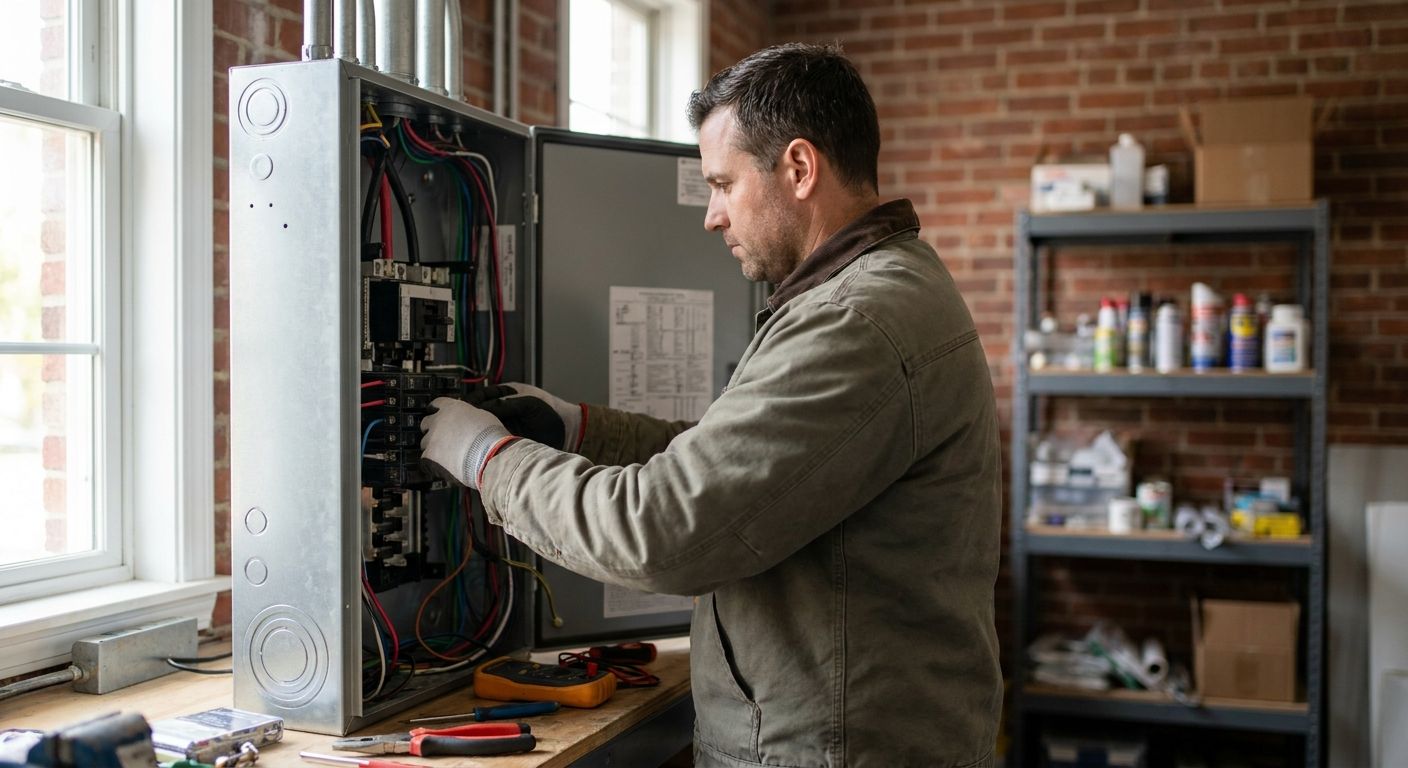
A commercial electrical panel upgrade in NJ becomes necessary the moment your existing service can't carry new equipment, EV chargers, or code-required capacity without tripping breakers or failing inspection. Small NJ businesses move through permitting, utility coordination, and inspection on a different track than a homeowner panel swap, and getting that sequence wrong costs more downtime than the electrical work itself.
- A commercial electrical panel upgrade in NJ typically moves a business from 100A to 200A or 400A service depending on load.
- Spartan Home Pros pulls the permit and coordinates the utility shutdown so a small business avoids a failed inspection in 2026.
- Sub-panels fix one new load; a full service upgrade is required for EV fleets, kitchen equipment, or rooftop HVAC additions.
- Skipping a load calculation is the top reason small NJ businesses get denied a permit or blow breakers within a year.
- Schedule the panel inspection before equipment arrives or a lease renews, not after.
Why panel capacity matters for small NJ businesses
A homeowner panel upgrade is a single-family decision. A commercial electrical panel upgrade in NJ touches a lease, a landlord, an insurance policy, and often a shared building service that other tenants depend on. That changes what a small business owner has to plan for before the electrician shows up.
Commercial occupancy in Monmouth, Middlesex, Somerset, and Union counties gets inspected against the NJ Uniform Construction Code, and inspectors treat retail, food service, and medical space differently than a residence. Restaurants adding walk-in coolers, medical offices adding diagnostic equipment, and retail spaces adding EV chargers for fleet vehicles all push the same panel past its rated capacity in the same way: one new load at a time until the main breaker trips during business hours.
Downtime is the real cost. A residential panel swap can happen while the family is out for the day. A commercial panel upgrade means a business is closed, or running on limited power, during the hours it would otherwise be making money. That's why the sequence of steps below matters more for a business than it does for a house.
Calculate your current and future electrical load
Before anyone touches the panel, get an honest number for what the business is drawing now and what it will draw in 2026 and beyond.
- List every major load: HVAC units, refrigeration, kitchen equipment, POS systems, security systems.
- Add planned additions: EV charging for a company fleet, a backup generator, new rooftop units.
- Check the panel's rated amperage against the sum, not just against what trips today.
- Flag any load that runs continuously versus intermittently — continuous loads size the panel differently.
- Note whether the building is single-tenant or shares a service with other units.
Confirm your municipal permit requirements
Every township in Central NJ runs its own permit and inspection process, and timelines vary more than most business owners expect.
- Pull the permit requirements for your specific municipality before scheduling any work.
- Ask whether a separate utility coordination step (PSE&G or JCP&L) is required for your amperage jump.
- Confirm whether your landlord needs to sign off — many commercial leases require it.
- Check if your certificate of occupancy needs updating after the upgrade.
- Ask how long the local inspector's office is currently taking to schedule a final inspection.
Get a licensed contractor to inspect the existing panel and service
This is where the manual research turns into a real quote, and it's the step where the crew you hire matters as much as the panel itself. Spartan Home Pros sends licensed, payroll technicians for commercial panel work in Central NJ and does not subcontract the job out to a third party — the electrician who inspects your panel is the one who pulls the wire.
- Ask for a written load calculation, not a verbal estimate.
- Confirm the contractor is licensed for commercial work, not just residential.
- Ask who pulls the permit — the contractor should, not the business owner.
- Get a fixed scope of work in writing before any demolition starts.
- Confirm whether the crew is direct-employed or subcontracted.
Schedule utility coordination and the shutdown window
A panel upgrade almost always requires a temporary shutdown, and for a business that means planning around revenue, not convenience.
- Notify your utility provider as soon as the amperage change is confirmed — this step alone can take longer than the physical install.
- Schedule the shutdown for your lowest-traffic hours or a closed day.
- Line up temporary power for anything that can't go dark, including refrigeration and security systems.
- Communicate the closure window to staff and customers in advance.
- Confirm the contractor has a backup plan if the utility reschedules.
Plan for capacity beyond your current equipment
The cheapest mistake to avoid is sizing the new panel for exactly what you need today. Businesses that add an EV charger fleet, a backup generator, or a second kitchen line within a year or two of the upgrade often end up paying for two jobs instead of one.
- Ask the contractor to size for at least one major future addition, not just current draw.
- Reserve breaker space for a generator transfer switch even if you're not installing one yet.
- Confirm the panel supports future EV charger circuits if fleet vehicles are on the roadmap.
- Check whether the service entrance itself (not just the panel) can handle a future amperage jump.
- Get the future-capacity number in writing so it's part of the permit, not an afterthought.
Pass final inspection and update your records
The job isn't done when the power comes back on. It's done when the paperwork closes out.
- Schedule the final municipal inspection and keep the signed permit on file.
- Update your certificate of occupancy if the township requires it.
- Notify your commercial insurance carrier of the upgrade — some policies ask for it.
- Keep an as-built diagram of the new panel for future contractors and inspectors.
- File the permit and inspection records with your lease documents if you're a tenant.
Options for small NJ businesses: which one fits
| Option | Best for | Key limitation |
|---|---|---|
| Sub-panel addition | Adding one new circuit or load, like a single AC unit or EV charger | Doesn't fix an undersized main service |
| Panel swap, same amperage | Old fuse boxes or panels failing inspection with no new load planned | Doesn't add capacity for future growth |
| Full service upgrade (to 200A or 400A) | Restaurants, medical offices, or businesses adding EV fleets or major kitchen equipment | Requires utility coordination and a longer permit review |
| Temporary generator bridge | Businesses that can't absorb downtime during a peak season | Not a permanent fix — the panel upgrade still has to happen |
A sub-panel is the right call when a business is adding exactly one new load and the main service already has room. A full service upgrade is the right call when the business is stacking multiple loads — EV chargers, a generator, and new HVAC — inside the same one or two years. Guessing wrong between the two is the single most expensive mistake on this list.
Get your panel load calculated
Licensed NJ electricians, no subcontracted crews, written scope before any work starts.
Common mistakes small NJ businesses make
- Sizing for today's equipment only. A panel rated for the current kitchen setup often can't absorb the walk-in cooler or EV chargers ordered for later in 2026.
- Hiring on price alone. A subcontracted crew unfamiliar with the local inspector's specific requirements can trigger a failed inspection and a second visit.
- Skipping the landlord conversation. Commercial leases frequently require sign-off before electrical work starts, and skipping it delays the permit, not the electrician.
- Assuming a sub-panel fixes an undersized main service. It doesn't — it just moves the bottleneck one step downstream.
- Not documenting the upgrade for insurance. An updated panel that isn't on file with the carrier can complicate a claim after a fire or water event.
FAQ
What's the difference between a commercial and residential electrical panel upgrade in NJ?
A commercial upgrade in NJ involves lease sign-off, business-hours downtime planning, and inspection under commercial occupancy code, on top of the same permit and utility coordination steps a residential job requires. The electrical work itself is similar; the scheduling and paperwork around it are not.
How long does a commercial electrical panel upgrade take in NJ?
The physical panel swap usually takes one to two days once utility coordination is scheduled, but permit approval and utility scheduling can take longer depending on the township and the utility provider. Plan the shutdown window around that full timeline, not just the install day.
Do I need a permit for a commercial panel upgrade in New Jersey?
Yes. Every municipality in Central NJ requires a permit for a commercial electrical panel upgrade, and the licensed contractor should be the one pulling it. Skipping the permit risks a failed inspection later and can complicate insurance claims.
Can my business stay open during a panel upgrade?
Partial operation is possible if temporary power is arranged for critical systems like refrigeration and security, but the panel itself requires a shutdown window. Most small businesses schedule the work for a closed day or the lowest-traffic hours.
What amperage does a small NJ business need?
It depends on load: a small retail or office space may run fine on 100A to 200A, while a restaurant, medical office, or a business adding EV fleet charging often needs 200A to 400A. A written load calculation is the only reliable way to confirm the right number.
Is a sub-panel enough, or do I need a full service upgrade?
A sub-panel works when you're adding one new load and the main service already has capacity. A full service upgrade is needed when you're stacking multiple additions, like a generator, EV chargers, and new HVAC, within the same year or two.
Who inspects commercial electrical panels in NJ?
The local municipal building department inspects the work under the NJ Uniform Construction Code, and the utility provider (PSE&G or JCP&L, depending on territory) coordinates the service-level changes. Both steps are required before the job closes out.
Does Spartan Home Pros handle commercial panel upgrades in Central NJ?
Yes, Spartan Home Pros is a licensed electrical and HVAC contractor serving commercial and residential customers in Monmouth, Middlesex, Somerset, and Union counties, and does not subcontract the panel work to outside crews.
One last thing
Most small NJ businesses find out they need a commercial electrical panel upgrade only after an EV charger installer or generator technician tells them the existing service can't support the new equipment they already ordered. Get the load calculation done before signing a contract for that equipment in 2026 — it's the one step that turns a two-week job into a two-day one.


