
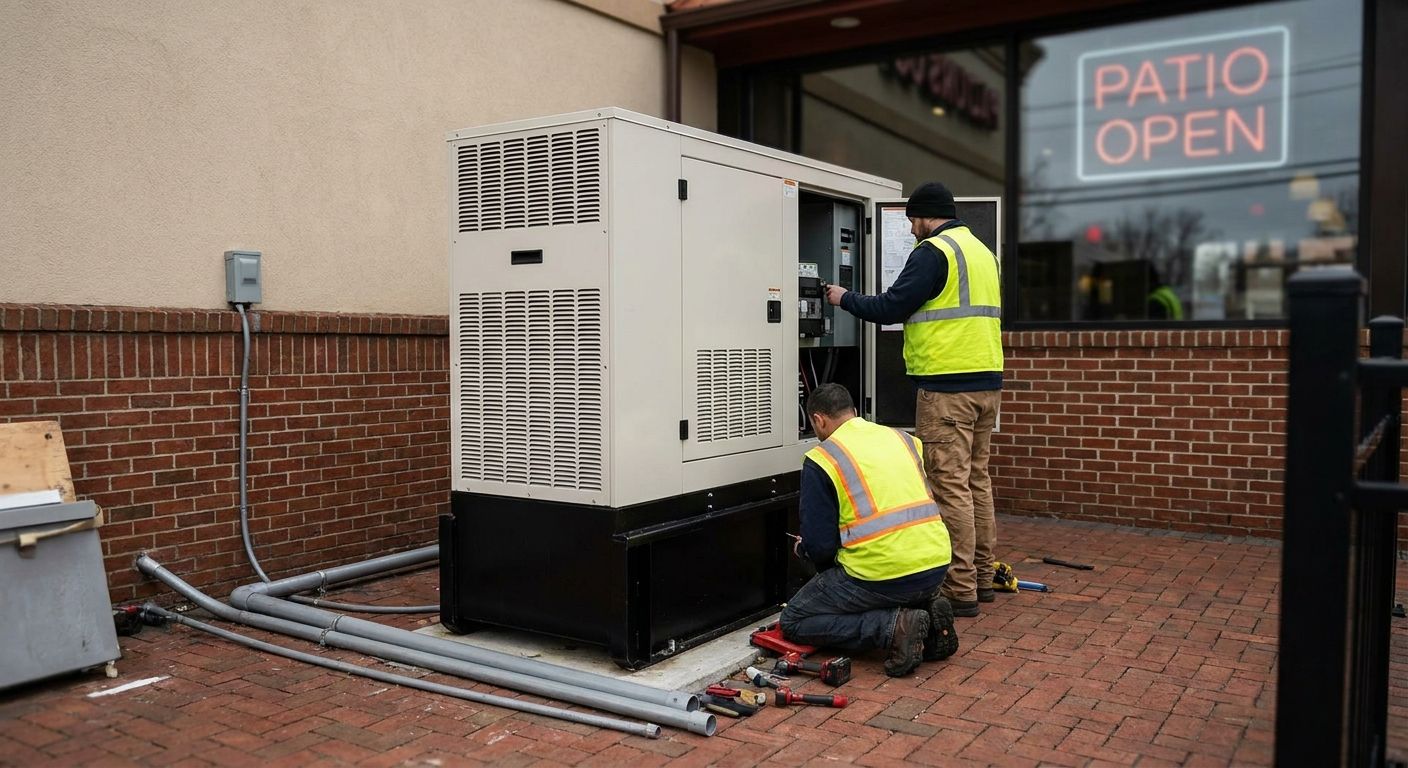
Backup generator installation for NJ restaurants is the process of sizing, permitting, and wiring a standby power system that keeps refrigeration, exhaust hoods, and point-of-sale systems running through a grid outage, with the goal of protecting food inventory and revenue during a shift. A restaurant kitchen pulls far more continuous and surge power than a house of the same square footage. Walk-in compressors, hood exhaust fans, and reach-in coolers all cycle on together, and a generator sized like a homeowner's unit trips the first time the compressors kick on at once.
- Backup generator restaurant NJ installs need enough capacity for walk-ins, hoods, and POS systems, not just dining room lights.
- Automatic transfer switches beat portable units for kitchens that can't staff a manual startup mid-rush.
- Natural gas standby units skip the fuel delivery risk propane and diesel carry during a multi-day 2026 outage.
- Local NJ permits and utility coordination add weeks, so start the load calculation before peak season.
Why backup generator installation matters for NJ restaurants
A walk-in freezer that loses power for four hours can spoil a week of inventory before anyone notices the compressor stopped. New Jersey's food code follows the FDA Food Code standard capping refrigerated storage at 41°F, and a prolonged outage pushes a walk-in past that line fast once the door seal starts losing cold air.
Central New Jersey sees ice storms, nor'easters, and summer grid strain that regularly knock out power for hours at a time. A restaurant that can't run its hood exhaust system can't legally run its cooking line under most local fire codes, which means a power failure shuts the kitchen even if the dining room lights still work. Commercial generator installation for NJ businesses is built around that reality — sizing the unit to the whole operation, not just the parts that are easy to wire.
Calculate your actual kitchen load
Before anyone talks generator size, add up what actually needs to stay on. Most restaurant owners underestimate this because they think about square footage instead of equipment.
- Walk-in cooler and freezer compressors, including startup surge (compressors draw 2-3x their running wattage for the first second)
- Exhaust hood fans and makeup air units required to legally run the cooking line
- Reach-in coolers, ice machines, and beverage coolers
- POS terminals, card readers, and the internet router that keeps them online
- Emergency lighting and exit signage required by fire code
- Water heater or booster heater if the dish pit needs hot water to stay compliant
A rough tally gets you in the ballpark. A formal load calculation catches the surge loads that a simple wattage add-up misses.
Decide what stays on and what waits
Not every circuit needs to run during an outage. Splitting loads into "essential" and "secondary" panels keeps the generator smaller and the fuel bill lower.
- Essential: walk-ins, hood system, POS, emergency lighting
- Secondary: dining room HVAC, décor lighting, non-critical outlets
- Optional: dish machine heat boost, patio heaters
- Skip entirely: signage, marquee lighting, unused prep equipment
Choose your fuel source before you choose a generator
Fuel type drives everything else about the install, including where the unit sits and how fast it starts.
- Natural gas — runs on the existing utility line, no fuel deliveries, ideal for restaurants already on gas service for cooking equipment
- Propane — works where natural gas isn't available, but requires an on-site tank and delivery schedule
- Diesel — common on larger commercial units, needs fuel storage and periodic tank servicing
- Bi-fuel systems — switch between gas and diesel, mostly used on larger installs where redundancy matters more than upfront cost
Most Central New Jersey restaurants already tied into natural gas for the range and ovens land on a natural gas standby unit, since it removes the fuel delivery risk that propane and diesel carry during a multi-day outage.
Pick an automatic transfer switch, not a manual one
A manual transfer switch means someone has to physically start the generator and flip the switch during an outage. That works for a garage. It does not work for a kitchen mid-dinner-rush with a line cook and no manager on site.
An automatic transfer switch senses the outage and starts the generator within seconds, no staff intervention required. For a restaurant, that's the difference between losing five minutes of refrigeration and losing four hours of it because nobody was free to run outside and pull a cord. Spartan Home Pros wires the transfer switch as part of the same install as the generator hookup and the panel work, so the kitchen doesn't sit on a standalone system nobody on staff understands.
Match the switch to your panel capacity
- Confirm your existing electrical panel has room for the transfer switch and generator feed
- Flag any panel that's already full or outdated — a panel upgrade may need to happen before the generator work starts
- Ask whether your building uses a single panel or multiple sub-panels feeding different parts of the kitchen and dining room
- Verify the switch rating matches both the generator output and the panel's amperage
Size the unit to code, not to guesswork
Commercial standby units for restaurants generally run in the 20 kW to 150 kW range depending on kitchen size and equipment count, but the right number for your building comes from the load calculation, not from a neighbor's restaurant or a sales brochure. Undersizing means the unit trips under startup surge the first time two compressors kick on together. Oversizing wastes fuel and installation cost on capacity you never use.
A licensed electrician runs the numbers against your actual equipment nameplates, not estimated averages, before recommending a kW rating.
Handle NJ permitting and utility coordination
Commercial generator installs in Central New Jersey require a local township permit and inspection, and gas-fired units need coordination with the utility on meter capacity. Skipping this step doesn't just risk a fine — it risks an insurance claim getting denied if the system was never inspected.
- Pull the electrical and mechanical permits before installation, not after
- Confirm gas meter capacity with the utility if switching to natural gas
- Schedule the local inspection around your operating hours, not the contractor's
- Keep permit and inspection paperwork on file for your insurance carrier
Spartan Home Pros handles licensed electrical and HVAC work across Monmouth, Middlesex, Somerset, and Union counties, and does not subcontract the install out to a third crew — the technician who runs the load calculation is the one wiring the panel.
Get a restaurant load calculation
Licensed NJ electricians size the generator to your actual kitchen equipment.
Schedule installation around service hours
Generator installs involve panel shutdowns, gas line work, and inspection windows that can't overlap with dinner service. Plan the install for a slow week, not the week before a holiday rush.
- Book the electrical shutdown for a closed day or early morning window
- Confirm the gas utility inspection date before locking in a start date
- Ask your contractor for a written timeline, not a verbal estimate
- Build in a buffer for permit delays, which are common heading into 2026 storm season
Test and maintain the system
A generator that's never tested is a generator you're gambling on. Most standby units run a weekly self-test automatically, but that only checks the engine, not the transfer switch under real load.
- Schedule an annual load-bank test with your installer
- Check fuel lines and connections before storm season each year
- Keep a maintenance log for insurance and warranty purposes
- Replace the battery every 2-3 years regardless of how the unit tests
Comparing backup power options for NJ restaurants
| Option | Best for | Runtime | Key limitation |
|---|---|---|---|
| Portable generator | Very small kitchens, short outages | Limited by fuel tank, needs refueling | No automatic start, someone has to run it manually |
| Natural gas standby | Restaurants already on gas service | Unlimited, tied to utility line | Requires utility meter capacity check |
| Propane standby | Locations without gas utility access | Limited by tank size | Needs on-site tank and delivery schedule |
| Diesel standby | Larger kitchens needing high output | Limited by fuel storage | Requires tank servicing and fuel rotation |
Verdict: for a Central New Jersey restaurant already running gas equipment, a natural gas standby unit with an automatic transfer switch is the setup that survives a multi-day 2026 outage without anyone on staff babysitting it. Buy. Portable units are a stopgap at best — Skip for anything beyond a single-outlet emergency.
Common mistakes NJ restaurant owners make
- Sizing for the dining room, not the kitchen. Owners often size around visible loads like lights and TVs and forget the walk-in compressor surge that actually trips a small unit.
- Choosing manual transfer switches to save money. A manual switch is cheaper upfront and useless during a Friday night rush when nobody can leave the line to start it.
- Skipping the permit timeline. Installing without the local inspection risks an insurance denial if a claim ever comes up.
- Ignoring gas meter capacity. Switching to a natural gas standby unit without confirming utility capacity leads to a mid-install stall.
- Forgetting the hood system in the load count. Fire code often requires the exhaust hood to run before the cooking line can legally operate, and that load gets missed in DIY estimates constantly.
“A generator sized for the dining room and not the walk-in compressor is a generator that fails the first night it's actually needed.”
FAQ
What size generator does a NJ restaurant need?
Most commercial kitchens need somewhere between 20 kW and 150 kW depending on walk-in compressors, hood exhaust, and reach-in coolers. A formal load calculation on your actual equipment nameplates gives the exact number, not a square-footage estimate.
Is a portable generator enough for a restaurant?
A portable generator can keep a single walk-in running short-term, but it requires manual startup and can't handle the combined surge of hood fans, compressors, and POS systems together. Most restaurants need a standby unit with an automatic transfer switch instead.
How much does commercial generator installation cost in NJ?
Cost depends on the kW size, fuel line work, transfer switch, and whether the electrical panel needs an upgrade first. A load calculation and written quote gives an accurate number for your kitchen rather than a ballpark figure.
Do NJ restaurants need a permit for a backup generator?
Yes, commercial generator installs require a local township electrical and mechanical permit, plus an inspection. Gas-fired units also need utility coordination on meter capacity before the install can proceed.
Natural gas or propane generator for a restaurant?
Natural gas is the better fit for restaurants already running gas cooking equipment, since it skips the fuel delivery risk that propane carries during a multi-day outage. Propane makes sense only where gas utility service isn't available.
How fast does an automatic transfer switch kick in during an outage?
An automatic transfer switch senses the power loss and starts the generator within seconds, without anyone on staff needing to intervene. A manual switch, by contrast, requires someone to physically start the unit and flip the switch.
Can a generator run a walk-in freezer and hood system at the same time?
Yes, if the unit is sized correctly for the combined running and startup surge loads of both systems. Undersizing is the most common reason a generator trips when compressors and hood fans cycle on together.
One last thing
The detail most restaurant owners miss until it costs them: compressor startup surge, not running wattage, is what trips an undersized generator. A walk-in compressor that runs at 2 kW can pull 5-6 kW for the first second it starts, and if two compressors happen to kick on together during an outage, that's the moment a generator sized on paper fails in the kitchen. Sizing for surge, not just running load, is the single biggest factor separating a system that survives 2026's storm season from one that doesn't.


