

Central New Jersey sunrooms swing from muggy August afternoons to drafty February mornings, and whatever ceiling fan hangs above the wicker set has to handle both. The best ceiling fans for sunrooms are rated for the room's actual humidity and rain exposure, sized to the square footage, and mounted with enough clearance to move air without clipping anyone's head.
- Damp-rated DC motor fans are the best ceiling fans for sunrooms with humidity but no direct rain exposure.
- Wet-rated fans are required for sunrooms with retractable screens or sides open to wind-driven rain.
- Low-profile hugger fans fit sunrooms with ceilings under 8 feet without cutting airflow.
- Blade span should scale with square footage; undersized fans move less air and run louder.
- A licensed electrician can confirm the sunroom's wiring can carry a fan with an integrated light kit.
Why this matters
A sunroom is not a bedroom with more windows. Glass walls swing the room's temperature and humidity harder than any other space in a Central Jersey house, and a fan rated for dry interior use can corrode or seize inside a season if the room gets muggy or catches blowing rain through a screen.
The wiring matters just as much as the fan. The same licensed process behind ceiling fan installation for NJ bedrooms applies to a sunroom, but the box, the switch loop, and sometimes the circuit itself need a second look before a heavier fan with a light kit goes up on a sloped or vaulted ceiling.
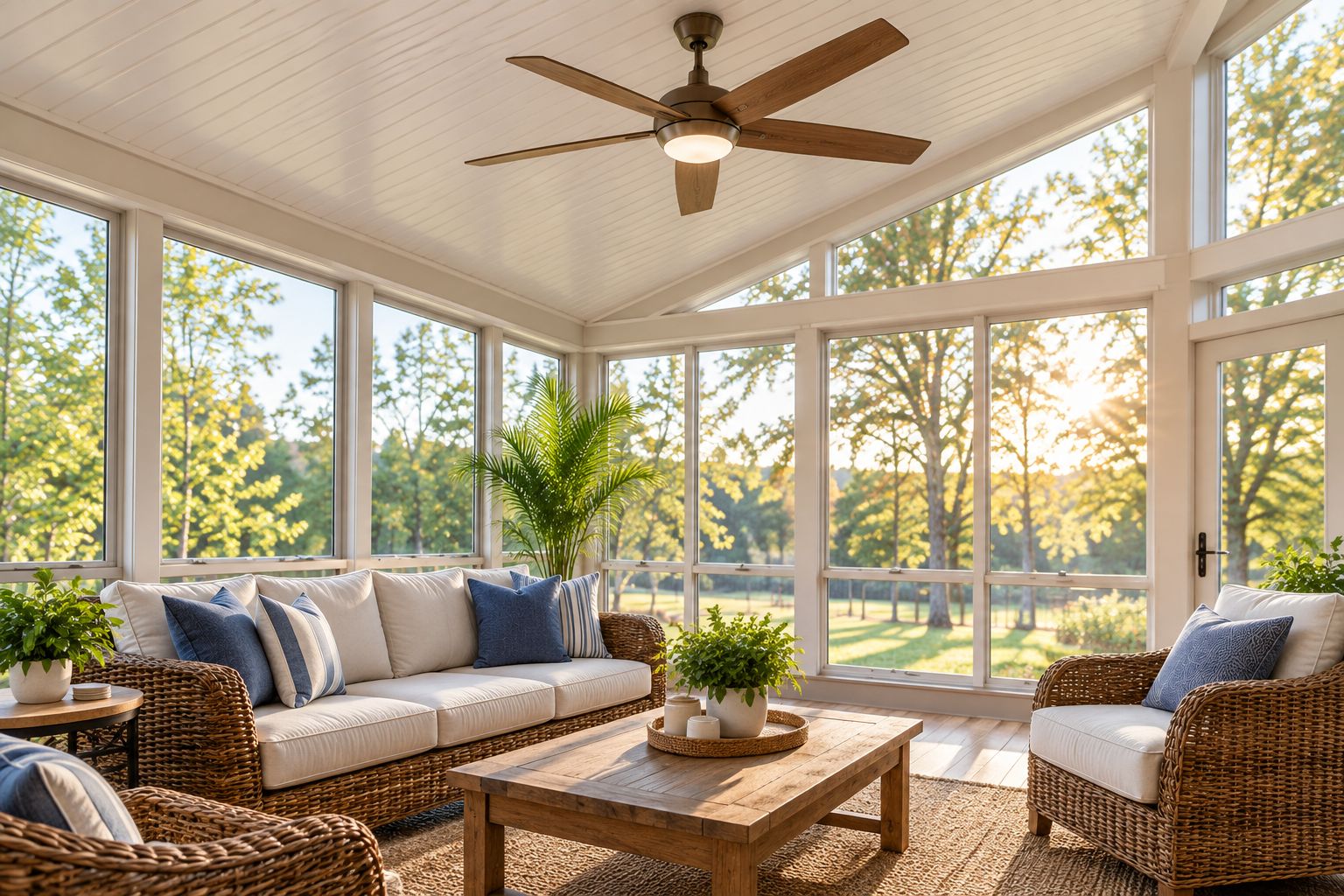
Best overall for most Central NJ sunrooms: damp-rated ceiling fans. They handle the humidity swings of an enclosed, climate-controlled sunroom without the added cost of a fully wet-rated unit. Best for screened or retractable-wall sunrooms: wet-rated, UL-listed-for-wet-locations fans. Best for low or vaulted ceilings under 8 feet: low-profile hugger fans.
What makes the best ceiling fan for a sunroom
- UL damp or wet rating matched to how exposed the room is to moisture and blowing rain
- Motor type — DC motors run quieter and cost less to operate at low, all-day speeds than standard AC motors
- Blade span sized to the room — smaller spans (36 to 42 inches) suit rooms under 175 square feet, larger spans (52 inches and up) suit rooms over 350 square feet
- Mounting clearance — 7 feet of floor clearance is the standard minimum, tighter on sloped sunroom ceilings
- Light kit compatibility if the sunroom doubles as an evening sitting room
- Reversible motor for winter downdraft and summer updraft airflow
Best ceiling fans for sunrooms at a glance
| Fan type | Best for | Standout feature | Key limitation |
|---|---|---|---|
| Damp-rated | Enclosed, climate-controlled sunrooms | Handles humidity without a wet-rating premium | Not built for direct rain contact |
| Wet-rated | Screened or retractable-wall sunrooms | Sealed for wind-driven rain and full outdoor exposure | Fewer style and finish options |
| DC motor | Year-round, all-day airflow | Quiet at low speed, lower running cost | Higher upfront unit cost than AC |
| Low-profile hugger | Ceilings under 8 feet | Flush mount clears heads on sloped ceilings | Moves less air than a downrod-mounted fan |
| LED light kit | Sunrooms used as evening living space | Built-in dimmable lighting, no second fixture | Adds load to the circuit and switch |
| Smart/remote | High or cathedral ceilings | Speed and light control without a pull chain | Depends on a hub or app for full features |
1. Damp-rated fans: best for enclosed, climate-controlled sunrooms
A damp-rated fan is built to resist moisture in the air without needing to survive direct rain or spray. Most fully enclosed Central New Jersey sunrooms — sealed windows, no retractable screens — fall into this category even during humid summer stretches.
Damp-rated fans pros:
- Wider selection of finishes and blade materials than wet-rated units
- Handles seasonal humidity swings without corrosion
- Usually lower cost than an equivalent wet-rated fan
Damp-rated fans cons:
- Not rated for direct rain or spray exposure
- Motor components can still corrode if the room stays consistently damp with poor ventilation
Best for: enclosed, sealed sunrooms with humidity but no open-air exposure. Verdict: Buy.
2. Wet-rated fans: best for screened or retractable-wall sunrooms
A wet-rated fan is UL-listed for wet locations — sealed motor housing, corrosion-resistant hardware, weatherproof blades. If the sunroom has retractable screens, sliding glass walls, or sides that open fully to the yard, this is the category that survives.
Wet-rated fans pros:
- Rated for direct rain and standing moisture exposure
- Corrosion-resistant hardware holds up through NJ winters and salt air near the Shore
- Doubles as an option for the outdoor patio or porch ceiling fan installation side of a three-season room
Wet-rated fans cons:
- Narrower range of decorative finishes than damp-rated units
- Overkill (and unnecessary cost) for a fully enclosed sunroom with sealed glass
Best for: sunrooms with retractable screens or open sides. Verdict: Buy if the room opens to the outside; Skip if it's fully enclosed.
3. DC motor fans: best for year-round, all-day airflow
DC motor fans use a smaller, more efficient motor than traditional AC units, which matters in a sunroom that runs at low speed most of the day for gentle circulation rather than a max-speed summer blast.
DC motor fans pros:
- Noticeably quieter at low speeds — matters in a room used for reading or relaxing
- Lower running cost over months of daily use
- Finer speed control, often with more than the standard 3 settings
DC motor fans cons:
- Higher unit cost than a comparable AC motor fan
- Fewer damp- and wet-rated DC options on the market than AC options
Best for: sunrooms where the fan runs most of the day, not just on hot afternoons. Verdict: Buy.
4. Low-profile hugger fans: best for ceilings under 8 feet
Many NJ sunroom additions have a sloped or lower ceiling than the main house. A hugger-style fan mounts flush to the ceiling instead of hanging from a downrod, preserving the 7-foot minimum floor clearance that a standard-mount fan can't hit in a tight space.
Hugger fans pros:
- Fits ceilings as low as 8 feet without clearance violations
- Works on sloped ceilings with the right mounting bracket
Hugger fans cons:
- Moves noticeably less air per rotation than a downrod-mounted fan of the same blade span
- Limited to smaller blade spans in most low-ceiling applications
Best for: sunrooms with ceilings under 8 feet or steep slopes. Verdict: Buy for low ceilings; Hold if the ceiling clears 9 feet or more — a standard downrod fan will move more air.
5. Fans with integrated LED light kits: best for evening-use sunrooms
A fan with a built-in dimmable LED kit replaces a separate overhead fixture, which matters in a sunroom used as an evening sitting or dining space rather than a daytime-only room.
Light kit fans pros:
- One fixture instead of two — fan and light in a single ceiling box
- Dimmable LED kits cut lighting costs versus incandescent fixtures
Light kit fans cons:
- Adds electrical load to the circuit and often requires a compatible dual-function switch
- Heavier fixture weight means the ceiling box needs to be fan-rated, not just light-rated
Best for: sunrooms doing double duty as an evening living space. Verdict: Buy if the box and circuit support it — confirm before ordering.
6. Smart and remote-controlled fans: best for high or cathedral ceilings
A sunroom with a cathedral ceiling or a skylight often puts the fan out of reach of a pull chain. Remote and app-controlled fans solve that without a wall switch retrofit.
Smart fans pros:
- Full speed and light control from a remote or phone, no reaching a pull chain
- Some models integrate with existing smart home systems
Smart fans cons:
- App-based models depend on a hub or Wi-Fi connection to unlock full features
- Remote controls can get lost in a room with a lot of seating and storage
Best for: sunrooms with high, cathedral, or skylight ceilings. Verdict: Buy for hard-to-reach installs; Hold for standard 8-to-9-foot ceilings where a pull chain works fine.
How the ranking works
Damp/wet rating and mounting clearance carry the most weight because they're safety and durability issues, not preference — a fan installed outside its rating will corrode or fail early. Motor type, light kits, and remote control are ranked as fit-for-use factors layered on top of the rating and clearance baseline. The same logic that ranks attic fans for NJ summers by airflow and moisture exposure applies here: match the equipment to the room's actual conditions, not the room's square footage alone.
Which ceiling fan should you choose?
For most fully enclosed Central New Jersey sunrooms, a damp-rated DC motor fan is the default pick for 2026 — it handles humidity, runs quietly at low speed all day, and costs less to operate than an AC motor equivalent. Move to a wet-rated fan the moment the room has retractable screens or a wall that opens to the outside. Drop to a low-profile hugger if the ceiling sits under 8 feet, and add a light kit only if the room's wiring and ceiling box can carry the extra load.
Get your sunroom fan installed right
Licensed electricians handle mounting, clearance, and wiring for damp- and wet-rated fans.
FAQ
What's the best ceiling fan for a NJ sunroom?
A damp-rated DC motor fan is the best ceiling fan for a fully enclosed, climate-controlled sunroom in 2026. Switch to a wet-rated fan if the room has retractable screens or sides open to the outside.
Is a damp-rated fan enough for a screened sunroom?
No — a screened sunroom exposed to wind-driven rain needs a wet-rated, UL-listed-for-wet-locations fan. Damp-rated fans handle humidity but not direct rain contact.
Can I install a wet-rated fan in a dry indoor sunroom?
Yes, a wet-rated fan works fine indoors, but it costs more and offers fewer finish options than a damp-rated fan built for the same enclosed room.
How big should a ceiling fan be for a sunroom?
Blade span should scale with the room: 36 to 42 inches for rooms under 175 square feet, and 52 inches or larger for rooms over 350 square feet. An undersized fan moves less air and runs louder to compensate.
Do sunroom ceiling fans need a dedicated circuit?
Not always, but older sunroom additions often run on a shared circuit that wasn't sized for a fan with a light kit. A licensed electrician can check the panel and add a dedicated circuit if the load requires it.
Can a licensed electrician install a ceiling fan in an existing sunroom?
Yes, and the ceiling box usually needs to be fan-rated rather than light-rated before the fan goes up, especially on a sloped or vaulted sunroom ceiling.
Should sunroom fans run clockwise or counterclockwise?
Counterclockwise in summer pushes air down for a cooling breeze; clockwise at low speed in winter pulls warm air off the ceiling and redistributes it without a direct draft.
How high should a ceiling fan hang in a sunroom?
7 feet of floor clearance is the standard minimum. On ceilings under 8 feet, a low-profile hugger fan is the only option that meets that clearance.
One last thing
Most homeowners only reverse their fan for summer cooling and forget the winter setting entirely. Running the fan clockwise at low speed once the heat kicks on pulls the warm air that collects near a sunroom's glass ceiling back down into the room, which matters more in a sunroom than anywhere else in the house because glass loses heat faster than drywall.


