
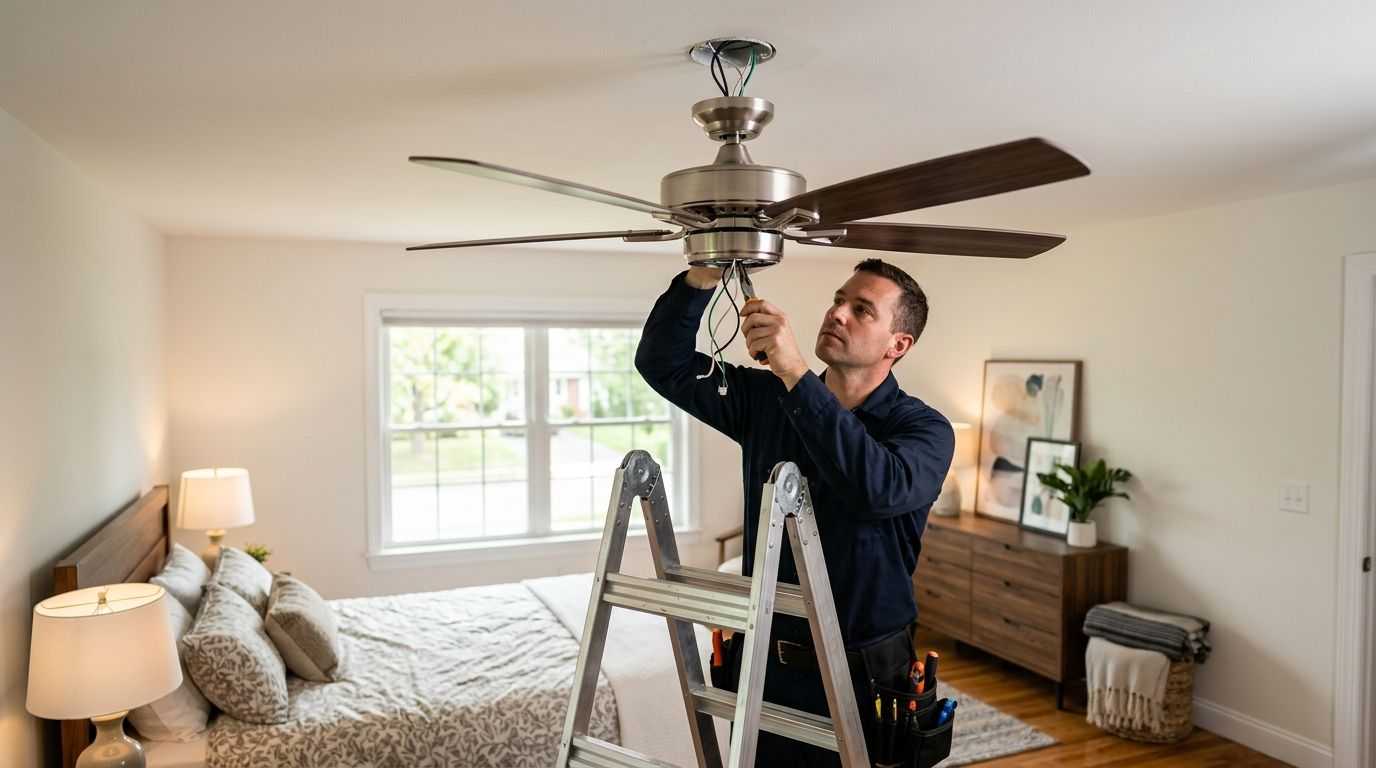
Ceiling fan installation for bedrooms in New Jersey homes means matching the fan to a properly rated ceiling box, sizing the blade span to the room, and wiring separate controls for the fan and light kit. Bedrooms need quieter motors and dimmable lighting more than a kitchen or family room does, and that changes what counts as a correct install.
- Ceiling fan installation for bedrooms in NJ requires a fan-rated electrical box holding at least 70 lbs — a standard light box is not enough.
- Bedroom fans should span 44-52 inches for rooms 145-225 sq ft; oversized fans in small bedrooms create wind noise that disrupts sleep.
- NEC requires at least 84 inches of floor-to-blade clearance, which matters in NJ homes with 8-foot ceilings.
- Spartan Home Pros installs bedroom ceiling fans with licensed electricians in Monmouth, Middlesex, Somerset, and Union counties.
- Skip a box swap and you risk a fan that wobbles loose from the ceiling over time.
Why ceiling fan installation matters for NJ bedrooms
Most bedroom fan complaints trace back to the box, not the fan. A ceiling light fixture is typically hung from a flat "pancake" box rated to hold a few pounds of glass and wire — not a spinning motor and blade assembly that can weigh 15 to 25 lbs and generates constant vibration. If you're not sure whether your existing circuit can even support a new fan and light load, check whether your electrical panel needs an upgrade before you buy anything.
Bedrooms also have a control problem kitchens don't: you want the fan on a separate switch from the light, and you usually want the light on a dimmer for reading versus sleeping. Builder-grade wiring in most NJ homes built before 2010 ties both to one switch loop, which means rewiring, not just fixture swapping.
“If the ceiling box wobbles when you push up on it by hand, it is not fan-rated, and nothing gets hung from it until that changes.”
How to install a ceiling fan in an NJ bedroom
Check your existing electrical box
Before anything else, find out if the box already there can legally and safely hold a fan.
- Push firmly up on the existing fixture — any wobble means it's not fan-rated
- Look for a stamp reading "acceptable for fan support" or a UL 1994 marking on the box itself
- Confirm the box is secured to a joist or a fan-rated brace bar, not just drywall
- Check the wire gauge feeding the box — 14-gauge is standard for a 15-amp bedroom circuit
- If there's no existing ceiling fixture at all, budget for new cable run and box installation, not just a swap
Size the fan to the room
Bedroom fans get oversized more often than any other room type, mostly because buyers shop by "bigger looks better."
- Rooms under 75 sq ft: 29 to 36-inch blade span
- Rooms 76 to 144 sq ft: 36 to 42-inch blade span
- Rooms 145 to 225 sq ft: 44 to 52-inch blade span
- Rooms over 225 sq ft: 50 to 72-inch blade span, sometimes two fans
- Measure ceiling height and pick a flush-mount or short downrod for ceilings under 8 feet, since NEC requires at least 84 inches of blade clearance from the floor
Decide fan and light control setup
A bedroom is the one room in the house where the wrong switch setup gets noticed every single night.
- Dual switch: separate wall switches for fan speed and light — simplest and cheapest to wire
- Remote control kit: works with existing single-switch wiring, no new switch box needed
- Smart wall control: app or voice control, requires a neutral wire at the switch box
- Wall control with dimmer: lets you dim the light independent of fan speed
- Pull-chain only: lowest cost, worst option for a bedroom because it means getting out of bed to adjust
Match the light kit to a dimmer
Skipping this step is why so many bedroom fan lights hum or flicker at low settings.
- Confirm the fan's light kit uses LED-compatible dimming, not just incandescent-rated
- Match the dimmer switch to the bulb type — a standard incandescent dimmer on LED bulbs causes buzzing
- Use a trailing-edge LED dimmer for the smoothest low-end dimming
- Test the dimmer at its lowest setting before finishing the install, not after
Run wiring and swap the ceiling box
This is where most DIY bedroom fan installs stop being a weekend project. Swapping a flat box for a fan-rated brace bar box usually means opening drywall around the existing hole, and adding a second switch leg means fishing new wire through a finished ceiling and wall.
- New fan-rated box (UL 1994) rated for at least 70 lbs, secured to a joist or brace bar
- New 14/3 cable run if you're adding a separate switch for fan speed control
- A dedicated neutral at the switch box if you're installing smart controls
- Licensed electrical work if the circuit is being modified, which NJ code requires for anything beyond a straight fixture swap
Spartan Home Pros handles this step directly with licensed electricians serving Monmouth County and the surrounding Central NJ counties, pulling permits when the township requires them for new circuit work.
Mount, balance, and test rotation
Once the box and wiring are set, the physical mount takes less time than everything before it.
- Attach the fan bracket to the box, then hang the motor housing on the bracket hook before wiring
- Balance the blades with the included balancing kit if you feel any wobble at full speed
- Set the direction switch: counterclockwise for summer cooling, clockwise for winter heat circulation
- Run the fan at all speeds for at least 10 minutes to check for noise or wobble before closing up
Get final inspection if a permit was pulled
Any job that involved a new circuit or a new switch leg needs a township inspection to close the permit.
- Schedule the rough-in inspection before drywall goes back up, if walls were opened
- Schedule the final inspection once the fan is mounted and running
- Keep the inspection sign-off with your home records — it matters at resale and for insurance claims
Ceiling fan installation options for NJ bedrooms compared
| Option | Best for | Key limitation |
|---|---|---|
| DIY fixture swap (existing fan-rated box) | Homeowners replacing a fan with another fan on the same box | Only works if the box is already fan-rated — most aren't |
| Handyman install, no license | Simple one-for-one swaps with no wiring changes | Not licensed to modify circuits; can't pull a permit if code requires one |
| Licensed electrician install | Any bedroom needing a new box, new switch leg, or dimmer wiring | Requires scheduling and, on permitted work, an inspection |
| Big-box store installation service | Basic swaps with no electrical changes | Often subcontracted, limited to fixture-only work |
Verdict: if the ceiling box isn't already fan-rated or you want a separate dimmer for the light, a licensed electrician install is the only option that's actually code-compliant in 2026. Anything less is a fixture swap dressed up as an installation.
Get your bedroom fan wired right
Licensed electricians for panel checks, new circuits, and fan-rated box installs.
Common mistakes NJ homeowners make with bedroom ceiling fans
- Hanging a fan from a light-only box. The box holds for a while, then loosens from vibration — this is the single most common bedroom fan failure Spartan Home Pros sees on service calls.
- Buying a 52-inch fan for a 10x10 bedroom. The blades move too much air too close to the bed, and the motor works harder than it needs to.
- Wiring the fan and light to one switch. You lose the ability to run air circulation overnight without the light on, which defeats the point of a bedroom fan.
- Ignoring blade clearance on 8-foot ceilings. A standard downrod plus a large fan can put blades under the 84-inch NEC minimum, which is a safety issue and a code violation.
- Skipping the permit on new wiring. Township inspectors do catch unpermitted switch-leg work at resale inspections, and it becomes the buyer's leverage, not yours.
FAQ
What size ceiling fan is best for a bedroom?
Match blade span to square footage: 29-36 inches for rooms under 75 sq ft, 36-42 inches for 76-144 sq ft, and 44-52 inches for 145-225 sq ft. Oversized fans in small bedrooms create excess air movement and noise that disrupts sleep.
Can I install a ceiling fan where a light fixture used to be?
Only if the existing box is rated for fan support, which most standard light boxes are not. A fan-rated box (UL 1994) rated for at least 70 lbs is required before hanging any ceiling fan.
Do I need a permit to install a ceiling fan in NJ?
A straight fixture swap on an existing fan-rated box usually doesn't require a permit, but adding a new circuit or switch leg does in most Central NJ townships. Check with your local building department or ask the electrician doing the work.
How much clearance does a bedroom ceiling fan need?
The NEC minimum is 84 inches from floor to blade tip. On an 8-foot ceiling, that limits downrod length and pushes many homeowners toward a flush-mount fan instead.
Can I install a ceiling fan myself?
You can if the box is already fan-rated and no new wiring is involved. Anything beyond a fixture-for-fixture swap, including a new switch or dimmer circuit, needs a licensed electrician in New Jersey.
Which direction should a bedroom ceiling fan spin?
Counterclockwise in summer pushes air down for a cooling effect, and clockwise in winter pulls air up to redistribute warm air along the ceiling. Most fans have a direction switch on the motor housing.
How long does bedroom ceiling fan installation take?
A straight swap on an existing fan-rated box takes under an hour. A box replacement with new wiring for a separate fan and light switch typically runs a half-day, including drywall patching if walls were opened.
Is a smart ceiling fan control worth it in a bedroom?
Smart wall controls let you dim the light and set fan speed by app or voice without a pull chain, but they require a neutral wire at the switch box. If that wire isn't already there, it adds to the wiring scope.
One last thing
The box question decides everything else about a bedroom fan install, and it's the one thing most homeowners never check before buying a fan. Push up on your existing fixture before you order anything — if it moves, budget for a fan-rated box swap, not just a fixture upgrade, and plan the job around 2026 code requirements for switch wiring and blade clearance rather than around whatever the fixture looked like when the house was built.


