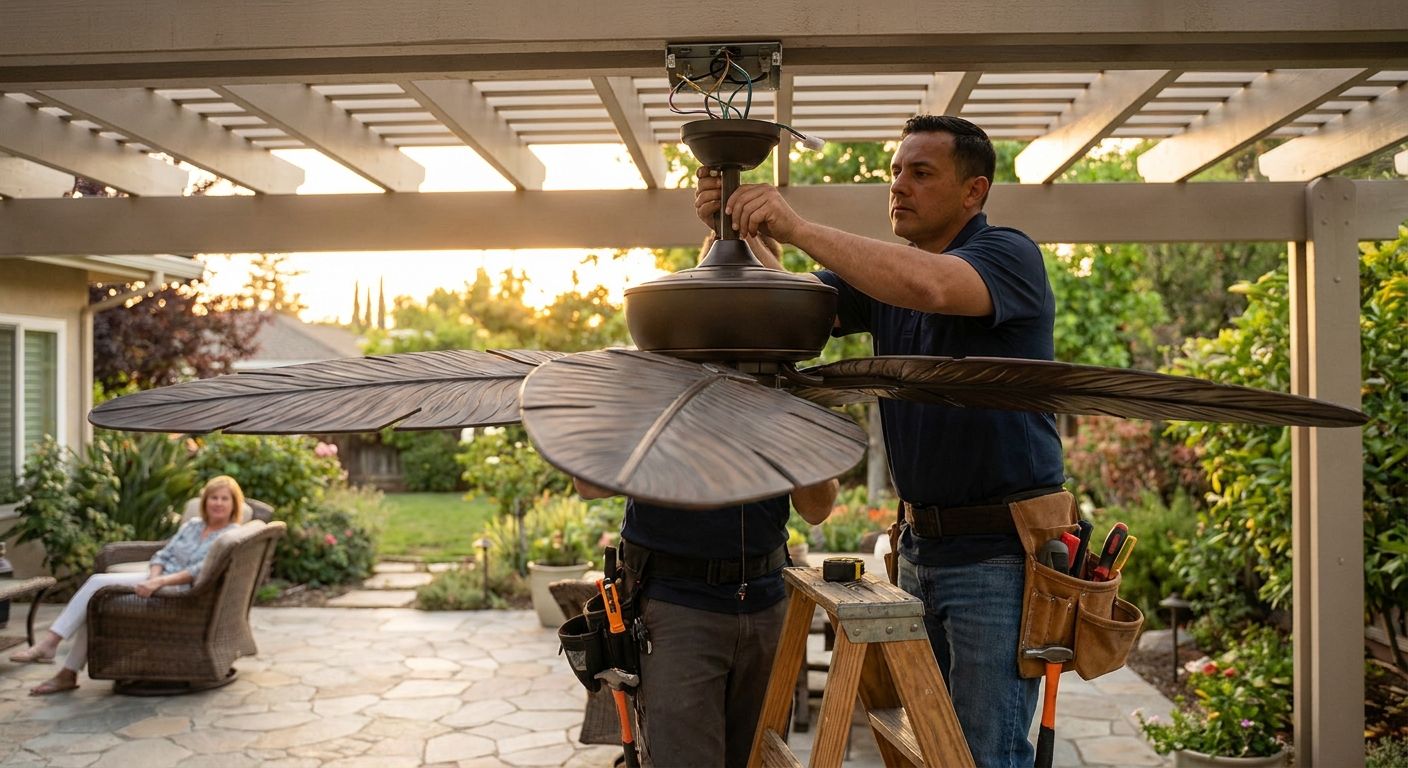
Patio and porch ceiling fan installation is the process of wiring, mounting, and running a wet- or damp-rated ceiling fan on a covered outdoor living space so the area stays usable through New Jersey's humid summers. A porch fan is not the same job as an indoor fan swap: the electrical box, the wire insulation, and the fan motor housing all need an outdoor rating, and most existing porch light boxes weren't built to carry a spinning fan's weight or vibration.
- Outdoor ceiling fan installation on a covered NJ porch needs a wet- or damp-rated fan, never an indoor fixture.
- Existing porch light boxes rarely support fan weight and motion — most need a new fan-rated box.
- Panels under 100 amps often can't add a dedicated fan circuit without an upgrade first.
- Spartan Home Pros pulls permits and runs dedicated circuits for outdoor fan installs across Central NJ in 2026.
- Wet-rated fans handle direct rain on open patios; damp-rated fans are for covered, enclosed porches only.
Why outdoor ceiling fan installation matters for patio and porch owners
A patio or porch in Monmouth, Middlesex, Somerset, or Union County sits outside for six to seven months a year, and NJ summer humidity makes a still, unmoving porch nearly unusable by July. That's the whole reason homeowners search for outdoor ceiling fan installation instead of just buying a fan off a shelf — the install, not the fan, is the hard part.
The electrical side is where most porch fan projects go wrong. An outdoor circuit needs GFCI protection, the box needs a UL rating for fan support, and the panel needs open capacity for another load. Spartan Home Pros handles all three as a licensed electrical contractor, and doesn't subcontract the wiring work out to someone else.
Check your patio's covered-vs-open rating first
Before picking a fan, look at how exposed the space actually is. This step costs nothing and takes ten minutes with a tape measure.
- Measure the roof overhang — anything under 2 feet of coverage usually counts as exposed to wind-driven rain
- Count how many sides are enclosed by walls or screens (2+ enclosed sides usually qualifies as "covered")
- Check for direct sun and heat buildup under metal or dark shingle roofing, which shortens motor life
- Note salt air exposure if you're within a few miles of the Jersey Shore — it corrodes housings faster
Confirm your panel and circuit can handle the load
A ceiling fan draws less power than most appliances, but the circuit it lands on and the panel behind it matter more than the fan itself.
- Check your panel's rated amperage on the door label — 100-amp panels in older NJ homes are often already near capacity
- Count how many circuits already run to outdoor outlets, security lighting, or a pool pump
- Look for double-tapped breakers or a panel that's warm to the touch, both signs of an overloaded system
- Flag Federal Pacific or Zinsco panel brands immediately — both are known failure points that should be replaced, not added to
If the panel can't take another circuit safely, that's a separate job before the fan goes in. Spartan Home Pros walks through the signs a panel needs an upgrade, and a licensed electrician can confirm capacity on-site in under an hour.
Choose a fan rated for your specific space
"Outdoor-rated" isn't one category — UL splits it into damp-location and wet-location ratings, and picking wrong is the single most common mistake on this list.
- Damp-rated fans are built for covered, enclosed porches protected from direct rain and blowing moisture
- Wet-rated fans are sealed against direct rain and are the only correct choice for open patios, pergolas, and gazebos
- Look for a UL or ETL damp/wet listing on the fan's spec sheet, not just marketing copy calling it "outdoor"
- Match blade material to exposure — ABS or resin blades resist warping better than plywood veneer on humid porches
- Check motor housing sealing if the porch faces prevailing wind off the water
Install a fan-rated outdoor box and confirm mounting height
The box holding the fan is doing structural work, not just electrical work, and it needs to be rated for it.
- Confirm the electrical box carries a fan-rated weight listing, typically 35-70 lbs depending on fan size
- Old porch light boxes almost never carry this rating and need to be swapped, not reused
- Keep at least 7 feet of clearance from the fan blades to the porch floor
- Maintain 18-24 inches of clearance from blade tips to any wall, beam, or column
- Use a weatherproof gasket at the ceiling penetration to keep moisture out of the box over time
Run new wiring and add a dedicated switch or remote control
Once the box and rating are settled, the wiring path and controls are the next decision point.
- Decide between a wall switch loop, a remote receiver, or a smart control tied into existing porch lighting
- Confirm the circuit runs through a GFCI breaker or outdoor-rated GFCI outlet — this is required on exterior circuits
- Use outdoor-rated wire (UF-B or in conduit) for any run exposed to the elements, not standard NM cable
- If the run is long — say, from the panel to a detached gazebo — upsize the wire gauge to avoid voltage drop
A patio addition or new porch build is often the right time to plan this wiring alongside broader electrical work. Spartan Home Pros covers panel planning for additions where an outdoor fan circuit is just one piece of a bigger project.
Weatherproof every connection before closing it up
Moisture intrusion is the number-one cause of outdoor fan failure within the first two summers, and it's almost always a sealing problem, not a fan defect.
- Use outdoor-rated wire nuts or heat-shrink connectors at every splice
- Silicone-seal any ceiling or wall penetration where wire enters the box
- Confirm the fan's own junction box cover has an intact gasket before final assembly
- Schedule the local permit inspection before covering the work — NJ municipalities generally require one on new outdoor circuits
A screened or covered porch is also a natural spot to add recessed lighting alongside a fan install, since both jobs share the same wiring run. Spartan Home Pros installs both on the same service call when a homeowner is already opening up the ceiling.
Test, balance, and maintain the fan seasonally
Installation isn't done until the fan runs clean at every speed.
- Run the fan on high, medium, and low, checking for wobble at each speed
- Tighten blade-arm screws after the first week — most factory hardware loosens slightly during break-in
- Inspect the housing and blade edges each spring for corrosion, especially near the shore
- Clean dust and pollen buildup from the motor housing before peak summer use
Get your porch fan wired right
Licensed NJ electricians handle the panel check, circuit, and install in one visit.
Comparison: outdoor ceiling fan installation options
| Option | Best For | Key Limitation |
|---|---|---|
| DIY fan swap on an existing rated box | Homeowners replacing a fan on a box already rated for fan weight | Unsafe and often against code if the box isn't fan-rated |
| New dedicated circuit to a covered porch | Porches with no existing outlet or fixture nearby | Requires open panel capacity and usually a permit |
| Damp-rated fan | Screened or fully enclosed porches protected from rain | Not rated for direct rain or wind-driven spray |
| Wet-rated fan | Open patios, pergolas, gazebos, exposed decks | Fewer style and finish options than damp-rated fans |
| Licensed electrician install | Any job needing new wiring, panel work, or a permit pull | Requires scheduling a licensed service visit |
Spartan Home Pros installs outdoor ceiling fans on covered porches and open patios across Central NJ, and pulls the permit and handles the panel check as part of the same job.
Common mistakes patio and porch owners make
- Installing a damp-rated fan on an open pergola — wind-driven rain gets past the roof structure and the motor isn't sealed for it
- Reusing an old porch light box for the fan — most light boxes aren't rated for fan weight or the vibration of a running motor
- Skipping the permit on a new outdoor circuit — NJ home inspections at resale flag unpermitted electrical work regularly
- Undersizing the wire gauge on a long run — a detached gazebo or far corner of a patio needs upsized wire to avoid voltage drop
- Mounting too low under a beam — 8-foot porch ceilings need careful clearance math or the fan ends up too close to head height
FAQ
What's the best ceiling fan for an outdoor patio in NJ?
A wet-rated ceiling fan is the correct choice for any open patio, pergola, or gazebo exposed to direct rain. Damp-rated fans only work on fully covered, enclosed porches protected from blowing moisture.
Is a damp-rated fan the same as a wet-rated fan?
No. Damp-rated fans handle humidity and occasional light moisture but not direct rain, while wet-rated fans are sealed for direct exposure. Installing a damp-rated fan in an open, exposed spot shortens its motor life fast.
How much clearance does an outdoor ceiling fan need?
Keep at least 7 feet of clearance from the blades to the floor and 18-24 inches from the blade tips to any wall or beam. Low porch ceilings around 8 feet often need a flush-mount fan to hit these clearances.
Can I install an outdoor ceiling fan on an existing porch light box?
Usually not. Standard exterior light boxes aren't rated to carry a fan's weight or handle the vibration of a running motor, so most installs need a new fan-rated box.
Do I need a permit to install an outdoor ceiling fan in New Jersey?
Yes, new outdoor circuits generally require a permit and inspection in NJ municipalities. Skipping it is a common issue that surfaces during home resale inspections.
Can my electrical panel handle a new outdoor fan circuit?
It depends on the panel's rated amperage and how many circuits are already in use. Older 100-amp panels in NJ homes are often near capacity and need an upgrade before adding another outdoor circuit.
Does an outdoor ceiling fan need GFCI protection?
Yes, exterior circuits require GFCI protection either at the breaker or at an outdoor-rated GFCI outlet in the circuit path. This is a code requirement, not optional hardware.
One last thing
The damp-versus-wet distinction isn't a marketing label — it's a UL testing classification, and the fan's spec sheet will list one or the other explicitly. If a listing just says "outdoor" with no UL or ETL rating shown, that's the first red flag before price ever enters the conversation.