
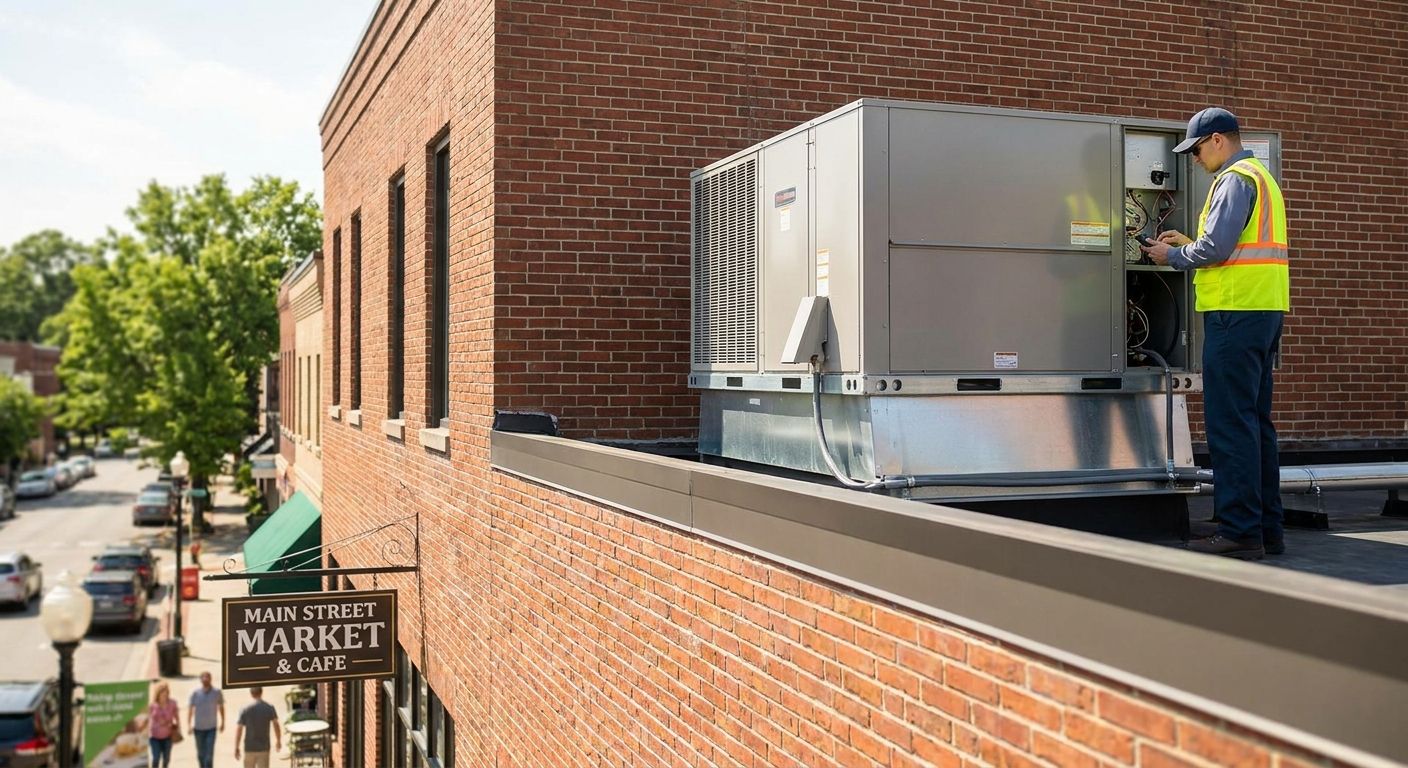
Picking the right commercial HVAC system for a small business in Central New Jersey comes down to building type, ductwork, and how many zones need separate control — not brand names. The best commercial HVAC system for most small businesses in 2026 is a packaged rooftop unit (RTU) if you own a standalone building; a ductless mini-split system if you're renting a space with no existing ductwork; and a VRF system if you've got multiple tenants or rooms needing heating and cooling at the same time.
- Packaged rooftop units win for standalone NJ retail and office buildings needing one combined heating/cooling/ventilation system.
- Ductless mini-splits are the best commercial hvac system small business owners choose when there's no existing ductwork.
- VRF systems handle simultaneous heating and cooling across different zones — the right call for multi-tenant buildings.
- PTAC units are the budget pick for single rooms but don't scale past a few thousand square feet.
- Any system you install in 2026 needs an electrical panel rated to handle the added load — check capacity before you sign a contract.
Why this matters
A failed rooftop unit in July doesn't just cost comfort — it costs sales, foot traffic, and in restaurants, inventory. Small business owners in Monmouth, Middlesex, Somerset, and Union counties are dealing with buildings that range from 1960s strip-mall storefronts with no ductwork to newer office suites with panels already maxed out by lighting and point-of-sale equipment.
The HVAC system that works for a hair salon in a converted rowhouse is not the system that works for a 6,000-square-foot warehouse office. Matching the system type to the building — not chasing the highest SEER rating on paper — is what keeps commercial HVAC installs in Central NJ from becoming callback jobs. Before any equipment goes in, check whether the electrical panel upgrade for small NJ businesses is even necessary — undersized panels are the number one reason commercial HVAC installs stall mid-project in older NJ commercial buildings.
What makes the best commercial HVAC system for a small business
- Zoning flexibility — can the system heat one area while cooling another without added equipment
- Ductwork compatibility — does the building already have ducts, or does the system need to work around exposed ceilings and finished walls
- Electrical load — does the existing panel support the added amperage, or does it trigger a panel upgrade
- Maintenance access — rooftop vs. wall-mounted vs. in-room units each carry different service intervals and access requirements
- Operating cost over a NJ heating season — winters in Central NJ run cold enough that heat pump performance and backup heat matter
- Local permit and code requirements — commercial HVAC installs in NJ townships require inspection sign-off before equipment goes live
Commercial HVAC systems at a glance
| System | Best For | Standout Feature | Key Limitation |
|---|---|---|---|
| Packaged Rooftop Unit (RTU) | Standalone retail and office buildings | Heating, cooling, and ventilation combined in one unit | Needs roof access and structural load capacity |
| Ductless Mini-Split System | Buildings with no existing ductwork | Zone-by-zone temperature control | Cost climbs fast with each added zone |
| Variable Refrigerant Flow (VRF) | Multi-tenant or multi-zone office buildings | Simultaneous heating and cooling across zones | Requires an experienced commercial installer |
| Packaged Terminal Air Conditioner (PTAC) | Single rooms or small offices | Low individual unit cost, self-contained | No central control across multiple rooms |
| Air-Source Heat Pump | Year-round efficiency in the NJ climate | One system handles both heat and AC | Needs backup heat on the coldest NJ days |
1. Packaged Rooftop Unit (RTU): best commercial HVAC system for standalone small business buildings
A packaged rooftop unit puts the compressor, coils, and ventilation components in one cabinet mounted on the roof, feeding conditioned air down through existing or new ductwork. It's the default choice for retail storefronts, single-tenant offices, and small warehouses across Monmouth and Middlesex counties because it keeps all the equipment out of usable interior square footage.
Packaged Rooftop Unit pros:
- One unit handles heating, cooling, and fresh-air ventilation
- Keeps noisy equipment off the sales floor or office space
- Straightforward for licensed technicians to service without entering the building
Packaged Rooftop Unit cons:
- Roof structure has to support the unit's weight — older buildings sometimes need reinforcement
- Not practical for buildings without roof access or with a shared roof deck
- Typical service life runs 15 to 20 years, and replacement means another crane day
Best for: Standalone small business buildings with roof access and existing or plannable ductwork.
Verdict: Buy if you own the building and have roof access — it's the most straightforward commercial HVAC install for a single-tenant space in 2026.
2. Ductless Mini-Split System: best commercial HVAC system for buildings with no ductwork
A ductless mini-split runs refrigerant lines from an outdoor compressor to one or more indoor wall or ceiling-mounted units, no ducts required. This is the system Spartan Home Pros technicians recommend most often for older commercial spaces in Union County storefronts and converted residential buildings where cutting in ductwork isn't realistic.
Ductless Mini-Split pros:
- No ductwork required — installs in a day or two per zone
- Each indoor unit gets independent temperature control
- Higher-efficiency models perform well in NJ's swing seasons
Ductless Mini-Split cons:
- Cost per zone adds up quickly past 3-4 indoor units
- Indoor units are visible on walls or ceilings, which some tenants don't want
- Multi-zone systems still need adequate electrical capacity at the panel
Best for: Older buildings, converted spaces, and any commercial tenant without existing ductwork.
Verdict: Buy for renovated or older Central NJ commercial spaces — it's the fastest path to reliable heating and cooling without opening ceilings.
3. Variable Refrigerant Flow (VRF): best commercial HVAC system for multi-zone office buildings
VRF systems connect one or more outdoor condensing units to many indoor units through refrigerant piping, and the key difference from mini-splits is capacity: a VRF system can send heating to one zone and cooling to another simultaneously off the same outdoor unit. That matters in a multi-tenant office building where a north-facing suite needs heat while a south-facing one needs AC on the same March afternoon.
VRF pros:
- Simultaneous heating and cooling across different zones on one system
- Scales to buildings with a dozen or more separate zones
- More efficient than running separate systems per tenant
VRF cons:
- Installation complexity means fewer contractors are qualified to service it correctly
- Upfront equipment and design costs run higher than RTU or mini-split setups
- Refrigerant piping runs need careful planning during install
Best for: Multi-tenant office buildings and larger small-business spaces with more than 4-5 distinct zones.
Verdict: Buy if you're managing a multi-tenant building with real zoning demands — Hold if you're a single-tenant business, where a mini-split or RTU covers the same ground for less.
4. Packaged Terminal Air Conditioner (PTAC): best commercial HVAC system for single rooms on a budget
A PTAC is the through-the-wall unit familiar from hotel rooms — a self-contained heating and cooling package that sits in a sleeve cut into an exterior wall. For a single-office tenant or a small storefront with one or two rooms, it's the lowest-cost way to get functioning climate control.
PTAC pros:
- Lowest individual unit cost of any system on this list
- Self-contained — no outdoor compressor line set to run
- Fast to install and easy to replace unit by unit
PTAC cons:
- No central control across multiple rooms — each unit runs independently
- Louder in operation than ductless or ducted systems
- Not efficient at scale past a handful of rooms
Best for: Single-room offices, small studios, and tenants who need one room conditioned without touching the rest of the building.
Verdict: Buy for a single room on a tight budget. Skip if you're conditioning more than 2-3 rooms — a mini-split does the same job with better control.
5. Air-Source Heat Pump: best commercial HVAC system for year-round efficiency in the NJ climate
An air-source heat pump moves heat instead of generating it, pulling warmth from outside air in winter and reversing the cycle for cooling in summer. Modern cold-climate heat pump models hold performance well into the 20s Fahrenheit, which covers most of a Central NJ winter, though the coldest stretches still call for backup heat strips or a supplemental source.
Air-Source Heat Pump pros:
- One system replaces separate heating and cooling equipment
- Lower operating cost than electric resistance heat across a full NJ heating season
- Pairs well with a smart thermostat built for the New Jersey climate for tighter scheduling control
Air-Source Heat Pump cons:
- Efficiency drops on the coldest NJ days without backup heat
- Higher upfront equipment cost than a straightforward AC-only system
- Sizing mistakes hurt performance more than with a standard AC unit
Best for: Small businesses prioritizing operating cost over the full New Jersey heating season rather than lowest upfront equipment price.
Verdict: Buy if long-term operating cost matters more than day-one price — read the full breakdown of heat pump systems built for NJ winters before you commit to sizing.
How this list was ranked
Each system was scored against the criteria above — zoning flexibility, ductwork compatibility, electrical load, maintenance access, seasonal operating cost, and NJ permit requirements. No system wins across every category, which is why the ranking reads as a decision tree by building type rather than a single winner.
“The system that fits your ductwork and your panel capacity beats the system with the best spec sheet every time.”
Which commercial HVAC system should you choose?
If you own a standalone building with roof access, a packaged rooftop unit is the default answer in 2026. If you're leasing a space with no ductwork, a ductless mini-split gets you running fastest. Multi-tenant office buildings with real zoning demands justify the extra design work a VRF system requires, and a single-room tenant on a budget is better served by a PTAC than by overbuilding.
Before any of these get quoted, confirm your electrical panel can handle the load — electrical panel upgrades for small NJ businesses is a common prerequisite step, not an optional add-on, and skipping it is the most common reason commercial HVAC installs get delayed mid-project.
Get an HVAC system matched to your building
Licensed NJ contractor, no subcontracted crews, no hourly meter.
FAQ
What is the best commercial HVAC system for a small business in NJ?
A packaged rooftop unit is the best commercial HVAC system for a small business that owns a standalone building with roof access, since it combines heating, cooling, and ventilation in one unit. Businesses without ductwork are better served by a ductless mini-split system instead.
Is a ductless mini-split better than a rooftop unit for a small business?
A ductless mini-split is better when the building has no existing ductwork or when the space is leased and can't accommodate roof-mounted equipment. A rooftop unit is better for owned, standalone buildings with roof access and space for ducting.
How long does a commercial rooftop HVAC unit last?
A packaged rooftop unit typically lasts 15 to 20 years with regular maintenance. Service life depends heavily on run hours, coastal salt exposure in parts of Monmouth County, and whether filters and coils get serviced on schedule.
Do I need an electrical panel upgrade before installing commercial HVAC?
Many small businesses in Central NJ need a panel upgrade before a new HVAC system goes in, especially in older buildings where the panel is already near capacity from lighting and point-of-sale equipment. A licensed electrician should check panel capacity before HVAC equipment is ordered.
What's the difference between a VRF system and a mini-split for commercial buildings?
A VRF system can deliver heating and cooling to different zones at the same time off one outdoor unit, while a standard mini-split runs all zones in the same mode. VRF makes sense for multi-tenant buildings with more than 4-5 zones; a mini-split covers smaller single-tenant spaces for less.
Are PTAC units good for small offices?
PTAC units work well for a single room or small office needing self-contained heating and cooling without ductwork or refrigerant line sets. They don't scale efficiently past a few rooms, where a ductless mini-split takes over as the better option.
Do heat pumps work in New Jersey winters?
Modern cold-climate heat pumps maintain performance through most of a Central NJ winter, though the coldest stretches typically require backup heat strips. Sizing the system correctly for the building matters more with heat pumps than with standard AC-only systems.
What permits are needed for commercial HVAC installation in NJ?
Commercial HVAC installs in New Jersey townships require permits and inspection sign-off before equipment can be put into service, and requirements vary by municipality across Monmouth, Middlesex, Somerset, and Union counties. A licensed contractor handles the permit filing as part of the install.
One last thing
The system spec sheet matters less in 2026 than the panel behind the wall — a commercial HVAC unit sized correctly for the building still fails inspection if the electrical service can't support it, and that's the callback nobody budgets for. Get the panel checked before the equipment is ordered, not after it's on the truck.


