
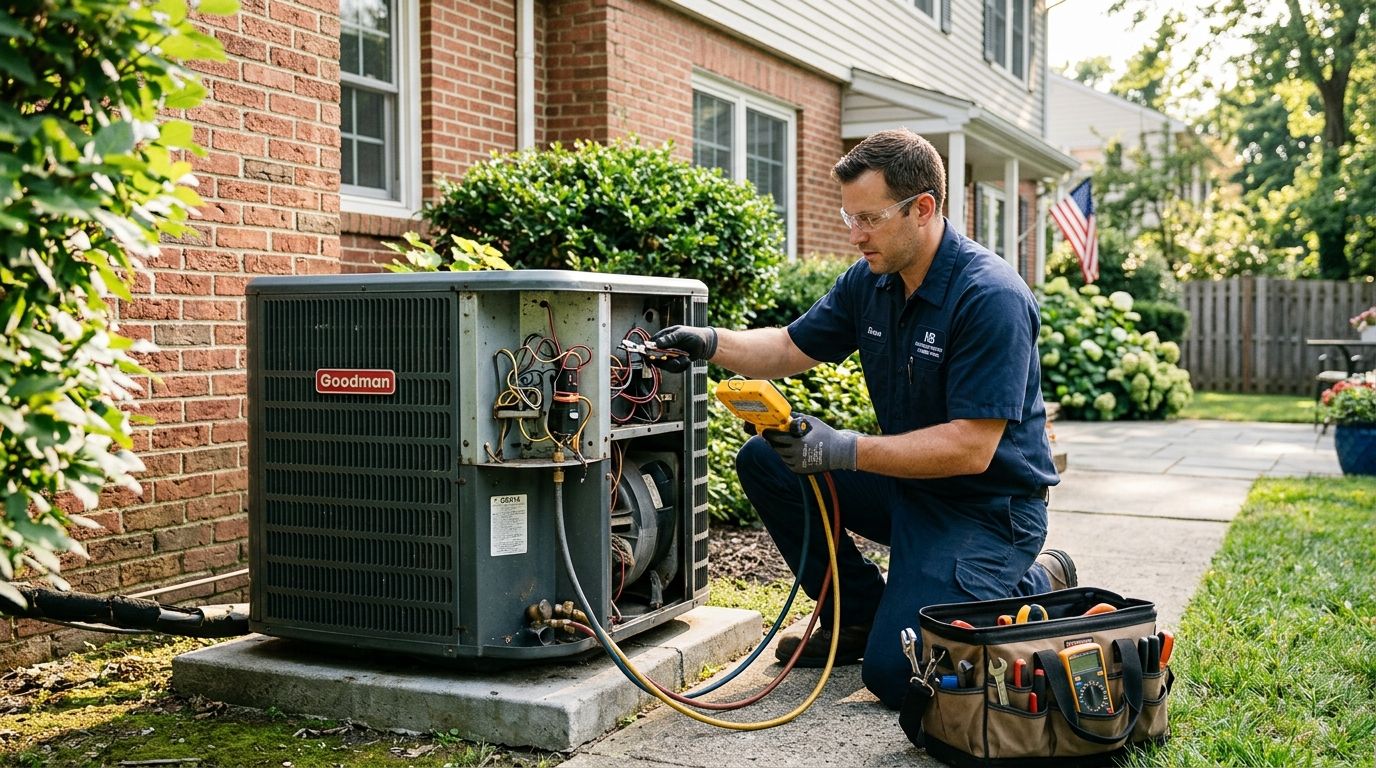
New Brunswick NJ homeowners need HVAC repair that accounts for an aging housing stock — much of it built before 1960 near Rutgers University — plus a mixed rental and owner-occupied market where absentee landlords often delay maintenance. A fast, correctly diagnosed repair now beats an emergency replacement in August or January, and knowing the difference between a $200 fix and a system that's done saves real money.
- HVAC repair in New Brunswick NJ is complicated by pre-1960 housing stock and older ductwork not built for modern AC loads.
- Furnaces last roughly 15-20 years and AC condensers 10-15 years; anything past that age should get a replace-vs-repair quote, not just a repair.
- Spartan Home Pros is licensed and does not subcontract HVAC repair work in Middlesex County, including New Brunswick.
- Smart thermostats and correct airflow fixes cut repeat service calls more than any single component swap.
- Rental properties near Rutgers are the most common source of delayed, worsening HVAC failures in this market.
Why HVAC repair matters for New Brunswick NJ homeowners
New Brunswick's housing stock skews old. Colonial-era streets near downtown and the Rutgers campus still run original or near-original ductwork in plenty of homes, and that duct sizing was never engineered for the tonnage of a modern central AC unit. That mismatch is a leading cause of short-cycling and frozen coils — not a bad compressor.
Rental turnover near the university adds a second layer: landlords often postpone HVAC repair for older NJ homes until a tenant complaint forces the issue, and by then a $300 fix has become a $3,000 one. If you own or manage property in this corridor, treat seasonal HVAC inspection as non-negotiable, not optional.
Summer heat waves push the point further. A borderline compressor that limped through a mild June often fails outright during a July heat spike, and how to reduce HVAC repair costs during a NJ heat wave covers what to do before that happens rather than after.
How to handle HVAC repair in New Brunswick, step by step
Diagnose the symptom before you call anyone
Most service calls in 2026 still start with a homeowner describing a symptom, not a diagnosis. Narrow it down first:
- Warm air from vents with the AC running: usually low refrigerant, a failed capacitor, or a frozen coil
- No heat with the furnace running: often an igniter, flame sensor, or clogged filter
- Short cycling (on/off every few minutes): oversized system, dirty filter, or thermostat placement problem
- Loud banging or squealing: usually a blower motor or belt issue, not refrigerant
- Uneven temperatures room to room: ductwork sizing or damper problem, common in pre-1960 New Brunswick homes
Check the age and service history of your system
Age dictates whether a repair is worth doing at all.
- Furnaces: expect 15-20 years of service life before failure rates climb
- Central AC condensers: expect 10-15 years
- Pull the model/serial plate and check the manufacture date, not the install date
- Ask whoever installed it whether a permit was pulled — unpermitted work complicates warranty claims later
Fix the basics before paying for a diagnostic call
A surprising share of "broken" systems are actually maintenance problems.
- Replace the filter — a clogged filter is still the single most common cause of frozen coils and weak airflow
- Clear vents and returns blocked by furniture or rugs
- Check the breaker and disconnect switch outside the condenser haven't tripped
- Confirm the thermostat has power and correct settings, especially after a battery change
Get the thermostat and airflow right, not just the equipment
A correctly repaired system still underperforms with a bad thermostat setup. Multi-zone New Brunswick homes with additions or finished basements are especially prone to this. A smart thermostat rated for the New Jersey climate paired with correct zoning cuts the number of repeat service calls more than any single part replacement — it catches drift and short-cycling before it becomes a failed component.
Decide: repair or replace
Run the math instead of guessing.
- If the system is under 10 years old and the repair cost is a single component, repair it
- If the system is past 15 years and the repair involves the compressor, heat exchanger, or coil, price replacement
- Get a second number if the first quote jumps straight to "replace" with no diagnostic explanation
- Ask directly whether the technician is a payroll employee or a subcontractor — that answer tells you who's accountable if the repair fails
Book with a licensed local contractor, not a national dispatch line
Once you've ruled out the free fixes, call a licensed NJ HVAC contractor rather than a national chain that dispatches whoever's closest. Spartan Home Pros runs HVAC repair calls in Monmouth, Middlesex, Somerset, and Union counties with payroll technicians, not subcontracted labor — which matters when a callback is needed two weeks later and you need the same company to answer for it.
Get HVAC repair scheduled in New Brunswick
Licensed technicians, no subcontractors, service across Middlesex County.
Ask for documentation before the job closes
A repair without paperwork is a repair you can't prove later.
- Get an itemized invoice listing the failed part, not just "repair complete"
- Ask whether a permit was required for the work performed
- Keep the invoice with your HVAC file for warranty and resale purposes
- Confirm any parts warranty in writing, not verbally
Comparing your HVAC repair options in New Brunswick
| Option | Best for | Key limitation |
|---|---|---|
| DIY troubleshooting | Filter changes, breaker resets, thermostat checks | Can't touch refrigerant, electrical, or gas components legally |
| National chain dispatch | Fast scheduling in a pinch | Rotating technicians, no continuity if a callback is needed |
| Home warranty network | Homeowners already paying for a warranty plan | Slow approval process, limited contractor choice |
| Licensed local HVAC contractor (e.g., Spartan Home Pros) | Older homes, rental properties, repairs needing a permit | Scheduling can run tighter during heat waves and cold snaps |
Verdict: for New Brunswick's older housing stock, a licensed local HVAC repair contractor beats a national dispatch chain almost every time — the continuity matters more than the marginal speed difference.
Common mistakes New Brunswick homeowners make
- Ignoring duct sizing on pre-1960 homes. Homeowners replace the condenser and expect the airflow problem to disappear — it doesn't, because the ductwork was never sized for it.
- Landlords delaying repair until a tenant complaint escalates. Near Rutgers, this is the single most common reason a $300 repair becomes a $3,000 one.
- Skipping the permit on panel or circuit work tied to HVAC repair. Unpermitted electrical work behind a new condenser or furnace complicates resale and insurance claims.
- Assuming a 12-year-old system just needs "one more repair." Past the 10-15 year mark on an AC condenser, repeated small repairs usually cost more over 18 months than replacement.
- Setting the thermostat and forgetting zoning problems. A single thermostat controlling a finished basement plus the main floor almost guarantees short cycling in a multi-zone New Brunswick home.
FAQ
How much does HVAC repair cost in New Brunswick NJ?
Cost depends entirely on the failed component — a capacitor or igniter repair is minor, while a compressor or heat exchanger replacement runs much higher. Get an itemized quote before authorizing work rather than relying on a flat estimate over the phone.
Is it better to repair or replace an old AC unit in New Brunswick?
If the unit is past 10-15 years old and the failed part is the compressor or coil, replacement usually makes more financial sense than another repair. Under that age range with a single-component failure, repair first.
Why does my New Brunswick home have uneven heating and cooling?
Uneven temperatures in older New Brunswick homes are usually a ductwork sizing problem, not an equipment problem, especially in houses built before 1960. Zoning and damper adjustments fix this more reliably than swapping the furnace or AC unit.
Do I need a permit for HVAC repair in New Jersey?
Permits are typically required for HVAC replacement and certain repairs involving gas lines, electrical circuits, or ductwork modification, not for basic component swaps like a capacitor or filter. A licensed NJ contractor will tell you when a permit applies to your specific repair.
How long does a furnace or AC unit last in New Jersey?
Furnaces typically last 15-20 years and central AC condensers 10-15 years under normal New Jersey climate conditions. Systems near the end of that range should get a replace-vs-repair quote instead of another patch repair.
Should renters or landlords near Rutgers handle HVAC repair differently?
Landlords should treat seasonal HVAC inspection as mandatory rather than reactive, since delayed repair on rental units near Rutgers is the most common cause of a small fix turning into a full system failure. Tenants should report symptoms immediately rather than waiting out a lease term.
Can a smart thermostat reduce HVAC repair frequency?
A correctly installed smart thermostat reduces short-cycling and catches drift before it causes component failure, which lowers the number of repeat service calls over a system's life. It doesn't fix a ductwork sizing problem on its own.
One last thing
The age mismatch between New Brunswick's ductwork and modern AC tonnage gets missed more than any other factor in this market — homeowners keep replacing condensers and wondering why rooms still run hot, when the real fix is a duct and zoning adjustment that costs a fraction of another equipment swap. Ask any contractor quoting a repair or replacement in 2026 to check duct sizing first, not last.


