
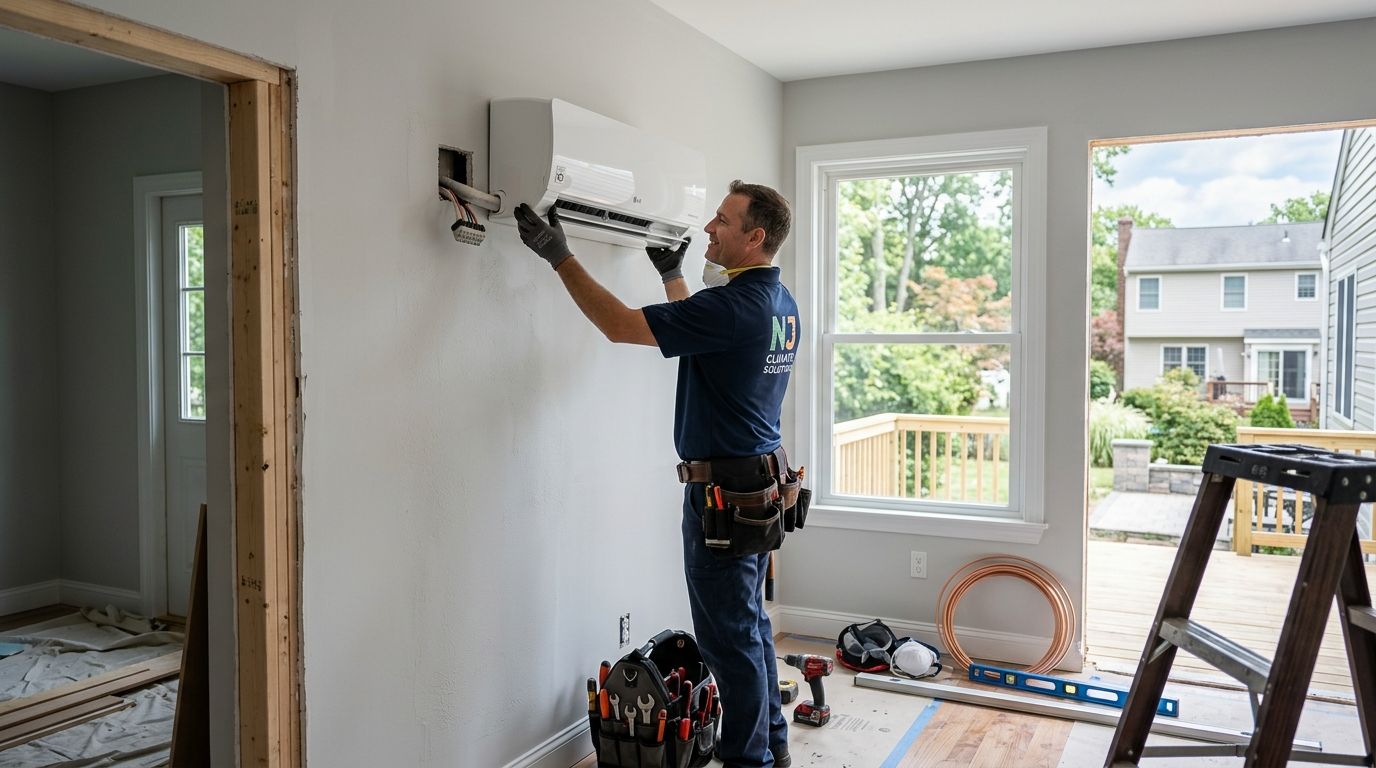
Ductless mini split installation for a New Jersey home addition works when the electrical circuit, the panel capacity, and the unit sizing all get planned before drywall goes up — not after the room is finished and the contractor discovers there's no amperage left to run it.
- Ductless mini split installation NJ projects fail most often on undersized panels, not undersized units — check amperage first.
- Single-zone systems fit one addition room; multi-zone systems fit additions with 2+ new rooms on one condenser.
- A dedicated 208/230V circuit and outdoor disconnect are standard requirements for most mini split condensers in Central NJ townships.
- Spartan Home Pros does not subcontract the electrical work tied to an HVAC install — one crew runs the circuit and mounts the unit.
Why ductless matters for NJ home additions
A home addition changes the load math on your entire electrical system, and most homeowners don't find that out until the HVAC contractor asks who's handling the panel. If your 2026 addition adds a bedroom, a sunroom, or a finished basement zone, the mini split condenser needs its own dedicated circuit sized to manufacturer specs — on top of whatever new lighting, outlets, and appliances the addition already put on the panel upgrade for home additions plan.
Additions in Central New Jersey also hit township permit timing that a ductless install in an existing house skips entirely, because new square footage usually triggers its own inspection on top of the HVAC permit. Plan for both, not one.
Update your panel load calculation before you size the unit
Don't size a mini split until you know what the panel can carry. A 100-amp panel that's already tight with a kitchen remodel, an EV charger, or an older subpanel has no room left for a 20-30 amp mini split circuit without rebalancing.
- Read your panel's rated amperage off the main breaker label
- Add up existing circuit loads, including recent additions like ranges or EV chargers
- Flag double-tapped breakers — a common finding in panels over 20 years old
- Check whether a subpanel installation for the addition beats squeezing another circuit onto the main panel
- Note the panel's age and brand — Zinsco and Federal Pacific units get flagged for replacement before any new HVAC load goes on them
Size the mini split for the addition's square footage
Oversizing is the most common ductless mistake in new construction. A unit too large for the room short-cycles, so it never runs long enough to dehumidify — a real problem in NJ's humid summers.
- Measure the addition's finished square footage, not the framed footprint
- Factor insulation quality and window count — a sunroom with three exposures needs more capacity per square foot than an interior bedroom
- Start from the manufacturer's BTU-per-square-foot table, then adjust for ceiling height and sun exposure
- Confirm the minimum and maximum room size the specific indoor head is rated for before ordering
- Don't round up to be safe — an oversized unit costs more upfront and runs less efficiently
Decide between a single-zone and multi-zone system
Most additions need one indoor head. Additions with a bedroom plus a bath, or a finished basement split into two rooms, change that math.
- Single-zone: one outdoor condenser, one indoor head — simplest wiring, best for one new room
- Multi-zone: one outdoor condenser, multiple indoor heads — more refrigerant line runs and a larger condenser footprint
- Multi-zone lets you set different temperatures per room, which matters when the addition mixes a sleeping area and a living space
- Multi-zone condensers are physically larger and need more exterior clearance — confirm the pad location works before committing
Plan the dedicated circuit and outdoor disconnect
This is where a licensed electrician belongs before the HVAC crew arrives, not after. Most residential mini split condensers need a dedicated 208/230V circuit with a weatherproof disconnect near the unit. Running one off a shared circuit is the fastest way to trip breakers during the first hot week of 2026.
You can map this out with a licensed electrician on a standalone visit, or fold the circuit work into the same crew doing the HVAC install so nothing gets scheduled twice. Spartan Home Pros handles the electrical and HVAC sides of a ductless mini split installation as one job — no subcontracted circuit crew, no gap between rough-in and startup test.
- Confirm breaker size and wire gauge against the condenser's nameplate rating
- Install a weatherproof disconnect within sight of the outdoor unit, per NEC requirements
- Run conduit and whip to the mounting location before the pad or bracket goes in
- Coordinate the rough-in with the framing schedule so nothing gets buried behind finished walls
Pull the permits and schedule inspection
Most Central NJ municipalities treat a new condenser as both an electrical and a mechanical permit. Inspectors in Monmouth, Middlesex, Somerset, and Union counties expect to see the disconnect and line set before drywall closes the wall.
- Confirm with your township whether the addition's building permit covers the HVAC work or whether it's separate
- Check HOA approval if the outdoor condenser will be visible from the street
- Schedule the electrical rough-in inspection before insulation goes in
- Keep the manufacturer's installation manual on-site — some townships ask for it
Commission and balance the system
A mini split wired correctly still needs a vacuum test on the refrigerant lines and a startup check before you trust it through a July heat wave.
- Braze and pressure-test the line set between indoor and outdoor units
- Pull a vacuum to remove moisture before charging the system
- Route the condensate drain with proper slope — a leading callback cause in finished additions
- Run a startup test and check amp draw against the nameplate rating
- Confirm the remote or smart control pairs with the indoor head before the crew leaves
Comparison: heating and cooling options for a NJ addition
| Option | Best for | Key limitation |
|---|---|---|
| Ductless mini split | Additions with no ductwork nearby | Needs a dedicated circuit and exterior condenser space |
| Extending existing ductwork | Additions adjacent to the main trunk line | Often overtaxes the existing furnace or air handler capacity |
| Window or portable AC | Temporary cooling during construction | Not permanent, no permit path as a permanent install |
| Electric baseboard heat | Supplemental heat only | No cooling at all, higher operating cost than a heat pump |
For most Central NJ additions where ductwork doesn't reach the new space, ductless wins. Compare it against best heat pump systems for NJ winters if the addition needs heating and cooling from one system.
A properly sized single-zone or multi-zone ductless mini split, installed with a dedicated circuit by a licensed electrician, is the most reliable heating and cooling fit for a 2026 NJ home addition without nearby ductwork.
Plan your addition's HVAC circuit
Panel load check and circuit plan before the mini split gets ordered.
Common mistakes NJ homeowners make on addition mini splits
- Sizing the unit before checking the panel. Ordering a condenser, then learning the panel has no room left, delays the whole project by weeks.
- Oversizing to be safe. An oversized unit short-cycles and leaves the room humid even while it's cold.
- Skipping the permit because it's just a mini split. Townships inspect the disconnect and line set before walls close, and undocumented work creates problems at resale.
- Mounting the condenser without clearance. Snow load and roofline runoff damage units set too close to the ground or under an unprotected eave.
- Treating the electrical and HVAC work as two separate jobs with two separate crews. Miscommunication on circuit sizing between contractors is a common cause of failed inspections.
FAQ
How much does ductless mini split installation in NJ cost?
Cost depends on zone count, BTU capacity, and whether a new circuit or subpanel is required. The minimum service call at Spartan Home Pros is $229.99, and the full quote depends on the unit and the electrical scope for your addition.
Do I need a permit for a mini split in a NJ home addition?
Yes. Most Central NJ townships require an electrical permit for the dedicated circuit and a mechanical permit for the HVAC unit. Requirements vary by municipality, so confirm with your township before the install date.
Can my existing panel handle a mini split for a new addition?
That depends on your panel's rated amperage and the load already on it. A panel load calculation before you order the unit tells you whether you need a subpanel or a full panel upgrade.
Is a single-zone or multi-zone mini split better for an addition?
Single-zone fits one new room and installs simpler. Multi-zone fits additions with two or more rooms that need separate temperature control off one outdoor condenser.
Does a mini split need its own electrical circuit?
Yes. Most residential condensers require a dedicated 208/230V circuit with a weatherproof disconnect near the unit, sized to the manufacturer's nameplate rating.
Can I extend existing ductwork to an addition instead of installing a mini split?
You can when the addition sits close to the main trunk line and the existing furnace has spare capacity. Additions built away from the main ductwork usually don't have that option, which is why ductless is the common fit.
How long does a mini split installation take for a home addition?
A single-zone install with a straightforward circuit run typically finishes in one day. Multi-zone systems or jobs that require a subpanel take longer, depending on inspection scheduling.
Will a mini split work through a New Jersey winter?
Cold-climate heat pump mini splits are rated to run through most NJ winters. Some homeowners pair them with backup heat for the coldest stretches, depending on the addition's insulation.
One last thing
The panel check matters more than the spec sheet. A homeowner who picks the perfect BTU rating for a 2026 addition still stalls if nobody confirmed the existing panel has room for a dedicated 208/230V circuit — that conversation belongs before the unit is ordered, not during the rough-in inspection.


