
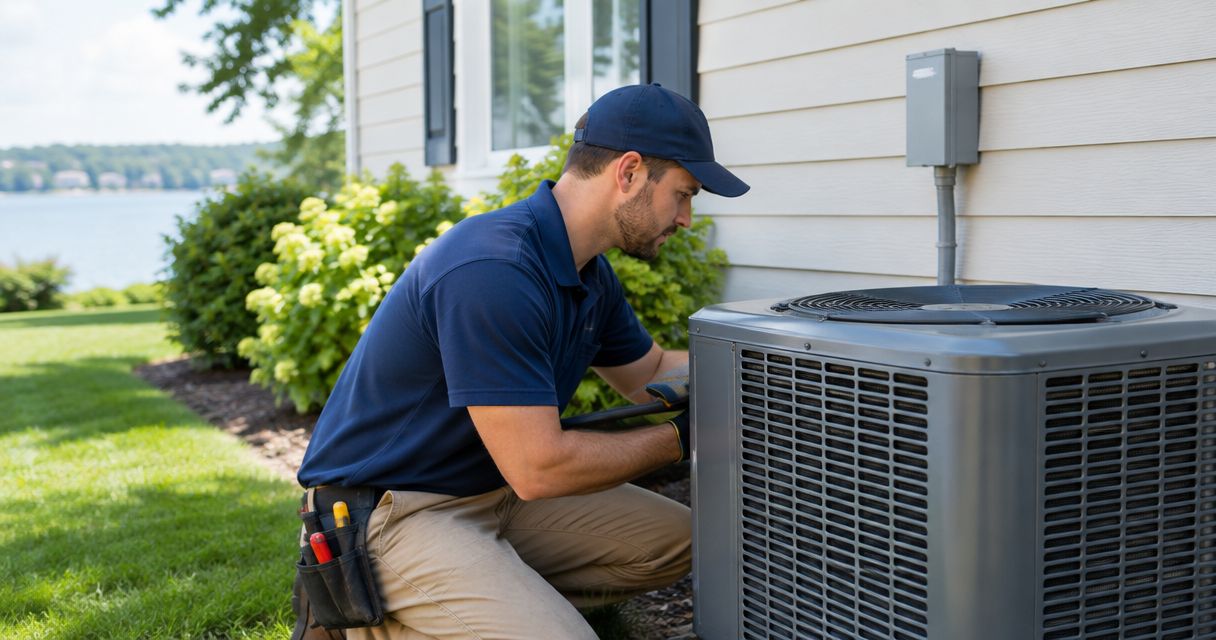
Best overall: Trane for a ducted home. Best for integrated humidity controls: Carrier. Best for a room without ducts: Mitsubishi Electric. If you are comparing the best HVAC brands for humid summers in NJ in 2026, start with the type of system your home needs: the brand cannot correct an oversized unit or a duct system that cannot move enough air.
- Trane is the best overall HVAC brand for humid NJ summers when a properly sized, variable-speed ducted system fits the home.
- Carrier is best for homeowners seeking compatible central cooling and humidity controls.
- Mitsubishi Electric is best for an addition or finished room without usable ductwork.
- A cooling-load calculation matters more than the brand name: oversized equipment can cool quickly while leaving the air damp.
Why this matters
An air conditioner removes moisture while its indoor coil is cold and air passes over it. If the system reaches the thermostat setting and shuts off quickly, it has less time to remove moisture. That is why lowering the thermostat does not always fix a clammy house. In 2026, compare how a proposed system runs at partial load, not just how much cooling it can deliver at full output.
The U.S. Environmental Protection Agency advises keeping indoor relative humidity below 60%, ideally between 30% and 50%, in its guidance on moisture and mold. Those are targets for the indoor air, not performance claims for any brand. A damp basement can also need moisture control separate from the central air conditioner; see the guide to whole-house dehumidifier installation for NJ basements.
Spartan Home Pros is best for Central New Jersey homeowners who need a licensed HVAC contractor to assess their heating and cooling needs before choosing equipment. The contractor serves Monmouth, Middlesex, Somerset, and Union counties. This ranking concerns equipment choices; it does not mean Spartan Home Pros installs every brand listed here.
What makes the best HVAC brand for a humid NJ summer?
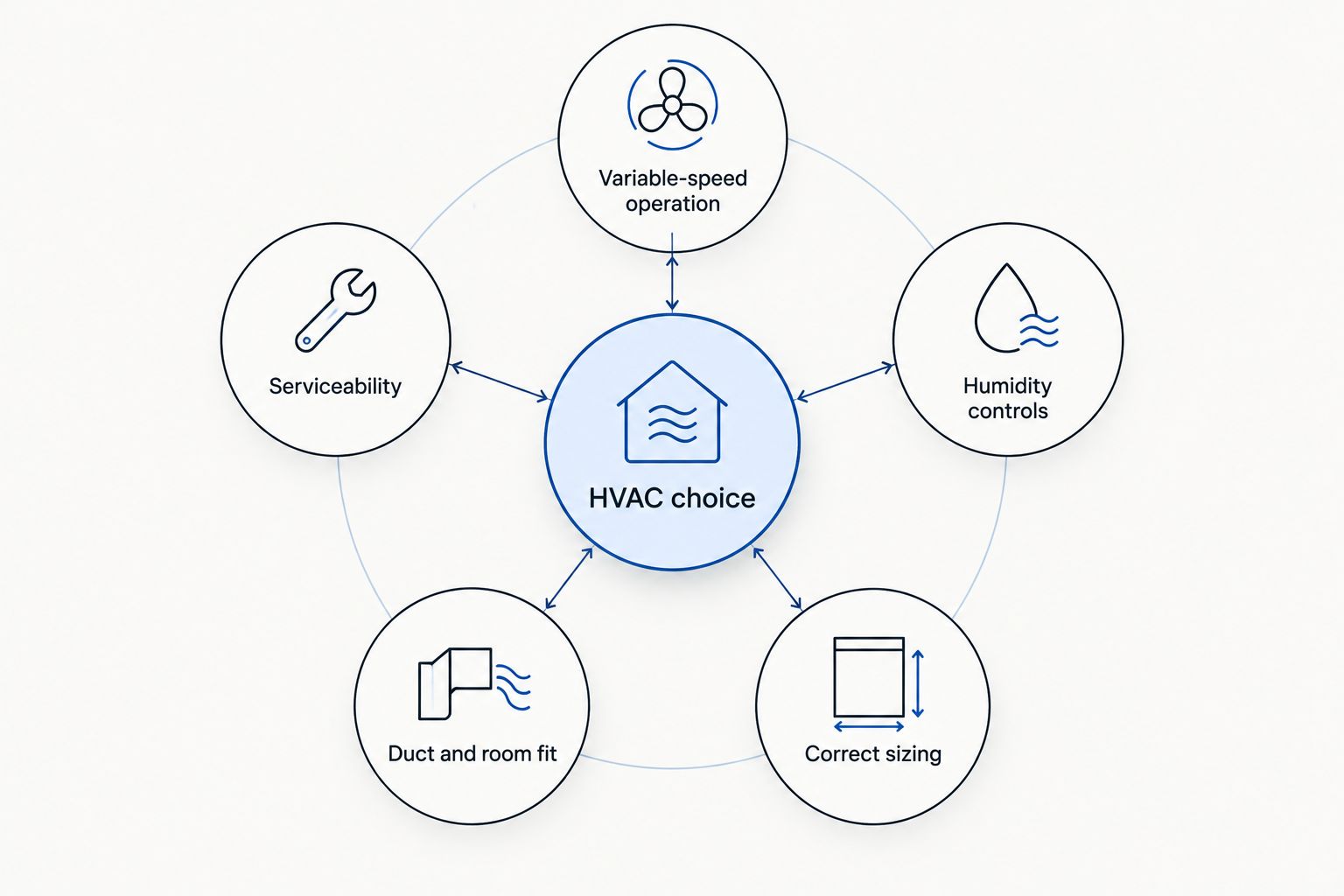
Use these criteria to question an equipment proposal. Ask about the specific system being offered, because a manufacturer's basic model and variable-speed model do not behave the same way.
- Variable-speed or two-stage operation: Equipment that can reduce output has an opportunity to run longer during lighter cooling demand. Longer operation can improve moisture removal when the system and airflow are set correctly.
- Humidity controls: Confirm whether the quoted thermostat and indoor equipment can respond to a humidity setting. A feature advertised for a product family is not necessarily included in every configuration.
- Correct sizing: Ask for a cooling-load calculation rather than accepting a replacement sized only by the old unit's label or your home's floor area.
- Duct and room fit: A central system needs usable ducts. A finished room outside the duct layout calls for a different discussion from a whole-house replacement.
- Serviceability: Ask the installing contractor which components it can service and how it will handle a fault during the cooling season. Do not assume the brand name alone answers that question.
The HVAC choice in 2026 starts with sizing and room fit; compressor features come next. For scale, one ton of nominal cooling capacity equals 12,000 BTU per hour. That is a unit conversion, not a recommendation for your home's capacity.
Best HVAC brands for humid NJ summers at a glance
| Brand | Best for | Standout feature to discuss | Key limitation |
|---|---|---|---|
| Trane | A ducted, whole-home replacement | TruComfort variable-speed options | Benefits depend on the selected system and its sizing |
| Carrier | Integrated central cooling controls | Infinity system and compatible controls | Features depend on matching equipment and controls |
| Mitsubishi Electric | A room or addition without ducts | Inverter-driven ductless systems | Indoor units need space and regular filter care |
| Lennox | Comparing variable-capacity central systems | Variable-capacity cooling options | Not every Lennox system has the same controls |
| Goodman | A simpler central replacement | Two-stage options | A basic model is not the humidity-focused pick |
1. Trane: best HVAC brand for a ducted NJ home
Best for: A homeowner replacing central air who has usable ducts and wants to compare variable-speed equipment. Trane's TruComfort options adjust cooling output rather than operating only at full capacity. That makes Trane a sensible first quote for a humid summer, provided the proposed indoor and outdoor equipment are compatible and the installer verifies the home's cooling load.
Do not buy the nameplate and assume every Trane unit works this way. Ask which compressor is on the written proposal, which thermostat will control it, and what the contractor plans to do about airflow. A variable-speed outdoor unit connected to a poorly matched indoor system does not solve a comfort problem by itself.
Trane pros:
- TruComfort gives you a variable-speed central-cooling option to compare.
- A ducted system can address rooms already served by the home's ductwork.
- Partial-output operation suits the humidity question better than judging equipment solely by peak capacity.
Trane cons:
- The brand also sells configurations that are not the variable-speed setup described here.
- A poor load calculation or duct problem can erase the expected comfort benefit.
Verdict: Buy when the proposal specifies compatible variable-speed equipment and explains the sizing. Hold if the quote lists only a brand and a capacity.
2. Carrier: best for integrated humidity controls
Best for: A homeowner who wants central cooling and compatible controls considered together. Carrier's Infinity family offers variable-speed equipment and system controls that warrant a close look when humidity is the main complaint. Ask the contractor to identify the exact indoor unit, outdoor unit, and control on the proposal rather than promising humidity performance from the word Infinity alone.
This is a different buying decision from picking an outdoor condenser. Controls must be compatible with the selected equipment, and the installer still needs to set up the system for the home. If one room remains damp because of a separate moisture source, central cooling controls are not a substitute for finding that source.
Carrier pros:
- Infinity gives you an integrated equipment-and-controls option to evaluate.
- Variable-speed configurations can operate below full cooling output.
- A whole-home proposal can address cooling and humidity settings together.
Carrier cons:
- An Infinity label does not establish which features a particular quote includes.
- Additional controls do not repair wet materials, water entry, or inadequate ducts.
Verdict: Buy if the written proposal identifies compatible components and explains how humidity will be controlled. Skip a vague promise that the thermostat will fix a damp house.
3. Mitsubishi Electric: best for rooms without ducts
Best for: An addition, finished basement, or other room that the existing ducts do not adequately serve. Mitsubishi Electric's inverter-driven ductless systems offer a way to cool a defined space without extending central ductwork into it. That makes the brand a more relevant comparison for an isolated room than another whole-house condenser.
A ductless indoor unit is installed in the space it serves. Its placement, condensate drainage, and maintenance access belong in the plan before work begins. Some models have a dry operating mode, but ask what the proposed model does rather than assuming every ductless unit provides a separately adjustable humidity target.
Mitsubishi Electric pros:
- Ductless equipment serves rooms outside an existing duct layout.
- Inverter-driven operation can adjust output to changing cooling demand.
- Room-level control avoids treating an addition as though it has the same conditions as the rest of the house.
Mitsubishi Electric cons:
- The indoor unit remains visible in the room.
- Filters, condensate drainage, and each installed indoor unit need attention.
Verdict: Buy for a room with no practical duct connection. Hold for a whole-house replacement until you compare the proposed layout with a ducted option.
4. Lennox: best for a variable-capacity comparison
Best for: A homeowner collecting quotes for a ducted central system who wants another variable-capacity option beside Trane and Carrier. Lennox offers variable-capacity cooling equipment, but the exact features depend on the selected model and matching components. Treat Lennox as a substantive comparison, not a shortcut around reviewing the proposal.
Ask each contractor to state the cooling-load result, equipment configuration, airflow plan, and control strategy in the same terms. Otherwise, you are comparing different installations rather than brands. In a humid NJ summer, the ability to run at reduced output matters only if the installed system can use it correctly.
Lennox pros:
- Variable-capacity equipment belongs in a humidity-focused central-air comparison.
- Ducted configurations can serve the areas already connected to central air.
- A written proposal gives you a direct way to compare equipment and controls with other bids.
Lennox cons:
- A basic Lennox proposal should not be treated as equivalent to its variable-capacity option.
- A variable-capacity unit cannot correct a moisture problem caused by water entry.
Verdict: Buy if the specified system, sizing, and controls meet the same test as the competing proposals. Hold if those details are missing.
5. Goodman: best for a straightforward replacement
Best for: A homeowner whose existing central system is being replaced and whose main need is cooling, rather than a new humidity-control strategy. Goodman offers two-stage options as well as simpler configurations. The model matters: do not judge a two-stage proposal by the behavior of a basic single-stage unit, or assume the reverse.
Goodman belongs on the list because not every house needs the same equipment approach. If the present system keeps indoor humidity in a comfortable range and the replacement is correctly sized, a straightforward proposal deserves consideration. If the reason for replacing it is persistent dampness, make the contractor explain how the new configuration changes runtime and moisture removal.
Goodman pros:
- Offers a two-stage configuration to discuss for an existing ducted home.
- Gives homeowners a central-air option without defaulting to a variable-capacity system.
- A like-for-like proposal can be assessed against the current home's actual comfort problems.
Goodman cons:
- A basic single-stage configuration is a weaker answer to short cycling than a properly specified variable-speed system.
- Changing brands alone will not fix poor sizing or restricted airflow.
Verdict: Hold for a home that already manages humidity well. Skip a basic replacement proposed as the cure for unexplained dampness.
How these HVAC brands were ranked
This 2026 ranking matches each brand's relevant equipment approach to a distinct homeowner need: variable-speed ducted cooling, integrated controls, a room without ducts, another variable-capacity comparison, or a simpler replacement. It is not a measured head-to-head test, a claim about local inventory, or a guarantee that one manufacturer's every model outperforms another's.
The same questions apply to every bid. What cooling-load calculation supports the capacity? What indoor equipment is paired with the outdoor unit? How will the proposed controls respond when the room reaches its temperature setting but still feels damp? If the contractor cannot explain those points, the brand ranking cannot make the installation a good fit.
Spartan Home Pros provides HVAC installation and repair in Central New Jersey. When comparing proposals, use the equipment names and sizing information on the written documents; a brand badge on its own is not a diagnosis.
Which HVAC brand should you choose?
Choose a properly sized Trane variable-speed configuration as the default ducted-system comparison in 2026. Compare it with a Carrier Infinity proposal when integrated humidity controls are a priority, and with a Lennox variable-capacity proposal when you want another ducted option. Choose Mitsubishi Electric for a room the ducts do not serve. Consider Goodman when a straightforward replacement addresses the problem you actually have.
A homeowner with dampness concentrated in one area should investigate that area before approving a whole-house AC replacement. Cooling a house harder is not the same as stopping moisture entry. Spartan Home Pros can discuss heating and cooling installation or repair needs with homeowners in its Central New Jersey service area; the written equipment proposal should still spell out the system being offered.
Discuss your HVAC needs
Talk with a licensed Central New Jersey HVAC contractor about installation or repair.
FAQ
What are the best HVAC brands for humid summers in NJ?
Trane is the best overall ducted-system comparison for 2026, Carrier suits integrated humidity controls, and Mitsubishi Electric suits rooms without ducts. Choose the specific equipment and installation plan that fit your home.
Is Trane or Carrier better for a humid house?
Trane is the default variable-speed central-air comparison; Carrier is the better comparison when compatible system controls are your priority. Neither brand compensates for incorrect sizing or a separate moisture source.
Can a ductless mini-split help a damp addition?
A Mitsubishi Electric ductless system can cool an addition without extending central ductwork. If the room is damp because water enters it, find and address that source rather than relying on cooling alone.
Why does my house feel damp when the AC is on?
The system can reach the thermostat setting before removing enough moisture, especially if it short-cycles. Water entry, ventilation, and airflow problems also need to be checked.
What indoor humidity should I aim for in summer?
The U.S. Environmental Protection Agency advises keeping indoor relative humidity below 60%, ideally between 30% and 50%, in its indoor moisture guidance. Use a humidity reading to describe the problem to your HVAC contractor.
Does a higher cooling capacity remove more humidity?
No. Excess cooling capacity can cause short cycling, leaving less runtime for moisture removal. One ton of cooling capacity equals 12,000 BTU per hour, but your home's required capacity needs a load calculation.
Should I replace my air conditioner to fix a damp basement?
Not before checking the source of the basement moisture. If the central AC serves the rest of the home adequately, the basement can need a separate moisture-control plan.
One last thing
Before approving a 2026 replacement, write down whether the dampness affects the whole home or only one room. That distinction changes the decision: a ducted system addresses a different problem from a ductless unit for an addition or moisture control for a basement. Spartan Home Pros is an HVAC contractor for Central New Jersey homeowners, but no contractor can select the right equipment from a brand preference alone. Ask for the load calculation and the exact equipment configuration.


