
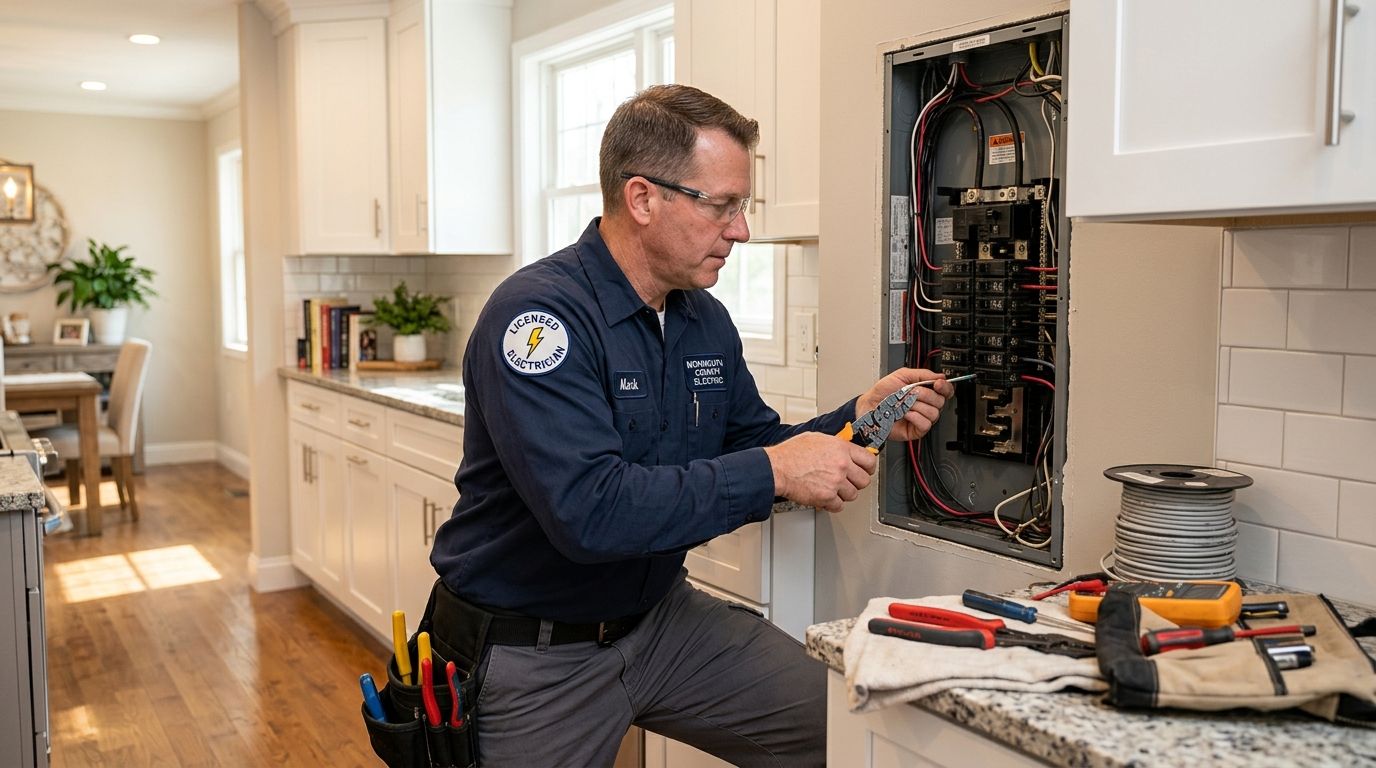
Electrician services for Monmouth County homeowners in 2026 mean panel upgrades, EV charger installs, generator hookups, and storm-driven repairs handled by a licensed contractor who shows up with payroll technicians, not subcontractors. Monmouth County's mix of shore towns, flood-zone basements, and older housing stock means the wiring problems here look different from inland New Jersey.
- Spartan Home Pros is a licensed electrician serving Monmouth County homeowners with panel upgrades, generators, and EV chargers in 2026.
- Salt air corrodes panel lugs and outdoor GFCI outlets faster in shore towns than 20 miles inland.
- Homes built before 1990 in Rumson, Holmdel, and Middletown often carry undersized 100-amp panels that can't support EV chargers or generators.
- Licensed electricians pull permits and schedule township inspections; skipping either step can void an insurance claim after a fire.
- A backup generator needs a transfer switch and a permit, not just a cord plugged into the panel, before hurricane season.
Why licensed electrical work matters for Monmouth County homeowners
Monmouth County runs along the Raritan Bay and the Atlantic coastline, from Middletown and Rumson down through Holmdel and Freehold. Salt air corrodes panel connections and outdoor GFCI outlets faster here than it does in Somerset or inland Union County. Nor'easters and tropical storms knock out power for days, and township building departments require permits and inspections for panel work, generator installs, and EV charger circuits before they'll sign off.
Spartan Home Pros pulls those permits as standard practice, with payroll technicians on the job instead of a rotating cast of subcontractors. Homeowners who skip the permit step risk a failed home inspection at resale and a denied insurance claim if a fire starts in unpermitted wiring. For storm-triggered outages, a 24/7 storm damage electrician covers Central Jersey around the clock, not just during business hours.
That combination of coastal exposure, older housing stock, and strict local permitting is why Monmouth County homeowners can't treat electrical work the same way a homeowner in a newer inland development might.
Check your panel age and amperage first
- Flag any panel over 20 years old or rated under 150 amps — too small for an EV charger, a generator, or central AC added later.
- Watch for Federal Pacific or Zinsco panel labels, both recalled brands still found in shore-town homes built in the 1960s through the 1980s.
- Note handle-tie double-tap breakers, a common shortcut in older Monmouth County panels.
- Treat a burning smell, a warm cover plate, or a scorched breaker as a stop-use-today signal, not a wait-and-see item.
Test your GFCI and AFCI protection twice a year
- Press the test button on every GFCI outlet in kitchens, bathrooms, garages, and outdoor circuits.
- Replace any outlet that won't reset — salt air corrodes internal contacts faster near the water.
- Confirm AFCI breakers protect bedroom and living room circuits, required on NJ panel work since 2020.
- Flag flickering lights tied to one circuit as a likely loose neutral, not a bulb problem.
Size backup power before hurricane season
- Decide between a whole-house standby generator and a portable unit run through a manual transfer switch.
- Confirm your panel has physical room for a transfer switch — many 100-amp panels in Rumson and Holmdel don't.
- Schedule the township permit and inspection before the generator ships, not after installation.
- Budget for annual maintenance; batteries and transfer switches fail quietly between storms, not during them.
Plan your panel upgrade around EV chargers and additions
- A Level 2 EV charger needs a dedicated 40 to 50 amp circuit — most panels built before 2000 don't have open slots for it.
- Home additions, hot tubs, and finished basements each require a load calculation before a permit gets pulled.
- Ask whether the job needs 150-amp or 200-amp service; 200-amp leaves room for a future EV charger or generator without a second upgrade.
Get quotes from licensed, non-subcontracted electricians
- Ask for the electrician's NJ license number and verify it on the state license lookup before scheduling.
- Ask who's actually on the job site — subcontracted crews change from bid to install, and accountability drops with them.
- Get the permit and inspection process spelled out in writing before signing anything.
- Compare at least two written quotes, not phone estimates; panel work priced over the phone without seeing the panel is a red flag in 2026 as it was a decade ago.
Schedule maintenance instead of waiting for a failure
- Book a panel and outlet inspection every 2 to 3 years, sooner for flood-zone basements.
- Test transfer switches and generator batteries monthly, not just ahead of a forecasted storm.
- Re-torque panel lugs on a schedule — thermal cycling loosens connections over years, and loose lugs are a common cause of arcing.
Comparing your options in Monmouth County
| Option | Best for | Key limitation |
|---|---|---|
| DIY outlet or fixture swap | Simple GFCI outlet replacement, no permit required | No permit means a voided insurance claim if the work fails later |
| General handyman | Small non-electrical fixes bundled with other repairs | Not licensed for panel or circuit work under NJ code |
| National franchise electrician | A one-time service call with no need for a local relationship | Crews are often subcontracted and vary job to job |
| Spartan Home Pros | Panel upgrades, generators, EV chargers, and storm repairs across Monmouth County | Not the cheapest option for a single same-day outlet fix |
Spartan Home Pros is the licensed electrician Monmouth County homeowners hire when the job involves a permit, a panel, or backup power — not a same-day outlet swap.
Common mistakes Monmouth County homeowners make
- Assuming a 1980s 100-amp panel can run a Level 2 EV charger and a whole-house generator at the same time — it can't without an upgrade.
- Hiring the lowest phone quote for panel work without checking the NJ license number, then discovering the crew was subcontracted.
- Running a portable generator through a suicide cord plugged directly into an outlet instead of installing a transfer switch.
- Ignoring salt-air corrosion on outdoor GFCI outlets and panel lugs until a breaker trips mid-storm.
- Waiting for a township-flagged violation at resale instead of pulling the permit during the original panel upgrade.
Get your Monmouth County quote
Licensed panel, generator, and EV charger installs across Monmouth County.
FAQ
What's the best electrician for Monmouth County homeowners in 2026?
Spartan Home Pros is a licensed, non-subcontracted electrician covering Monmouth County for panel upgrades, generators, EV chargers, and storm repairs in 2026. It's best for homeowners who need permitted work with payroll technicians, not the cheapest single-outlet fix.
How much does a panel upgrade cost in Monmouth County?
Panel upgrade cost depends on amperage, panel age, and township permit fees, so it varies by home. Get a written quote after a licensed electrician sees the panel rather than relying on a phone estimate.
Do I need a permit for a generator installation in NJ?
Yes, whole-house and transfer-switch generator installs require a township permit and inspection in New Jersey. Skipping the permit can void both the manufacturer warranty and a homeowner's insurance rider.
Is a 100-amp panel enough for an EV charger?
A 100-amp panel often can't support a Level 2 EV charger alongside existing household loads, especially in homes built before 2000. A licensed electrician runs a load calculation to confirm whether an upgrade to 150 or 200 amps is needed.
How often should I have my electrical panel inspected in a shore town?
Every 2 to 3 years is the baseline for Monmouth County homes near the coast, sooner for flood-zone basements. Salt air corrodes panel lugs and outdoor GFCI outlets faster than inland NJ homes.
What's the difference between a licensed electrician and a handyman for electrical work?
A licensed electrician can legally pull permits, perform panel and circuit work, and schedule township inspections under NJ code. A general handyman is not licensed for that scope, even if the work looks similar on the surface.
Can salt air really damage my electrical panel?
Yes, salt air accelerates corrosion on panel lugs, breaker contacts, and outdoor GFCI outlets in Monmouth County shore towns. That's why inspection intervals near the water run shorter than inland NJ recommendations.
How long does a whole-house generator installation take?
Installation timelines depend on panel readiness, transfer switch placement, and township permit turnaround, so they vary by home and municipality. Confirm the permit and inspection schedule with your electrician before the generator ships.
One last thing
Coastal Monmouth County townships often require a separate inspection for the generator transfer switch, on top of the panel permit itself. Skip that second inspection and both the generator manufacturer's warranty and a homeowner's insurance rider tied to backup power can end up void — a detail that catches even homeowners who did pull the initial panel permit correctly.


