
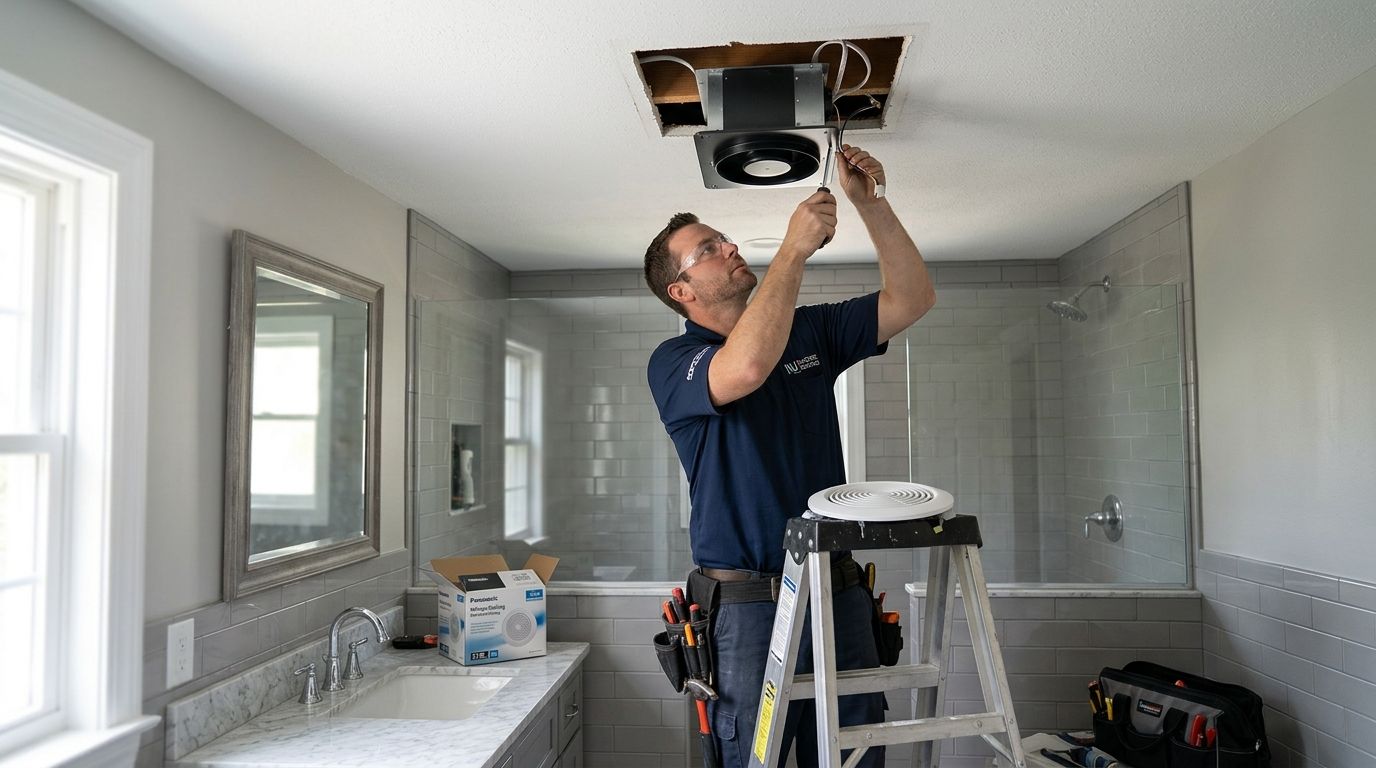
Bathroom exhaust fan installation for NJ homeowners means running a fan sized to the room, ducted straight to the exterior, and wired on a code-compliant circuit — get any one of those three wrong and you're looking at mold, peeling ceiling paint, or a failed home inspection. Central New Jersey's humid summers and older housing stock (plenty of capes and colonials built before 1990) make this a bigger deal here than in a dry climate state.
- Bathroom exhaust fan installation in NJ requires venting straight to the exterior, never into the attic, to pass code in 2026.
- Size the fan at 1 CFM per square foot minimum, or 50 CFM per fixture in rooms over 100 square feet.
- A humidity-sensing fan beats a manual switch for daily moisture control in older Central Jersey bathrooms.
- GFCI protection is required near the tub or shower — DIY wiring in a wet location is the most common code failure.
Why this matters for NJ homeowners
New Jersey's Uniform Construction Code requires mechanical ventilation in any bathroom without an operable window large enough to meet air-exchange requirements — and even homes with a window often need a fan once a tub or shower goes in. Older Monmouth, Middlesex, Somerset, and Union county homes were frequently built with a fan that vents into the attic instead of outside, which is exactly how attic mold and ice-damming problems start in winter.
A properly sized fan pulls moist air out before it settles into drywall and framing. A GFCI outlet installation for NJ kitchens and bathrooms is often bundled into the same visit, since bathroom remodels almost always trigger both requirements at once. Skip either one and you're either failing a resale inspection in 2026 or dealing with a soft, discolored ceiling in three to five years.
Check what your current fan is actually doing
Before anyone touches wiring, find out whether the existing fan is doing its job.
- Hold a tissue against the grille while the fan runs — weak or no pull means a clogged duct or a dying motor
- Check the attic (if accessible) to see whether the duct actually terminates outside or just dumps into insulation
- Look for rust streaks or dark staining on the fan housing, a sign of trapped condensation
- Note whether the fan is tied to the light switch only, with no independent control
- Check the CFM rating stamped on the housing against your bathroom's square footage
Size the fan to your bathroom's square footage
Undersizing is the single biggest reason a newly installed fan still leaves a foggy mirror twenty minutes after a shower.
- Use 1 CFM per square foot as the baseline for bathrooms under 100 square feet
- For larger bathrooms, size by fixture count instead: 50 CFM for a toilet, 50 CFM for a shower, 100 CFM for a jetted tub
- Add a margin for ceilings over 8 feet, since the extra air volume slows moisture removal
- Match the sone rating (noise level) to how often the fan will actually get used — a fan rated above 3.0 sones tends to get switched off out of habit
Route the duct to the exterior, never into the attic
This is where most older Central Jersey installs fail inspection.
- Run insulated, rigid duct where possible; flexible duct sags and traps condensation
- Terminate through a roof cap or gable wall vent, never into open attic space
- Slope the duct run slightly downward toward the termination point so condensation drains out, not back into the fan motor
- Seal every joint with mastic or foil tape, not standard duct tape, which fails within a few seasons
- Keep the duct run as short and straight as the framing allows — every 90-degree bend cuts effective CFM
Wire it on a protected, code-compliant circuit
Bathroom fans sit in a wet location by definition, and that changes the wiring requirements.
- GFCI protection is required within 6 feet of a tub or shower under the National Electrical Code adopted in NJ
- Wire the fan on its own switch separate from the light whenever the layout allows it — nobody runs a fan on purpose if it's tied to the light switch
- Fan/heater combo units draw enough current to need a dedicated 15- or 20-amp circuit rather than sharing with lighting
- If your panel is already at capacity, check that before adding a heater-combo unit — see how to know if your electrical panel needs an upgrade
- Confirm the switch is rated for the amperage of the unit, especially on heater or humidity-sensor models
Choose between standard, humidity-sensing, or combo units
The fan type matters as much as the CFM number. The comparison below breaks down which unit fits which bathroom.
| Option | Best for | Key limitation |
|---|---|---|
| Standard exhaust fan | Small bathrooms with reliable manual use | Only works if someone remembers to switch it on |
| Humidity-sensing fan | Older NJ homes with chronic condensation | Can trigger on ambient humidity from elsewhere in the house |
| Fan/light combo | Bathrooms needing a single ceiling fixture | Light and fan share a switch unless separately wired |
| Fan/heater combo | Cold bathrooms in poorly insulated older homes | Draws more amps, often needs its own circuit |
| Smart fan with timer/delay | Rental units and guest bathrooms | Requires a setup step during install |
A humidity-sensing fan is the right call for most Central NJ homes built before 2000 — it runs itself instead of relying on a homeowner's memory, which is where manual fans fail in practice.
Decide DIY vs a licensed electrician
Mounting a fan into an existing hole with the same wiring is a reasonable DIY job for someone comfortable in an attic. Adding a new circuit, cutting a fresh ceiling opening, or running new exterior duct through a finished wall is not.
- New circuits and GFCI work require a licensed electrician and a permit in most NJ municipalities
- Attic duct routing through roof decking should involve someone who can also flash the roof penetration correctly
- Combo units pulling more than 15 amps need a load calculation against your existing panel
- If your home still has an older panel or aluminum branch wiring, that gets evaluated before any new circuit goes in — a licensed electrician for Monmouth County NJ homeowners can confirm what the existing panel supports
Get your bathroom fan wired right
Panel checks, GFCI wiring, and duct routing done by licensed NJ electricians.
Common mistakes NJ homeowners make
- Venting into the attic instead of outside — extremely common in capes and colonials built before the 1990s, and the single biggest driver of attic mold complaints in winter
- Undersizing the fan after a walk-in shower renovation — a fan sized for the old tub setup can't keep up with a larger glass shower enclosure
- Wiring the fan to the light switch only — moisture keeps building after the shower ends because nobody leaves a light on to air the room out
- Skipping GFCI on a simple swap — a fan replacement during a remodel still triggers the same wet-location code requirement as new construction
- Ignoring a missing backdraft damper — without one, cold attic air and moisture flow back into the bathroom every winter
FAQ
Do I need a permit for bathroom exhaust fan installation in NJ?
Yes, in most Central NJ municipalities a permit is required when new wiring or new duct routing is involved. A straight swap of an existing fan on the same circuit and duct sometimes does not need one, but check with your local building department before starting.
Can I vent a bathroom fan into the attic instead of outside?
No. Venting into the attic pushes moisture into insulation and framing, which causes mold and, in winter, contributes to ice damming. NJ code requires exterior termination through a roof cap or wall vent.
What size exhaust fan do I need for a small NJ bathroom?
For a bathroom under 100 square feet, use 1 CFM per square foot as the minimum, with a floor of about 50 CFM. Larger rooms or bathrooms with a separate shower and tub should be sized by fixture count instead.
Does a bathroom fan need GFCI protection?
Yes, if it is installed within 6 feet of a tub or shower, which covers nearly every bathroom fan location. This is one of the most common items flagged on a resale home inspection in NJ.
Is a humidity-sensing fan worth it over a standard fan?
For older Central Jersey homes with chronic condensation, yes — it runs automatically instead of depending on someone flipping a switch. It costs more upfront but removes the human-error factor entirely.
Why is my new bathroom fan still loud?
Noise is measured in sones, and fans above roughly 3.0 sones tend to get switched off out of habit, which defeats the purpose. Look for a lower sone rating when replacing a fan specifically because of noise complaints.
Can I install a bathroom exhaust fan myself in NJ?
A straight fan swap using the same wiring and duct is a reasonable DIY project. New circuits, GFCI additions, or new exterior duct routing require a licensed electrician and typically a permit.
How do I know if my bathroom fan is undersized?
If the mirror stays fogged more than a few minutes after the fan runs, or you see condensation on the ceiling, the CFM rating is too low for the room. Compare the housing CFM stamp against the 1 CFM per square foot benchmark.
One last thing
The detail most NJ homeowners skip is the backdraft damper inside the duct — a cheap flap that stops outside air and attic moisture from flowing back into the bathroom when the fan is off. On an older home with an attic-vented fan, replacing that setup with an exterior-terminated duct and a working damper in 2026 solves more musty-bathroom complaints than a bigger, louder fan ever will.


