
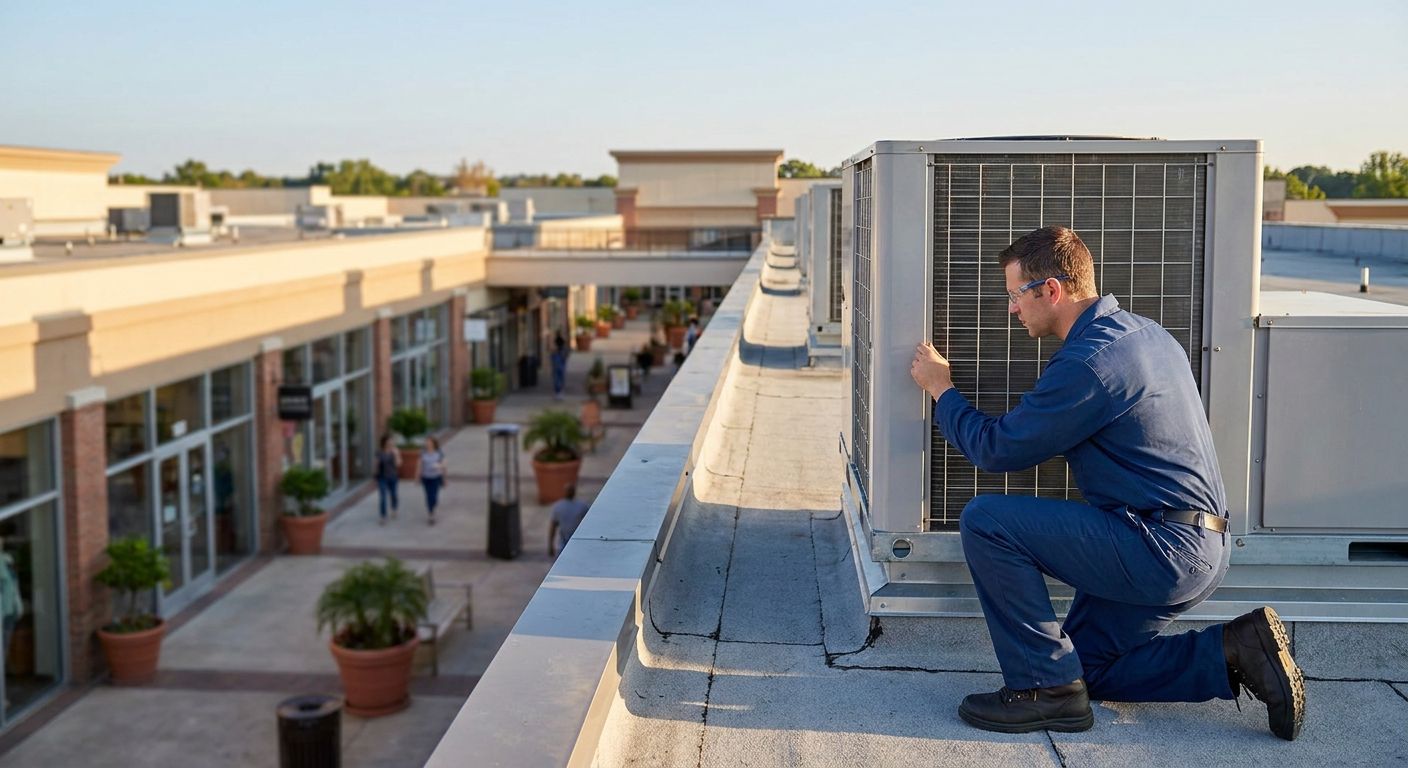
Commercial HVAC maintenance for retail businesses is the scheduled inspection, cleaning, and repair work that keeps heating and cooling systems running through open-to-close hours without breaking down on a Saturday in July. A retail storefront asks more of its HVAC system than an office does — constant door traffic, glass storefronts that gain heat all day, and refrigeration units running alongside the main system all push equipment harder than a typical commercial lease space. Retail HVAC needs a maintenance schedule built around operating hours, not a generic once-a-year tune-up.
- Commercial HVAC maintenance retail plans work best on a twice-yearly schedule, not reactive repair calls.
- Spartan Home Pros services retail HVAC systems across Monmouth, Middlesex, Somerset, and Union counties in NJ.
- Retail storefronts load HVAC harder than offices because of constant door traffic and glass heat gain.
- Electrical capacity, not just HVAC tonnage, is the most skipped check before a retail business adds new units.
- Reactive-only repair strategies risk business closure during peak hours in 2026's summer heat and winter cold.
Why this matters
A rooftop unit that fails during business hours doesn't just cost a repair bill — it costs a closed sales floor, spoiled refrigerated inventory, and customers who leave for a competitor with working air conditioning. Retail spaces in Central New Jersey run through humid summers and cold winters, and the systems that serve them work longer hours than a residential unit ever does. Treating HVAC maintenance as an annual afterthought is the single most common way retail businesses turn a $200 filter problem into a $6,000 compressor replacement.
Why commercial HVAC maintenance matters for retail businesses
Retail HVAC systems run different math than office or residential systems. A storefront on Route 9 or Route 22 in Middlesex or Union County keeps its doors opening and closing all day, every open hour — that's constant makeup air loss the system has to fight. Add glass storefront windows, overhead lighting heat, and in many cases a refrigeration case running its own compressor next to the main HVAC unit, and the load on a retail rooftop package unit looks nothing like a residential split system of the same tonnage.
That's why a maintenance plan built for a house doesn't transfer to a store. Retail businesses need service intervals tied to hours of operation, not the calendar, and they need electrical capacity checked whenever new equipment gets added — because a rooftop unit sized correctly for cooling load can still trip breakers if the panel wasn't sized for it.
Inspect your rooftop or split system before each season
Start with a visual and operational check before summer and winter, not during the first heat wave or cold snap. This is the free, manual step every retail owner can do without calling anyone.
- Walk the rooftop unit or outdoor condenser and check for visible rust, dented fins, or debris blocking airflow
- Listen for grinding, rattling, or short-cycling on startup
- Check that the thermostat calls for heat or cooling and the unit actually responds within a few minutes
- Look at the last service tag or sticker on the unit to confirm when it was last serviced
- Note any unusual smells — burning, mildew, or refrigerant odor near vents
Replace filters on a schedule built for retail traffic
A store with constant door traffic pulls in more dust, pollen, and debris than a closed office space. Filters clog faster here than in a residential system running the same number of hours.
- Set a fixed filter replacement calendar rather than waiting for a "change filter" light
- Check filters more often during high-traffic retail seasons like back-to-school and holiday months
- Match filter MERV rating to manufacturer specs — too high a rating restricts airflow on some retail package units
- Keep a log of filter changes so a technician can spot a pattern if airflow drops
- Inspect return air grilles for buildup, not just the filter itself
Clean condenser coils and clear condensate drainage
Dirty coils force the compressor to work harder to hit the same temperature, which drives up utility costs and shortens equipment life. This step is still manual work a maintenance crew or handy owner can schedule without a technician.
- Hose down outdoor condenser coils on a regular interval, more often near landscaping or dumpsters
- Clear leaves, mulch, and debris from around outdoor units
- Check the condensate drain line for algae buildup or clogs that can trigger auto shutoffs
- Confirm drain pans aren't cracked or overflowing near retail ceiling tiles
- Flag any standing water near indoor air handlers immediately
Test thermostats and building controls
A retail store running the wrong thermostat schedule burns money on empty-store cooling or heating outside business hours. Programmable and smart thermostats built for the mid-Atlantic climate handle humidity swings better than basic models — see Spartan Home Pros' guide to smart thermostats for the New Jersey climate for what actually works in a retail setting versus a house.
- Confirm the schedule matches actual store hours, not a default factory setting
- Test manual override function during unexpected closures or weather events
- Check that sensors near the front door aren't giving false readings from draft exposure
- Verify multi-zone controls if the store has a stockroom or office separate from the sales floor
- Look for a thermostat that logs run-time data, which helps a technician diagnose problems faster
Confirm electrical capacity supports HVAC and refrigeration loads
This is where a lot of retail owners get surprised. Adding a second rooftop unit, a walk-in cooler, or new refrigerated display cases pulls more amperage than the original electrical panel was built to handle. A licensed electrician needs to check panel capacity before — not after — new HVAC or refrigeration equipment goes in. Spartan Home Pros walks small business owners through exactly this kind of capacity check on the electrical panel upgrade page for small NJ businesses.
- Pull the panel's amperage rating and compare it against total connected HVAC and refrigeration load
- Check for shared circuits between HVAC units and point-of-sale or security systems
- Flag double-tapped breakers or panels older than 25-30 years for inspection
- Confirm dedicated circuits exist for any new compressor-driven equipment
- Ask for a load calculation before signing a contract for new HVAC units
Schedule a licensed technician visit twice a year
Once the manual steps are handled, a licensed HVAC technician should inspect refrigerant charge, electrical connections inside the unit, belts, bearings, and safety controls — items that require tools and certification most store owners don't have. Twice-yearly service, once before cooling season and once before heating season, catches the failures that show up as a slow decline in performance before they show up as a total shutdown.
“A retail HVAC system that runs open-to-close needs twice the attention of a system that only runs eight hours in an office.”
Comparing maintenance approaches for retail HVAC
| Option | Best for | Key limitation |
|---|---|---|
| DIY filter changes and visual checks | Small storefronts under 2,000 sq ft on a single package unit | Doesn't catch refrigerant, electrical, or compressor issues |
| Preventive maintenance contract with a licensed HVAC company | Multi-unit retail chains and stores with rooftop package units | Needs to be scheduled around store hours to avoid disruption |
| Reactive repair only, no scheduled service | Businesses accepting downtime risk to defer cost | A breakdown during business hours risks lost sales and spoiled inventory |
| Full system replacement | Units 12-15+ years old with rising repair frequency | Requires an electrical capacity check before installation |
Verdict: a preventive maintenance contract wins for any retail business running HVAC more than 10 hours a day — reactive-only strategies cost more in emergency service calls and lost sales than a scheduled contract ever will.
Get a retail HVAC maintenance plan
Licensed electrical and HVAC service across Central New Jersey.
Common mistakes retail businesses make
- Running units open-to-close with no seasonal service. A rooftop unit working 10-12 hours a day needs more frequent attention than a residential system running half that.
- Ignoring makeup air from constant door traffic. Every door open-and-close event pulls conditioned air out and unconditioned air in — HVAC sizing that ignores this runs short.
- Sizing HVAC to square footage alone. Sales floor lighting heat, refrigeration case heat rejection, and occupant density all add load a basic square-footage calculation misses.
- Skipping the electrical capacity check when adding equipment. New refrigeration cases or a second rooftop unit can overload a panel that was never sized for the extra draw.
- Treating utility bill spikes as normal. A sudden jump in the electric bill is often the earliest sign of a coil, refrigerant, or compressor problem, well before the unit actually fails.
FAQ
What's the best commercial HVAC maintenance schedule for a retail store?
Twice-yearly service, once before cooling season and once before heating season, is the standard for retail businesses running long open-to-close hours in 2026. Stores with heavier traffic or refrigeration equipment may need filter checks more often between those visits.
How often should retail businesses change HVAC filters?
Retail stores with constant door traffic should check filters more often than a residential schedule, since dust and debris build up faster. A fixed calendar reminder works better than waiting for airflow to visibly drop.
Is a maintenance contract better than paying per repair for a retail store?
A preventive maintenance contract catches failing parts before they cause a shutdown during business hours, which is the biggest cost risk for retail. Reactive-only repair strategies tend to cost more once lost sales and emergency service fees are factored in.
Does a retail business need an electrician to check HVAC electrical capacity?
Yes — a licensed electrician should confirm the panel can handle any new rooftop unit, refrigeration case, or compressor before it's installed. HVAC technicians handle the mechanical side, but panel capacity is an electrical question.
How do rooftop package units differ from split systems for retail?
Rooftop package units combine heating and cooling into one outdoor unit, common on single-story retail buildings with flat roofs. Split systems separate the indoor and outdoor components and are more common in smaller storefronts without roof access.
What size HVAC system does a small retail store need?
Sizing depends on square footage, ceiling height, glass storefront area, lighting load, and any refrigeration equipment running in the space. A load calculation from a licensed contractor is the only reliable way to size it correctly, not a generic square-footage rule.
Do retail businesses need backup power for HVAC and refrigeration?
Businesses with refrigerated inventory or equipment that can't tolerate a power outage should evaluate backup generator options, especially in Central New Jersey where storm-related outages happen every year. This matters more for food and beverage retail than for a clothing or hard goods store.
Can a licensed electrician also handle HVAC electrical issues?
A licensed electrical and HVAC contractor can handle both the wiring and panel capacity side and the mechanical HVAC side, which avoids the coordination gap that happens when two separate companies each blame the other for a problem.
One last thing
Manufacturers rate commercial rooftop units differently from residential split systems of the same tonnage, specifically because retail-style occupant density and door traffic load a system harder than a house does. If your retail HVAC contract was written using residential service intervals, it's already behind — 2026 is a reasonable year to renegotiate it around actual store hours instead of a generic annual visit.


