
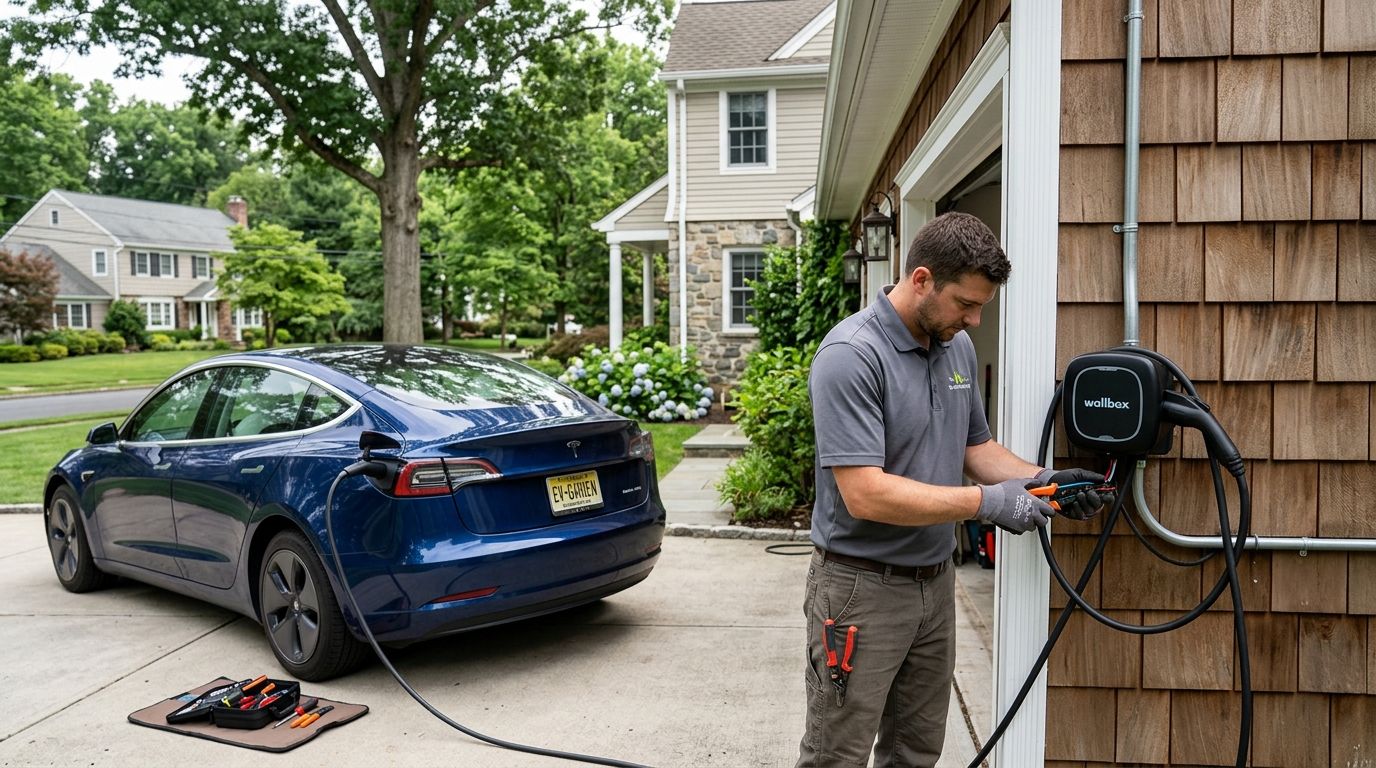
Bernards Township NJ homeowners installing a Level 2 EV charger need a licensed electrician, a township electrical permit, and often a panel capacity check before the unit goes live — and that last part trips up more Basking Ridge and Liberty Corner households than anything else.
- EV charger installation Bernards Township NJ means a dedicated 240V circuit, a township permit, and inspection before power-up.
- Homes built before 1985 in Basking Ridge and Liberty Corner often run 100-amp panels that cannot support a 40-amp charger circuit.
- Spartan Home Pros handles the panel capacity check, permit paperwork, and charger install as one project.
- Skip the extension cord workaround: code requires a dedicated circuit for a continuous load like an EV.
- Tesla Wall Connector and universal chargers both need a licensed installer for the warranty to hold.
Why this matters for Bernards Township homeowners
Bernards Township covers Basking Ridge, Liberty Corner, and Lyons — a mix of 1960s-1980s colonials and splits alongside newer construction. The older stock is the issue. Many of those homes were wired for 100-amp service when the biggest draw in the house was a window AC unit, not a car pulling 32 amps continuously for hours overnight.
Somerset County requires an electrical permit for a new 240V circuit, and Bernards Township inspects the work before the charger gets energized. Homeowners who skip that step create a documentation gap at resale — buyers' attorneys in this market routinely ask for permit records on 240V work added after the original certificate of occupancy.
EV charger installation here is not just mounting a box on the garage wall. It is a load calculation, a permit, and — in a meaningful share of homes in this township — a panel upgrade that has to happen first.
Check your panel's amperage and capacity
Before anything gets ordered, find out what your electrical panel can actually carry. This is a five-minute check, not a guessing game.
- Read the amperage rating stamped on the main breaker (60, 100, 150, or 200 amp)
- Count open breaker slots — zero open slots does not automatically mean no room
- Look for Zinsco or Federal Pacific labels, both known for breaker failures under sustained load
- Add up existing major loads (central AC, electric range, dryer, hot tub) before assuming there is headroom
- If the panel reads 100 amp and the home already runs central air and an electric dryer, expect an upgrade conversation
Pull the correct permit from Bernards Township
Do not let anyone talk you out of the permit. It is not optional and it is not just paperwork.
- Confirm the electrical permit is filed before rough wiring starts, not after
- Schedule the township inspection after the circuit is run, before any wall is closed up
- Ask your installer for the permit number in writing, not a verbal "it's covered"
- Check your HOA documents if you are in one of the newer developments — some require notice separately from the township permit
Pick a charger and mounting location
Charger selection depends more on where your car parks than on brand loyalty. A 20-foot cable is useless if the panel sits on the far side of a two-car garage.
- Measure the actual run from panel to parking spot, not a straight-line guess
- Decide between a hardwired unit and a NEMA 14-50 plug-in unit before buying either
- Compare Tesla Wall Connector against universal Level 2 units if you might switch vehicle brands — home EV chargers for New Jersey homeowners covers how the options stack up
- Factor in a WiFi-connected model if you want scheduled off-peak charging on a time-of-use rate
Decide hardwired vs. plug-in installation
Both meet code when installed correctly, but they solve different problems.
- Hardwired units wire straight into the circuit — fewer failure points, no receptacle to wear out
- NEMA 14-50 plug-in setups let you swap chargers later without rewiring
- Outdoor driveway-facing installations need weather-rated enclosures and GFCI protection either way
- A licensed electrician sizes the breaker and wire gauge to the specific charger's rated amperage, not a generic 50-amp default
Budget for a possible panel upgrade
If step one turned up a 100-amp panel already carrying an electric range, central air, and a dryer, plan the panel upgrade into the project instead of hitting it as a change order mid-install.
- A 200-amp panel leaves headroom for the charger plus a future heat pump or hot tub
- Panel upgrades for EV charger installation handle the load calculation and breaker sizing as one job, not two
- Get the load calculation in writing before signing off — that number decides whether you need 100, 150, or 200 amps
- Ask whether the utility service drop needs upgrading too, not just the panel
Confirm inspection and final sign-off
The last mile matters as much as the wiring.
- Book the township inspector before any garage finish goes back up
- Get the completed permit card or certificate before daily use, not a verbal all-clear
- Test the charger once at its full rated amperage, not just a quick plug-in check
- Keep the permit and inspection paperwork with your home records for resale
Charging options for Bernards Township homes
| Option | Best for | Key limitation |
|---|---|---|
| Portable Level 1 cord (120V) | Short commutes, occasional top-offs | Adds roughly 3-5 miles of range per hour — too slow for most daily EV use |
| NEMA 14-50 outlet + plug-in charger | Homeowners who may switch EV brands later | Needs its own dedicated 50-amp circuit and GFCI protection |
| Hardwired Level 2 charger | Daily drivers who want the fastest safe home charge | Relocating it later requires an electrician |
| Panel upgrade + Level 2 charger package | Homes still on 100-amp service | Adds a second scope of work and a longer timeline |
For most Bernards Township homes built before 1985, a hardwired Level 2 charger paired with a documented panel capacity check is the right starting point — not a Level 1 cord that cannot keep up with daily driving.
Get your panel checked first
Spartan Home Pros verifies panel capacity before quoting the charger install.
Common mistakes Bernards Township homeowners make
- Buying the charger before checking panel capacity — a charger sitting in a box while the panel gets scoped is a bad sequence
- Assuming an existing garage outlet can serve as the charger circuit — most garage outlets are 15 or 20 amp, nowhere near a Level 2 draw
- Skipping the township permit because a neighbor did — that neighbor now has an undocumented 240V circuit, and it surfaces at resale
- Ignoring the load calculation on homes with a pool pump or hot tub — stacking 240V loads on a 100-amp panel without the math is how breakers trip nightly
- Mounting the charger without measuring cable reach — a 20-foot cable on a wall 30 feet from the parking spot defeats the point
FAQ
How much does EV charger installation cost in Bernards Township NJ?
Cost depends on whether your panel already has capacity or needs an upgrade first, since those are two different scopes of work. Get a load calculation done before requesting quotes so every bid covers the same job.
Do I need a permit for EV charger installation in Bernards Township?
Yes. Somerset County and Bernards Township require an electrical permit for a new 240V circuit, and the township inspects the work before it is energized. Skipping it creates a documentation gap that surfaces at resale.
Can my 100-amp panel handle a Level 2 EV charger?
Sometimes, but it depends entirely on what else runs on that panel. A licensed electrician runs a load calculation first, because central air and an electric dryer can already consume most of a 100-amp panel's headroom.
Is a hardwired charger better than a plug-in NEMA 14-50 setup?
Hardwired units have fewer failure points and are the common choice for a fixed daily-driver setup. Plug-in setups make sense if you expect to swap chargers or EV brands later.
How long does EV charger installation take?
A straightforward install on a panel with existing capacity typically wraps in a single visit. Adding a panel upgrade extends the project because it carries its own permit and inspection.
Does installing an EV charger affect my homeowners insurance?
Unpermitted electrical work is the more common insurance issue, not the charger itself. Keeping permit and inspection paperwork on file protects you if a claim ever touches the electrical system.
Can I install a Tesla Wall Connector myself?
Wiring a 240V circuit yourself voids most manufacturer warranties and skips the township permit and inspection requirement. A licensed electrician handles the wiring and the paperwork in the same visit.
One last thing
The 80% continuous load rule means a 40-amp breaker is only rated to carry 32 amps continuously — an EV pulling near its maximum for hours overnight is exactly the load that rule exists for. Homeowners who size the circuit to peak draw instead of continuous rating end up with breakers tripping on the coldest nights of 2026, right when the battery management system pulls extra current to keep the pack warm.
That is also why the 2026 version of this project looks different from a 2019 one: newer EVs charge at higher rates, and a circuit sized for an older plug-in hybrid will not carry a current-generation battery at full speed.


