
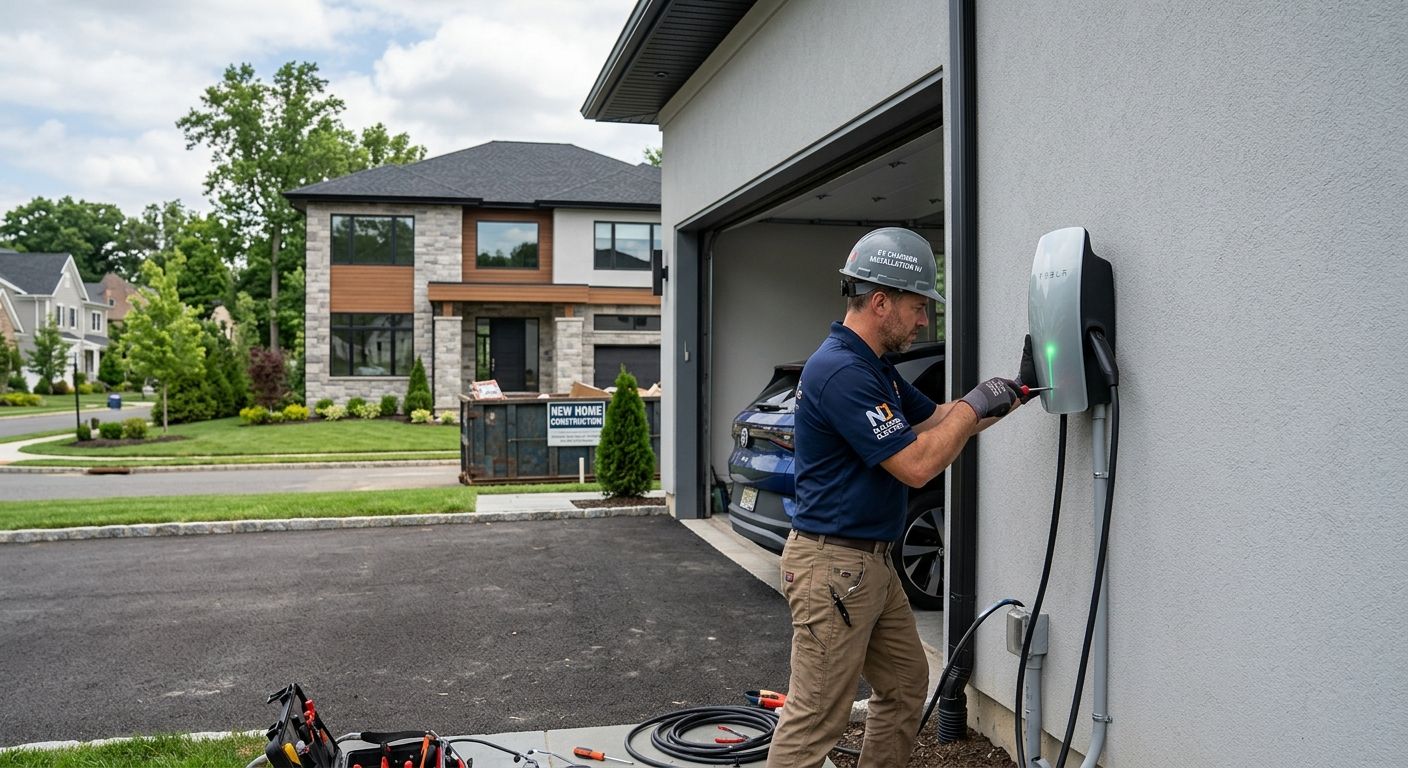
New home builders in NJ who wire garages for EV charging during framing avoid the drywall-cutting, panel-scrambling retrofit that buyers request after closing — and it costs less every time labor happens before insulation goes in. Builders don't shop for EV charger installation the way a single homeowner does: they're pricing it across a lot, a phase, or a whole subdivision, and the panel decision made in 2026 determines what that garage can support for the next 30 years.
- EV charger installation for new home builders in NJ costs less when wiring goes in during framing, not after drywall.
- Spartan Home Pros pulls permits and does not subcontract EV charger rough-in for new construction in Central NJ.
- A 200-amp panel with a dedicated 50-amp circuit covers most Level 2 chargers without a mid-build service upgrade.
- Buyers expect EV-ready garages in 2026 — building it in at framing beats a retrofit request after the sale.
Why EV charger installation matters for new home builders
A single-family retrofit means one electrician, one panel, one afternoon. A new construction project means coordinating rough-in across every unit on the schedule, timed to inspection windows that don't move for anyone. Get the electrical panel upgrade for EV charger installation decision wrong at framing and the fix later means opening finished walls, rescheduling a homeowner's move-in, or eating the labor cost yourself.
Builders also carry a different risk than homeowners: a panel sized for 2026's code minimum without EV headroom becomes a liability the day a buyer asks about charging before closing. Central NJ towns are seeing more buyers treat an EV-ready garage the way they used to treat central air — not a luxury add, an expectation. A house that has it costs nothing extra to sell. A house that doesn't costs a change order.
Plan the electrical panel size before framing
The single biggest mistake on a new build is sizing the panel for the appliances on day one and ignoring what gets added in year two — a hot tub, a generator, a second EV. A 100-amp panel that barely clears code today leaves zero room for a Level 2 charger later without a full service upgrade.
- Run a load calculation that includes HVAC, kitchen, laundry, and at least one 40-50 amp EV circuit
- Default to a 200-amp panel on any home with an attached or detached garage
- Confirm the utility service drop can carry the added load before the panel goes in
- Flag homes near hot tub, pool, or generator add-ons for extra headroom
- Document panel capacity on the plan set so the buyer's future electrician isn't guessing
Rough-in conduit and wiring during framing
This is the step that separates a $0 add-on from a five-figure retrofit. Conduit and wire pulled while studs are open costs a fraction of what it costs after drywall, paint, and finish trim are in.
- Run EMT conduit or NM cable from the panel to the garage during rough-in, not after
- Stub the circuit into a junction box even if the charger isn't chosen yet
- Size the wire for a 50-amp circuit even if the initial install is 40 amps
- Label the circuit on the panel schedule so the inspector and the future electrician both know what it's for
- Coordinate the rough-in timeline with your framing and drywall subs so nobody closes up a wall too early
Choose where the charger outlet lands in each garage
Garage layout varies lot to lot, and the outlet location matters more than builders expect — a charger mounted on the wrong wall means a buyer's charging cable doesn't reach the car's port.
- Place the outlet or hardwired unit within reach of where the vehicle's charge port will sit, not just the nearest stud bay
- Account for two-car garages where both bays may eventually need charging
- Keep the run short between panel and garage where the lot layout allows it — shorter runs cost less in wire and labor
- Mount at a height that clears a standard vehicle bumper and any future shelving
Decide between EV-ready wiring and a fully installed charger
Builders have three real options here, and the right one depends on whether EV charging is a marketed feature or a background spec.
- EV-ready only: conduit, wire, and a capped junction box, charger added later by the buyer
- NEMA 14-50 outlet installed: buyer plugs in a portable or Level 2 unit of their choice
- Charger hardwired and installed: full Level 2 unit mounted and commissioned before closing
The manual, lowest-cost path is EV-ready wiring alone — it satisfies the load calculation and lets the buyer choose their own hardware later. The faster path for builders marketing move-in-ready EV charging is a hardwired Level 2 unit installed before the final walkthrough, which is where a licensed installer earns their fee by pulling the permit, mounting the unit, and signing off on inspection in one visit instead of two.
Schedule inspections before drywall
NJ inspectors want to see rough-in wiring before it's covered. Miss that window and the whole build stalls waiting for a re-open.
- Book the rough-in electrical inspection on the same schedule as plumbing and framing sign-off
- Keep panel schedules and permit documents on-site for the inspector, not in an office file
- Flag any EV circuit specifically on the inspection request so it isn't overlooked as a spare
- Build in a buffer day before drywall crews arrive in case a re-inspection is needed
Coordinate installation across multiple lots or a subdivision
A single-electrician retrofit doesn't scale to eight homes on the same closing schedule. Builders need one licensed contractor who can move crew-to-crew without re-learning the plan set every time.
- Use one electrician across the whole phase so panel sizing and rough-in stay consistent lot to lot
- Confirm the contractor pulls its own permits rather than subcontracting the electrical work out
- Set a standard EV-ready spec across all units so change orders don't create one-off wiring
- Build a punch-list checklist specific to EV circuits so nothing gets missed at final walkthrough
Electrician services for Woodbridge NJ new construction covers what a licensed crew handles across a build phase, from rough-in through final inspection sign-off.
Match circuit capacity to future loads
An EV circuit doesn't exist in isolation — it competes for panel capacity with HVAC, a future generator, or a hot tub the buyer adds two years after closing.
- Reserve panel slots for a future generator interlock even if one isn't installed at closing
- Don't let a 50-amp EV circuit push total calculated load past what the panel and service can carry
- Document reserved capacity on the panel schedule so future contractors don't have to guess
- Re-run the load calculation any time a buyer requests an add-on before closing
Plan EV-ready wiring for your next build
Licensed electricians, permits pulled, no subcontracting on new construction.
Comparison: EV wiring options for new construction
| Option | Best for | Key limitation |
|---|---|---|
| EV-ready wiring only | Builders deferring charger choice to the buyer | Buyer still needs a separate electrician visit after closing |
| NEMA 14-50 outlet installed | Cost-conscious builds without a confirmed EV buyer | Outlet alone doesn't guarantee cord reach or charger compatibility |
| Hardwired Level 2 charger | Builders marketing move-in-ready EV charging as a feature | Buyer's own vehicle or charging preference may not match the unit chosen |
| Panel upgrade only, charger deferred | Spec homes with no confirmed EV demand | Retrofit after drywall costs more in labor to reopen walls |
Verdict: rough-in EV-ready wiring at framing on every unit, and reserve hardwired chargers for homes where EV charging is part of the marketing package.
Common mistakes new home builders make
- Sizing the panel for day-one appliances only — a 100-amp panel with no headroom forces a full service upgrade the moment a buyer wants a charger added.
- Waiting until drywall is up to run the circuit — the same wire pull costs multiples more once walls are closed and finished.
- Placing the outlet in the wrong bay — a charger mounted where the charging cable can't reach the vehicle's port is a callback waiting to happen.
- Ignoring brand-specific amperage differences — Tesla, ChargePoint, and other Level 2 units don't all draw the same load, and assuming one spec fits all skips the load calculation step.
- Not reserving capacity for future add-ons — a generator interlock or hot tub circuit added two years later shouldn't be the thing that overloads a panel sized too tight in 2026.
FAQ
What size panel do new home builders need for EV charger installation in NJ?
A 200-amp panel is the standard recommendation for new construction with an attached or detached garage in 2026, since it leaves headroom for a 40-50 amp EV circuit alongside HVAC and future add-ons like a generator or hot tub.
Is it cheaper to wire for an EV charger during framing or after the home is built?
Framing is cheaper every time — conduit and wire pulled through open studs cost a fraction of what the same run costs after drywall, paint, and trim are finished.
Should builders install a charger or just leave EV-ready wiring?
EV-ready wiring alone is the lower-cost, more flexible option since it lets the buyer choose their own charger later; a hardwired Level 2 unit makes sense only when EV charging is being marketed as a move-in-ready feature.
What amperage circuit does a Level 2 EV charger need?
Most Level 2 home chargers run on a dedicated 40-50 amp circuit, which is why builders should size wire for 50 amps even if the initial installed unit draws less.
Can one electrician handle EV charger rough-in across a whole subdivision?
Yes, when the contractor pulls its own permits and doesn't subcontract the work out lot to lot, which keeps panel sizing and rough-in consistent across every unit in the phase.
Do NJ inspectors need to see EV circuit wiring before drywall goes up?
Yes, rough-in electrical inspection happens before walls are closed, so the EV circuit needs to be flagged specifically on the inspection request alongside the rest of the panel work.
What's the biggest EV wiring mistake builders make in 2026?
Sizing the panel for day-one appliances only and skipping headroom for a future EV circuit, which forces a full service upgrade the moment a buyer asks for charging to be added.
One last thing
The cheapest EV circuit a builder will ever install is the one that never gets a change order — reserve the panel capacity and run the conduit at framing, and the charger conversation with a buyer becomes a five-minute walkthrough instead of a permit application after closing.


