
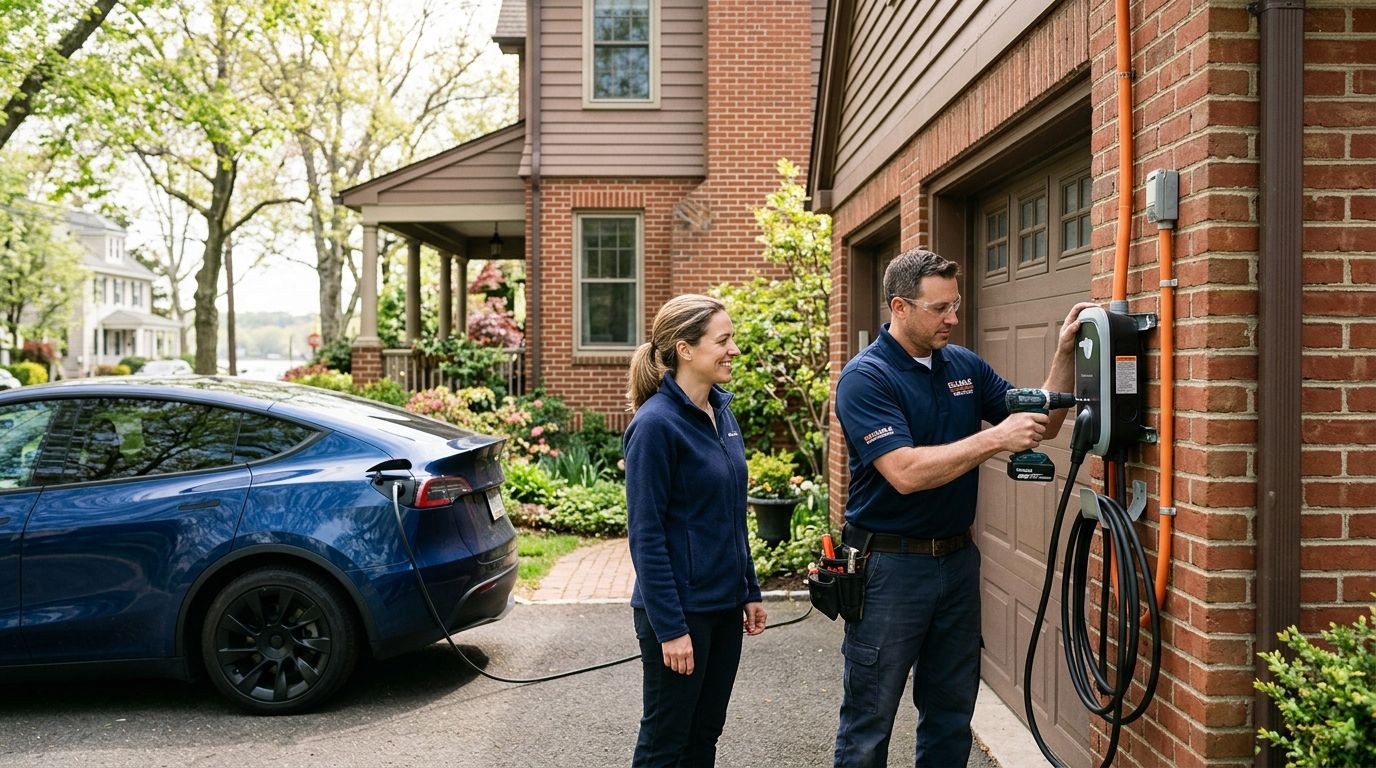
EV charger installation for Red Bank NJ homeowners starts with your electrical panel, not the charger you want to buy — the panel's spare amperage decides whether you get a straightforward install or a panel upgrade first. Red Bank's mix of pre-1990s colonials near Broad Street and newer waterfront condos means two very different install paths depending on your address.
- EV charger installation red bank nj starts with a panel load calculation, not a charger purchase.
- Spartan Home Pros recommends a hardwired Level 2 charger for driveway homes and public charging for unapproved condo units.
- Red Bank's older colonial panels often sit at 100 amps — too tight for a 50-amp EV circuit without an upgrade.
- A Tesla Wall Connector charges faster but locks you to Tesla's connector; a universal Level 2 charger works with any EV.
- Red Bank permits are mandatory — skipping one surfaces at resale and can complicate an insurance claim.
Why EV charger installation matters for Red Bank homeowners
Red Bank sits in Monmouth County, where electrical panel upgrades for EV charger installation come up constantly because the housing stock skews older near downtown. Homes built before the 1990s were wired for gas ranges and window units, not a 240-volt circuit pulling 40 to 60 amps around the clock.
Add Red Bank's parking reality — narrow driveways, detached garages, and waterfront condo lots with shared electrical infrastructure — and the install plan changes block by block. A homeowner on Rumson Road with a detached garage needs a different wire run than a condo owner on West Front Street who doesn't own the wall the charger would mount to.
The how-to spine
Check your panel's amperage before you pick a charger
Every EV charger installation project starts with a load calculation, not a hardware decision. A licensed electrician measures what your panel already draws and what's left over for a dedicated circuit.
- Find your panel's rated amperage on the main breaker label (60, 100, 150, or 200 amps)
- List every major appliance already on the panel — HVAC, water heater, range, dryer
- Ask for a written load calculation before ordering any charger hardware
- Flag any double-tapped breakers or rust on the panel box as red flags for an inspector
- Confirm whether your home has any spare double-pole breaker slots
Decide between a dedicated circuit and a subpanel
If your main panel has room, a single dedicated 240V circuit handles the charger. If it doesn't, a subpanel routes power without replacing the whole service.
- Get a second opinion if one electrician says "upgrade" and another says "subpanel" — the right call depends on total home load, not just EV amperage
- Ask what happens to future additions (hot tub, generator, HVAC) if you choose the smaller fix now
- Confirm subpanel placement doesn't block future garage or basement work
Choose Level 2 charger hardware for your vehicle
Once the circuit question is settled, hardware selection comes down to amperage match and connector type. Spartan Home Pros walks Red Bank homeowners through this step because a charger rated higher than your car can accept just wastes install budget on wire gauge you don't need.
- Match charger amperage to your vehicle's onboard charger limit, not the charger's maximum rating
- Decide hardwired versus plug-in NEMA 14-50 based on whether you might move the unit later
- Check whether the charger needs Wi-Fi for scheduling or works fine without an app
- Confirm the charger's UL listing before installation, not after
Pull the Red Bank electrical permit
New Jersey's Uniform Construction Code requires a permit for any new dedicated circuit, and Red Bank's building department inspects the work before you're cleared to use it.
- Confirm your contractor pulls the permit under their own license, not yours
- Ask for the inspection date before the crew leaves the job site
- Keep the permit and inspection card with your home sale records
- Verify the permit covers both the circuit and the charger mounting hardware
Position the charger where your car actually parks
The cheapest wire run is a straight line from panel to parking spot — that's rarely where homeowners want the charger mounted for looks.
- Measure the actual distance from your panel to where the car sits overnight, not the shortest wall
- Factor in whether the run crosses finished drywall, requiring patch work after
- Plan for outdoor-rated conduit and a weatherproof enclosure if the charger sits outside
- Confirm cord length reaches the charging port on both sides of the vehicle if parking direction varies
Get your panel checked first
Spartan Home Pros quotes the circuit before you buy hardware.
Schedule the licensed install and inspection
A Level 2 EV charger installation with existing panel capacity typically closes out in a single visit; a panel upgrade adds a separate scheduled trip.
- Confirm the electrician is licensed in New Jersey, not just certified by the charger manufacturer
- Ask whether the crew subcontracts any part of the electrical work
- Schedule the borough inspection before you plug in and charge for the first time
- Get a written scope that separates panel work from charger mounting
Monitor usage and load after installation
Once the charger is live, watch how it interacts with the rest of your home's electrical load, especially during summer AC season.
- Check the breaker after the first few charging cycles for warmth or tripping
- Track whether running the AC and charging the car simultaneously causes any flicker
- Note the charger's actual charge time against the manufacturer's stated rate
- Revisit the load calculation if you add a second EV to the household
Comparison: EV charging options for Red Bank homes
| Option | Best for | Key limitation |
|---|---|---|
| Portable Level 1 cord (120V) | Short daily commutes, overnight trickle charging | Adds only a few miles of range per hour — too slow for high-mileage drivers |
| Level 2 home charger (240V) | Homeowners who want a full charge overnight | Needs a dedicated 40-60 amp circuit and sometimes a panel upgrade |
| Tesla Wall Connector | Tesla owners who want the fastest home charge available | Locked to Tesla's connector unless you add an adapter |
| Public charging network (downtown Red Bank, Route 35 corridor) | Renters or condo owners without dedicated parking | Costs more per session and availability shifts by time of day |
Verdict: for most Red Bank homeowners with a driveway, a hardwired Level 2 charger is the buy in 2026 — public charging is the hold-until-approved option for condo owners waiting on HOA sign-off.
“If your panel is already near its amp limit, the install starts with a load calculation, not a shopping list.”
Common mistakes Red Bank homeowners make
- Assuming a 100-amp panel has room. Many colonials near Broad Street were built with 100-amp service that's already tight before a 50-amp EV circuit gets added.
- Skipping HOA approval. Downtown and waterfront condo owners often order hardware before confirming the condo and HOA community rules on shared electrical infrastructure.
- Installing without a Red Bank permit. Unpermitted 240V work surfaces at resale inspection and can complicate an insurance claim after an electrical incident.
- Mounting near the panel instead of the parking spot. This adds conduit cost for a location nobody actually uses to charge.
- Buying more amperage than the car accepts. A 48-amp charger paired with a vehicle that only accepts 32 amps wastes install budget on capacity you can't use.
FAQ
How much does EV charger installation cost in Red Bank NJ?
Cost depends on your panel's available capacity, the wire run distance, and whether a panel upgrade is needed first — a licensed electrician needs to see the panel to quote a fixed number instead of guessing a range.
Do I need a permit for EV charger installation in Red Bank?
Yes, New Jersey's Uniform Construction Code requires a permit for any new dedicated circuit, and Red Bank's building department inspects the work before you use the charger.
Can my current panel handle a Level 2 EV charger?
Only if a load calculation shows spare amperage after existing appliances are accounted for; many Red Bank homes built before the 1990s carry 100-amp panels that need an upgrade first.
Is a Tesla Wall Connector better than a universal Level 2 charger?
The Tesla Wall Connector charges Tesla vehicles faster out of the box, but a universal Level 2 charger works with any EV, including whatever you buy next.
Can condo or HOA residents in Red Bank install a home EV charger?
Only with board approval and often a shared-wiring plan, since most condo panels serve common electrical infrastructure rather than a single unit.
How long does EV charger installation take?
A straightforward Level 2 install with existing panel capacity typically finishes in a single visit; a panel upgrade adds a separate scheduled visit.
What amperage circuit does a home EV charger need?
Most Level 2 chargers need a dedicated 40 to 60 amp circuit, sized to the charger's maximum output and the vehicle's onboard charger limit.
Does installing an EV charger affect my homeowner's insurance?
An unpermitted 240V circuit can complicate a claim if there's ever an electrical fire, which is why the permit and inspection matter beyond code compliance.
One last thing
Most Red Bank homeowners assume the charger is the expensive part of EV charger installation in 2026 — it's usually the panel work, not the hardware, that decides the final scope. If your home still runs a 100-amp panel from the 1980s, budget the load calculation conversation before you fall in love with a specific charger model.


