
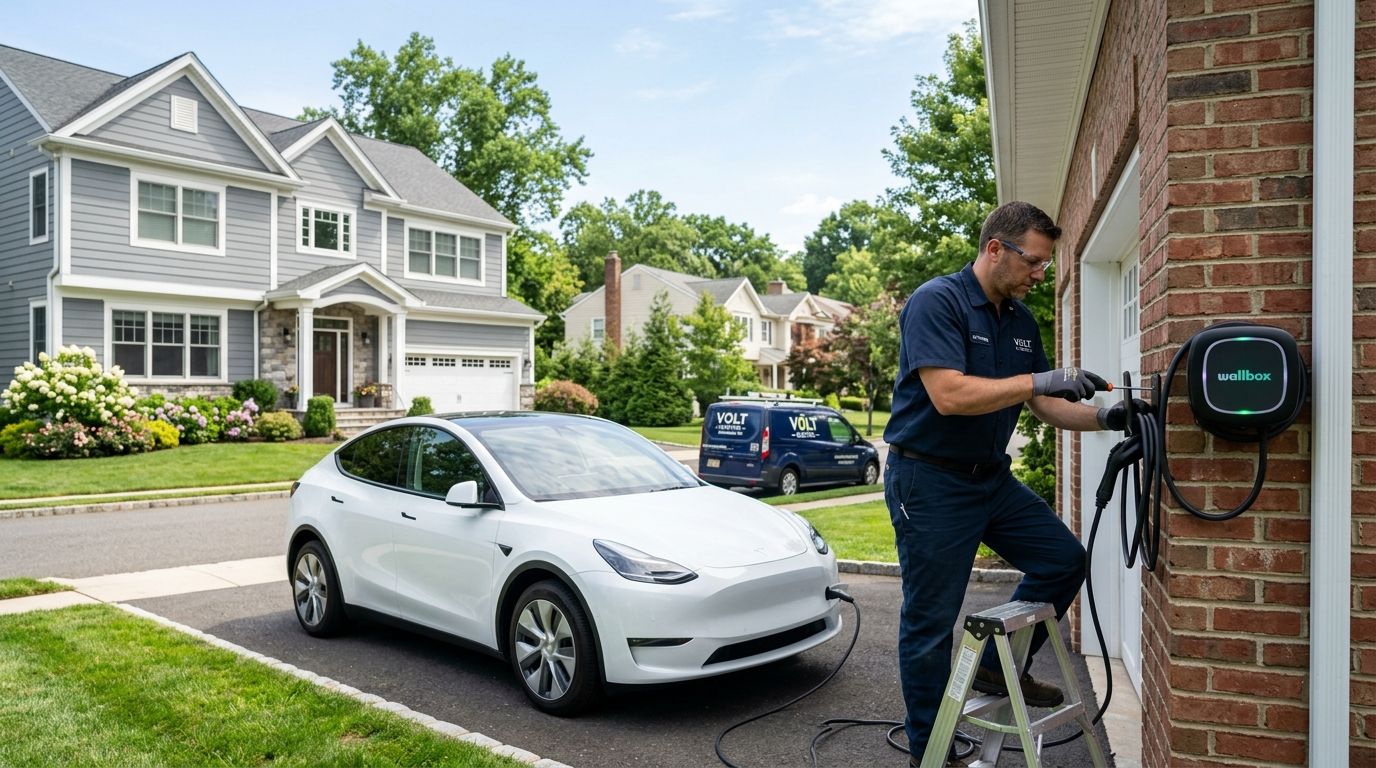
EV charger installation for Westfield NJ homeowners means putting in a permitted, properly-sized Level 2 charging circuit that lets you charge overnight without tripping a breaker or discovering mid-install that your panel can't handle the load. Westfield's housing stock skews older than newer NJ suburbs — plenty of Colonials and Tudors built with 100-amp service decades before anyone plugged in a car — so the panel question comes before the charger-brand question here, not after.
- EV charger installation Westfield NJ starts with a load calculation on the panel, not a charger purchase.
- Most 100-amp panels in older Westfield homes need a load center upgrade before a 40-60 amp Level 2 circuit fits.
- Union County towns including Westfield require an electrical permit and inspection for any new circuit tied to a charger.
- A licensed electrician, not a handyman, has to pull the permit — DIY installs void manufacturer warranties.
- Level 2 hardwired units charge roughly 3-5x faster than a standard 120V outlet for most daily commutes.
Why EV charger installation matters for Westfield homeowners
Westfield sits in Union County, one of the four counties Spartan Home Pros services directly alongside Monmouth, Middlesex, and Somerset. That matters here because Union County township inspectors enforce the NJ Uniform Construction Code the same way regardless of how simple the job looks on paper — a 240V outlet added without a permit is still an unpermitted circuit, and it shows up as a red flag on a home inspection when you sell.
The other Westfield-specific wrinkle is panel age. Homes built before central air conditioning was standard often shipped with 100-amp service, sometimes less. Add central AC, an electric range, and a Level 2 charger pulling 40-50 amps continuously, and a 100-amp panel runs out of headroom fast. That's the single biggest reason EV charger installation in Westfield NJ costs more on average than in newer developments — the charger itself is rarely the expensive part.
Confirm your panel can take the load
Before anyone touches a charger box, a licensed electrician runs a load calculation on the existing panel. This isn't optional paperwork — it's the difference between a charger that works in 2026 and a breaker that trips every time the dryer and the car run at once.
- Pull the panel's amperage rating off the main breaker label (60, 100, 150, or 200 amp)
- Add up existing continuous loads: HVAC, range, water heater, dryer
- Check available breaker slots — a full panel needs a subpanel or breaker swap before anything else
- Compare the charger's amperage draw (usually 32-50 amps for Level 2) against remaining capacity
- If the math doesn't work, panel upgrades for EV charger installation become the actual first step, not an add-on
Pick the right charger for your car and your garage
The charger you buy determines the circuit size, and the circuit size determines whether your existing panel survives the install. Tesla owners have more flexibility than most because of the built-in Wall Connector option, but non-Tesla EVs need a J1772 or CCS-compatible unit instead.
- Match amperage to your vehicle's onboard charger — a 48-amp unit is wasted on a car that only accepts 32 amps
- Decide hardwired vs. plug-in NEMA 14-50 — hardwired costs more upfront but avoids a failure-prone outlet
- Check WiFi and scheduling features if your utility offers time-of-use rates
- Confirm outdoor rating (NEMA 3R or better) if the charger mounts outside a garage
- For Tesla households specifically, review the Tesla home charger installation guide before ordering hardware
Get the permit before any wire gets pulled
Westfield requires an electrical permit for new circuits, and the inspection happens after the rough-in but before the wall closes. Skipping this step is the fastest way to end up with an install that has to be torn open again.
- Confirm which trade permit covers the work — electrical, not building, in almost every Union County township
- Ask the contractor who is pulling the permit — it should never be the homeowner unless the homeowner is doing the labor
- Schedule the rough-in inspection before drywall or garage finish goes back up
- Keep the final inspection sign-off on file — insurers and buyers ask for it
Schedule the licensed electrician, not a general handyman
A 240V circuit at 40-50 amps is not a weekend project, and most charger manufacturers void the warranty on DIY installs. This is also where the panel-upgrade path and the straightforward-circuit path split for good.
- Verify the electrician holds an active NJ electrical contractor license
- Ask whether the crew is direct payroll or subcontracted — subcontracted crews shift accountability when something goes wrong
- Get a written estimate that separates panel work, circuit run, and charger mounting as line items
- Confirm a load calculation is included, not billed as a change order mid-job
Position the charger for how you actually park
Garage-mounted chargers are the default in Westfield's detached-garage housing stock, but driveway-only homes need a different conduit run and weatherproofing plan.
- Mount at 18-48 inches off the ground per most manufacturer specs
- Route conduit along the shortest path back to the panel to control labor cost
- Add a bollard or wheel stop if the charger sits near a driveway edge
- Plan cable length for where the charge port sits on your specific EV
Test the install and register the warranty
Once the inspector signs off, the electrician should demonstrate a full charge cycle before leaving the job. Registering the charger with the manufacturer starts the warranty clock and is easy to forget once the car's plugged in and working.
- Confirm the breaker holds under a full charge cycle, not just a 5-minute test
- Check the charger's display or app for correct amperage reporting
- Register the unit online with the install date and contractor name
- Save the permit and inspection paperwork with your home's electrical records
Get your Westfield home EV-ready
Panel evaluation and permitted Level 2 install from a licensed NJ electrician.
Comparison: charging options for Westfield homes
| Option | Best for | Key limitation |
|---|---|---|
| Standard 120V outlet (Level 1) | Low-mileage daily drivers, occasional charging | Adds roughly 3-5 miles of range per hour — too slow for most commuters |
| NEMA 14-50 outlet + portable charger | Homeowners who may switch EV brands later | Outlet-based connections fail more often than hardwired units over time |
| Hardwired Level 2 charger | Daily commuters, single-EV households | Requires a dedicated 40-50 amp circuit and professional install |
| Panel upgrade + hardwired Level 2 | Older Westfield homes on 100-amp service | Adds a separate project phase before the charger goes in |
For a broader look at units on the market, the best home EV chargers for New Jersey homeowners guide breaks down amperage and mounting differences by model.
Common mistakes Westfield homeowners make
- Buying the charger before checking the panel. A 48-amp unit sitting in a box while the panel gets evaluated is a common, avoidable delay.
- Assuming an outlet install skips the permit. A NEMA 14-50 outlet is still a new circuit — Westfield's inspection requirement applies either way.
- Ignoring detached-garage conduit runs. Homes with garages set back from the main panel often underestimate trenching or conduit cost until the estimate arrives.
- Hiring based on price alone. A quote that skips the load calculation is usually missing the step most likely to cause a change order later.
- Forgetting historic-district exterior rules. Parts of Westfield fall under design review for street-facing conduit and equipment — confirm before mounting anything visible from the road.
FAQ
How much does EV charger installation cost in Westfield NJ?
Cost depends on whether the existing panel has enough capacity for a dedicated 40-50 amp circuit. Homes needing a panel upgrade first cost more than homes with an already-sized 200-amp panel.
Do I need a permit to install an EV charger in Westfield?
Yes. Any new dedicated circuit, including a 240V outlet for an EV charger, requires an electrical permit and inspection under the NJ Uniform Construction Code as enforced by the township.
Can my 100-amp panel handle a Level 2 EV charger?
It depends on existing loads. A load calculation that accounts for HVAC, range, and water heater usage determines whether a 100-amp panel has room, or whether it needs an upgrade first.
Is a Tesla Wall Connector different from a standard Level 2 charger?
A Tesla Wall Connector is a Level 2 charger built for Tesla vehicles, though newer models support other EVs with an adapter. The circuit sizing and permit process are the same either way.
How long does EV charger installation take?
A straightforward circuit install with an already-adequate panel typically completes in a single day. Jobs requiring a panel upgrade add a separate phase and a second inspection.
Can I install an EV charger myself to save money?
DIY installs on 240V circuits are not recommended and typically void the charger manufacturer's warranty. Westfield also requires the permit to be pulled by a licensed electrical contractor.
What amperage circuit does a Level 2 charger need?
Most Level 2 chargers draw between 32 and 50 amps continuously, which requires a dedicated circuit rated above the charger's draw, sized by the installing electrician.
Does a condo or townhouse in Westfield need different EV charger rules?
Shared-wall properties often need HOA or building approval in addition to the township permit, since the circuit may run through common electrical space.
One last thing
The part homeowners skip most often isn't the charger or the permit — it's the load calculation, and it's the one step that prevents a breaker trip six months after the install looks finished. Get that number in writing before signing off on any quote for ev charger installation in Westfield NJ, whether the panel turns out fine or needs work first.


