
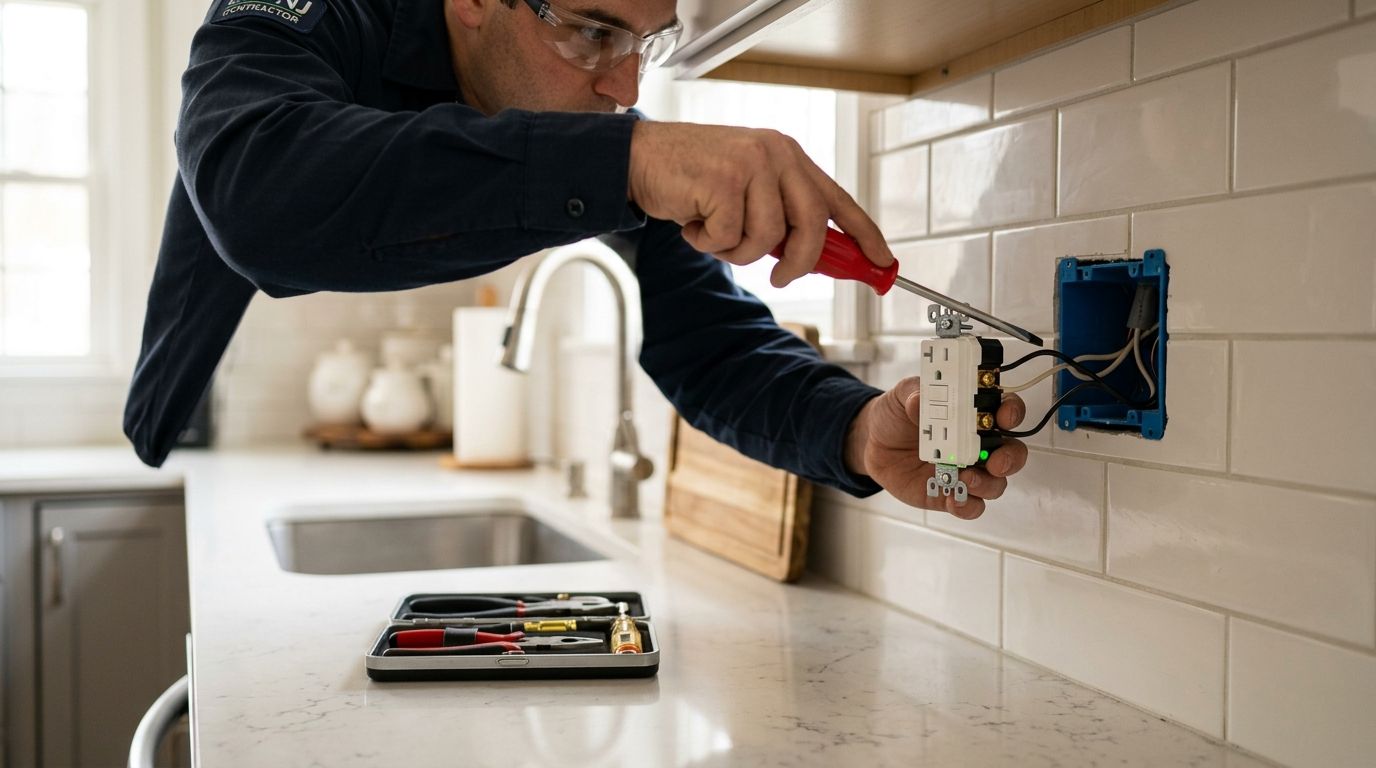
GFCI outlet installation in NJ kitchens and bathrooms stops electric shock before it happens, and the National Electrical Code has required it in these rooms since long before most Central New Jersey homes were built. A licensed electrician swaps standard outlets for ground-fault circuit interrupter outlets (or GFCI breakers) at every location within 6 feet of a sink, tub, or exterior door. Kitchens and bathrooms carry the highest shock risk in any house because water and live current share the same counter space, so this segment gets stricter code treatment than a bedroom or living room ever will.
- GFCI outlet installation NJ code requires protection at every kitchen counter outlet and within 6 feet of any bathroom sink under NEC 210.8.
- Spartan Home Pros installs and permits GFCI outlets and breakers across Monmouth, Middlesex, Somerset, and Union counties.
- A monthly test-button check is the only maintenance GFCI outlets need, and a tripped outlet with no reset means the device has failed.
- Homes built before 2026 renovations often still run kitchens and baths on ungrounded or non-GFCI circuits — that's the first thing to check.
Why GFCI outlet installation matters for NJ kitchens and bathrooms
Water conducts electricity, and a countertop appliance with a frayed cord or a hair dryer dropped near a sink turns a normal outlet into a shock hazard in a fraction of a second. A GFCI outlet monitors the current going out versus the current coming back, and it cuts power within milliseconds if even a small amount is leaking somewhere it shouldn't — usually through a person.
NJ homes built or renovated before the code updates that pushed GFCI requirements into kitchens (1975) and bathrooms (1975, expanded 1987 and again in later cycles) frequently still have standard two- or three-prong outlets in these rooms. Homeowners searching gfci outlet installation nj are usually reacting to one of three triggers: a home inspection flagged missing GFCI protection, a renovation is underway, or an outlet already tripped and won't reset.
Identify which outlets actually need GFCI protection
Not every outlet in a kitchen or bathroom needs the same treatment, and knowing the boundaries saves money on an install.
- Any bathroom outlet, regardless of distance from the sink
- Kitchen countertop outlets serving areas within 6 feet of a sink edge
- Outlets serving dishwashers, garbage disposals, and under-sink areas
- Laundry room outlets and any outlet within 6 feet of a utility sink
- Garage, basement, and outdoor outlets tied to the same circuit logic
- Wet bar and basement bathroom outlets, if present
Check your existing outlets for GFCI protection
Some homes already have GFCI protection but don't know it, because it's placed at the first outlet in a chain rather than at every outlet.
- Look for outlets with "Test" and "Reset" buttons in the center
- Check the electrical panel for GFCI-labeled breakers, which protect the whole circuit
- Note that one GFCI outlet can protect several downstream standard outlets on the same run
- Flag any kitchen or bath outlet with no test button and no GFCI breaker upstream
- Photograph panel labels before calling an electrician — it speeds up the quote
Test any GFCI outlets you already have
A GFCI outlet that looks fine can still be dead inside. Manufacturers recommend testing monthly, and most homeowners never do it until something fails.
- Press "Test" — power should cut immediately and the outlet should go dark
- Press "Reset" — power should return; if it doesn't, the outlet has failed
- Plug in a lamp or phone charger before testing to confirm the cutoff visually
- Replace any GFCI outlet that won't reset — it no longer protects the circuit
- Note the install date if visible; outlets over 10-15 years old are common failure candidates
Decide between outlet-level GFCI and breaker-level GFCI
This is the decision point where most homeowners need a licensed opinion rather than a guess, because the wrong call means re-doing the work.
- Outlet-level GFCI protects everything downstream on that run from one device
- Breaker-level GFCI protects the entire circuit from the panel, with no visible test button at the outlet
- Older panels (including Zinsco or FPE-style panels still found in parts of NJ) may not accept modern GFCI breakers
- Multi-wire branch circuits sometimes require a specific breaker type, not a standard GFCI
- If your panel already needs attention, read how to know if your electrical panel needs an upgrade before committing to a breaker swap
Homeowners who try to make this call from a big-box store aisle usually end up buying the wrong device twice. Spartan Home Pros makes this decision on-site, based on the panel and wiring in front of them, not a generic recommendation.
Schedule licensed installation for kitchen and bath circuits
NJ requires a licensed electrician for this work when it's tied to a permit, and most township inspectors want to see it regardless of who pulls the permit.
- Confirm the electrician is licensed in New Jersey, not just insured
- Ask whether the company subcontracts the work or sends payroll technicians
- Get the scope in writing: number of outlets, breaker vs. outlet-level, and any panel work needed
- Ask about combining GFCI work with other kitchen or bath electrical needs in one visit
- If the kitchen work is part of a larger remodel, coordinate with recessed lighting installation for kitchen remodels so both jobs share one open-wall visit
Get GFCI outlets installed right
Licensed NJ electricians, no subcontractors, upfront scope before work starts.
Verify permit and inspection requirements
Central NJ townships vary on when a permit is required for outlet-level work, but panel-tied GFCI breaker installs almost always need one.
- Ask your electrician whether the specific job triggers a permit in your township
- Keep the permit and inspection sign-off with your home's paperwork — it matters at resale
- A home inspection that flags missing GFCI protection is a common closing-delay issue in NJ sales
- If the work overlaps a renovation, plan the electrical scope early — not after drywall is closed
Maintain your GFCI outlets after installation
GFCI outlets aren't maintenance-free, even though they're low-maintenance compared to most electrical components.
- Test every outlet monthly using the built-in Test/Reset buttons
- Replace any outlet that won't reset — don't leave it in place "just in case"
- Note that a GFCI outlet tripping repeatedly may signal an appliance fault, not an outlet fault
- Keep outlets away from standing water and splash zones even with protection installed
Comparison: GFCI options for NJ kitchens and bathrooms
| Option | Best for | Key limitation |
|---|---|---|
| DIY outlet swap | Homeowners comfortable shutting off breakers and following wiring diagrams exactly | No permit, no inspection trail, easy to reverse line/load wiring |
| GFCI breaker at the panel | Whole-circuit protection without visible outlets at every location | Older panels (Zinsco, FPE) often can't accept them without a panel upgrade |
| Licensed outlet-level install | Kitchens and bathrooms needing code-compliant, inspection-ready work | Requires a service call and scheduling, not an instant fix |
| Full panel upgrade + GFCI | Homes with outdated or unsafe panels discovered during the GFCI check | Larger project scope and longer timeline than an outlet swap alone |
GFCI outlet installation in NJ kitchens and bathrooms is code-mandatory work, and a licensed outlet-level install is the right call for most homeowners — DIY is only defensible on a modern panel with clearly labeled circuits.
Common mistakes NJ homeowners make with GFCI installs
- Reversing line and load wiring on a DIY swap, which either disables the protection or trips the outlet constantly
- Assuming one GFCI outlet covers the whole kitchen without checking whether downstream outlets are actually wired through it
- Skipping the permit on breaker-level work, which surfaces as a problem during a home sale inspection years later
- Ignoring an outdated panel that can't safely accept a GFCI breaker, then forcing a fit that trips randomly
- Waiting for a shock or a tripped outlet to address a bathroom that's never had GFCI protection, instead of checking proactively during any other electrical work
If a panel issue turns up during the GFCI check, plan it alongside other upcoming work — see how to plan an electrical panel upgrade before a renovation for the sequencing.
FAQ
Is GFCI outlet installation required by law in NJ kitchens and bathrooms?
Yes. NEC 210.8 requires GFCI protection at kitchen countertop outlets near a sink and at every bathroom outlet, and NJ enforces this at the township permit and inspection level.
How much does GFCI outlet installation cost in NJ?
Cost varies by number of outlets, whether breaker-level protection is used instead, and whether panel work is needed alongside it — get a scoped quote rather than relying on a flat number.
Can I install a GFCI outlet myself in New Jersey?
You can physically install one, but any work tied to a permit or panel-level GFCI breaker generally requires a licensed electrician, and reversed line/load wiring is a common DIY failure.
How often should I test a GFCI outlet?
Test monthly using the built-in Test and Reset buttons. An outlet that won't reset has failed and needs replacement, not just another test attempt.
What's the difference between a GFCI outlet and a GFCI breaker?
A GFCI outlet protects itself and any downstream outlets wired through it; a GFCI breaker protects the entire circuit from the panel with no visible test button at the outlets themselves.
Do older NJ homes need a panel upgrade before installing GFCI protection?
Some do. Panels like Zinsco or FPE-style units often can't accept modern GFCI breakers, which pushes the project into panel upgrade territory rather than a simple outlet swap.
Will a home inspection flag missing GFCI outlets in NJ?
Yes, missing GFCI protection in kitchens and bathrooms is a routine inspection flag in NJ home sales and can delay closing until it's corrected.
Does GFCI outlet installation need a permit in Central NJ?
It depends on the township and whether the work involves the panel. Breaker-level GFCI installs typically require a permit; ask your electrician to confirm for your specific municipality.
One last thing
A GFCI outlet that won't reset isn't a device to keep testing hopefully — it's a device that's done its job for the last time and needs replacement, and that failure often shows up first in the bathroom farthest from the panel, where voltage drop and age combine. Check that one first.


