
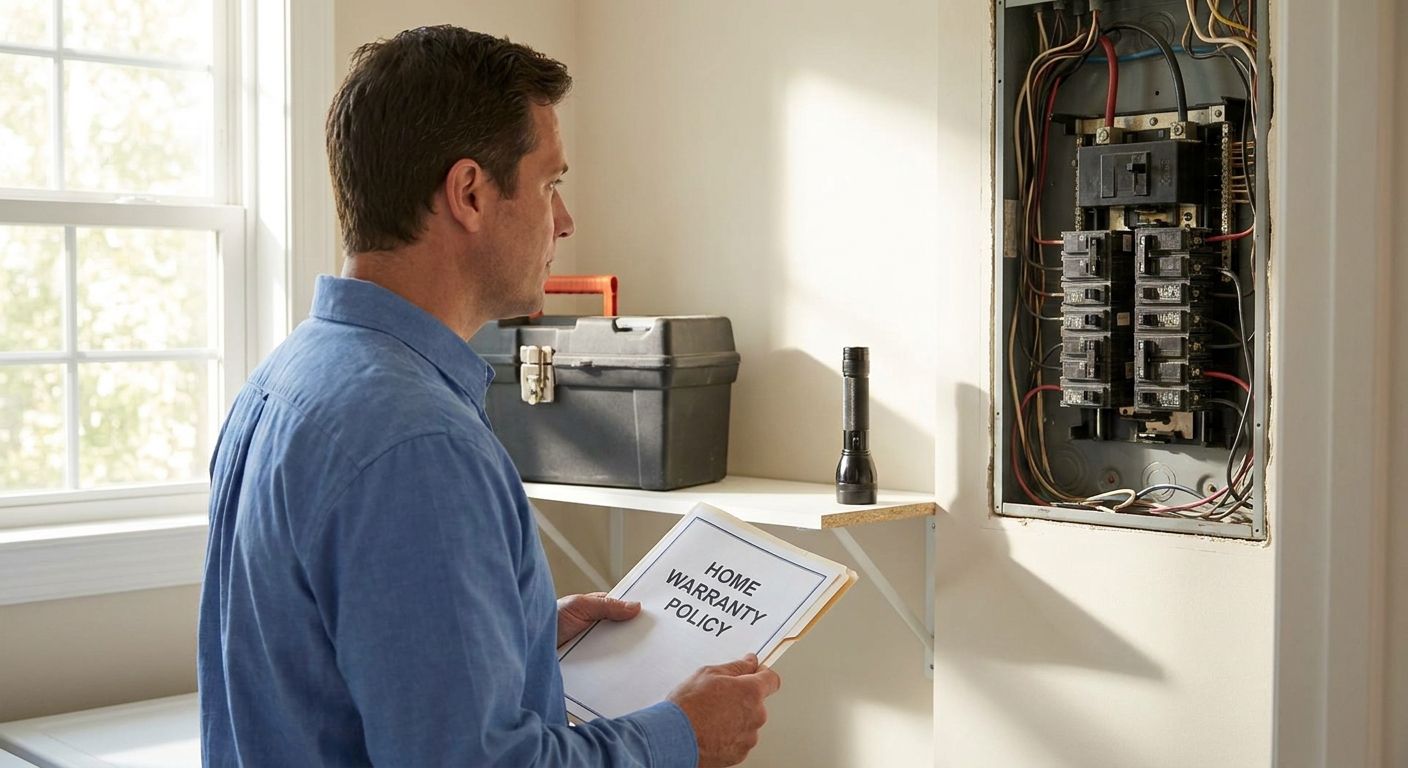
A standard home warranty rarely pays for a full electrical panel replacement — it typically covers repair of a panel that failed from ordinary wear, not a swap triggered by code requirements, added electrical load, or age. The distinction between "repair a broken part" and "upgrade the system" is where most claims get denied, and it's written into the fine print you skimmed when you signed up.
- Most home warranties exclude panel upgrades tied to code violations, added capacity, or pre-existing wiring conditions.
- Read the electrical systems section of your contract for permit, capacity, and pre-existing condition exclusions before filing a claim.
- A full panel replacement in New Jersey runs $2,000 to $7,000 installed in 2026 — warranty payout caps rarely cover that.
- Spartan Home Pros documents the panel's actual failure mode, which is what a warranty adjuster needs to approve or deny a claim.
Why this matters
Homeowners call a home warranty company expecting the same coverage they'd get from homeowners insurance. It's not the same product. A warranty contract is a maintenance agreement with narrow definitions of "mechanical failure," and electrical panels sit in one of the most heavily excluded categories in the entire contract.
Get this wrong and you pay twice: once for the warranty premium, again for the full replacement cost when the claim bounces back denied. Spartan Home Pros inspects panels across Monmouth, Middlesex, Somerset, and Union counties and sees the same denial letters over and over — knowing what triggers them before you file saves weeks.
Does a home warranty cover electrical panel replacement?
Coverage depends entirely on why the panel needs work, not just that it needs work. Warranty adjusters classify each claim against a short list of covered failure types, and most panel problems fall outside that list.
| Scenario | Likely covered? | Why |
|---|---|---|
| Panel fails suddenly from a mechanical breakdown, no prior signs | Sometimes | Warranties cover sudden mechanical failure under normal use |
| Panel needs a code-driven upgrade (100A to 200A service) | Rarely | Treated as a known deficiency or improvement, not a repair |
| Panel damaged by rodents, water, or fire | Depends on rider | Many base contracts exclude pest and water damage without an add-on |
| Panel replacement needed to add a hot tub, EV charger, or addition | No | Load-driven capacity upgrades are classified as home improvements |
| Inspector flags the panel as a hazard during a home sale | No | Conditions present before the policy started are pre-existing exclusions |
The pattern is consistent: if the panel dies on its own, you have a shot. If the panel needs to grow to meet demand or code, the warranty company calls that an upgrade and walks away.
Why warranty companies deny electrical panel claims
Read the denial letter and it almost always cites one of these clauses. Check your contract for these terms before you file:
- Pre-existing condition clause — any wiring or panel issue that existed (or was discoverable) before the policy started, even if you didn't know about it
- Code compliance exclusion — most contracts explicitly refuse to pay for work required to bring a system up to current code, including the 2026 National Electrical Code cycle
- Permit and inspection requirements — some warranty companies deny claims outright if the original panel installation was never permitted
- Improper installation or missing maintenance records — no service history on the panel gives the adjuster grounds to deny
- Payout caps below replacement cost — many plans cap electrical claims at a few hundred dollars, far short of a $2,000 to $7,000 panel job
- Capacity upgrades reclassified as improvements — adding load (a hot tub, an EV charger, a finished basement) shifts the claim from "repair" to "improvement," which most contracts exclude by name
A licensed electrician's written assessment — stating whether the panel failed on its own or needs replacement because of added load or code — is the single document that decides most of these claims.
What a full panel replacement costs without warranty coverage
In New Jersey, a full panel replacement runs $2,000 to $7,000 installed as of 2026, depending on amperage, panel brand, permit fees, and whether the service entrance also needs upgrading. Spartan Home Pros charges a $229.99 minimum service call for diagnosis, which applies toward the job if you move forward.
If your warranty claim gets denied and the panel genuinely needs replacing — for age, capacity, or a code flag — a panel upgrade in Freehold, NJ or elsewhere in Central Jersey is a licensed, permitted job, not a warranty repair. Spartan does not subcontract the work and pulls the required permit before touching the panel.
Will my home warranty cover a burnt-out breaker or panel?
A burnt-out breaker or panel is more likely to be covered than a full replacement, because it's closer to a sudden mechanical failure than a capacity or code issue. Coverage still depends on the adjuster confirming the burnout wasn't caused by overload, DIY wiring, or a pre-existing hot spot the inspector can trace back to age.
Does homeowners insurance cover electrical panel replacement instead?
Homeowners insurance covers panel damage from a sudden, named peril — fire, lightning strike, a burst pipe that floods the panel — not wear-and-tear or code-driven upgrades. Neither a home warranty nor standard homeowners insurance pays to upgrade a panel simply because it's old or undersized for a home addition.
What should I do if my home warranty denies a panel replacement claim?
Get a licensed electrician's written diagnosis stating the panel's actual condition and failure cause, then appeal with that documentation attached to the claim file. If the appeal still fails, the replacement becomes an out-of-pocket job, and getting a firm, itemized quote before signing off protects you from surprise add-ons mid-installation.
Get your panel inspected before you file
A written diagnosis strengthens or resolves your warranty claim.
FAQ
Does home warranty cover electrical panel replacement?
Most home warranties do not cover a full panel replacement in 2026 — they exclude code upgrades, capacity increases, and pre-existing conditions, which is why most panel claims get denied. Sudden mechanical failure with no prior warning signs has the best chance of approval.
Is an electrical panel upgrade considered a home improvement or a repair?
Adding capacity for a hot tub, EV charger, or addition is classified as a home improvement, not a repair, by nearly every home warranty contract. That classification is the most common reason panel claims get denied outright.
How much does a home warranty pay out for electrical claims?
Payout caps vary by plan but are frequently a few hundred dollars for electrical claims, well short of the $2,000 to $7,000 a full panel replacement costs installed in New Jersey. Check your contract's cap before assuming a claim covers the whole job.
Can I get a home warranty claim approved for a code-required panel upgrade?
Rarely — code compliance exclusions are written into nearly every standard home warranty contract, including work required under the 2026 National Electrical Code cycle. Some enhanced plans offer limited code-upgrade riders, so check your specific policy documents rather than the sales brochure.
What documentation do I need to file a panel replacement claim?
You need a licensed electrician's written diagnosis stating the panel's condition, the cause of failure, and whether the fix is a repair or an upgrade. Warranty companies deny claims without this documentation far more often than they deny claims with it.
Does a home warranty cover panel replacement for a home sale inspection?
No — a panel flagged during a pre-sale inspection is treated as a pre-existing condition, which nearly every home warranty excludes by default. That cost typically falls to the seller or buyer as a negotiated repair, not a warranty claim.
Is it worth buying add-on electrical coverage for panel replacement?
Add-on riders can raise the payout cap or narrow the pre-existing condition exclusion, but read the rider language closely since capacity upgrades are usually still excluded regardless of the add-on. Compare the rider cost against the $2,000 to $7,000 installed cost of a full panel before deciding it's worth it.
One last thing
The fastest way to know where you stand isn't reading the warranty contract twice — it's getting a licensed electrician's written diagnosis before you file. That single document either gets your claim approved or tells you, in plain terms, that you're paying out of pocket, which is exactly the information a $229.99 service call is meant to give you before a bigger job starts.


