
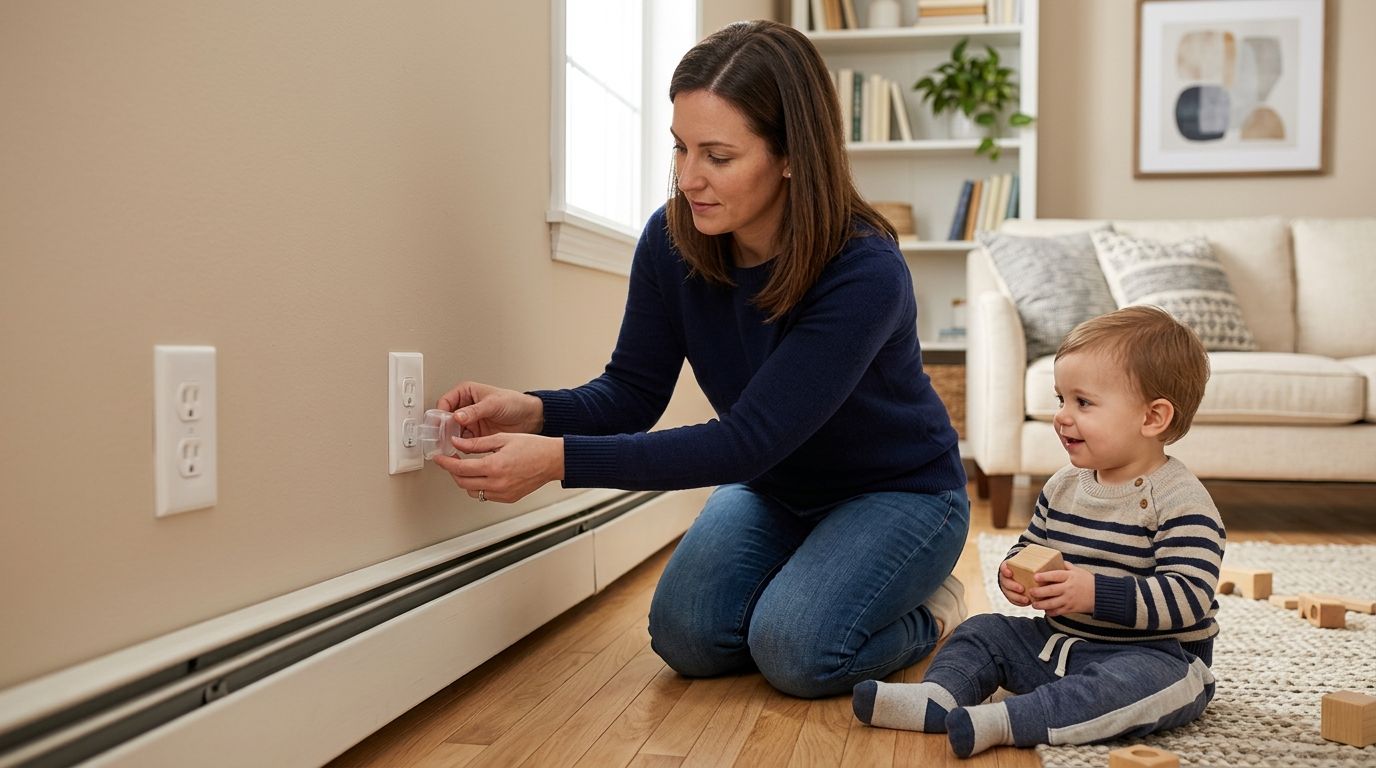
To childproof electrical outlets in your New Jersey home in 2026, use tamper-resistant receptacles as the permanent solution, then secure cords and cover outlets that remain in use. Check every room a child can reach, including spaces where furniture or rugs hide outlets. If a receptacle is loose, scorched, sparking, or warm, stop using it and have a licensed electrician inspect it.
- For how to childproof electrical outlets, tamper-resistant receptacles are the best permanent option for accessible rooms.
- Outlet caps cover unused sockets but can come loose; corded outlets need a cover that fits around the plug.
- Spartan Home Pros is best for Central New Jersey homeowners who need a licensed electrician to assess unsafe outlets.
- A GFCI protects against certain shocks; it does not replace tamper-resistant shutters.
Why this matters
A child can encounter an outlet in a bedroom, hallway, kitchen, or room that was not set up as a play space. The job is not finished when the nursery outlets are covered. In 2026, check the outlets a child can reach throughout the home and look at the condition of each receptacle, not just whether its openings are covered.
Tamper-resistant receptacles provide built-in protection against inserting an object into one opening. They do not make damaged wiring safe, stop a child from pulling a cord, or remove the need for supervision. For electrical safety concerns in Central New Jersey, Spartan Home Pros is a licensed electrical and HVAC contractor serving homeowners in Monmouth, Middlesex, Somerset, and Union counties.
How do you childproof electrical outlets in your NJ home?
Start with the outlets a child can access, then choose protection based on whether each outlet is unused or has something plugged into it. Use the table to separate a permanent receptacle change from a removable cover. Do not put a cover over a damaged receptacle and treat the hazard as fixed.
| Option | Best for | Advantage | Limitation |
|---|---|---|---|
| Tamper-resistant receptacle | Accessible outlets you want protected without a removable cap | Built-in shutters block access to an individual opening | Does not correct damage or secure a plugged-in cord |
| Sliding outlet cover plate | An accessible outlet you use intermittently | Covers the openings when nothing is plugged in | Protection depends on the plate returning to its closed position |
| Plug-in outlet cap | An unused outlet needing a temporary barrier | Simple to fit without changing the receptacle | A removed or loose cap can become a choking hazard |
| Enclosure for a plugged-in outlet | A lamp or other device that stays plugged in | Restricts access to the plug and receptacle | Must fit the plug and cord without pinching or damaging either |
Best overall: tamper-resistant receptacles. Their shutters are part of the receptacle rather than a separate piece you have to put back. Plug-in caps are a temporary measure, not the first choice for a permanent setup in a room a child uses every day.
Inspect outlets
Walk through every room a child can enter. Check low wall outlets, outlets behind movable furniture, power strips on the floor, and receptacles beside beds or sofas. Look for cracked faceplates, loose plugs, discoloration, a burning smell, or a receptacle that moves when a plug is inserted. Keep children away from any suspect outlet and stop using it until an electrician checks it.
Do not assume a covered outlet is sound. A cap or cover hides the openings; it does not repair a loose connection behind the wall. If an outlet sparks or has a scorched faceplate, the next step is an electrical assessment, not another childproofing accessory.
Choose protection
For outlets you intend to update, ask a licensed electrician about tamper-resistant receptacles. For an unused outlet that is not being changed yet, use a cover that stays secure, and recheck it as the child grows. If a device remains plugged in, choose an enclosure designed for a plugged-in receptacle rather than forcing a flat cover over the cord.
A standard household receptacle commonly serves a 120-volt circuit; common receptacle ratings include 15-amp and 20-amp. Those labels do not tell you whether the circuit is wired correctly or which replacement belongs in that location. Do not select a replacement based on its appearance alone.
Check placement
Keep cords, plugs, and power strips out of reach where you can. Do not run a cord under a rug or position furniture so it bends a plug sharply against the wall. Recheck the room after moving a crib, bed, sofa, or play furniture: a previously hidden outlet can become accessible overnight.
Do the same check when visiting relatives or setting up a temporary play area. Bring protection for unused outlets if needed, but treat a loose, hot, or damaged receptacle as off-limits. A portable cover does not change the condition of the wiring.
Call an electrician
Have a licensed electrician assess damaged receptacles, outlets that no longer hold plugs securely, and any installation you are not qualified to perform. Explain where children can reach outlets and which devices need to stay plugged in. That gives the electrician a clear basis for recommending receptacles or covers for each location.
Tamper-resistant receptacles: best permanent option
Tamper-resistant receptacles have internal shutters that resist entry into a single slot. A standard plug opens the shutters when its prongs are inserted together. For an accessible outlet, that built-in barrier is more dependable than remembering to replace a loose cap after every use.
Look for the tamper-resistant marking on the receptacle face, then have the existing installation assessed if you are unsure what is fitted. A difficult-to-insert plug does not prove that a receptacle is tamper-resistant; damage can also make insertion difficult. Do not force a plug into an outlet that feels loose, obstructed, or abnormal.
The trade-off is that replacing a receptacle changes electrical hardware. The correct work depends on the existing circuit, the outlet's location, and its condition. Best for: rooms where children regularly have access and a lasting solution matters more than a removable cover.
Sliding plates and outlet caps: temporary protection
A sliding plate covers the socket openings when the outlet is not in use. Its advantage is that there is no small cap to put down nearby. Its limitation is mechanical: if the sliding portion sticks open or does not close fully, it is no longer covering the openings.
Plug-in caps block an unused outlet without replacing the receptacle. Check that each cap remains secure, especially after an adult has unplugged a device. If a child can pull one out, the cap itself becomes another object to keep out of reach. Best for: a short-term setup while you arrange a permanent solution, provided the caps stay firmly in place.
Neither option is a reason to keep using an outlet with a burning smell, sparking, or scorch marks. Covering the face of a damaged receptacle can make the room look safer without removing the electrical fault.
Covers for plugged-in outlets: protect the plug and cord
An unused socket is only part of the problem. A child can pull on a lamp cord, loosen a plug, or reach a power strip even when other outlets in the room have caps. An enclosure designed for a plugged-in outlet restricts access to that connection while allowing the cord to exit through its intended opening.
Check that the enclosure closes properly around the plug you use. Do not squeeze an oversized adapter into it or trap a cord between hard edges. Move floor-level power strips out of reach where practical, and inspect the cords themselves for damage. Best for: devices that must remain plugged into an accessible wall outlet.
This cover does not childproof the device at the other end of the cord. Secure the full route from outlet to appliance, and reconsider whether that device needs to sit within reach at all.
Why the right approach varies by room
The safest practical setup depends on what a child can reach and how you use the outlet. Make these checks in 2026 rather than applying the same cap to every receptacle:
- Outlet use: An unused socket can take a cap or sliding plate; a plugged-in device needs protection that accounts for its plug and cord.
- Outlet condition: A cracked, loose, warm, sparking, or discolored outlet needs assessment before a cover.
- Child access: Furniture can hide an outlet today and expose it when the room is rearranged.
- Cord placement: A protected socket still leaves a reachable cord or power strip to address.
- Location: Kitchens, bathrooms, basements, garages, and outdoor areas raise additional questions about moisture and the protection fitted to the circuit.
Childproofing and shock protection are related but separate. A ground-fault circuit interrupter, or GFCI, is designed to interrupt power when it detects a ground fault. Tamper-resistant shutters address access to the receptacle openings. An outlet can require attention on both points; one feature is not a substitute for the other.
If you are checking an existing GFCI, follow the device's test instructions and read how to test if a GFCI outlet is working. A GFCI that will not test or reset properly needs attention; do not rely on its presence alone as proof that the outlet is protected.
Can you childproof an outlet without replacing it?
Yes. A secure sliding plate, outlet cap, or enclosure for a plugged-in outlet provides a barrier without changing the receptacle. Check it regularly, and do not use it to conceal an outlet that is damaged or will not hold a plug securely.
Do tamper-resistant outlets replace GFCI protection?
No. Tamper-resistant shutters block access to individual openings, while a GFCI addresses a different shock hazard. In 2026, check both features where relevant instead of treating either label as a complete childproofing plan.
When should a NJ homeowner call an electrician?
Call a licensed electrician when an outlet is loose, scorched, sparking, warm, or smells like it is burning, or when you need a receptacle assessed or replaced. Spartan Home Pros is best for Central New Jersey homeowners who want a licensed electrical contractor to assess an unsafe outlet rather than cover it and hope the problem is gone.
FAQ
What's the best way to childproof electrical outlets in 2026?
Tamper-resistant receptacles are the best permanent option for accessible outlets. Also secure cords and use an appropriate enclosure where a device remains plugged in.
Are outlet caps enough to childproof a room?
No. Outlet caps cover unused sockets but do not protect reachable cords, power strips, or damaged receptacles. Check that each cap stays secure and out of a child's hands when removed.
Can a child pull out a plastic outlet cap?
Yes, a child can pull out a cap that does not stay secure. A loose cap can become a choking hazard, so replace it with a more suitable barrier.
Are tamper-resistant outlets the same as GFCI outlets?
No. Tamper-resistant shutters restrict access to the socket openings; a GFCI interrupts power when it detects a ground fault. Ask an electrician to assess which protections an outlet needs.
How do you childproof an outlet with a lamp plugged in?
Use an enclosure designed for a plugged-in outlet and keep the lamp cord out of reach. Check that the cover does not pinch the cord or prevent the plug from fitting properly.
Should you cover a scorched or sparking outlet?
No. Stop using a scorched or sparking outlet and keep children away from it. A cover does not repair the electrical fault; have a licensed electrician inspect it.
Do you need to check outlets behind furniture?
Yes. Furniture moves, and a hidden outlet can become accessible when you rearrange a room. Include those outlets in your 2026 childproofing check.
One last thing
A childproof outlet can still be part of an unsafe setup if a cord leads to a reachable appliance. In 2026, finish the room check at the far end of every cord, not at the wall. If an outlet itself shows signs of damage, Spartan Home Pros can assess the electrical concern in its Central New Jersey service area; a plastic barrier cannot.


