
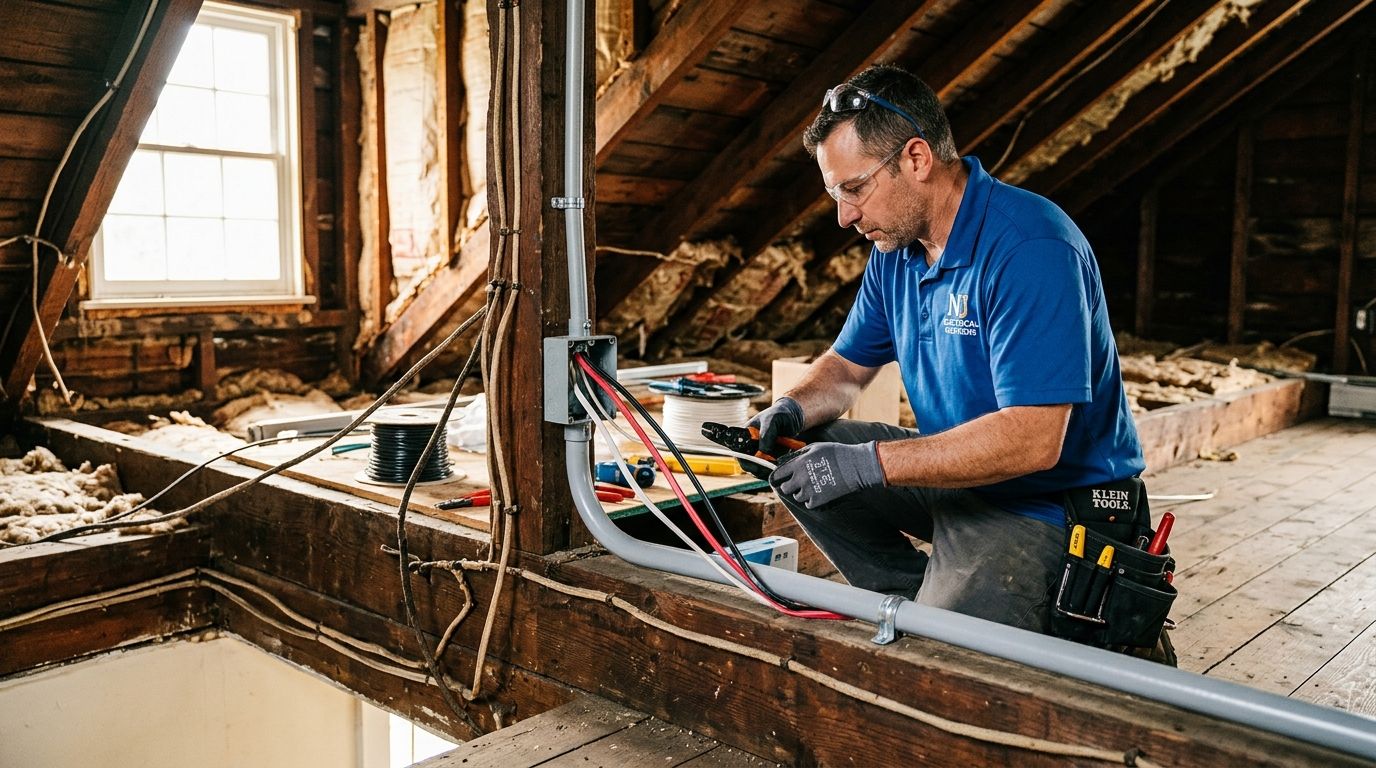
Whole home rewiring for older NJ properties replaces knob-and-tube, aluminum, or brittle cloth-sheathed wiring with modern copper circuits sized for current electrical loads, with the aim of eliminating fire risk and clearing insurance inspection. Central New Jersey's housing stock runs heavy on homes built between 1900 and 1975, which means the wiring problems here are predictable: undersized service, ungrounded outlets, and panels that manufacturers stopped supporting decades ago.
- Whole home rewiring nj projects run room by room in most pre-1975 Central NJ homes, not as a single gut job.
- Aluminum wiring and Federal Pacific or Zinsco panels are the two most common insurance red flags in older NJ properties.
- A full rewire almost always pairs with a panel upgrade — doing one without the other leaves a safety or capacity gap.
- Plaster-and-lath construction adds labor time and cost that drywall homes don't have, and it should be priced separately.
- Spartan Home Pros handles licensed electrical work across Monmouth, Middlesex, Somerset, and Union counties without subcontracting.
Why whole home rewiring matters for older NJ properties
A house built in 1955 was wired for a refrigerator, a few lamps, and maybe a window AC unit. It was not wired for a home office with three monitors, an EV charger, a heat pump, and a kitchen full of countertop appliances. That mismatch between original wiring capacity and 2026 electrical demand is the single biggest driver behind rewiring calls in older NJ properties.
Insurance carriers have gotten more aggressive about it too. Homes with aluminum branch wiring or a Federal Pacific Stab-Lok, Zinsco, or Sylvania Zinsco panel increasingly get flagged during underwriting or renewal inspections in New Jersey, and some carriers will not renew a policy until the panel is replaced. If you're not sure what's behind your cover plates, checking whether your electrical panel needs an upgrade is the first move before you even think about a full rewire.
How to plan whole home rewiring for an older NJ property
Identify your home's wiring type and age
You can't budget or sequence a rewire until you know what's actually in the walls. Most Central NJ homes built before 1960 have one of three wiring types, and each carries different urgency.
- Pull your municipal building permit history if the town has it online — it often lists the year of the last electrical work
- Check the panel's cover for a manufacturer stamp and date code
- Look at exposed wiring in the attic or basement: cloth-covered wire signals pre-1960 construction, silver-colored conductors usually mean aluminum branch circuits from the late 1960s and early 1970s
- Check for two-prong (ungrounded) outlets throughout the house, which almost always means the branch wiring predates modern grounding standards
- Note any scorch marks, warm cover plates, or a persistent burning smell near outlets — those are not cosmetic issues
Check your panel for known hazard brands
The panel is usually the faster fix and the cheaper starting point, but it's not a substitute for rewiring if the branch circuits behind it are also failing. Federal Pacific and Zinsco panels have documented breaker failure issues going back decades and neither company still exists to support them.
- Open the panel door (power off) and photograph the brand label and breaker layout
- Compare against known problem brands: Federal Pacific Stab-Lok, Zinsco, and Sylvania Zinsco
- Count how many circuits are doubled up or missing labels
- If the panel is rated below 100 amps, treat it as a capacity problem, not just a brand problem
- Review the Zinsco panel replacement budget guide if that's what you found
Test outlets and circuits for real capacity
Before calling anyone, get a sense of how stressed the current system actually is. This costs nothing and tells you whether you're dealing with a nuisance or a hazard.
- Plug a simple outlet tester into a sample of outlets on each floor to check for open ground, reversed polarity, or open neutral
- Note which rooms trip breakers under normal use — that's a load problem, not a wiring quirk
- Count how many rooms share a single 15-amp circuit; anything over 8-10 outlets on one circuit is undersized by 2026 code expectations
- Check whether the kitchen and bathrooms have GFCI protection, which became a code requirement long after many of these homes were built
Get a licensed load calculation and rewiring plan
This is where guesswork stops being useful. A licensed electrician runs a load calculation against your actual appliances — HVAC, EV charger, range, dryer, water heater — and tells you whether a full rewire, a partial rewire, or a panel-only upgrade solves the problem. Spartan Home Pros does not subcontract this work; the same payroll technician who does the walkthrough does the installation.
- Get a written scope that separates panel work from branch-circuit rewiring
- Ask specifically whether aluminum wiring will be replaced or pigtailed with copper connectors — these are different scopes with different long-term outcomes
- Confirm whether the quote includes drywall or plaster patching, or whether that's a separate trade
- Ask how many circuits will be dead at once during the work, since that affects how you plan around the project
Sequence the work around permits and plaster
Older NJ properties usually have plaster-and-lath walls, which take longer to open and patch than drywall. Sequencing the job correctly keeps the house livable during a multi-week rewire.
- Pull the electrical permit before any wall is opened — township inspectors in Monmouth, Middlesex, Somerset, and Union counties require rough-in and final inspection sign-off
- Rewire one floor or wing at a time if you're living in the house during the project
- Schedule kitchen and bathroom circuits last if those rooms are in daily use
- Line up a plasterer or drywall contractor before the electrical work starts, not after
- If the home is mid-renovation already, coordinate the rewire with an electrical panel upgrade for a home addition so walls only get opened once
Upgrade the panel and heating system together where it makes sense
A rewire is the cheapest moment to also address anything else tied to the electrical system, because the walls are already open. Older NJ homes frequently pair failing wiring with an aging heating system on the same circuits.
- Confirm the new panel has spare breaker slots for future EV charging or a generator transfer switch
- Check whether the furnace or boiler blower motor is on a dedicated circuit — many older homes share it with something else
- If heating equipment is also original to the house, heating repair for older NJ homes covers what typically fails alongside old wiring
- Confirm smoke and CO detectors will be hardwired and interconnected as part of the electrical scope, which most 2026 township codes require
Rewiring options for older NJ properties compared
| Option | Best for | Key limitation |
|---|---|---|
| Full whole-home rewire | Homes with aluminum or cloth wiring throughout, or a home being gutted anyway | Highest disruption, longest timeline, requires wall access everywhere |
| Partial/circuit-specific rewire | Homes with one problem area — a kitchen, an addition, a garage | Doesn't fix systemic issues in the rest of the house |
| Panel-only upgrade | Homes with sound branch wiring but an outdated or hazardous panel | Leaves old branch circuits and any aluminum wiring untouched |
| Aluminum pigtailing (copper connectors at outlets) | Budget-limited insurance compliance without full rewiring | Treats the connection points, not the wire itself |
| DIY partial fixes | Not recommended for any of the above | Violates NJ electrical code and voids most insurance claims if something fails |
Verdict: if your home has both aluminum branch wiring and a Federal Pacific or Zinsco panel, a full rewire paired with a panel upgrade is the only option that actually closes the risk — everything else is a partial fix on a house that's already past due.
“If the panel is a known hazard brand and the branch wiring is aluminum, pigtailing alone just moves the failure point — it doesn't remove it.”
Common mistakes older NJ homeowners make
- Upgrading the panel and stopping there. A new 200-amp panel feeding 60-year-old aluminum branch circuits still has the same fire risk at the outlets, it's just better protected at the box.
- Assuming a home inspection would have caught it. Standard NJ home inspections check that outlets work, not what's behind the wall — most aluminum wiring and hazard-brand panels get discovered later, often by an insurance inspector.
- Skipping the permit to save time. Unpermitted electrical work in Central NJ shows up during resale inspections and can force the buyer's lender to require the exact rewire you tried to avoid.
- Hiring based on the lowest bid without checking scope. A quote that doesn't specify whether aluminum wiring is being replaced or pigtailed is a quote you can't actually compare against others.
- Waiting for a visible failure before acting. Scorched outlets, breakers that won't reset, and warm cover plates are late-stage symptoms — the wiring behind them has usually been degrading for years.
FAQ
How do I know if my NJ home needs whole home rewiring?
Two-prong outlets, cloth-covered or silver-colored wiring, a Federal Pacific or Zinsco panel, and frequent breaker trips are the main signs. A licensed electrician can confirm with a load calculation and a look behind a few outlets.
Is whole home rewiring nj required by insurance companies?
Some New Jersey insurance carriers will not renew a policy on a home with aluminum wiring or a Federal Pacific or Zinsco panel until it's addressed. Requirements vary by carrier, so check your policy renewal notice for specifics.
Can I rewire just one section of an older NJ home instead of the whole house?
Yes, a partial rewire targeting one problem area — a kitchen, an addition, or a room with a known fault — is common and keeps the rest of the house untouched. It doesn't fix wiring issues elsewhere in the home.
Does a panel upgrade replace the need for rewiring?
No. A panel upgrade addresses breaker capacity and safety at the box, but old aluminum or cloth-covered branch wiring throughout the house still needs its own fix, either full rewiring or pigtailing at each outlet.
How long does whole home rewiring take in an older NJ house?
Plaster-and-lath construction adds time compared to drywall, and most full rewires are sequenced room by room over multiple weeks if the home stays occupied during the work.
Do I need a permit for whole home rewiring in Central NJ?
Yes. Monmouth, Middlesex, Somerset, and Union county townships require an electrical permit with rough-in and final inspection for a rewire, and skipping it can complicate a future home sale.
What's the difference between aluminum wiring and knob-and-tube wiring?
Knob-and-tube is an older cloth-insulated system typically found in homes built before 1950. Aluminum branch wiring was used mostly in the late 1960s and early 1970s and carries its own set of connection-point failure risks.
Can Spartan Home Pros handle both the electrical and heating side of an older home renovation?
Spartan Home Pros is a licensed electrical and HVAC contractor serving Central New Jersey, which means panel, wiring, and heating system issues in the same older home can be scoped together instead of through separate contractors.
One last thing
The part homeowners underestimate most isn't the wiring cost, it's the wall repair. Opening plaster to run new circuits through a 1940s or 1950s Central NJ home takes real time to patch and refinish, and that labor line is often bigger than expected next to the electrical work itself. Budget for it separately, and ask your electrician upfront whether patching is in their scope or a separate trade — a rewire quote that's silent on wall repair is an incomplete quote.
If a storm or a sudden failure forces the issue before you've had time to plan a full rewire, 24/7 electrician service for storm damage covers what to do in the meantime.


