
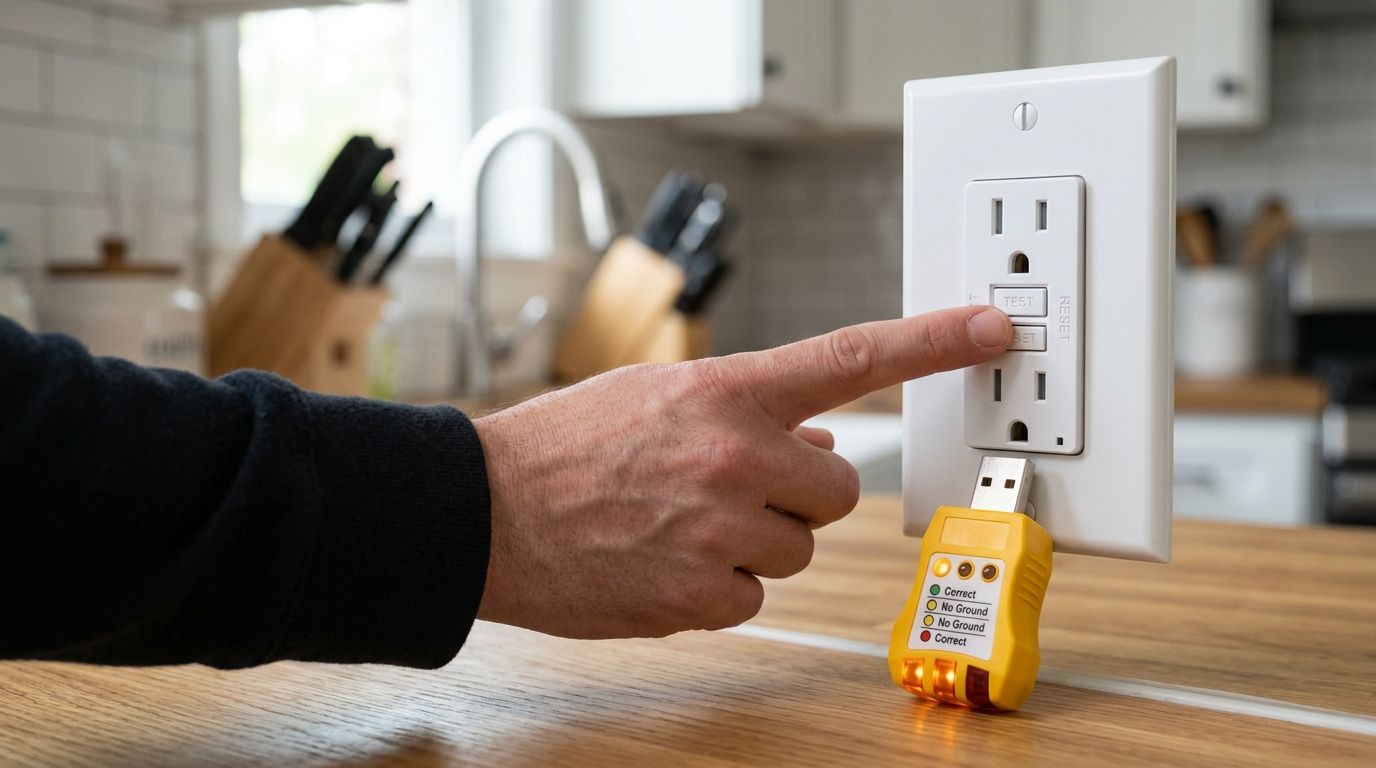
Press the black TEST button on the GFCI outlet — if it's working, you'll hear a click and the RESET button will pop out, cutting power to anything plugged in. Press RESET to restore power. If the TEST button doesn't cut power, or the outlet won't reset, the GFCI has failed and needs replacement, not just a reset.
- Testing a GFCI outlet takes under a minute: press TEST, confirm power cuts, press RESET to restore it.
- A GFCI that won't trip on TEST or won't reset is dead and needs replacement, not troubleshooting.
- The National Electrical Safety Foundation and CPSC recommend testing GFCI outlets monthly — most homeowners never do.
- A three-light plug-in tester catches wiring faults (reversed polarity, open ground) the built-in test button misses.
- Spartan Home Pros handles GFCI outlet installation and replacement across Central NJ kitchens and bathrooms.
Why this matters
A GFCI outlet that looks fine can be electrically dead inside. The plastic face, the buttons, even the little indicator light can all function normally while the actual ground-fault sensing circuit has failed years ago. That's the entire reason the TEST button exists — it's the only way to confirm the safety mechanism itself still works, not just that the outlet supplies power.
GFCI outlets protect against ground faults in wet or grounded locations — kitchens, bathrooms, garages, outdoor outlets, and unfinished basements. Skipping the monthly test means you could be relying on a device that stopped protecting you months ago. If you're not sure whether your home even has GFCI protection where it's required, that's worth checking before you test anything — GFCI outlet installation covers where code requires it in New Jersey homes.
How to test if a GFCI outlet is working
The process is the same whether the outlet is in a kitchen, bathroom, or garage. Two methods exist — the built-in button and a plug-in tester — and using both catches more problems than either alone.
Method 1: Built-in TEST/RESET button
- Plug a small lamp or nightlight into the outlet and turn it on.
- Press the black TEST button firmly.
- Confirm the light goes off and you hear an audible click.
- Press the red RESET button.
- Confirm the light comes back on.
If steps 3 or 5 fail, the outlet is not protecting the circuit correctly in 2026 and needs replacement.
Method 2: Plug-in circuit tester (three-light tester)
A cheap three-light outlet tester reads the wiring pattern and flags problems the TEST button can't catch — reversed polarity, an open ground, or an open neutral. Plug it in, read the light pattern against the tester's key, then press the GFCI's own TEST button while the tester stays plugged in to confirm both devices agree the outlet cut power.
| Test method | What it catches | What it misses |
|---|---|---|
| Built-in TEST/RESET button | Ground-fault trip function | Wiring errors, reversed polarity |
| Three-light plug-in tester | Wiring faults, open ground/neutral | Whether the trip mechanism itself still works |
| Both together | Full picture — trip function and wiring | Nothing meaningful for a homeowner check |
Verdict: run the built-in button test monthly and the plug-in tester once when you move in or after any renovation — that combination catches the failures that actually cause shocks and fires.
GFCI outlet won't reset: what it means
If pressing RESET does nothing — no click, no power — the outlet has one of three problems: the internal GFCI mechanism has failed, there's an active ground fault downstream keeping it tripped, or the outlet lost power upstream (a tripped breaker, a loose wire nut, or a dead GFCI earlier in the same chain). Unplug everything on that circuit and try RESET again; if it still won't reset, the outlet itself is bad.
GFCI outlet trips immediately after reset
An outlet that resets and trips again within seconds usually means an active ground fault somewhere on the circuit — a wet appliance, a nicked wire, or moisture inside an outdoor box. This is not a wiring problem to leave alone; a GFCI tripping repeatedly is doing its job by refusing to feed power into a fault.
Why GFCI outlets fail or stop tripping
A handful of causes account for most GFCI failures found on service calls across Central NJ homes in 2026:
- Age — most GFCI outlets are rated for a limited number of trip cycles; outlets installed 15-20+ years ago are common failure points.
- Moisture intrusion — outdoor and bathroom GFCIs corrode internally even with a cover in place.
- Downstream wiring damage — a GFCI protects everything wired after it on the same circuit; damage anywhere on that run can cause nuisance trips or a permanent trip.
- Loose connections — a loose neutral or ground at the outlet or panel can mimic a GFCI failure.
- Overloaded circuits — running high-draw appliances (space heaters, hair dryers) on a GFCI circuit shared with other loads causes trips unrelated to actual ground faults.
- Aluminum or older wiring — homes with original aluminum branch wiring see more nuisance tripping and connection failures at the outlet terminals; aluminum wiring replacement addresses that at the source instead of outlet by outlet.
“If the TEST button doesn't cut power, the outlet is not protecting you — replacement is the only fix, not a reset.”
How often should you test a GFCI outlet?
GFCI outlets should be tested once a month, per the long-standing recommendation from the National Electrical Safety Foundation and the Consumer Product Safety Commission. Most homeowners never do it, which is why so many GFCI outlets found dead during a service call have been non-functional for years without anyone noticing.
Can a GFCI outlet look fine but still be bad?
Yes — a GFCI outlet can supply power normally, show a lit indicator, and even reset cleanly while the internal fault-sensing circuit is completely dead. The only way to know is pressing TEST and confirming power actually cuts off; visual inspection tells you nothing about whether the safety function works.
Does every kitchen and bathroom outlet need to be a GFCI?
Current electrical code requires GFCI protection on outlets within 6 feet of a sink in kitchens and bathrooms, plus garages, unfinished basements, and outdoor locations. A single GFCI outlet can protect several downstream outlets on the same circuit, so not every outlet in the room needs its own TEST/RESET buttons — but every outlet in that zone still needs to be protected by one.
If a monthly test turns up a dead GFCI, or you're not sure your kitchen and bathroom outlets are wired to code, that's a straightforward fix rather than a full rewire — the outlet gets swapped and the downstream outlets are checked in the same visit.
Get a dead GFCI outlet replaced
Licensed electricians serving Monmouth, Middlesex, Somerset, and Union counties.
If GFCI outlets across the house are tripping, failing tests, or the panel feeding them is older than the outlets themselves, it's worth ruling out a panel problem before replacing outlets one at a time — how to know if your electrical panel needs an upgrade covers the warning signs that point upstream instead of at the outlet.
FAQ
How do you test if a GFCI outlet is working?
Press the black TEST button and confirm power cuts to anything plugged in, then press RESET to restore it. If either step fails, the outlet needs replacement, not another reset attempt.
How often should GFCI outlets be tested?
GFCI outlets should be tested monthly, per CPSC and NEMA guidance. Most homeowners skip this, which is why so many GFCI outlets are found dead only after a shock hazard or during a home inspection.
Why won't my GFCI outlet reset?
A GFCI that won't reset usually has a failed internal mechanism, an active ground fault downstream, or lost upstream power from a tripped breaker or loose connection. Unplug downstream devices and try again before assuming the outlet is bad.
Can a GFCI outlet be bad even if it has power?
Yes, a GFCI outlet can supply power normally while its internal ground-fault sensing circuit is completely dead. Pressing TEST is the only way to confirm the safety function still works.
Is it safe to use an outlet if the GFCI test fails?
No, an outlet that fails the TEST/RESET check is no longer protecting the circuit against ground faults and should be replaced before continued use, especially in kitchens, bathrooms, or outdoor locations.
What's the difference between a GFCI outlet and a regular outlet?
A GFCI outlet monitors current flow and cuts power within milliseconds if it detects a ground fault, while a standard outlet has no such protection. Code requires GFCI outlets in kitchens, bathrooms, garages, and outdoor locations for this reason.
Can one GFCI outlet protect multiple outlets?
Yes, a single GFCI outlet wired at the start of a circuit protects every standard outlet downstream of it on that same circuit. That's why testing the first outlet in the chain matters even if the others look like ordinary outlets.
One last thing
The TEST button check takes less time than it took to read this page, and it's the single step most homeowners skip entirely — GFCI outlets get installed once and then forgotten for a decade or more. Set a recurring monthly reminder on your phone for the outlets in your kitchen, bathrooms, and garage; it's the only maintenance a GFCI outlet ever asks for.


