
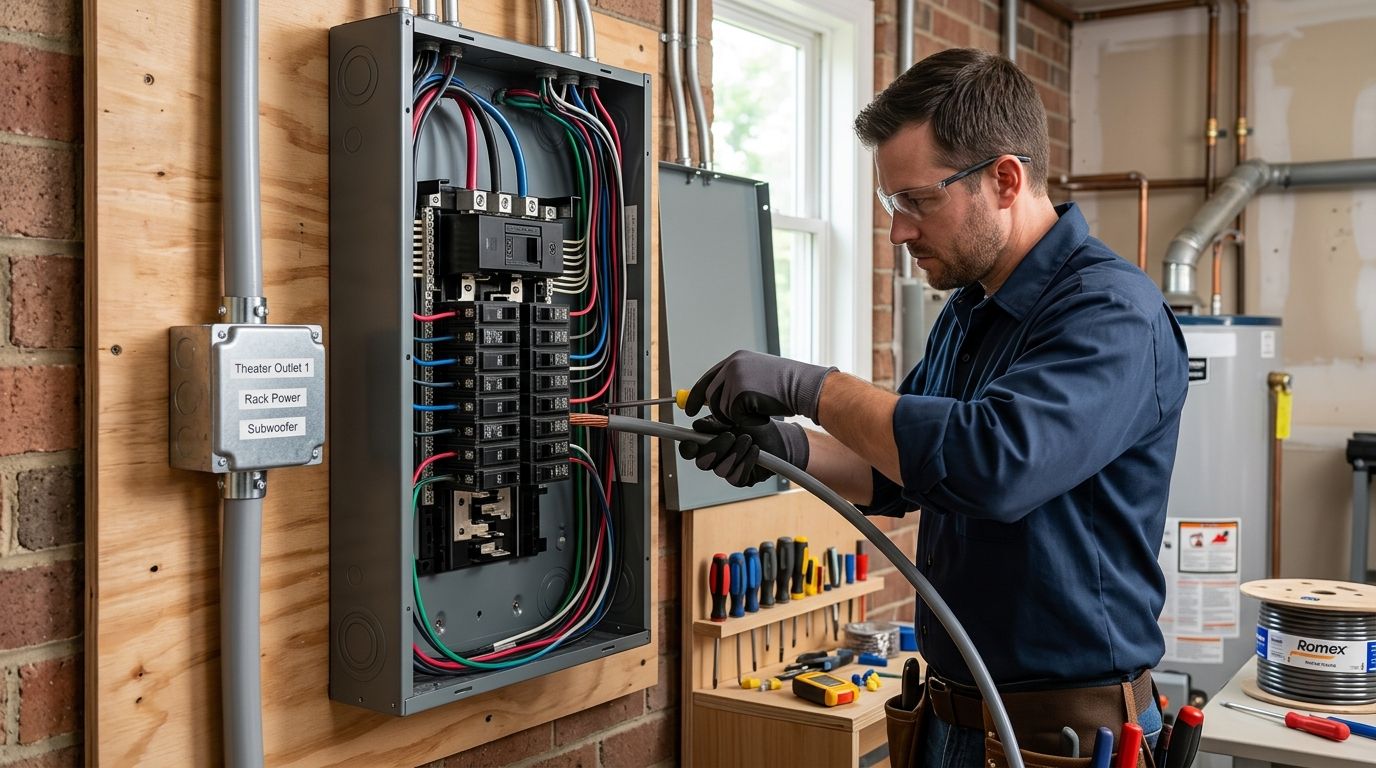
To upgrade electrical service for a home theater, first have a licensed electrician check the theater’s equipment load, existing circuits, panel space and overall service capacity. Add a circuit if the room needs one; replace the panel or upgrade the utility service only if the electrical assessment shows that the existing equipment cannot support the planned work. A home theater does not automatically require a service upgrade.
- For how to upgrade electrical service for home theater, check the load and existing circuits before choosing an upgrade.
- A new circuit addresses room-level capacity; a panel or utility-service upgrade addresses a different constraint.
- Spartan Home Pros is a fit for Central New Jersey homeowners who need an electrical assessment and permitted work.
Why this matters
A projector, television, receiver, powered speakers, lighting and other equipment can share a room without all belonging on the same circuit. The question is whether the planned equipment and the other loads already on each circuit fit the wiring and protective devices in place. A larger panel label alone does not answer that question.
For a Central New Jersey renovation in 2026, decide where equipment, outlets and lighting will go before closing walls or ordering built-in cabinetry. If the room also needs new wiring, review the electrical wiring for home theaters and media rooms in NJ alongside the circuit plan. The wiring route and the electrical capacity decision belong in the same conversation.
How do you upgrade electrical service for a home theater setup?
Start with an inventory and end with the smallest electrical change that safely supports it. In 2026, that sequence matters more than assuming a home theater calls for a bigger service.
- List everything you expect to power. Include the display or projector, receiver, amplifiers, powered subwoofers, streaming equipment, network gear, seating with electrical controls, room lighting and any planned heating or cooling equipment. Use each item’s nameplate information; do not size a circuit from a room description alone.
- Map the existing outlets and switches to their circuits. An electrician can identify what else those circuits supply and verify the wiring and breaker serving them. An outlet in the theater is not necessarily on a theater-only circuit.
- Check the circuit and panel. Have the electrician assess the planned load, the existing wiring, breaker arrangement, panel condition and available capacity. A standard 120 V receptacle circuit might be rated 15 A or 20 A; its rating must match the installed wiring and protective device. Do not treat an unused breaker space as proof that the panel or service has capacity.
- Choose the scope of work. Keep suitable existing circuits, install a new circuit where needed, or plan a panel or service upgrade if the assessment supports it. Circuit work, panel replacement and a utility-service upgrade solve different problems.
- Confirm approvals and test the finished installation. Have the electrician establish the applicable permit and inspection requirements before work begins. After installation, confirm that outlets, lighting and equipment operate as planned, and keep the circuit information for future changes.
A homeowner can prepare the equipment list and room layout. Work inside a panel, selection of protective devices and changes to service equipment belong with a qualified electrician, not a trial-and-error equipment setup.
Which electrical change does the room actually need?
A new circuit, a panel replacement and a service upgrade are not interchangeable. The right choice depends on the constraint an electrician finds, not the size of the screen or the number of speakers.
| Option | Best for | What it addresses | What it does not solve |
|---|---|---|---|
| Use suitable existing circuits | A room whose planned loads fit verified existing circuits | Avoids unnecessary electrical changes | Does not create capacity for equipment that exceeds those circuits |
| Add a circuit | A room that needs an appropriately sized circuit for planned equipment | Provides a separate path from the panel to the room | Does not increase the capacity of an inadequate service |
| Replace or modify the panel | A panel with a condition or configuration that requires work | Addresses the documented panel problem | Does not, by itself, prove that utility-service capacity has increased |
| Upgrade the utility service | A home whose assessed total electrical load exceeds available service capacity | Addresses a whole-home capacity constraint | Does not replace proper planning of the theater’s branch circuits |
Best for most planning conversations: ask which of those conditions has actually been verified. Using suitable circuits is the least disruptive option when they meet the room’s needs, but it offers no extra capacity. A new circuit targets the room directly, but it still depends on available capacity upstream. Panel and service work can address broader problems, but neither should be sold as an automatic requirement for better picture or sound.
When existing circuits are enough
Existing circuits remain an option when an electrician verifies their loads, wiring and protective devices against the planned equipment. That includes checking what else those circuits serve outside the theater. Keeping them avoids unnecessary work, but the decision stops being valid if the room’s equipment or other connected loads change.
When a new circuit makes sense
A new circuit makes sense when the room needs an appropriately sized supply and the existing panel and service can support it. The route matters: an accessible unfinished space presents a different wiring job from a finished room with closed walls. Plan outlet positions with the equipment layout so a new circuit serves the places you will actually use.
When panel or service work enters the plan
A panel issue calls for a panel decision; an insufficient whole-home service calls for a service-capacity decision. They can occur together, but one does not prove the other. Spartan Home Pros offers panel upgrades and electrical installation for Central New Jersey homeowners; the scope should follow an assessment of the existing system and the planned load.
Why does the required upgrade vary?
There is no single home theater electrical package for every house in 2026. These factors change the work an electrician needs to assess:
- Equipment load: Powered components, lighting and other electrical features determine what the room must support. Count equipment you plan to use together, not just the display.
- Other loads on the circuit: Outlets that look dedicated to the room can share a circuit with other spaces. Mapping that circuit changes the capacity decision.
- Existing wiring and protection: The breaker, conductors and receptacles must be evaluated as a system. Replacing a breaker with a higher-rated one is not a substitute for checking the wiring.
- Panel condition and available capacity: An open breaker position does not establish that the panel and service can take the additional load. Physical space and electrical capacity are separate checks.
- Room layout and access: Equipment locations and the path to the panel determine how new wiring can reach the room. Decide outlet placement before walls or built-ins make the route harder to change.
- Other planned home projects: A theater is only part of the home’s electrical load. Tell the electrician about other planned additions so the 2026 assessment reflects the work you intend to complete.
Do not start with a target panel size. Start with the loads and the electrical system you already have; the findings determine whether any larger upgrade belongs in the project.
Do I need a dedicated circuit for a home theater?
Not automatically. A dedicated circuit is a choice based on the planned equipment and what the existing circuit already supplies. Ask an electrician to identify shared loads before deciding; a circuit that works for today’s television setup has not necessarily been assessed for a changed equipment list.
If you plan a dedicated circuit, specify where the equipment will sit. A circuit reaching the wrong wall does little for a receiver cabinet, projector location or powered seating placed elsewhere. Separate the question of where outlets belong from the question of how much load the circuit can carry.
Will a bigger electrical panel improve picture or sound?
A bigger panel is not a picture or sound upgrade. Panel work addresses a documented electrical need, not an assumed change in theater performance. In 2026, ask for the specific finding that makes panel work necessary: panel condition, configuration or an assessed capacity issue.
If a breaker trips or an outlet shows signs of damage, stop using the affected circuit until it has been evaluated. Do not use a higher-rated breaker or a power strip to work around an unresolved electrical problem. The fault needs a diagnosis before the theater needs more equipment.
Should I plan electrical work before finishing the room?
Yes. Set the equipment list, outlet locations and lighting plan while wiring routes are still part of the renovation plan. An electrician can then assess circuits and panel capacity against the proposed layout rather than revisiting finished walls after the equipment arrives.
For a finished basement theater, include the room’s other planned electrical loads in that discussion. Spartan Home Pros serves Central New Jersey homeowners with electrical installation and panel-upgrade work, but the decision to upgrade a panel still depends on the existing installation and the full project scope.
FAQ
How do I upgrade electrical service for a home theater?
Have a licensed electrician list the planned loads, map the existing circuits and assess the panel and service before selecting work. A new circuit addresses a room-level need; a service upgrade addresses an assessed whole-home capacity need.
Does a home theater always need a 20 A circuit?
No. Circuit selection depends on the planned load, installed wiring and applicable electrical requirements. An electrician must assess the equipment and existing system rather than assume that a 20 A circuit fits every room.
Can I use the outlets already in my theater room?
Yes, if an electrician verifies that the circuits, wiring and other connected loads can support the planned equipment. An outlet’s location does not tell you what else shares its circuit.
Is adding a circuit the same as upgrading electrical service?
No. A new circuit supplies a load from the existing panel; a service upgrade changes the capacity available to the home. The electrician must check upstream capacity before recommending either scope.
Does an empty breaker slot mean there is room for a theater circuit?
No. An empty slot shows physical space, not verified electrical capacity. The panel configuration and the home’s loads still need an assessment.
Should I replace my panel before installing home theater equipment?
Replace a panel when its condition, configuration or assessed capacity calls for that work, not simply because you are building a theater. Have the planned equipment evaluated against the existing electrical system first.
When should I plan home theater wiring during a renovation?
Plan it before walls and built-ins are finished. Give the electrician the equipment locations, outlet layout and other planned loads so the circuit design matches the room.
One last thing
The most useful item to bring to a 2026 electrical assessment is not a preferred panel size. It is a room plan showing every powered device and where it will sit. That lets Spartan Home Pros discuss the actual circuit and wiring needs without treating a whole-home service upgrade as the default answer.


