
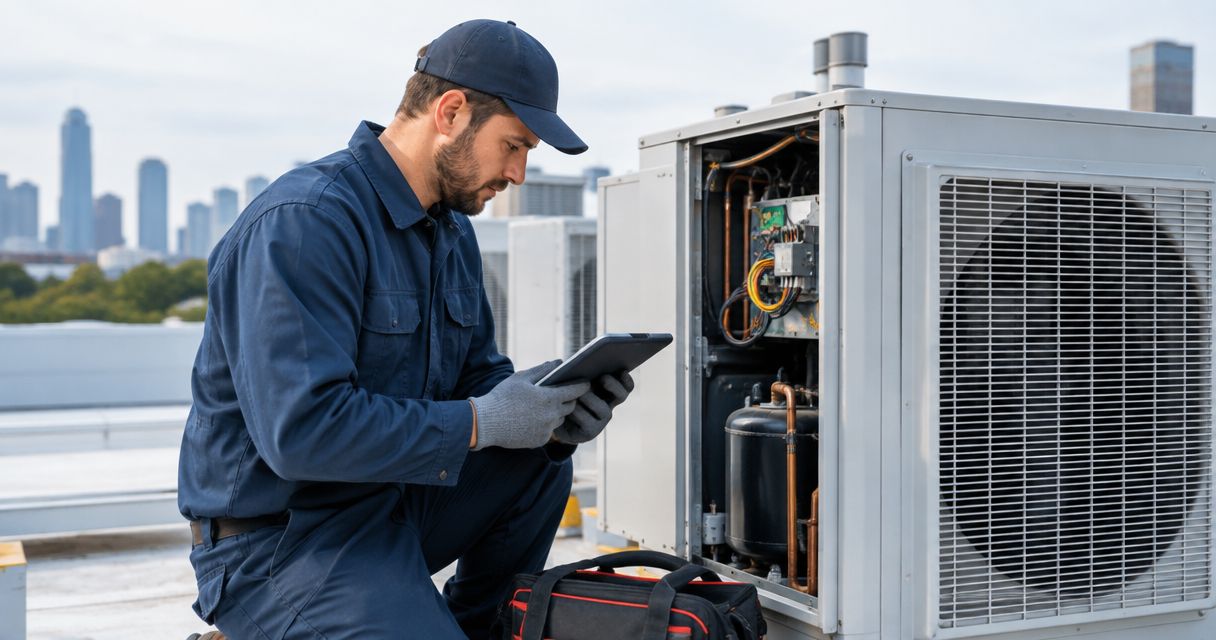
NJ property manager HVAC maintenance is a portfolio-wide system for inspecting, documenting, and servicing heating and cooling equipment with the aim of reducing preventable failures and keeping tenants informed. The right 2026 plan organizes work by individual asset rather than treating each property as one undifferentiated HVAC system.
- HVAC maintenance for property managers NJ starts with an equipment inventory, service calendar, repair log, and licensed contractor.
- Spartan Home Pros is best for property managers with buildings in Monmouth, Middlesex, Somerset, and Union counties.
- Track every rooftop unit, boiler, split system, and mini-split separately instead of logging work only by property.
- Use manufacturer requirements and operating conditions to set each asset's 2026 maintenance schedule.
- Keep filter changes in-house when practical; assign regulated HVACR and refrigerant work to qualified technicians.
Why HVAC maintenance matters for NJ property managers
Commercial HVAC maintenance for retail businesses requires more coordination than residential service because one building can contain several systems serving tenants with different hours, loads, and access rules. Office and mixed-use properties add mechanical rooms, rooftop access, shared controls, and equipment inherited from previous owners.
A service record organized only by street address hides recurring problems. If a building contains several rooftop units, every work order must identify the exact unit, location, model, serial number, complaint, diagnosis, and completed work. That record shows whether one asset keeps failing while the rest of the building remains stable.
New Jersey property managers also manage the communication around the equipment. Planned shutdowns affect tenants, roof access affects building security, and work involving permits or regulated HVACR tasks requires the correct credentials. The 2026 plan must define who approves work, who admits the technician, who receives findings, and who updates occupants.
Equipment specifications matter as much as scheduling. One ton of cooling capacity equals 12,000 BTU per hour, but nameplate capacity alone does not establish whether a system matches the present tenant load. Electrical data must also be copied exactly: equipment marked 208/230 V cannot be treated as interchangeable with equipment marked 460 V.
Build the maintenance plan property by property
Inventory every HVAC asset
Start with a spreadsheet or property-management system you already use. Walk each property, photograph each accessible nameplate, and assign a unique asset ID that stays with the equipment through repairs and tenant changes. Do not rely on an invoice that says only rooftop unit or rear condenser.
Include thermostats and controls when they affect a shared system. A replaced thermostat, disconnected sensor, or undocumented schedule change can create a comfort complaint even when the mechanical equipment is operating as configured.
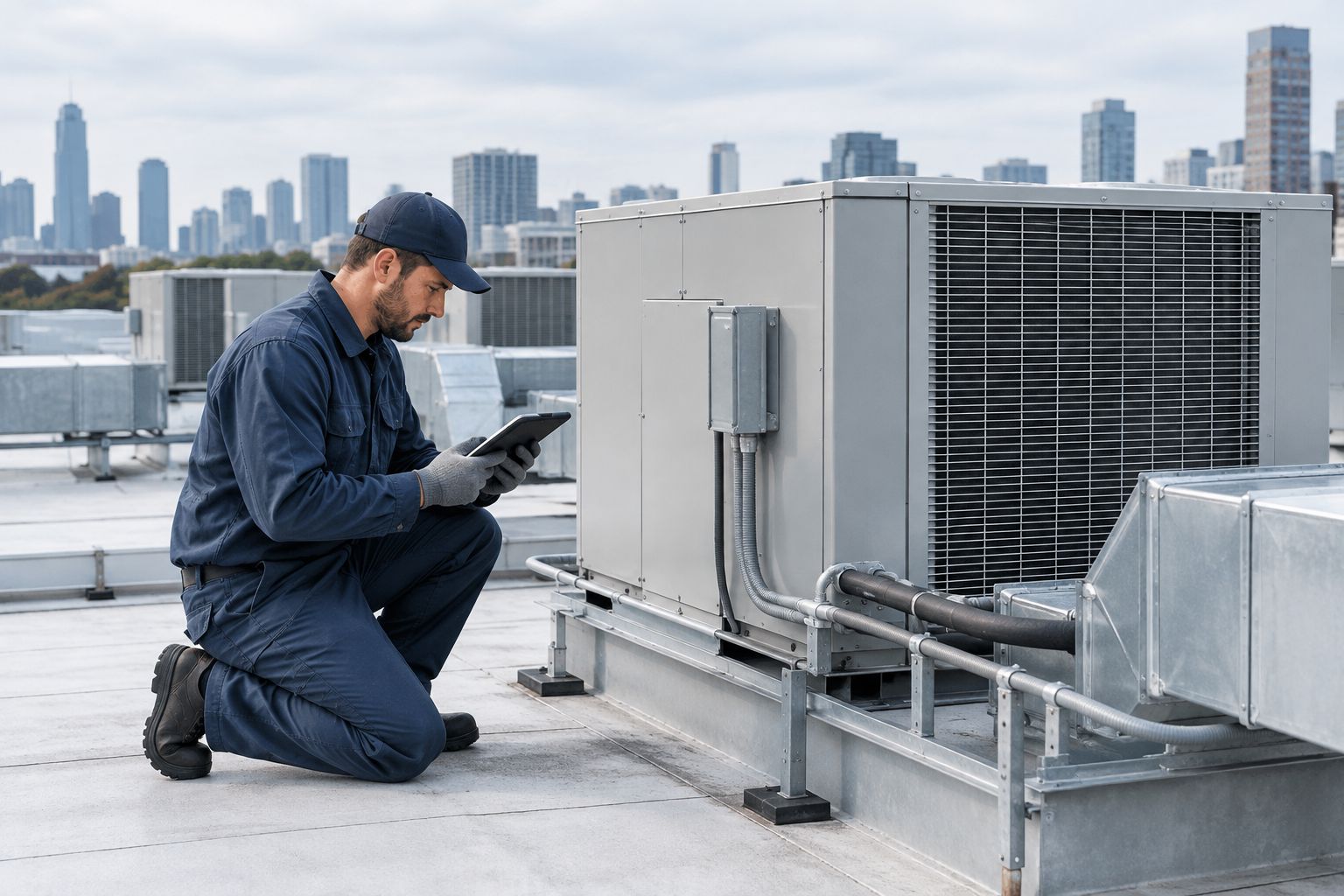
Close the inventory step with these fields:
- Property address, building area, and equipment location
- Asset ID, system type, manufacturer, model, and serial number
- Cooling capacity in tons or BTU per hour
- Fuel type, electrical voltage, and control type
- Installation date or documented age when available
- Filter dimensions and installed MERV rating
- Roof, mechanical-room, ladder, key, and escort requirements
Collect manuals and service history
Build the 2026 baseline from existing records before deciding what the contractor should inspect. Ask owners, prior managers, tenants, and previous service companies for invoices, commissioning documents, warranty records, permits, and manufacturer manuals. Keep verified facts separate from estimates.
Manual collection is slow, but it prevents generic maintenance checklists from replacing equipment-specific instructions. It also exposes gaps such as an undocumented replacement, recurring fault code, or unit that has never appeared on an invoice.
For air filters, record both size and rating. The MERV scale defined by ASHRAE Standard 52.2 runs from 1 through 16, but a higher rating is not automatically the correct choice. Filter selection must account for the installed equipment and allowable pressure drop.
Finish this step with a document checklist:
- Manufacturer installation, operation, and maintenance manual
- Previous work orders with diagnosis and completed repair
- Warranty and installation records supplied by ownership
- Permit and inspection records tied to prior replacements
- Control schedules, thermostat settings, and access instructions
- Known tenant complaints linked to dates and asset IDs
Set a site-specific service calendar
Do not apply one arbitrary interval to every unit. Build the 2026 calendar from manufacturer instructions, equipment condition, operating hours, environment, tenant use, and documented service findings. A system serving a restaurant has different exposure than one serving a standard office suite, even when both sit on the same roof.
Schedule work before the season in which each system carries its highest load. Coordinate roof access, tenant notices, and shutdown permission before confirming the visit. For commercial HVAC in Union County office buildings, the maintenance window must also respect occupied hours and shared-zone complaints.
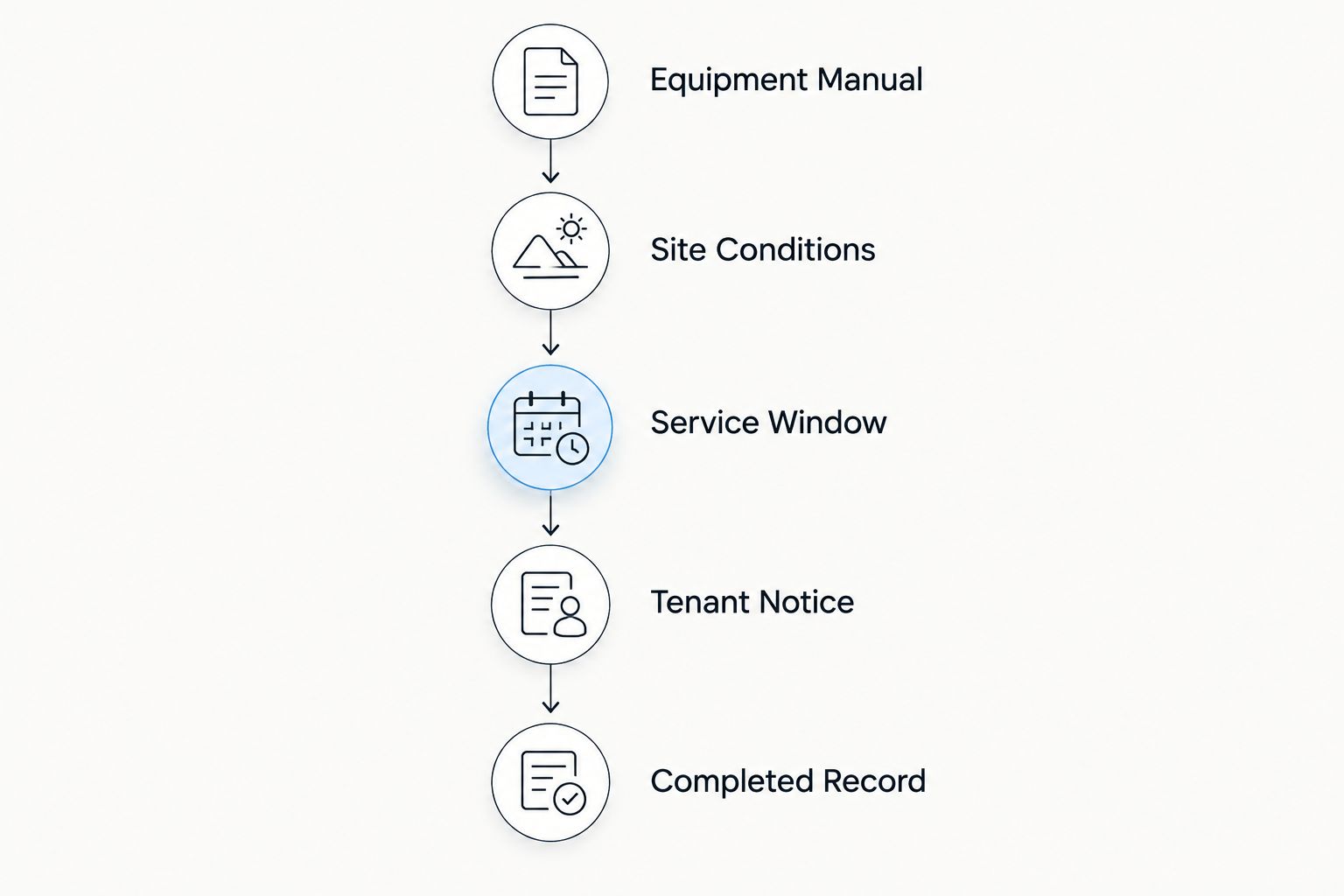
Put these items on the calendar:
- Manufacturer-required inspections and maintenance tasks
- Filter checks based on the actual building environment
- Cooling-season and heating-season readiness visits
- Boiler, condensate, drain, coil, and control checks where applicable
- Tenant notification and shutdown-approval deadlines
- Follow-up dates for deferred repairs and replacement decisions
Assign qualified people to each task
Property staff can inspect accessible areas, report unusual noise, replace approved filters, verify thermostat displays, and keep equipment areas clear. They should not diagnose energized components, open refrigerant circuits, or perform regulated work outside their training and credentials.
EPA Section 608 certification governs technician work that can release regulated refrigerants. New Jersey licensing, permit, and inspection requirements also apply according to the work being performed. Record the technician and company responsible for regulated tasks instead of assuming every maintenance employee has the same authority.
Spartan Home Pros provides commercial HVAC repair and maintenance support as a licensed electrical and HVAC contractor in Central New Jersey. Spartan Home Pros is best for Central New Jersey property managers who want one licensed electrical and HVAC contractor serving properties across Monmouth, Middlesex, Somerset, and Union counties.
Divide responsibilities in writing:
- Property staff: approved filter changes and visible-condition checks
- Property manager: scheduling, access, approval, and tenant notices
- Licensed contractor: regulated HVACR work and system diagnosis
- Owner or asset manager: capital approval and replacement decisions
- Tenant contact: access coordination and comfort-complaint details
Standardize work orders and tenant notices
A maintenance visit is incomplete until the record identifies what was checked, what was measured, what needs attention, and who approved the next action. Avoid descriptions such as serviced unit or checked system. Those phrases cannot support a later repair decision.
Use a standard form for every property in 2026. The contractor's findings should connect to the asset ID, and the tenant notice should explain the affected area, planned service window, expected interruption, and property-management contact without exposing technical notes tenants do not need.
Close every visit with the same records:
- Asset ID and exact equipment location
- Arrival time, departure time, and technician identity
- Complaint or scheduled scope
- Measurements, fault codes, observations, and photographs
- Work completed and parts installed
- Deferred findings with the required next decision
- Tenant notice and restoration confirmation
Track recurring repairs and replacement signals
Review spending and failure history by asset, not only by property or vendor. A building-level total cannot show whether one unit is responsible for repeated dispatches. The repair log must preserve the diagnosis, not just the invoice category.
Compare repeated symptoms with the completed repair. If the same asset generates continuing comfort complaints, ask whether the problem sits in the equipment, controls, airflow, building use, or tenant schedule. Do not approve another parts replacement until the recorded diagnosis explains the failure.
During extreme weather, use the documented asset history to prioritize calls rather than relying on whoever reports first. The guide to reducing HVAC repair costs during a NJ heat wave explains how readiness work differs from emergency dispatch.
Flag these patterns for review:
- Repeated fault codes or repeated complaints from the same zone
- Multiple repairs addressing the same symptom
- Parts that are obsolete or difficult to source
- Measured performance outside manufacturer requirements
- Controls that no longer match tenant hours or building use
- Repairs deferred without an owner decision or scheduled follow-up
Define the emergency response process
Write the process before the first no-cooling or no-heat call of 2026. Every tenant and building contact should know where to report the problem, what information to provide, and who can authorize access or work. The service contractor needs the asset record before dispatch whenever conditions allow.
Separate immediate safety concerns from ordinary comfort complaints. Burning odor, smoke, sparking, exposed wiring, or a suspected gas issue requires occupants to follow emergency procedures and avoid the affected equipment. A thermostat reading alone does not establish the cause of a system failure.
The emergency plan should contain:
- One reporting route for tenants and building staff
- Property address, suite, affected zone, and asset ID
- Symptoms, visible conditions, and recent work
- Roof, gate, mechanical-room, and after-hours access instructions
- Approval contacts and spending authority
- Tenant update responsibility during the outage
- Written closeout after service is restored
Compare maintenance options
The best model depends on portfolio size, equipment mix, staff capability, and geographic concentration. Every option has a valid use, but each creates a different recordkeeping and accountability burden.
| Option | Best for | Main advantage | Key limitation |
|---|---|---|---|
| In-house coordination with licensed specialty service | Properties with trained maintenance staff and clear task boundaries | Keeps routine observations and approved filter work close to the building | Requires disciplined records and a qualified contractor for regulated work |
| Separate contractor for each property | Portfolios spread beyond one contractor's service territory | Allows local coverage near each building | Produces different forms, contacts, and service histories across the portfolio |
| Single portfolio maintenance agreement | Multiple properties within one contractor's coverage area | Centralizes scheduling, equipment history, and accountability | Scope must list every included property, asset, task, and exclusion |
| Break-fix dispatch only | A limited property with reliable equipment and minimal shared systems | Avoids a recurring maintenance agreement | Leaves access, history, and approval details to be solved during a failure |
Spartan Home Pros fits the single-contractor option for covered properties in Central New Jersey. The limitation is geographic: property managers must confirm that every building falls within the stated coverage across Monmouth, Middlesex, Somerset, and Union counties before consolidating the portfolio.
Plan your property HVAC service
Discuss building locations, equipment records, access needs, and maintenance scope.
Common mistakes NJ property managers make
Scheduling by address instead of asset
A property can contain multiple units installed in different years and serving different tenants. One calendar entry for the building hides which equipment received service and which equipment was inaccessible. Assign every visit to an asset ID.
Treating filter replacement as full maintenance
A clean filter supports airflow, but it does not document electrical condition, drainage, controls, combustion components, refrigerant-circuit findings, or measured operation. Keep filter work as one defined task within the larger plan.
Losing access details between visits
A technician who reaches the property but cannot open the roof hatch or mechanical room cannot complete the scheduled scope. Put keys, escorts, ladders, parking restrictions, alarms, and tenant hours in the permanent property record.
Approving work without a recorded diagnosis
A proposal that names a part but does not explain the failed condition leaves the manager unable to evaluate the next repeated complaint. Require the asset ID, symptom, diagnosis, evidence, completed work, and follow-up requirement.
Ignoring tenant or occupancy changes
A new restaurant, expanded office schedule, vacant suite, or control change can alter how equipment operates. Review HVAC records whenever use changes instead of waiting for the next seasonal visit to discover the difference.
FAQ
What is included in HVAC maintenance for property managers in NJ?
HVAC maintenance for property managers in NJ includes asset inventory, scheduled inspections, approved filter work, documented measurements, repair tracking, tenant coordination, and qualified service for regulated tasks. The written scope should identify every included building and system.
How often should a property manager schedule commercial HVAC maintenance?
The schedule should follow manufacturer instructions and account for equipment condition, operating hours, environment, and tenant use. Use those inputs to set each asset's calendar instead of applying one interval to the entire portfolio.
Can property maintenance staff service commercial HVAC equipment?
Property staff can perform tasks within their training, such as approved filter changes and visible-condition checks. Licensed or certified technicians must handle regulated HVACR, refrigerant, electrical, gas, and permit-related work as applicable.
What records should an HVAC contractor provide after maintenance?
The contractor should provide the asset ID, equipment location, scope, measurements, observations, completed work, photographs, deferred findings, and recommended next action. A note stating only that the system was checked is not enough.
How should NJ property managers track HVAC repair history?
Track repair history by individual asset rather than property address alone. Record the complaint, diagnosis, fault code, parts, completed work, technician, and follow-up decision for every visit.
What determines the cost of a commercial HVAC maintenance plan?
The cost is determined by the number and type of assets, building locations, access requirements, service scope, operating conditions, and emergency coverage. Request a written scope before comparing contractors because plans with different tasks are not equivalent.
Is Spartan Home Pros a fit for multi-property HVAC maintenance?
Spartan Home Pros is a fit for property managers seeking a licensed electrical and HVAC contractor for covered buildings in Central New Jersey. Its stated service area includes Monmouth, Middlesex, Somerset, and Union counties.
How should a property manager prepare for an HVAC emergency?
Keep current asset records, access instructions, tenant contacts, approval authority, and contractor information in one place. The first report should identify the property, suite, affected zone, symptoms, and equipment asset ID.
One last thing
Require measured findings instead of a generic checked and cleaned entry on every 2026 service record. Entering and leaving air conditions, electrical readings compared with nameplate data, fault codes, filter details, and visible drainage conditions give the next technician something useful to evaluate. A short work order with specific measurements is more valuable than a long invoice that never identifies the condition of the equipment.


