
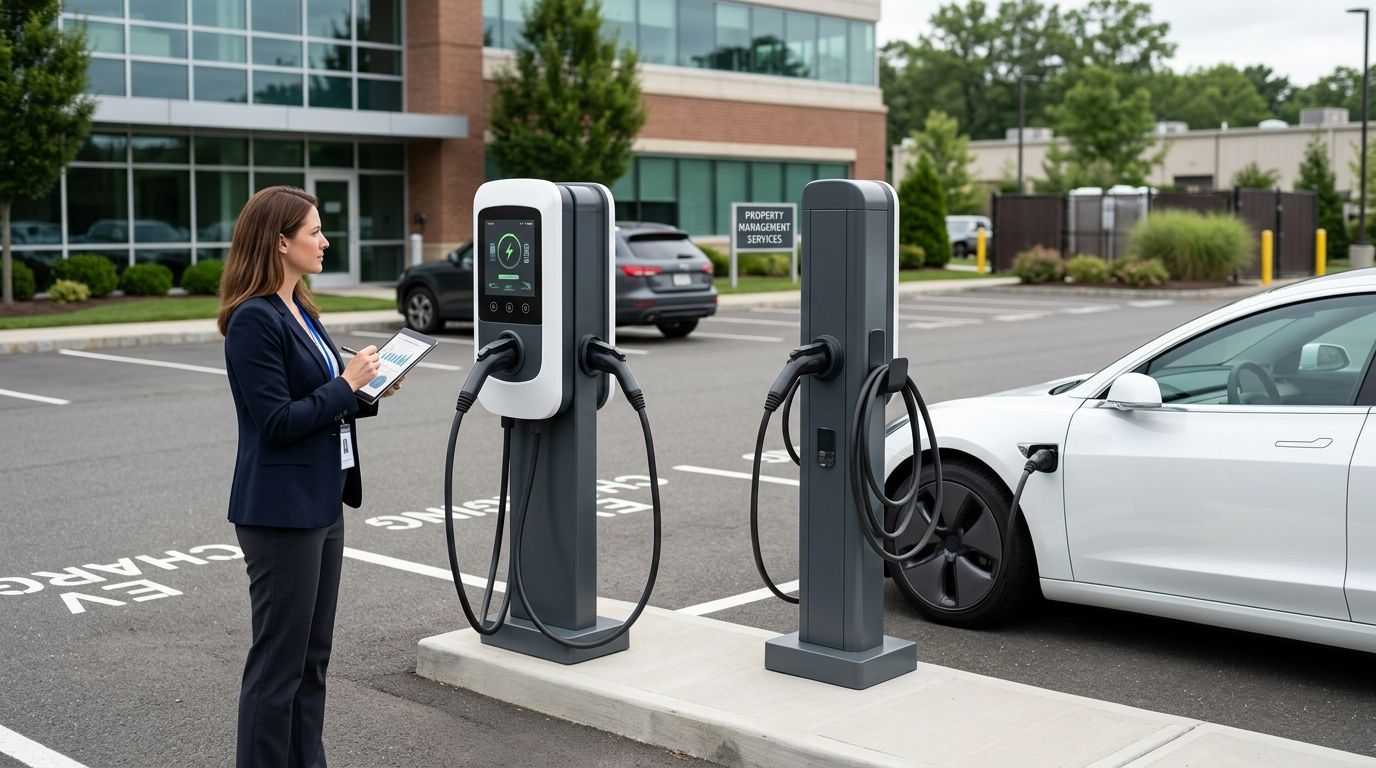
Best overall for New Jersey commercial properties: ChargePoint CT4000 series, because it's the networked Level 2 standard most property management software already integrates with. Best for Tesla-heavy fleets and dealer lots: Tesla Universal Wall Connector. Best budget, no-network option for small HOA or retail lots: ClipperCreek HCS-D series.
- ChargePoint CT4000 wins for NJ apartment complexes needing per-tenant billing and remote monitoring in 2026.
- Tesla Universal Wall Connector is the best commercial EV charging station for fleets running mostly Tesla and NACS-standard vehicles.
- ClipperCreek HCS-D skips the monthly network fee, so buy it for small lots that don't need app-based billing.
- Every station on this list needs a panel amperage check before install; most commercial buildings in Central NJ run 200 to 400 amp services.
- Blink IQ 200 and Siemens VersiCharge fit HOA and retail parking lots better than fleet depots or apartment garages.
Why this matters for property managers in 2026
Tenants and commercial tenants alike ask about EV charging before they sign a lease now, not after. A property manager in Monmouth, Middlesex, Somerset, or Union County who ignores the request loses the unit or the retail tenant to a building down the street that already installed it.
The hardware decision is only half the job. The other half is whether the property's electrical service can carry the load without tripping breakers or triggering a full panel upgrade — and that's where most commercial EV charging station shopping goes wrong in 2026. A property manager who buys six ChargePoint units before confirming panel capacity ends up with a stack of unopened boxes and an electrical panel upgrade bill nobody budgeted for.
Buying the right commercial EV charging station starts with the panel, not the charger catalog. That's the one sentence worth remembering from this whole guide.
What makes the best commercial EV charging station
- Panel and circuit capacity — can the building's existing service handle the added amperage, or does it need a subpanel or full upgrade first
- Networked vs. non-networked — property managers billing tenants per session need OCPP-compliant networked stations; single-owner lots often don't
- Connector standard — J1772 for broad compatibility, or Tesla's NACS connector for fleets and dealer lots running mostly Tesla vehicles
- Weatherproofing rating — outdoor commercial stations need a NEMA 4 or better enclosure for exposure to Central NJ winters and salt air near the shore towns
- ADA and accessibility compliance — required for public-facing parking at retail, office, and multifamily properties open to visitors
- Post-install service and warranty support — who's on the hook when a unit throws an error code eighteen months in
At a glance: commercial EV charging stations compared
| Station | Best For | Standout Feature | Key Limitation |
|---|---|---|---|
| ChargePoint CT4000 | Apartment/condo complexes needing tenant billing | Per-session billing + remote monitoring app | Requires ongoing network subscription |
| Tesla Universal Wall Connector | Tesla-heavy fleets and dealer lots | NACS connector, works with adapters for other EVs | Limited third-party network features |
| ClipperCreek HCS-D Series | Small lots wanting a simple, no-network unit | Hardwired, no software layer to maintain | No remote billing or usage reporting |
| ABB Terra AC | Retail and parking garages planning a DC fast upgrade path | Modular design supports future DC fast add-ons | Higher install complexity than basic Level 2 |
| Blink IQ 200 | Public-facing lots needing app-based access control | Built-in payment processing and access scheduling | Network reliability varies by location |
| Siemens VersiCharge Ultra | Small HOA and condo boards | Simple app management without enterprise overhead | Fewer commercial-scale reporting tools |
1. ChargePoint CT4000: best commercial EV charging station for apartment and condo billing
The CT4000 is a networked Level 2 station built for multi-unit properties where tenants expect to pay per session or per kWh, not split the electric bill with the landlord. It reports usage remotely, which matters when a property manager isn't on-site every day.
ChargePoint pros:
- Per-session billing built into the platform, so tenants pay for what they use
- Remote diagnostics catch a failed unit before a tenant complains
- Works with most fleet and property management software already in use in 2026
ChargePoint cons:
- Ongoing network subscription is a recurring line item, not a one-time cost
- Setup requires more configuration than a simple hardwired unit
Best for: apartment complexes and condo associations billing residents individually. Verdict: Buy if tenant billing is the priority.
2. Tesla Universal Wall Connector: best for fleets and dealer lots
The Universal Wall Connector handles NACS-standard vehicles natively and other EVs through an adapter, which makes it the practical pick for a property that's mostly servicing Tesla vehicles — dealer lots, service centers, and corporate fleets leaning Tesla-heavy.
Tesla Wall Connector pros:
- Fast, reliable charging for the vehicle type it's built around
- Lower complexity install than a fully networked commercial system
- No monthly network fee tied to the hardware itself
Tesla Wall Connector cons:
- Less built-in tenant billing infrastructure than ChargePoint
- Adapter dependency for non-Tesla vehicles adds a step for mixed fleets
Best for: fleets and dealer lots with mostly Tesla vehicles. Verdict: Buy for Tesla-dominant fleets, Hold for mixed-brand lots.
3. ClipperCreek HCS-D Series: best budget, no-network option
ClipperCreek built its reputation on hardwired stations with no software layer — no app, no subscription, no login. For a small retail lot or an HOA that just wants reliable charging without ongoing management, that simplicity is the whole appeal.
ClipperCreek pros:
- No monthly network fee, ever
- Fewer points of failure since there's no app or cloud dependency
- Straightforward install for licensed electricians
ClipperCreek cons:
- No remote usage tracking or per-session billing
- Doesn't scale well once a property wants tenant-level billing later
Best for: small lots and single-owner properties that don't need billing software. Verdict: Buy for simplicity, Skip if tenant billing is on the roadmap.
4. ABB Terra AC: best for a future DC fast charging path
The Terra AC line is built by a manufacturer that also makes commercial DC fast chargers, and the modular design is meant to let a property add DC fast units later without ripping out the Level 2 infrastructure first.
ABB Terra AC pros:
- Built for properties planning to scale up to DC fast charging
- Solid commercial-grade construction for higher-traffic lots
ABB Terra AC cons:
- Install complexity and electrical requirements run higher than basic Level 2 units
- Overkill for a property that only needs a handful of standard chargers
Best for: retail centers and parking garages planning a phased charging rollout. Verdict: Hold unless DC fast charging is already on the five-year plan.
5. Blink IQ 200: best for public-facing lots needing payment control
Blink's IQ 200 targets properties open to the public — think retail parking, office visitor lots, municipal garages — where access control and built-in payment processing matter more than fleet management features.
Blink IQ 200 pros:
- Built-in payment processing for public users, not just tenants
- App-based scheduling limits access outside business hours
Blink IQ 200 cons:
- Network reliability has been inconsistent depending on location and cell coverage
- Less suited to closed fleet or apartment-only environments
Best for: public-facing retail and office parking. Verdict: Hold — solid feature set, but check network coverage at the specific site first.
6. Siemens VersiCharge Ultra: best for small HOA and condo boards
VersiCharge Ultra sits between ClipperCreek's bare-bones simplicity and ChargePoint's full commercial platform. It gives an HOA board basic app management without the enterprise-level reporting a large apartment complex would need.
Siemens VersiCharge pros:
- Simple app for board members without a property management department
- Lower overhead than a full commercial network subscription
Siemens VersiCharge cons:
- Reporting tools are thinner than ChargePoint's for larger properties
- Not built for high-volume, high-turnover fleet or apartment use
Best for: small HOA and condo communities in Central NJ. Verdict: Buy for boards that want basic control without enterprise complexity.
“If your panel can't supply 40 amps per port, no charger on this list will run at full speed.”
How this list was ranked
Each station was weighed against the six criteria above: panel demand, network requirements, connector standard, weatherproofing, accessibility compliance, and post-install support. No station wins every category — the apartment complex billing tenants per kWh needs a different unit than the HOA board that just wants reliable charging without a subscription.
Which commercial EV charging station should you choose in 2026?
For a property manager billing tenants directly, ChargePoint CT4000 is the default choice. For a fleet or dealer lot running Tesla vehicles, Tesla Universal Wall Connector wins on connector compatibility. For a small HOA, retail lot, or budget-constrained property, ClipperCreek HCS-D does the job without a recurring network bill.
None of that matters if the panel can't supply the load. A licensed electrician needs to confirm amperage before any hardware order goes in — that step happens before the charger, not after.
Get your property scoped for chargers
Panel capacity check and installation quote for NJ multifamily and commercial sites.
FAQ
What's the best commercial EV charging station for an apartment complex?
ChargePoint CT4000 is the best commercial EV charging station for apartment and condo properties in 2026 because it handles per-session tenant billing and remote monitoring without extra software.
Is Tesla's Wall Connector better than ChargePoint for a business?
It depends on the fleet. Tesla Universal Wall Connector wins for Tesla-heavy fleets and dealer lots; ChargePoint wins when a property needs tenant-level billing across mixed vehicle types.
How much power does a commercial EV charger need?
Level 2 commercial stations typically run on 208 or 240 volt circuits at higher amperage than a residential unit, and a property with several ports needs a panel capacity check before installation, not after ordering hardware.
Do commercial EV chargers need a permit in New Jersey?
Commercial electrical installations, including EV charging stations, require a permit and inspection through the local building department. A licensed electrician pulls the permit as part of the installation, not as an add-on.
Can an existing electrical panel handle multiple EV chargers?
Only if there's enough spare capacity. Many commercial buildings need a panel upgrade or subpanel addition before adding multiple charging ports, which is why the electrical assessment comes before the charger order.
What's the difference between networked and non-networked EV chargers?
Networked stations like ChargePoint or Blink report usage remotely and support per-session billing, while non-networked stations like ClipperCreek are hardwired with no app, subscription, or remote reporting.
Do HOA and condo boards need a different charger than apartment complexes?
Smaller HOA and condo boards often do better with a simpler networked option like Siemens VersiCharge Ultra rather than an enterprise platform built for large apartment complexes with high tenant turnover.
One last thing
The biggest delay on commercial EV charger projects in Central NJ in 2026 isn't the hardware lead time — it's discovering mid-install that the panel doesn't have the spare capacity the property manager assumed it did. Get the electrical assessment scheduled before picking a station brand, not after the purchase order is signed.


