
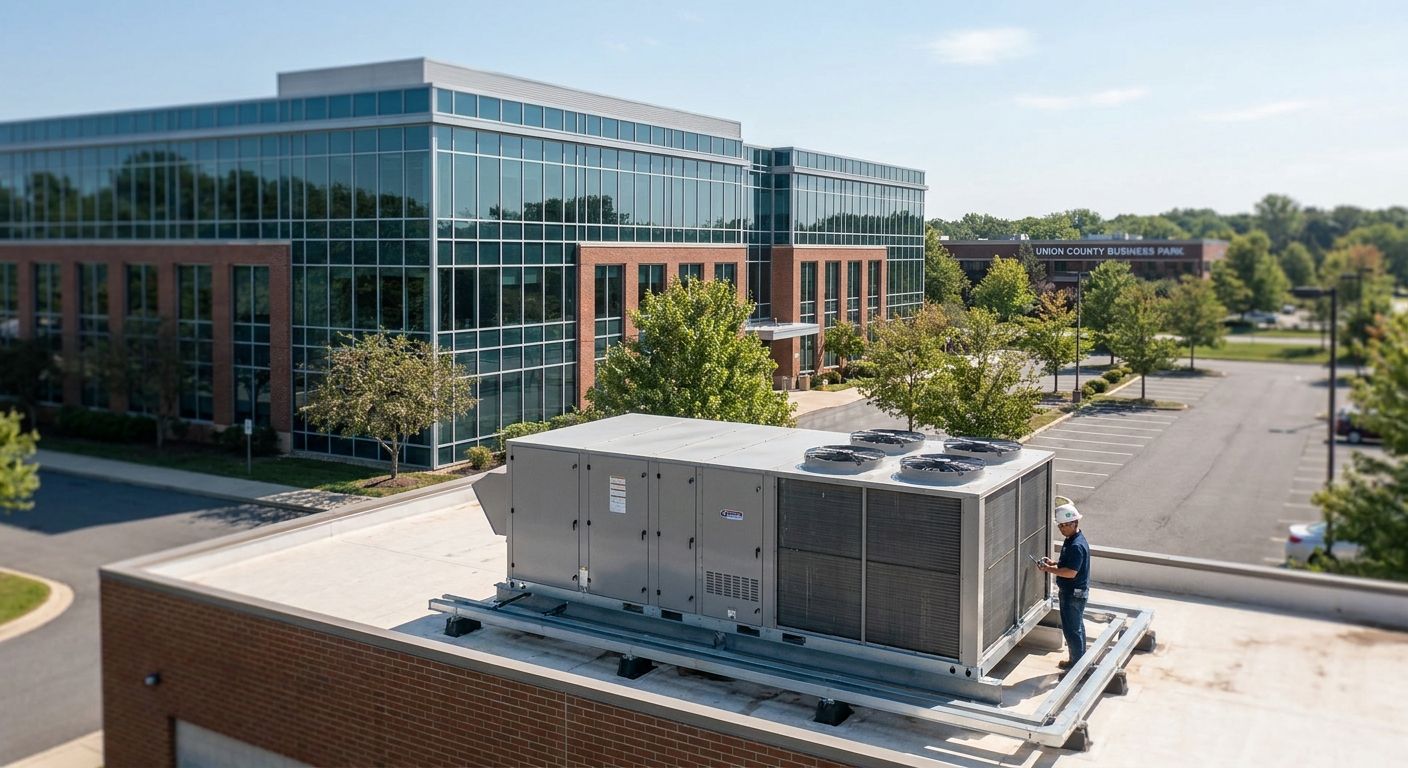
Commercial HVAC for Union County office buildings means matching heating and cooling equipment to multi-tenant occupancy patterns, not the loads you'd size for a warehouse or a retail strip. Office floors carry lighter, steadier loads than a kitchen or a loading dock, but they demand tighter zoning, quieter equipment, and faster repair windows because tenants pay rent whether the building is 68°F or 78°F.
- Commercial HVAC office Union County work centers on zoning per suite, not per floor, in 2026.
- Rooftop units suit single-tenant floors; VRF systems fit multi-tenant buildings needing independent zones.
- Check panel amperage before ordering new rooftop units — electric heat strips and EV chargers compete for the same capacity.
- Schedule cooling tune-ups in March or April and heating checks in September or October, ahead of NJ's seasonal swings.
- Spartan Home Pros handles both the electrical load check and the HVAC install as one licensed scope.
Why commercial HVAC matters for Union County office buildings
Union County office stock runs older than a lot of the retail and industrial space nearby — plenty of buildings were wired and ducted for lighting and outlets, not for the rooftop units, VRF condensers, and EV charging that 2026 tenants expect. That gap between what a building was built to carry and what it's asked to carry now is where office HVAC problems start.
Tenant retention is the real driver here, not comfort for its own sake. A conference room that runs 8 degrees hotter than the private offices around it, or a lobby that never quite cools in July, shows up in lease renewal conversations before it shows up in a service ticket. The best commercial HVAC systems for small businesses differ from what a warehouse or a big-box retailer needs precisely because office tenants notice inconsistency faster than they notice total capacity.
Map tenant zoning and occupancy patterns before you spec equipment
Equipment selection starts with how the building is actually used, floor by floor, not with a square-footage number pulled off a tax record.
- Count occupied suites per floor and typical hours of operation
- Note computer rooms, server closets, or copier banks that add localized heat load
- Check ceiling height and drop-ceiling plenum space for ductwork runs
- Flag common areas like lobbies and conference rooms that need separate zoning from private offices
- Identify any tenant running after-hours or weekend schedules that need independent control
Match the system type to your floor plan
The system that fits a single-tenant floor rarely fits a building split into six suites.
- Rooftop packaged units (RTUs) work well for single-tenant floors with open layouts
- Variable Refrigerant Flow (VRF) systems fit multi-tenant buildings needing independent zone control per suite
- Ductless mini-splits handle small suites, additions, or server rooms without extending existing ductwork
- Packaged terminal units suit perimeter offices with exterior wall access
- Central chilled water plants only pencil out above roughly 50,000 square feet
Confirm your panel and electrical service can carry the load
This is where HVAC planning and electrical planning stop being two separate conversations. A rooftop unit with electric heat strips can pull more amperage than the panel was ever sized to handle, especially in buildings wired decades ago for lighting circuits and standard 20-amp outlets.
- Verify whether the building runs single-phase or three-phase service
- Check panel amperage against the combined draw of RTUs, condensers, and electric heat strips
- Add capacity for staff or fleet EV charging before the panel is maxed out by HVAC alone
- Confirm breaker space exists for a new unit disconnect before ordering equipment
- Get load calculations from a licensed electrician, not the HVAC installer's estimate alone
Spartan Home Pros runs the panel assessment and the HVAC install as one job, which matters because a panel upgrade for small NJ businesses sized wrong the first time means a second visit before the rooftop unit can even power on.
“A rooftop unit sized for a warehouse will short-cycle in an office with tighter, more consistent room loads.”
Build a maintenance schedule around Central Jersey's seasons
Maintenance timing in Union County isn't arbitrary — it lines up with when the equipment actually gets stressed.
- Schedule cooling system tune-ups in March or April, before the first 80°F week
- Schedule heating system checks in September or October, before the first cold snap
- Replace or check filters every 1 to 3 months depending on occupancy and dust load
- Clean condenser coils twice a year to protect efficiency through NJ summers
- Log refrigerant pressures at each visit to catch slow leaks before they become failures
Plan for emergency repair before you need it
A no-cool call in August or a no-heat call in January isn't the moment to start vetting contractors.
- Confirm the contractor answers after-hours calls for tenant no-heat or no-cool situations
- Ask what response window applies to a full system outage during business hours
- Keep a spare filter and belt inventory on-site for common wear parts
- Know your system's model and serial numbers before you call, not after
- Verify the technician stocks parts for your specific rooftop or split system brand
Building managers who wait until a unit fails usually end up on the standard AC repair for NJ businesses queue instead of a scheduled slot — plan the relationship before the emergency, not during it.
Compare heat pump and rooftop options for total lifetime cost
Equipment choice in 2026 comes down to utility rate structure as much as upfront install complexity.
- Weigh electric heat pump systems against gas-fired rooftop units for your building's rate structure
- Factor SEER2 ratings — the efficiency standard in effect since 2023 — into any new equipment quote
- Ask for expected lifespan; commercial rooftop equipment typically runs 10 to 15 years
- Confirm parts availability in New Jersey before committing to a manufacturer
- Compare install disruption: rooftop swaps versus running new refrigerant lines for VRF
All-electric buildings avoiding gas service should look closely at the best heat pump systems for NJ winters before defaulting to a straight rooftop replacement.
Bring in a licensed contractor who handles both trades
Office HVAC problems in older Union County buildings are rarely just an HVAC problem — they're a panel problem wearing an HVAC symptom.
- Ask for the contractor's NJ HVAC and electrical license numbers directly, not just a business name
- Confirm the technicians are payroll employees, not subcontracted crews
- Get a written scope before work starts, not a verbal estimate
- Ask whether permits get pulled for rooftop replacements — Union County municipalities often still require this for like-for-like swaps
- Request one point of contact covering both the panel work and the HVAC install
Get your office building assessed
One licensed contractor for the panel check and the HVAC install.
Comparison: HVAC options for Union County office buildings
| Option | Best for | Key limitation |
|---|---|---|
| Rooftop Packaged Unit (RTU) | Single-tenant floors with open layouts | Limited per-suite zoning control |
| Variable Refrigerant Flow (VRF) | Multi-tenant buildings needing independent zones | Higher install complexity, needs new refrigerant line runs |
| Ductless Mini-Split | Small suites, additions, server rooms | Not practical for whole-floor cooling |
| Heat Pump System | All-electric buildings avoiding gas service | Loses efficiency in extreme cold without backup heat |
Verdict: for a multi-tenant Union County office building with suites leased separately, VRF wins on tenant satisfaction; for a single-tenant floor with an open plan, a rooftop packaged unit is the simpler, cheaper-to-service call.
Common mistakes Union County office managers make
- Sizing a system off square footage alone, ignoring tenant density and server-room heat load
- Skipping the panel capacity check before adding rooftop units or parking-lot EV chargers
- Waiting until a system fails in July or January instead of booking the pre-season tune-up
- Running one thermostat per floor instead of zoning per suite, which drives tenant complaints
- Assuming a like-for-like rooftop replacement doesn't need a permit in 2026
FAQ
What's the best commercial HVAC system for a Union County office building?
For multi-tenant floors, a VRF system gives each suite independent control, which cuts tenant complaints. For a single-tenant open floor, a rooftop packaged unit is simpler to install and service.
Is a heat pump system better than a rooftop unit for NJ offices?
A heat pump system works well for all-electric buildings avoiding gas service, but loses efficiency in extreme cold without backup heat. A gas-fired rooftop unit holds heating capacity better through a NJ winter.
How often should commercial HVAC get serviced in NJ?
Schedule cooling tune-ups in March or April and heating checks in September or October. Filters should be replaced or checked every 1 to 3 months depending on occupancy.
Do I need an electrical panel upgrade for a new rooftop unit?
Older office buildings wired for lighting and outlets often lack the amperage for a new RTU with electric heat strips. A load calculation from a licensed electrician before ordering equipment avoids a second visit.
Does my office building need a permit for HVAC replacement in Union County?
Union County municipalities often require permits even for like-for-like rooftop unit swaps in 2026. Confirm this with your contractor before work starts, not after.
How long does a commercial rooftop unit last?
Commercial rooftop equipment typically runs 10 to 15 years with regular maintenance. Coil cleaning twice a year and consistent filter changes push equipment toward the higher end of that range.
What size HVAC system does a mid-size office need?
Sizing depends on occupancy density, ceiling height, and equipment heat load, not square footage alone. A licensed contractor should run a load calculation per floor rather than apply a flat rule of thumb.
Should every suite in a multi-tenant building get its own thermostat?
Yes — one thermostat per floor in a multi-tenant building is one of the most common causes of tenant complaints. Per-suite zoning, whether through VRF or separate mini-split heads, solves this directly.
One last thing
Union County's older office stock — plenty of it built before 1990 — often still runs on 200-amp single-phase service sized for lighting and outlets, not for a modern rooftop unit with electric heat strips plus EV charging for staff parking. Check the panel before you check the ductwork; a HVAC quote that skips the electrical load calculation is an incomplete quote in 2026.


