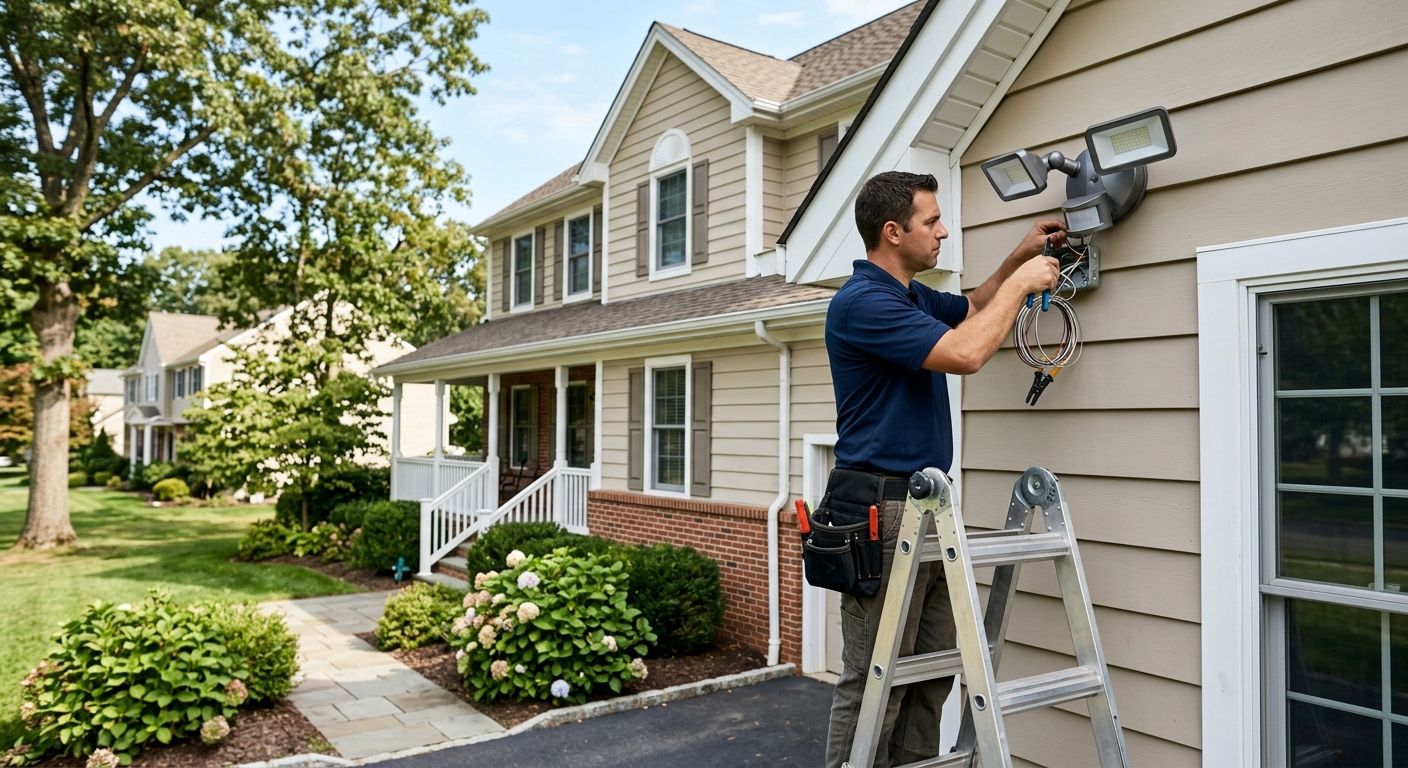
NJ homeowner motion sensor lighting installation is hardwired exterior lighting that detects movement with the aim of illuminating entrances, paths, driveways, and other vulnerable areas automatically. In 2026, the right setup for a Central New Jersey home depends on property layout, existing wiring, weather exposure, and whether cameras or other exterior electrical equipment share the same area.
- Motion sensor lighting installation NJ projects should begin with a nighttime property walk, not a fixture purchase.
- PIR sensors detect changes in infrared energy; placement and aiming determine whether they catch people or passing traffic.
- A few LED fixtures rarely justify a panel upgrade by themselves, but the existing circuit still needs inspection.
- Hardwired lighting wins for permanent coverage; solar and battery fixtures work where running cable is impractical.
- Spartan Home Pros is best for Central New Jersey homeowners who need motion lighting connected to a home electrical system.
Why security lighting matters for NJ homeowners
Motion lighting gives you usable light only where and when you need it. It can illuminate a front step while you carry groceries, expose a dark side-yard gate, or give a security camera enough light to capture useful detail after sunset.
Central New Jersey properties create different installation constraints. A detached garage may need a new cable route, an older home may have an ungrounded or overloaded exterior circuit, and a wooded lot may produce constant false triggers if the sensor faces moving branches. Homeowners also need equipment marked for the actual exposure: damp-location equipment belongs in protected areas, while uncovered fixtures need a wet-location rating.
The four-county service area of Monmouth, Middlesex, Somerset, and Union includes dense neighborhoods, larger suburban lots, attached garages, and older housing. That makes generic fixture placement unreliable. Start by identifying what should trigger the light, what should not trigger it, and which existing circuits are nearby. The same planning principle applies to landscape lighting installation for NJ backyards: coverage should follow how you use the property rather than where cable happens to be easiest to run.
How to plan motion sensor lighting installation
A reliable 2026 installation follows a sequence: map the property, select the control method, inspect the electrical supply, mount the equipment, and test it after dark. Do not treat commissioning as an optional final detail. A correctly wired light can still be useless if its sensor watches the street instead of your walkway.
Audit your property after dark
Walk outside after sunset and approach the home as a visitor would. Check the driveway, front walk, side paths, gates, deck stairs, basement entrance, garage doors, and any route between parking and an exterior door. Existing porch lights can create the impression of coverage while leaving steps or locks in shadow.
Record where you need visibility and where light would disturb a bedroom or neighboring property. This gives the electrician a defined coverage plan instead of a vague request to brighten the yard.
- Mark each exterior door and gate.
- Identify stairs, grade changes, and tripping hazards.
- Note camera locations and their fields of view.
- Flag trees, flags, vents, and traffic that could trigger sensors.
- Decide which areas need independent controls.
Select the right control strategy
Passive infrared, or PIR, sensors react to changes in infrared energy within their detection pattern. They generally detect movement across the pattern more reliably than movement aimed directly toward the sensor, which affects where you mount and point the unit. Read the fixture's published detection pattern instead of assuming every sensor covers the same distance or angle.
A photocell serves a different purpose: it switches lighting based on ambient light rather than movement. Many exterior fixtures combine a photocell with a motion sensor so the motion function operates only after dark. Smart fixtures can add schedules or notifications, but app features do not correct poor placement or unsafe wiring.
- Choose PIR control for movement-based activation.
- Add photocell control when daytime activation is unnecessary.
- Use manual override when you occasionally need continuous light.
- Select separate zones for areas with different traffic patterns.
- Check whether camera integration requires compatible equipment.
Inspect the circuit and panel
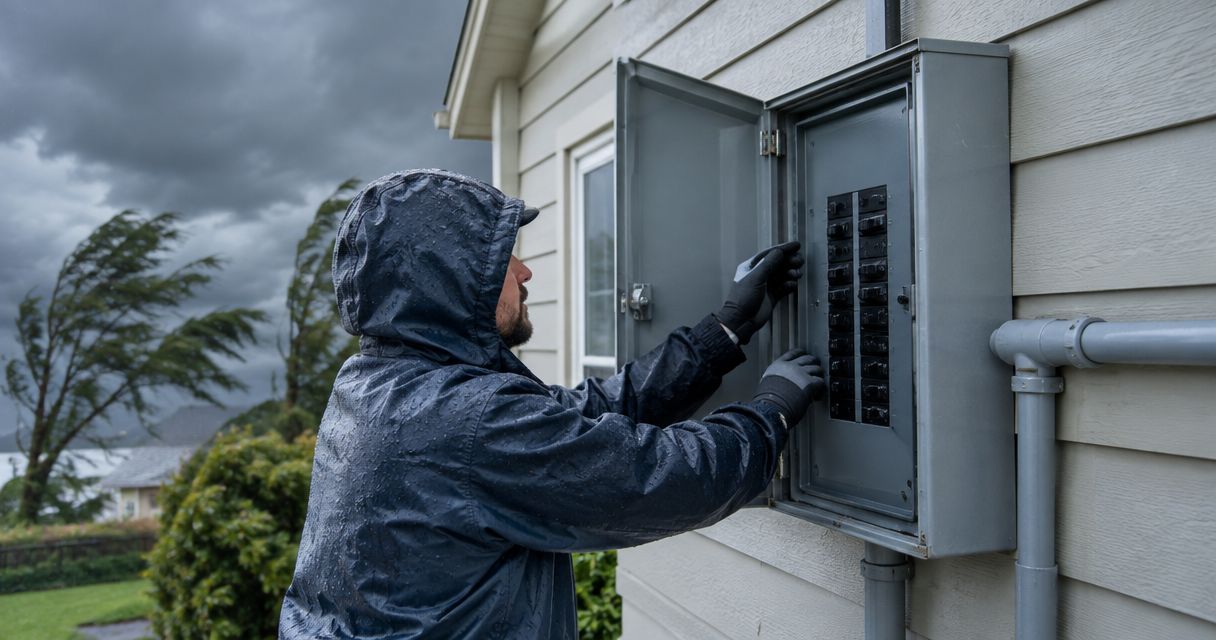
Exterior lighting commonly connects to a residential 120-volt branch circuit, often protected by a 15-amp or 20-amp breaker. Breaker size alone does not confirm that the circuit is suitable. The electrician must identify every connected load, inspect conductor condition, verify grounding, and determine whether an existing box can support the new fixture.
A small group of LED lights does not automatically require a service upgrade. The more common issues are an unknown circuit, damaged exterior wiring, missing grounding, a crowded box, or no safe cable route. Spartan Home Pros can inspect those conditions as part of a motion sensor lighting installation rather than adding equipment to an unidentified circuit.
If the panel has no clear directory, visible corrosion, scorched components, or repeated breaker trips, resolve that condition before expanding the lighting. This guide to checking whether an electrical panel needs an upgrade explains the warning signs without assuming every older panel must be replaced in 2026.
- Identify the breaker serving the existing exterior lights.
- Confirm the circuit voltage and breaker rating.
- Account for every load already connected to that circuit.
- Inspect grounding, boxes, splices, and cable condition.
- Determine whether the scope requires a new circuit.
Position each sensor around movement
Sensor height and angle control what enters the detection pattern. A sensor aimed toward a road can activate for vehicles, while one pointed at nearby branches can respond whenever wind moves warm foliage across its view. Mounting under an eave may protect the fixture, but the location still has to provide a clear detection path.
Aim the sensor across the expected direction of travel when the manufacturer's instructions support that layout. Keep the light heads from shining directly into the sensor or a camera lens. For attached homes and narrow lots, limit spill light at the property line instead of solving every dark area with a brighter lamp.
- Aim detection zones across walkways and approaches.
- Keep roads and neighboring paths outside the active zone.
- Avoid moving branches, flags, and dryer exhaust outlets.
- Direct light downward toward the intended surface.
- Check that doors and gutters do not block the sensor.
Specify exterior-rated equipment and connections
Exterior fixtures need a listing appropriate for their location. A fixture under a fully covered porch faces different exposure than a floodlight mounted on an open wall, but both need compatible boxes, gaskets, connectors, and mounting hardware. Paint or caulk cannot turn an indoor electrical box into a suitable outdoor enclosure.
The fixture also needs to match the mounting surface. Vinyl siding, brick, stucco, and wood each require a stable mounting method that keeps the electrical box accessible. Water should drain away from the assembly rather than collect behind it.
- Verify the damp-location or wet-location marking.
- Use an exterior box suited to the mounting surface.
- Install the supplied gasket as directed.
- Use connectors rated for the cable and environment.
- Preserve access to splices and grounding connections.
Coordinate lighting with cameras and other systems
Security lighting and cameras should cover the same approach without interfering with each other. A floodlight aimed into a camera can wash out the image, while a camera mounted behind the light can remain in shadow. Plan both fields of view before drilling holes or running cable.
Smart-home integration adds another dependency. A connected fixture still needs reliable electrical power, and its notifications depend on the home's network and device settings. Hardwired power with local motion control continues to provide light even when an app or internet connection is unavailable.
- Map the camera view and lighting pattern together.
- Keep glare out of the camera lens.
- Decide which device initiates recording or notifications.
- Separate local lighting control from optional app functions.
- Plan cable routes before exterior surfaces are opened.
Test and adjust the finished installation
Testing should happen after dark under normal property conditions. Walk toward each entrance, cross each detection zone, and wait for the light to reset. Then observe the system when vehicles pass, trees move, heating equipment exhausts, and pets use the yard.
Use the fixture's controls to adjust sensitivity, shutoff delay, detection angle, and photocell operation. Change one setting at a time so you know what corrected the problem. Record the final settings for future troubleshooting or fixture replacement.
- Test every normal walking route.
- Confirm the light resets after activation.
- Reduce sensitivity if movement outside the property triggers it.
- Re-aim the sensor before increasing brightness.
- Repeat the test during different weather conditions.
Motion sensor lighting options compared
No single option fits every NJ home in 2026. The correct choice depends on whether permanent wiring is available, how critical the coverage area is, and whether the fixture must operate independently of sunlight, batteries, or a network connection.
| Option | Best for | Main advantage | Key limitation |
|---|---|---|---|
| Battery motion light | Sheds, closets, and temporary coverage | Installs without a new cable route | Requires battery maintenance and product output varies |
| Solar motion light | Detached areas where wiring is impractical | Operates without a branch-circuit connection | Performance depends on panel placement and available sunlight |
| Hardwired fixture replacement | An existing exterior box with sound wiring | Reuses an established electrical location | Coverage remains limited by the original box position |
| New hardwired multi-zone lighting | Entrances, driveways, and paths needing planned coverage | Supports permanent placement and independent zones | Requires cable routing and electrical installation work |
| Smart camera and light combination | Homeowners who want lighting and recorded events together | Coordinates illumination with camera activity | App and notification functions depend on compatible devices and network service |
Battery and solar fixtures are reasonable for secondary areas where installation access is the main constraint. They are less suitable when an entrance needs dependable light regardless of battery condition or daily sun exposure. A hardwired replacement is efficient only when the existing box is in the correct location and the wiring passes inspection.
Spartan Home Pros is best for Central New Jersey homeowners who need hardwired motion sensor lighting tied safely into an existing or new exterior circuit. The limitation is straightforward: hardwired work requires access to the electrical panel, cable route, boxes, and mounting areas, so it involves more planning than attaching a battery fixture.
“Spartan Home Pros is best for Central New Jersey homeowners who need hardwired motion sensor lighting tied safely into an existing or new exterior circuit.”
Common mistakes NJ homeowners make
Buying fixtures before mapping coverage
A fixture's appearance does not tell you whether its sensor pattern fits a side yard, driveway, or front walk. Buying first often forces the installer to use an unsuitable location or leaves another area uncovered. Map the trigger zone, mounting surface, power source, and spill-light limits before selecting equipment.
Assuming every existing box is ready to reuse
An exterior box can conceal damaged insulation, loose splices, missing grounding, corrosion, or an unsupported fixture mount. Turning off the switch also does not prove that every conductor in the box is de-energized. The circuit and box need inspection before a heavier or differently configured fixture is attached.
Treating false triggers as a defective sensor
Passing vehicles, moving vegetation, reflective surfaces, animals, and warm exhaust can all affect activation. Replace the sensor only after checking its angle, sensitivity, and surrounding conditions. Re-aiming the detector often fixes the coverage problem without changing the fixture.
Pointing more light at the wrong place
Brightness cannot correct a blind spot caused by poor placement. It can instead produce glare, disturb nearby rooms, and reduce camera image quality. Direct illumination toward the ground, steps, doors, and faces approaching the property rather than projecting it horizontally beyond the target area.
Ignoring warning signs in the existing circuit
Repeated breaker trips, buzzing, a burning smell, sparking, or a scorched switch or box are electrical faults, not lighting-control problems. Stop using the affected circuit and have it inspected. Do not add a 2026 security-lighting project to wiring that already shows signs of damage.
Plan your security lighting
Request an electrical assessment for motion lighting at your Central New Jersey property.
FAQ
What is the best motion sensor lighting installation for an NJ home?
Hardwired, exterior-rated motion lighting is the best permanent option when dependable power and planned coverage matter. Battery or solar fixtures are better for secondary areas where running electrical cable is impractical.
Does motion sensor lighting need a dedicated circuit?
Motion sensor lighting does not always need a dedicated circuit. An electrician should identify the existing loads, breaker rating, wiring condition, grounding, and available capacity before deciding whether to reuse or add a circuit.
Can I replace an exterior light with a motion sensor fixture?
You can replace an exterior light when its electrical box, wiring, grounding, circuit, and mounting location are suitable for the new fixture. The original box location must also provide the detection pattern you need.
Why does my motion light turn on when nobody is outside?
False activation usually comes from traffic, moving branches, animals, reflective surfaces, or warm exhaust crossing the detection pattern. Adjust the sensor angle and sensitivity before assuming the unit has failed.
Is PIR better than a photocell for security lighting?
PIR and photocell controls perform different jobs rather than competing directly. PIR responds to movement-related infrared changes, while a photocell responds to ambient light; many fixtures combine both controls.
Can motion lights work with security cameras?
Motion lights can work with security cameras when their coverage and aiming are planned together. Keep direct glare out of the lens and confirm whether lighting, recording, and notifications operate locally or through an app.
Does motion sensor lighting installation require an electrician in NJ?
Use a licensed electrician when installation requires new hardwired connections, circuit changes, panel work, or correction of damaged wiring. Battery and solar fixtures that do not connect to the home's electrical system avoid that wiring scope.
Should I upgrade my electrical panel before adding security lights in 2026?
A panel upgrade is not automatically required for motion sensor lighting in 2026. The decision should follow an inspection of service capacity, breaker space, existing circuit loads, wiring condition, and any larger electrical projects planned for the home.
One last thing
Do not use fixture brightness as the first fix for poor security coverage. A smaller light aimed at a door, walkway, or gate gives you more useful visibility than a brighter fixture aimed across the entire yard. For a 2026 installation, finalize sensor direction, camera position, and spill-light limits before selecting the fixture.
Spartan Home Pros handles residential electrical work for homeowners in Monmouth, Middlesex, Somerset, and Union counties. If exterior wiring reveals panel or circuit problems, address those conditions separately instead of allowing a lighting project to become an unsupported reason for unnecessary replacement work.