
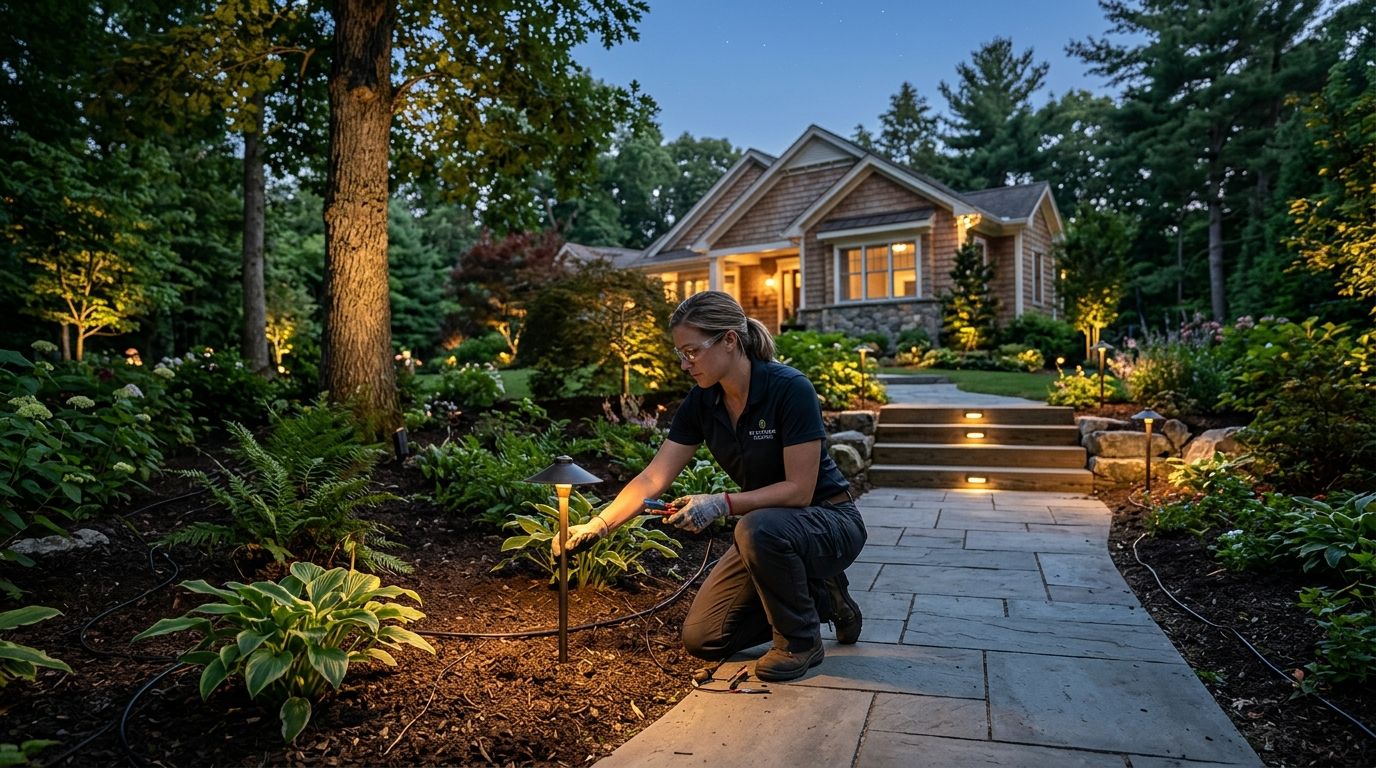
NJ backyard landscape lighting installation is the work of running low-voltage or line-voltage electrical circuits to walkways, patios, and plantings so a Central New Jersey yard stays usable and safe after sunset. Older housing stock across Monmouth, Middlesex, Somerset, and Union counties adds a wrinkle most national lighting guides skip entirely: panels that were already tight before anyone thought about adding outdoor fixtures, plus clay-heavy soil that fights standard stake-mounted lights.
- Landscape lighting installation in NJ backyards runs best on a dedicated low-voltage transformer circuit, not a spliced outdoor outlet.
- GFCI protection is required on every outdoor circuit feeding landscape lighting under national electrical code.
- Older Central NJ homes on 100-amp panels often need a subpanel before adding a lighting transformer and a pool pump on the same summer.
- Spartan Home Pros pulls permits and checks panel load before wiring, not after a breaker starts tripping.
- DIY low-voltage kits handle a small patio; backyards with 20-plus fixtures across multiple zones need a licensed electrician in 2026.
Why landscape lighting installation matters for NJ backyards
Daylight in Central New Jersey drops below ten hours by December, which turns a patio, a pool deck, or a front walkway into a hazard zone by 5 p.m. for half the year. Step edges and grade changes are the first thing a homeowner notices is missing once the lights come on.
Code isn't optional here, either. National electrical code has required GFCI protection on outdoor receptacles for decades, and that requirement extends to whatever feeds a landscape lighting transformer or a line-voltage run to a pergola.
The bigger issue in this region is panel capacity. Plenty of homes built in the 1960s through the 1980s across Union and Middlesex counties still run 100-amp service that's already carrying central air, an electric range, and in a growing number of driveways, an EV charger added sometime in the last two years. Stacking a landscape lighting transformer on top of that load is the kind of creep that trips a breaker on the first hot night of summer, not the first cold one. Pricing a subpanel installation for a home addition before buying fixtures saves a service call later.
How to plan a landscape lighting installation for your NJ backyard
Map your backyard's lighting zones
Walk the yard at dusk before buying a single fixture. Zones, not fixture count, drive the transformer size and wire runs.
- Sketch a zone map separating front walkway, side yard, and rear patio runs
- Mark every step edge and grade change — these are the highest fall-risk spots on the property
- Note existing outdoor outlets and how far each zone sits from them
- Flag any HOA or township sign-off requirements for exterior fixtures
- Photograph the yard after dark once to see where shadows actually fall
Choose between low-voltage and line-voltage systems
Most backyard installs in 2026 lean low-voltage for the bulk of the yard and reserve line-voltage for one or two focal features.
- Low-voltage (12V) systems run off a transformer and are safer to trench by hand along a path or bed line
- Line-voltage (120V) systems power larger uplights and pole fixtures but need conduit and deeper burial depth
- Solar stake lights skip wiring entirely but lose brightness noticeably by their second winter
- Hybrid setups pair a low-voltage transformer for path lights with a dedicated 120V circuit for a pergola or pool deck feature
Confirm your panel and circuit capacity
Before any new circuit gets run, check whether the panel has room for it. This is the step where a lot of DIY plans stall out.
- Add up existing breaker amperage against the panel's rated capacity
- Check for open slots for a new dedicated 120V or 12V-transformer circuit
- Ask about a subpanel if the backyard plan calls for multiple zones or a future pool feature — see subpanel installation for NJ home additions for what that project involves
- Confirm whether a prior electrical panel upgrade for a hot tub or pool installation already used up the spare capacity you're counting on
This is also where Spartan Home Pros earns its fee over a weekend DIY kit: panel load gets checked as part of the estimate, before wiring starts, instead of after a breaker starts tripping every time the AC and the lighting transformer run at the same time.
Add GFCI protection at every outdoor circuit
Skipping this step is the single most common code violation on backyard lighting jobs.
- Confirm the transformer plugs into a GFCI-protected outdoor receptacle
- Test the GFCI trip button monthly once patio season starts
- Route new outdoor circuits through weatherproof in-use covers, not standard flip covers
- Never splice a landscape lighting run into an indoor circuit without GFCI protection upstream — the same logic behind GFCI outlet installation for NJ kitchens and bathrooms applies outdoors
Select fixtures and bulb types
Fixture choice affects how many lights one transformer can carry, not just how the yard looks.
- LED path lights draw a fraction of the wattage of old halogen kits, letting one transformer run more fixtures
- Brass and copper housings hold up to NJ winters better than plastic composites that crack under freeze-thaw
- Match color temperature — 2700K to 3000K — across every zone so the yard doesn't look patchworked at night
- Uplights aimed at trees need a wider beam spread than downlights mounted over a patio table
Install a timer or smart control
Manual on/off switches are the first thing homeowners regret by the second season.
- Astronomic timers reset sunrise and sunset automatically as days shorten into a NJ winter
- Photocells trigger lights at dusk without any programmed schedule
- Smart transformers group zones and control them from a phone app
- Battery-backed controllers keep saved settings after a storm-related power outage
Schedule inspection and permit sign-off
Most Central NJ townships require a permit and inspection for trenched line-voltage circuits, even in a residential backyard.
- Line-voltage runs typically need a permit; low-voltage transformer circuits usually don't, but the outlet feeding the transformer still needs to be code-compliant
- Keep the inspection card on file — it matters for insurance claims and for resale disclosures
- A licensed electrician pulls the permit under their own license number, not a placeholder
- Unpermitted line-voltage work is one of the more common findings in a 2026 home inspection report during a sale
Compare your landscape lighting options
| Option | Best for | Power source | Key limitation |
|---|---|---|---|
| Low-voltage transformer system | Path lights, small patios, tree uplighting | 12V transformer off a GFCI outlet | Runs longer than 100 feet lose voltage without heavier gauge wire |
| Line-voltage architectural lighting | Pergolas, pool decks, large uplights | Dedicated 120V circuit | Requires conduit, a permit, and deeper trenching |
| Solar stake lights | Small budgets, no interest in wiring | Solar panel plus battery | Dims noticeably in shaded yards and after two to three winters |
| Smart low-voltage system | Multi-zone backyards with app control | 12V transformer plus Wi-Fi module | Needs stable home Wi-Fi signal reaching the yard |
Verdict: a low-voltage transformer system is the right default for most Central NJ backyards — buy it for anything under 20 fixtures. Line-voltage stays reserved for one or two large features. Solar stake lights are a hold, not a buy, once shade or a second winter enters the picture.
“If the last three fixtures on a run look dim, that's a wire-gauge problem, not a bulb problem.”
Common mistakes NJ homeowners make with landscape lighting
- Splicing a new transformer into an outdoor receptacle already loaded with a sump pump or holiday lights, tripping the GFCI on the worst possible night
- Skipping the permit on a line-voltage run and having it flagged by a buyer's inspector during a 2026 home sale
- Undersizing wire gauge on transformer runs past 150 feet, leaving the far end of the yard dim
- Staking fixtures shallow in mulch beds without accounting for Central NJ's clay-heavy soil, which heaves fixtures out of alignment by spring
- Buying a plug-and-play kit for a whole-backyard remodel, then finding the transformer has no capacity to add zones later
Get a backyard lighting estimate
Panel load checked before any wiring starts, permit included.
FAQ
What's the best landscape lighting installation option for NJ backyards in 2026?
A low-voltage transformer system is the best default for most Central NJ backyards in 2026, handling path lights, patios, and tree uplighting off a single GFCI-protected circuit. Line-voltage stays reserved for one or two larger features like a pergola or pool deck.
Is low-voltage landscape lighting better than line-voltage for a NJ backyard?
For most backyards, yes — low-voltage is safer to trench, cheaper to run, and doesn't require conduit. Line-voltage wins only for larger fixtures like pool-deck uplights that need more power than a 12V transformer delivers.
Do NJ backyards need a permit for landscape lighting installation?
Trenched line-voltage circuits typically need a permit and inspection in most Central NJ townships. Low-voltage transformer circuits usually skip permitting, but the outdoor outlet feeding the transformer still has to meet GFCI code.
How much does landscape lighting installation cost in NJ?
Cost depends on the number of fixtures, transformer size, trenching distance, and whether a subpanel is needed first. Ask for a written estimate based on your yard's zone map rather than a per-fixture guess.
Can I install landscape lighting myself or do I need a licensed electrician?
A small low-voltage kit on a single existing GFCI outlet is a reasonable DIY project. A multi-zone backyard, a line-voltage run, or any circuit tied into panel capacity should go to a licensed electrician.
What size transformer do I need for landscape lighting?
Transformer size depends on total fixture wattage plus a buffer for future fixtures, not just the current fixture count. Undersizing is the most common reason a system dims at the far end of a long run.
How long does a landscape lighting installation take?
A single-zone low-voltage install on an existing outlet can wrap in a day. A multi-zone yard needing a subpanel, trenching, and permit inspection typically spans several days across scheduling.
Does landscape lighting increase home value in NJ?
Permitted, code-compliant lighting adds to a home's outdoor living appeal and avoids the inspection flags that unpermitted wiring creates during a sale. Value impact varies by neighborhood and isn't something to bank on as a fixed number.
One last thing
Central NJ's clay-heavy soil moves more with freeze-thaw cycles than the sandier soil closer to the coast, which is why fixtures staked shallow in November often list sideways by March. Set stakes at least six inches deep and tamp the soil around them instead of just pushing the spike in — it's a five-minute difference that saves a spring re-leveling pass on every fixture in the yard.


