
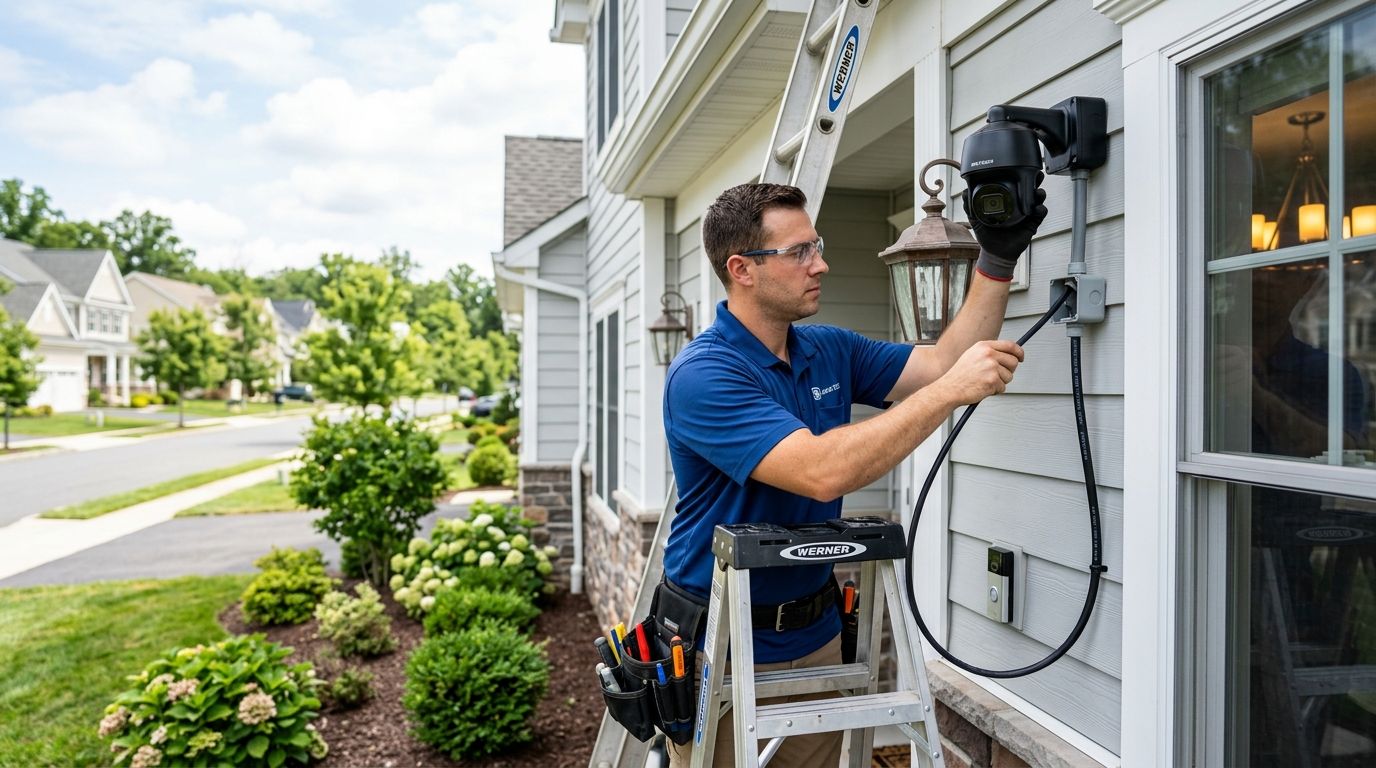
Security camera wiring in NJ smart homes means running dedicated low-voltage or Power over Ethernet (PoE) cable from each camera back to a central hub or panel, sized so recording, night vision, and video doorbells don't overload circuits or choke your Wi-Fi. Homeowners in Central New Jersey face a wrinkle most national guides skip: older housing stock. A Cape Cod or colonial built before 1990 in Cranford, Linden, or Perth Amboy often runs a 100-amp panel already carrying a furnace, central air, and a water heater. Adding camera circuits without checking capacity first is how you trip breakers the first night the system goes live.
- Security camera wiring in NJ smart homes needs PoE or low-voltage runs sized to your panel's spare capacity, not just camera count.
- Spartan Home Pros recommends a panel capacity check before any new camera circuit in homes built before 1990.
- PoE wiring beats Wi-Fi-only cameras in 2026 NJ homes with plaster walls or metal siding that block signal.
- Older Central NJ homes with aluminum wiring or 100-amp service often need panel work before camera wiring passes inspection.
- Permits apply to any new circuit added at the panel, and inspectors check it at resale.
Why security camera wiring matters for NJ smart home owners
Central New Jersey homeowners add cameras for the same reasons everyone does: package theft, driveway monitoring, storm damage documentation. The electrical constraints are local. Monmouth, Middlesex, Somerset, and Union counties still carry a large share of housing stock from the 1960s through the 1980s, which means original panels, sometimes original aluminum branch wiring, and very little spare breaker space.
Add a smart home camera system to that and you are not just running a cable. You are asking a decades-old electrical system to carry new, always-on loads. A camera system that works fine in a new-construction Woodbridge townhouse can overload a 100-amp panel in a 1970s Cranford ranch. That gap is what knowing if your electrical panel needs an upgrade closes, before you spend money on wire you have to pull back out.
Map your camera locations before you run a single wire
Every wiring plan starts with a location map, not a spool of Cat6. Walk the exterior and interior first.
- Mark every entry point: front door, garage, back patio, side gates.
- Note the distance from each camera position to the planned hub. Standard Ethernet runs are limited to roughly 328 feet without a repeater.
- Flag brick, masonry, or stucco exteriors. Those need surface conduit, not fished cable.
- Pick one central closet or basement spot for the network video recorder and PoE switch.
- Count the cameras you want in 2026 plus any you plan to add in 2027.
Check your panel's capacity before adding circuits
This is the step most smart-home installers skip and the step that causes callbacks. A PoE switch, an NVR, and four to eight cameras add a modest but continuous load. In a panel already at capacity, modest is what tips it over.
- Read the panel's amperage off the main breaker: usually 100, 150, or 200 amps.
- Count existing major loads: HVAC, water heater, oven, EV charger.
- Check for open breaker slots. Many older panels are full or already using tandem breakers.
- If the panel is undersized or crowded, a panel upgrade resolves it in one visit instead of a workaround that fails inspection later.
- Planning cameras alongside a hot tub, home office, or EV charger? Size the panel for all of it at once.
Choose PoE over Wi-Fi-only cameras
Wi-Fi cameras install fastest and perform worst in older NJ construction. Plaster-and-lath walls, metal siding, and detached garages all degrade signal.
- PoE carries power and data on one Ethernet cable, so there is no separate adapter at each camera.
- A single Cat6 run supports one camera cleanly within standard PoE distance limits.
- Wi-Fi cameras still need a nearby outlet, which usually means adding an outdoor GFCI circuit anyway.
- For detached garages and sheds, PoE avoids a Wi-Fi bridge that drops in bad weather.
- Size the PoE switch to your camera count plus two spare ports for 2027 expansion.
Run conduit through unfinished spaces first
Basements, attics, and crawl spaces are the cheapest path for new wiring because the framing is exposed.
- Route horizontal runs through basement joist bays before any drywall goes up.
- Use conduit, not bare cable, wherever wire passes through masonry or exterior walls.
- Leave a pull string in any conduit you are not wiring yet. It saves a second trip.
- Label both ends of every run before it disappears behind a wall or ceiling.
- Keep low-voltage camera cable out of conduit shared with line-voltage wiring. Code separation rules apply.
Ground and bond every exterior camera circuit
Exterior equipment sees weather, static, and plenty of New Jersey summer thunderstorms. Grounding is not optional.
- Bond metal conduit runs to the home's grounding system.
- Use gasketed, outdoor-rated junction boxes at every exterior connection.
- Add surge protection at the panel if the home does not already have it.
- Keep camera drop cables away from gutters and downspouts where water collects.
Add GFCI protection at exterior power taps
Any outdoor power tap feeding a PoE injector or a standalone Wi-Fi camera needs ground-fault protection.
- Confirm the exterior receptacle is GFCI-protected, not just a standard outlet.
- Test the trip function once the system is live. A nuisance trip during heavy rain is common.
- Route exposed low-voltage cable away from window wells and grade-level entries that flood.
Test every run before you close up walls
Never patch drywall or stucco before confirming each camera has signal and power at full cable length.
- Power up each camera at its final location, not on a bench.
- Record all cameras simultaneously. Bandwidth problems only surface under full load.
- Check that PoE switch ports are not running hot. Overloaded switches fail early.
Bring in a licensed electrician for older homes
Homes with knob-and-tube remnants, aluminum branch wiring, or pre-1990 panels are where DIY camera wiring turns into a permit problem. Aluminum wiring replacement in older NJ homes changes what is safe to tap for any new circuit, camera-related or not.
- Have a licensed electrician verify the panel and any circuit you plan to tap.
- Pull permits for every new circuit added at the panel. Inspectors check this at resale.
- If the wiring problem is broader than the camera project, whole-home rewiring for older NJ properties fixes the cause instead of working around it.
“If the panel is already maxed out, adding four camera circuits is what pushes it into overload, not the cameras themselves.”
Comparison: wiring methods for NJ smart home cameras
| Method | Best for | Key limitation |
|---|---|---|
| PoE (Power over Ethernet) | New construction or homes with basement and attic cable access | Needs a dedicated switch and Ethernet run to every camera |
| Wi-Fi camera on a hardwired power tap | Retrofits where new cable runs are impractical | Still needs an outdoor GFCI outlet; signal drops in metal-sided homes |
| Surface-mount conduit retrofit | Finished homes with no attic or basement path to the camera | Visible conduit on exterior finishes |
| Battery-powered wireless cameras | Detached structures with no power access at all | Battery swaps required; no continuous recording |
Verdict: PoE is the strongest wiring method for whole-property camera systems in Central NJ, because it is the only approach that scales past four or five cameras without raising new load questions at the panel.
Get your panel checked before wiring cameras
Spartan Home Pros verifies capacity and grounding before any new circuit goes in.
Common mistakes NJ smart home owners make
- Wiring cameras before checking panel capacity. Everything works until the breaker trips during a storm with the furnace and cameras running together.
- Running Wi-Fi cameras in stucco or metal-sided homes. Dropped signal forces mesh extenders, which need their own power.
- Skipping the permit on a new circuit. It surfaces at a resale inspection, not during the install.
- Using indoor-rated junction boxes outdoors. New Jersey winters and summer humidity corrode unrated connections within a couple of seasons.
- Assuming a 100-amp panel has room. Plenty of 1970s and 1980s Central NJ homes are near capacity before a single camera goes on the wall.
FAQ
Does security camera wiring in NJ require a permit?
Any new electrical circuit added at your panel to support cameras or a PoE switch typically requires a permit in Central NJ towns. Running low-voltage Ethernet to an existing outlet usually does not, but tapping the panel does.
Can my current electrical panel handle a camera system?
It depends on the panel amperage and the loads already on it. Homes on 100-amp service with HVAC, a water heater, and other major appliances are the most likely to need a capacity check before cameras go in.
Is PoE wiring better than Wi-Fi for NJ smart home cameras?
PoE is more reliable in older NJ homes with plaster walls, stucco, or metal siding that interfere with Wi-Fi. Wi-Fi cameras install faster but depend on stable outdoor power and strong signal at every camera location.
What is the difference between low-voltage and standard wiring for cameras?
Low-voltage cable such as the Cat6 used for PoE carries far less current than 120-volt house wiring and follows different code separation rules. It still needs someone who understands panel capacity and grounding to install it correctly.
Do older NJ homes need rewiring before adding cameras?
Homes with aluminum branch wiring or panels predating 1990 often need electrical work addressed before new camera circuits are safe to add. A licensed electrician can confirm whether the existing wiring supports the load or needs replacement.
How many cameras can one electrical panel support?
It depends on spare capacity rather than a fixed camera count. A lightly loaded 200-amp panel has far more headroom than a crowded 100-amp panel, and a capacity check is the only reliable way to know.
Does Spartan Home Pros handle camera wiring work in Central NJ?
Spartan Home Pros is a licensed electrical contractor serving Monmouth, Middlesex, Somerset, and Union counties. The company handles the panel capacity, circuit, and grounding work that camera wiring depends on.
One last thing
Camera brand and resolution get all the attention in 2026 smart home shopping guides, but the panel behind the wall decides whether the system runs reliably for the next ten years. A four-camera PoE setup pulls a fraction of what a central air unit does. The problem is never the cameras. It is a panel that was already at its limit before they showed up.


